Maharashtra State Board Class 7 Geography Solutions Chapter 6 Natural Regions
Class 7 Geography Chapter 6 Natural Regions Textbook Questions and Answers
1. Read the following statements carefully. Correct the wrong ones and write them down:
Natural Regions Class 7 Geography Question 1.
Due to its mild and warm climate, people from the West European region are not energetic.
Answer:
False – Due to its mild and warm climate people from the West European region are industrious and energetic.
Std 7 Geography Chapter 6 Natural Regions Question 2.
The prairie region is called the wheat basket of the world.
Answer:
True.
Natural Regions Class 7 Questions And Answers Question 3.
The trees in the Mediterranean region have oily leaves and the bark is quite thick. There is a high rate of transpiration.
Answer:
False – The trees in the hot desert region have oily leaves and the bark is quite thick. There is high rate of transpiration.
Natural Regions Class 7 Question 4.
The camel is an important animal of the hot desert region as it can survive without water and is useful for transport.
Answer:
True.
Class 7 Geography Chapter 6 Natural Regions Question 5.
Carnivorous animals like tigers and lions are found in large numbers in the equatorial regions.
Answer:
False – Carnivorous animals like tigers and lions are found in large numbers in the grassland region (Sudan).
2. Give geographical reasons:
6 Natural Regions Question 1.
People in monsoon region are mainly engaged in agriculture.
Answer:
(i) The monsoon region is located in tropical & subtropical belt between 10° & 30°N & parallels which receives almost perpendicular rays of the sun for most part of the year.
(ii) The summers temperature are hot with between 27° & 32°C & the winters are mild with temperatures between 15° to 24°C.
(iii) This region receives rainfall during specific season from the south west monsoon winds and the rainfall varies between 250 to 2500 mm.
(iv) Thus as the climatic conditions are such that they favour growth of variety of crops.
(v) Thus, people in the monsoon region are engaged in agriculture.
Natural Regions Std 7 Question 2.
Trees in equatorial forests grow tall.
Answer:
(i) The equatorial forest are found in regions between 50°N & 50°S of the equator. This region receives perpendicular rays of the sun throughout the year.
(ii) The climate of the equatorial region is hot & it receives rainfall throughout the year. Annual rainfall in this region is between 2500 & 3000 mm.
(iii) Hence, dense evergreen forests are found here. Due to dense vegetation sunlight does not reach the ground & the trees compete for sunlight.
(iv) Thus, trees in equatorial forests grow tall.
3. Answer the following questions:
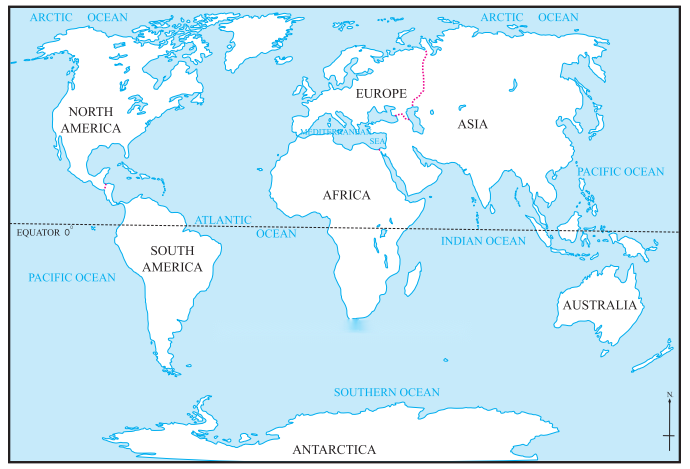
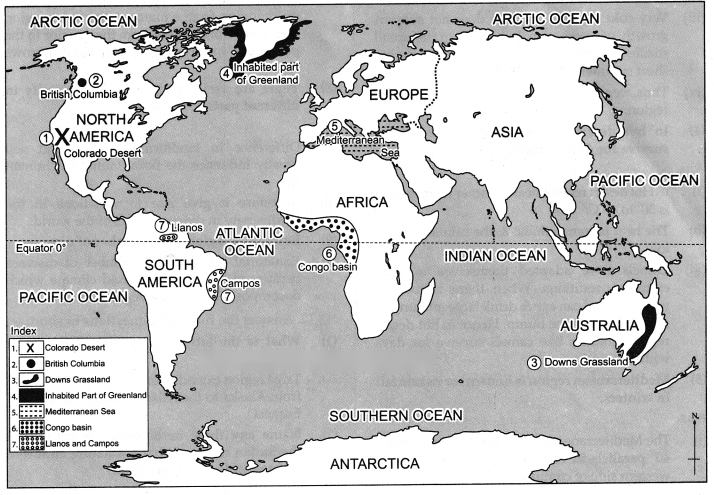
4. Show the following items on an outline map of the world. Prepare the index:
Answer:
Activity:
Using the Internet, check the information given in this lesson. Collect pictures of the flora and fauna and the human life of the various natural regions. Make a collage by pasting these pictures on the world map.
Class 7 Geography Chapter 6 Natural Regions InText Questions and Answers
Can you tell:
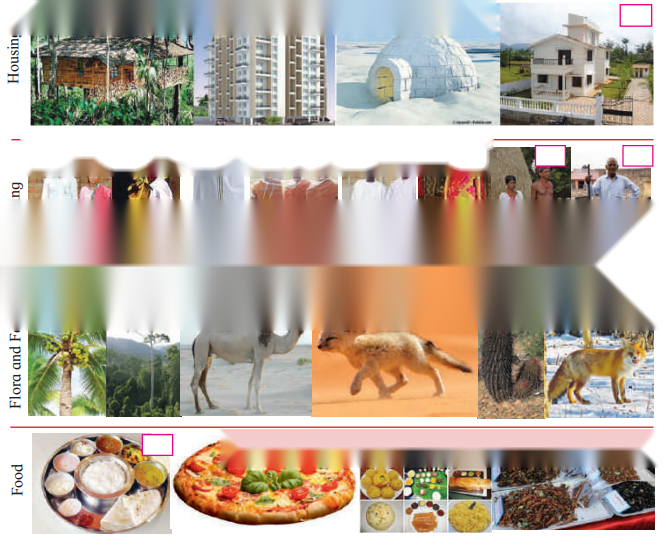
Observe the picture given on Pg. no. 30 of Geography textbook and answer the following question given below.
Page no: 31
Question 1.
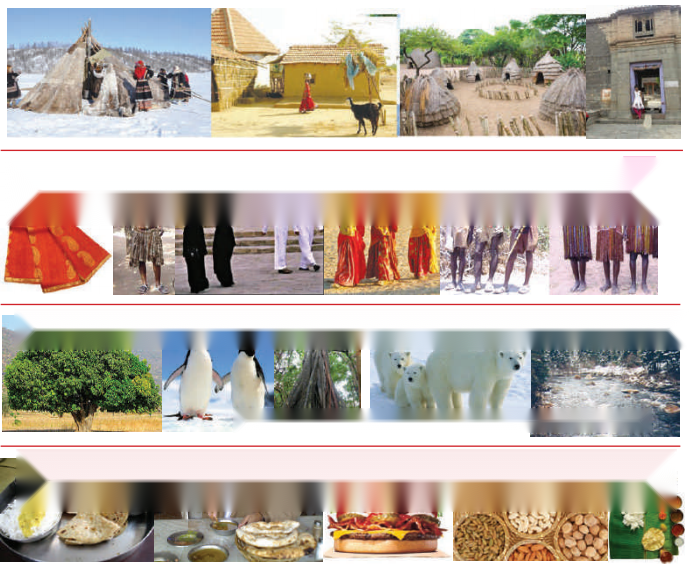
Why are the house types shown in the pictures not seen in our surrounding?
Answer:
All the house types shown in the pictures are not seen in our surroundings because house types differ from place to place. They are built taking into consideration rainfall, temperature and raw material available for building houses.
Think about it:
(ii) As the sunlight does not reach the ground the trees compete to get sunlight & hence trees grow very tall.
(iii) Mainly animals which can survive in swampy & marshy environment of forests are arboreal animals found in equatorial forests.
Hence animals like lions are not found in equatorial forests.
Make friends with maps!
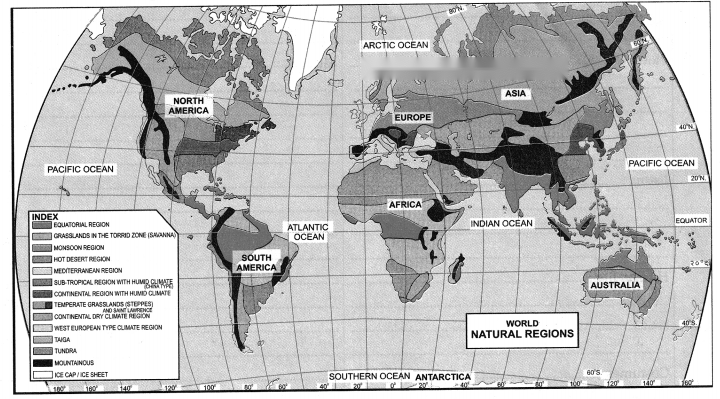
Observe the map and answer the following questions
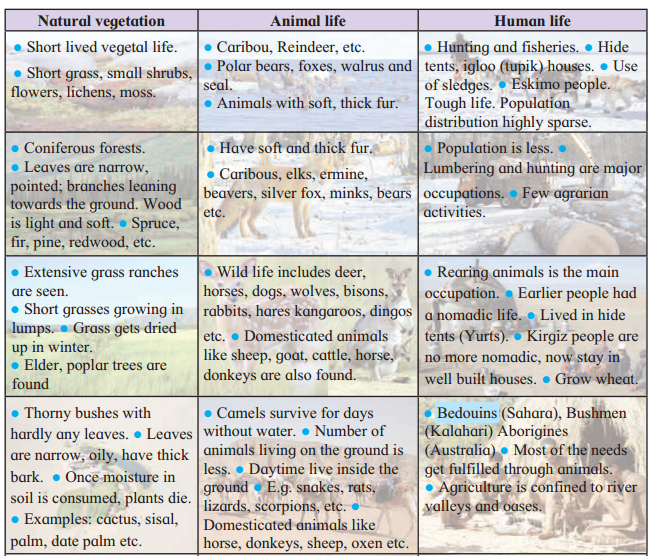
Observe the table of natural region on Pg. 33 of textbook, then answer the following questions:
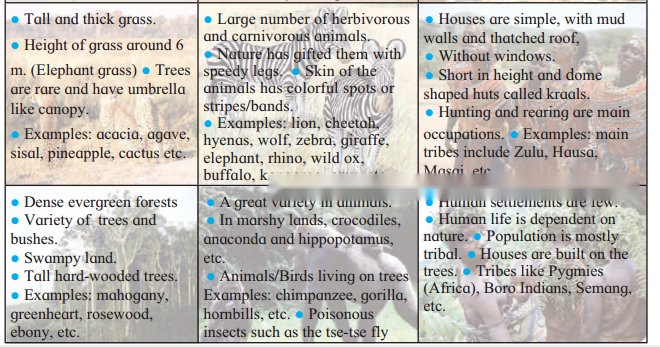
Class 7 Geography Chapter 6 Natural RegionsAdditional Important Questions and Answers
Fill in the blanks choosing the correct option from the bracket:
Match the pair correctly:
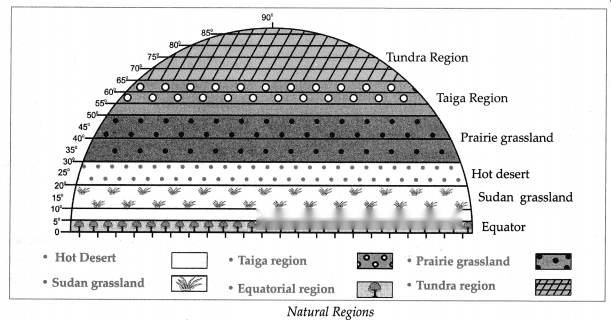
Region | Latitudinal extent |
(1) Tundra region | (a) 5° to 20° N and S |
(2) Taiga region | (b) 20° to 30° N and S |
(3) Grassland (Steppes and Prairies | (c) 30° to 55° N and S |
(4) Hot Desert | (d) 55° to 65° N and S |
(5) Grassland (Sudan type) | (e) 65° to 90° N and S |
1 – e
2 – d
3 – c
4 – b
5 – a
Do the following tasks:
Question 1.
Write the important occupation of the region in the following table:
Answer:
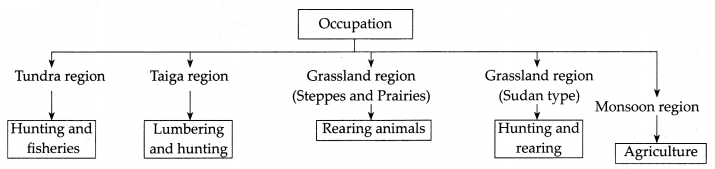
Question 2
Maharashtra Board Solution
Find the location of the following regions from the world map and write down in the table given below:
Solution & Step-by-Step Answer:
Who am I. (Type of region):
Question 1
Maharashtra Board Solution
I am found in Indonesia and Guinea
Solution & Step-by-Step Answer:
Equatorial Region
Question 2
Maharashtra Board Solution
I am found as Llanos and Campos
Solution & Step-by-Step Answer:
Grasslands (Sudan type)
Question 3
Maharashtra Board Solution
I am found in the Colorado and the Atacama
Solution & Step-by-Step Answer:
Hot Desert region
Question 4
Maharashtra Board Solution
I am found in South America and North America
Solution & Step-by-Step Answer:
Grassland (steppes and prairies)
Question 5
Maharashtra Board Solution
I am found from the Alaska to the Atlantic coast
Solution & Step-by-Step Answer:
Taiga region
Question 6
Maharashtra Board Solution
I am found in Greenland and North Canada
Solution & Step-by-Step Answer:
Tundra region
Question 7
Maharashtra Board Solution
I am found in California.
Solution & Step-by-Step Answer:
Mediterranean region.
Name the following:
Question 1
Maharashtra Board Solution
Any two animals of Tundra region
Solution & Step-by-Step Answer:
Reindeer, Polar bears.
Question 2
Maharashtra Board Solution
Any 2 types of trees of the Taiga region.
Solution & Step-by-Step Answer:
Spruce, Pine.
Question 3
Maharashtra Board Solution
A tribe found in the Steppes and Prairies grassland who are no more nomadic.
Solution & Step-by-Step Answer:
Kirghiz
Question 4
Maharashtra Board Solution
Any two tribes found in Sudan type grassland region.
Solution & Step-by-Step Answer:
Zulu, Hausa
Question 5
Maharashtra Board Solution
Any three hot deserts
Solution & Step-by-Step Answer:
Sahara (N. Africa), Thar (Asia), Colorado (N. America)
Answer in one sentence:
Question 1
Maharashtra Board Solution
What is the mean winter temperature in the Tundra region?
Solution & Step-by-Step Answer:
The mean winter temperature in the tundra region is approximately -20° to -30°C.
Question 2
Maharashtra Board Solution
How are the summers and winters in Sudan region?
Solution & Step-by-Step Answer:
In the Sudan region, summers are hot and humid where as winters are warm and dry.
Question 3
Maharashtra Board Solution
What are the annual rainfall in the Equatorial region?
Solution & Step-by-Step Answer:
The annual rainfall in the equatorial region is between 2500 and 3000 mm.
Question 4
Maharashtra Board Solution
Which animal is commonly found in the hot deserts? Why?
Solution & Step-by-Step Answer:
Camels are commonly found in the hot deserts. as they can survive for days without water.
Question 5
Maharashtra Board Solution
What are the characteristics of plants in the hot desert region?
Solution & Step-by-Step Answer:
Their vegetation is in the form of thorny bushes with hardly any leaves; also the leaves are narrow, oily & the plants have a thick bark.
Question 6
Maharashtra Board Solution
What type of forest are found in the Taiga region?
Solution & Step-by-Step Answer:
Mainly coniferous forests are found in the Taiga region.
Give Geographical reasons for:
Question 1
Maharashtra Board Solution
In hot desert region, animals like camels survive for days without water.
Solution & Step-by-Step Answer:
(i) In Hot desert region mean summer temperature is 30° to 45°C. (ii) The heat is tremendous & the rainfall is very low. (iii) Camels have adapted themselves to such extreme conditions. When there is food & water a camel can eat & drink large amounts & store it as fat in the hump. Hence in hot desert region, animals like camels survive for days without water.
Question 2
Maharashtra Board Solution
The Mediterranean region is known for its rainfall in winters.
Solution & Step-by-Step Answer:
(i) The Mediterranean region lies between 30°and 40° parallels in both the hemispheres on the western side of continents. (ii) Therefore, the Mediterranean region comes under the influence of westerlies. (iii) Hence, it receives rainfall in winter.
Question 3
Maharashtra Board Solution
Taiga region, lumbering is the main occupation.
Solution & Step-by-Step Answer:
(i) The Taiga region has a cool climate. The summer temperature ranges between 15° to 20°C & the winter temperature falls below 0°C. (ii) Hence, mainly coniferous forests are found here. (iii) The wood of the trees here is light & soft. (iv) Hence, lumbering is the main occupation in the Taiga region.
Question 4
Maharashtra Board Solution
As one travels from the equator to the poles the spectrum of biodiversity narrows down.
Solution & Step-by-Step Answer:
(i) In Equatorial region the occupation is based on forest produce, for eg. gathering of gum, rubber, etc.
(ii) Whereas towards the poles, the availability of natural resources adversely affects the human occupations. (iii) The availability of sunlight and water keep on changing from equator to the polar region therefore as one travels from the equator to the poles, the spectrum of biodiversity narrows down.
Question 5
Maharashtra Board Solution
There are variations in the biodiversity in different parts of the world.
Solution & Step-by-Step Answer:
(i) Difference in landforms, climate and soil greatly influence the flora, fauna and human life. (ii) Therefore it give rise to variations in the biodiversity in different parts of the world.
Question 6
Maharashtra Board Solution
Equatorial region has a number of diseases.
Solution & Step-by-Step Answer:
Equatorial region has a number of diseases because of the hot and humid climate which,decomposes and causes vegetal litter.
Answer the following questions in short:
Question 1
Maharashtra Board Solution
Describe coniferous trees in the Taiga region.
Solution & Step-by-Step Answer:
Question 2
Maharashtra Board Solution
Describe the vegetation in the Mediterranean region.
Solution & Step-by-Step Answer:
Question 3
Maharashtra Board Solution
What types of forests are found in the Monsoon region?
Solution & Step-by-Step Answer:
In the Monsoon region, semi-evergreen and deciduous forest are found.
Answer the following questions in detail:
Question 1
Maharashtra Board Solution
What are the characteristics of the West European Region?
Solution & Step-by-Step Answer:
The characteristics of the West European Region are as follows
Question 2
Maharashtra Board Solution
What are the characteristics of the Mediterranean region?
Solution & Step-by-Step Answer:
The characteristics of the Mediterranean region are as follows :
Arrange the name of the region given in the semicircular globe depending on the parallels they lie:
Question 1
Maharashtra Board Solution
Solution & Step-by-Step Answer:
|