Maharashtra State Board Class 7 Geography Solutions Chapter 5 Winds
Class 7 Geography Chapter 5 Winds Textbook Questions and Answers
1. Rewrite the following statements after choosing the correct option:
2. Identify the type of winds from the description given below:
3. Given below are the values of air pressure in millibars. Using the same, draw diagrams to show a cyclone and an anticyclone:
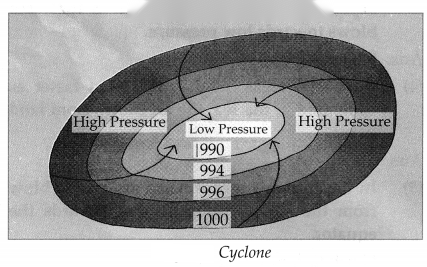
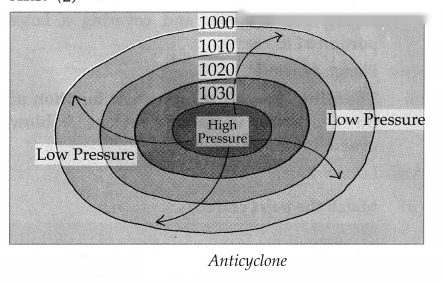
4. State one reason why:
(ii) During summers, land heats up quickly as compared to water & an area of low pressure is created on the land whereas an area of high pressure is created on the water.
(iii) But during winters low pressure is created on the water and an area of high pressure is created on land as it cools down quickly as compared to the water.
(iv) As winds blow from high pressure areas to low pressure areas, it blows from sea to land in summers & from land to sea in winters.
Thus the monsoon winds in summer come from sea but the retreating monsoon winds come from land.
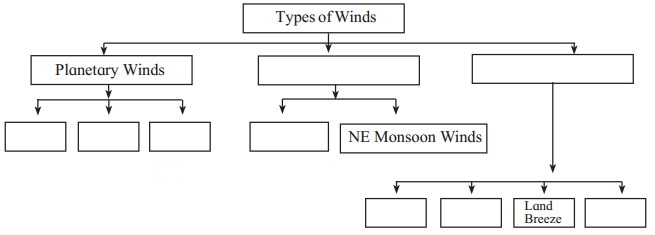
5. Complete the flow chart:
Answer:
6. Answer in short:
(ii) But due to the rotation of the earth in the northern hemisphere the winds deflected towards the right of their original direction whereas in the southern hemisphere they get deflected towards the left of their original direction which causes the cyclone winds to blow in a circular manner.
Activity:
Using the internet, obtain information, photos and maps of the recent cyclone that arrived at India’s eastern coast.
Write the social and economic effects of that cyclone.
ICT Question:
Use the mobile app ‘Windyty’ and try to know the direction of winds and pressure areas in the world.
Class 7 Geography Chapter 5 Winds InText Questions and Answers
Formative Assessment
Can you tell?
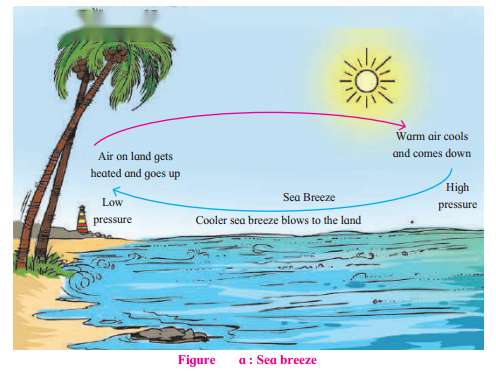
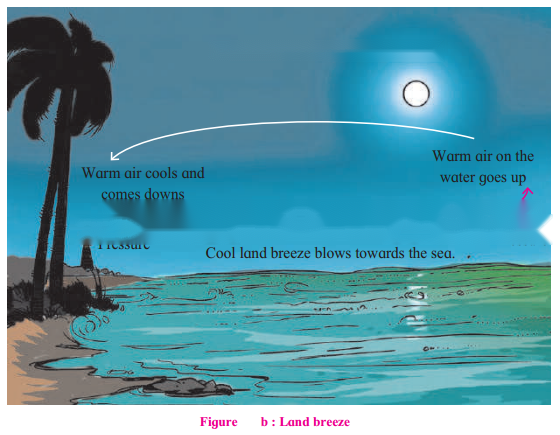
Observe the diagrams given below. Answer the questions related to sea and land breeze
Question 1.
Why do the breezes blow from the sea to the land during the day?
Answer:
During the day as land gets heated up faster than water, an area of low pressure is created on land whereas there is a region of comparatively higher pressure on the sea. As a result the breezes blow from the sea to the land during the day.
Give it a try.
Write the changed directions of the wind in the table below:
Pressure Belts | Northern Hemisphere | Southern Hemisphere |
Mid Latitudes | ……….. | ………….. |
………… | ………….. | |
Poles | ……………….. | ……………. |
Pressure Belts | Northern Hemisphere | Southern Hemisphere |
Mid Latitudes | (1) Easterlies blow from northeast to south west | Easterlies blow from south east to northwest |
(2) Westerlies blow from southwest to northeast | Westerlies blow from northwest to southeast | |
Poles | Polar winds blow from northeast to south west | Polar winds blow from southeast to northwest Try this:
Question 1
Maharashtra Board Solution
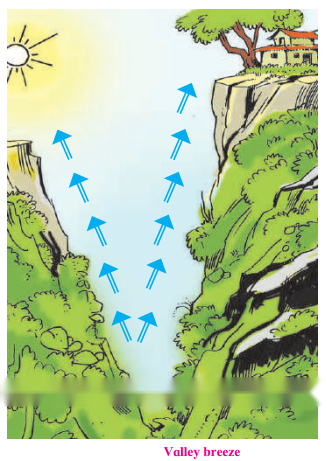
Observe the pictures given below and describe the valley breeze considering the elevation of land, the heating and cooling properties of land and water, the air pressure, etc.
Solution & Step-by-Step Answer:
Characteristics of Valley Breeze:
Question 2
Maharashtra Board Solution
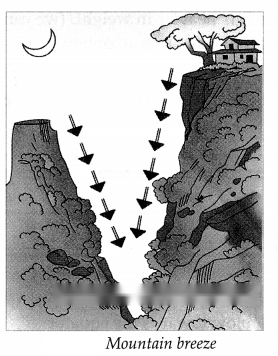
Read the following information carefully and draw a diagram for the mountain breeze accordingly. Characteristics of the Mountain breeze: |
Try this:
Question 1
Maharashtra Board Solution
Without touching the roll of the paper on the table, what can be done to move the paper rolls to the other end of the table?
Solution & Step-by-Step Answer:
To move the paper rolls to the other end of the table without touching a person can
Question 2
Maharashtra Board Solution
See who moves the paper roll first to the other end of the table:
Solution & Step-by-Step Answer:
The object which blows the air with maximum force, moves the paper roll first to the other end of the table.
Question 3
Maharashtra Board Solution
What could be the reason of the delay in making the rolls reach to the other end of the table?
Solution & Step-by-Step Answer:
There will be a delay in making the rolls reach the other end of the table if the air is blown with lesser force.
Question 4
Maharashtra Board Solution
What can we do to move the rolls to the other end of the table with a greater speed?
Solution & Step-by-Step Answer:
We mostly use the technique/object which will blow air with maximum force to move the rolls to the other end of the table with a greater speed.
Question 5
Maharashtra Board Solution
Can a bottle filled with water be moved to the other end of the table in this manner? Can we use the same method that you tried for moving paper rolls?
Solution & Step-by-Step Answer:
A bottle filled with water cannot be moved to the other end of the table in this manner. We cannot use the same methods that we tried for moving paper rolls to move a bottle filled with water as it is heavier in weight, (we can if we tilt the table which was an option.)
Class 7 Geography Chapter 5 WindsAdditional Important Questions and Answers Fill in the blanks choosing the correct option from the bracket:
Question 1
Maharashtra Board Solution
Air moves from high pressure to low pressure areas in a ______ manner. (vertical, horizontal, parallel)
Solution & Step-by-Step Answer:
horizontal.
Question 2
Maharashtra Board Solution
Winds velocity is measured in the units of ________. (knots, metres, seconds)
Solution & Step-by-Step Answer:
knots.
Question 3
Maharashtra Board Solution
Wind which cover a large portion of the earth are called _____ wind. (local, polar, planetary)
Solution & Step-by-Step Answer:
planetary.
Question 4
Maharashtra Board Solution
Winds blowing between mid latitudinal high pressure belt and the equator are called ______. (westerlies, easterlies, polar)
Solution & Step-by-Step Answer:
easterlies.
Question 5
Maharashtra Board Solution
Winds blowing between mid latitudinal high pressure belt and the sub polar low pressure belt are called _______. (easterlies, westerlies, polar)
Solution & Step-by-Step Answer:
westerlies.
Question 6
Maharashtra Board Solution
Winds that blow for a short duration of time, over a limited area are called ______. wind. (polar, local, easterlies)
Solution & Step-by-Step Answer:
local.
Question 7
Maharashtra Board Solution
Mountain winds blow during ______.(morning, night, midday)
Solution & Step-by-Step Answer:
night.
Question 8
Maharashtra Board Solution
Winds that blow at night in coastal areas are called ________ breeze, (sea, land, valley)
Solution & Step-by-Step Answer:
land.
Question 9
Maharashtra Board Solution
Cyclones occurring in the western part of the Pacific ocean are called ______.(hurricane, typhoons)
Solution & Step-by-Step Answer:
typhoons.
Question 10
Maharashtra Board Solution
Hot winds blowing in the Thar Desert are called the _______ (simoons, loo, chinook)
Solution & Step-by-Step Answer:
loo.
Rewrite the following statements after choosing the correct option:
Question 1
Maharashtra Board Solution
During an anticyclone the sky ______. (a) is dark. (b) is cloudy. (c) is clear. (d) is white.
Solution & Step-by-Step Answer:
(c) is clear.
Question 2
Maharashtra Board Solution
Winds blowing from the polar high pressure to sub polar low pressure belt (a) blow from west to east. (b) blow from east to west. (c) blow from south to north. (d) blow from north to south.
Solution & Step-by-Step Answer:
(b) blow from east to west.
Question 3
Maharashtra Board Solution
The minimum velocity of cyclonic storms is ________. (a) 50 km per hour (b) 60 km per hour (c) 70 km per hour (d) 80 km per hour.
Solution & Step-by-Step Answer:
(b) 60 km per hour
Question 4
Maharashtra Board Solution
Winds which originate in specific regions and blow over a limited area are called _____. (a) local winds. (b) seasonal winds (c) monsoon winds (d) planetary winds
Solution & Step-by-Step Answer:
(a) local winds.
Find out the odd man out and give reason for your answer:
Question 1
Maharashtra Board Solution
Polar winds, Local winds, Easterlies, Westerlies
Solution & Step-by-Step Answer:
Local winds – Others are names of planetary winds.
Question 2
Maharashtra Board Solution
Landbreeze, Valley winds, Westerlies, Mountain winds.
Solution & Step-by-Step Answer:
Westerlies – Others are names of local winds.
Question 3
Maharashtra Board Solution
Mistral, Bora, Pampero, Foehn
Solution & Step-by-Step Answer:
Foehn – Others are cold and dry winds.
Question 4
Maharashtra Board Solution
Loo, Foehn, Mistral, Simoon
Solution & Step-by-Step Answer:
Mistral – Others are hot and dry winds.
Question 5
Maharashtra Board Solution
Mistral, Bora, Chinook, Foehn
Solution & Step-by-Step Answer:
Chinook – Others originate in the Alps Mountain.
Question 6
Maharashtra Board Solution
Southeast Asia, West Europe, East Africa, North Australia.
Solution & Step-by-Step Answer:
West Europe – Others receive monsoon rains.
Question 7
Maharashtra Board Solution
India, Japan, China, Phillippines.
Solution & Step-by-Step Answer:
India – Others experience typhoons.
Question 8
Maharashtra Board Solution
Furious Fifties, Screaming Seventies, Screeching Sixties,, Roaring Forties.
Solution & Step-by-Step Answer:
Screaming Seventies – Others are names of winds in the southern hemisphere.
Place a tick mark (✓) against the correct option:
Question 1
Maharashtra Board Solution
Towards which direction do the southern hemisphere winds get deflected?. (a) Towards the left. (b) Towards the right. (c) Towards the centre.
Solution & Step-by-Step Answer:
(a) Towards the left.
Question 2
Maharashtra Board Solution
What are the winds blowing between polar high pressure belt and subpolar low pressure belt called? (a) Monsoon winds (b) Polar winds (c) Westerlies winds
Solution & Step-by-Step Answer:
(a) Monsoon winds
Question 3
Maharashtra Board Solution
Hot and destructive winds blowing in the Sahara (a) Chinook (b) Simoom (c) Loo
Solution & Step-by-Step Answer:
(b) Simoom
Question 4
Maharashtra Board Solution
Cold winds around the Mediterranean. (a) Foehn (b) Pampero (c) Mistral
Solution & Step-by-Step Answer:
(b) Pampero
Question 5
Maharashtra Board Solution
How is cyclonic condition created? (a) Low pressure area is surrounded by high pressure. (b) A high pressure area is surrounded by low pressure. (c) A low pressure area is surrounded by mid pressure.
Solution & Step-by-Step Answer:
(c) A low pressure area is surrounded by mid pressure.
Identify the type of winds from the description given below:
Question 1
Maharashtra Board Solution
In coastal areas, land cools down faster as compared to the sea, the air blows from land to sea.
Solution & Step-by-Step Answer:
Land Breeze.
Question 2
Maharashtra Board Solution
In the Indian subcontinent, dry winds blow from the Indian Subcontinent towards the equator.
Solution & Step-by-Step Answer:
North-East monsoon winds.
Question 3
Maharashtra Board Solution
The winds blowing over the earth’s surface throughout the year and covering a large portion of the earth.
Solution & Step-by-Step Answer:
Planetary winds.
Question 4
Maharashtra Board Solution
The winds that blow for a short duration of time, originate in specific regions & blow over a limited area.
Solution & Step-by-Step Answer:
Local winds.
Match the pairs correctly:
Question 1
Maharashtra Board Solution
|
Name of the Wind | Nature of the Wind |
(1) Loo | (a) Hot and dry |
(2) Simoom | (b) Cold and dry |
(3) Chinook | (c) Hot, dry and destructive |
(4) Mistral | (d) Warm and dry |
1 – a
2 – c
3 – d
4 – b
Define the following terms:
Question 1
Maharashtra Board Solution
Roaring Forties:
Solution & Step-by-Step Answer:
Beyond 40°S winds blow with tremendous velocity. These winds are called the Roaring Forties.
Question 2
Maharashtra Board Solution
Furious Fifties:
Solution & Step-by-Step Answer:
Around 50°S winds are stormy hence they are called the Furious Fifties.
Question 3
Maharashtra Board Solution
Screeching Sixties:
Solution & Step-by-Step Answer:
The stormy winds around 60°S make tremendous noise and hence they are called the Screeching Sixties.
Question 4
Maharashtra Board Solution
Local Winds:
Solution & Step-by-Step Answer:
The winds that blow for a short duration of time, originate in specific region and blow over a limited area are called Local Winds.
Question 5
Maharashtra Board Solution
Doldrums:
Solution & Step-by-Step Answer:
The region up to 5° North and 5° South of the equator remains calm for most of the year and winds do not blow in this region. It is called the equatorial calm zone or Doldrums.
Question 6
Maharashtra Board Solution
Horse Latitudes:
Solution & Step-by-Step Answer:
In the area near the Tropic of Cancer and Tropic of Capricorn, that is between 25° and 35° north and south, there exist a high pressure belt, which is a calm belt. This belt is called as the Horse latitudes.
Question 7
Maharashtra Board Solution
Typhoons:
Solution & Step-by-Step Answer:
Storms arising in the months between June and October in the western part of the Pacific Ocean which blow with high velocity winds and heavy rains causing destruction are called Typhoons.
Question 8
Maharashtra Board Solution
Hurricanes:
Solution & Step-by-Step Answer:
The cyclones in the Caribbean sea which are destructive in nature are called Hurricanes.
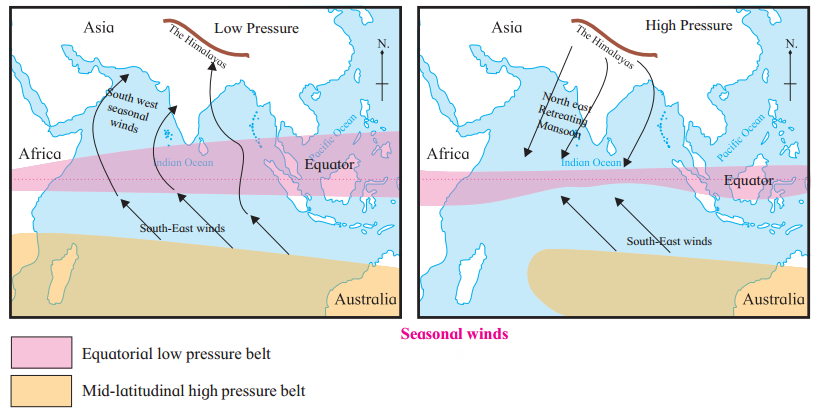
Observe the pictures given below of Seasonal winds and write its characteristics:
Question 1
Maharashtra Board Solution
Solution & Step-by-Step Answer:
Characteristics of the Seasonal winds (Monsoon):
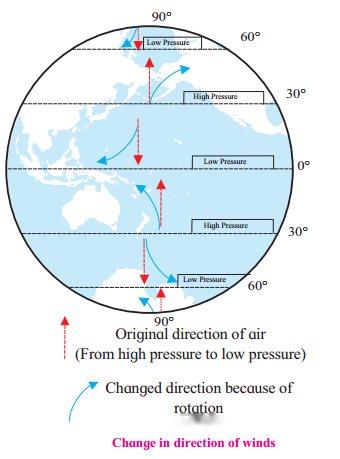
change in direction of wind:
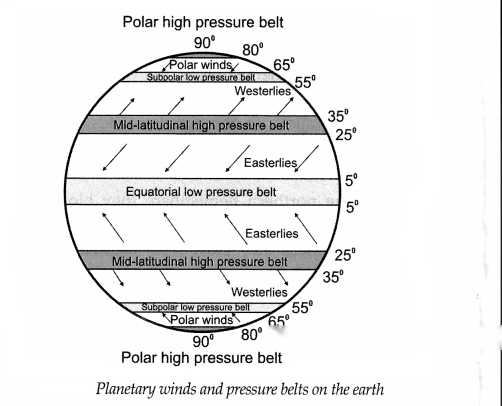
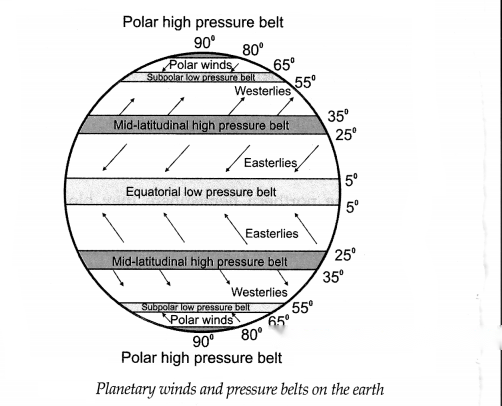
Draw a neat labelled diagram:
Question 1
Maharashtra Board Solution
Planetary winds and pressure belts on the earth
Solution & Step-by-Step Answer:
Distinguish between the following:
Question 1
Maharashtra Board Solution
Easterlies and Westerlies:
Solution & Step-by-Step Answer:
Question 2
Maharashtra Board Solution
Valley breeze and Mountain breeze:
Solution & Step-by-Step Answer:
Question 3
Maharashtra Board Solution
Cyclones and Anticyclones:
Solution & Step-by-Step Answer:
State one reason why:
Question 1
Maharashtra Board Solution
Planetary winds change their original direction.
Solution & Step-by-Step Answer:
The rotation from the west to east causes the change in the original direction of the planetary winds.
Question 2
Maharashtra Board Solution
The air pressure in land and water is different
Solution & Step-by-Step Answer:
(a) The land is made up of dense matter. Land is stable and opaque. As a result, heat is transferred at a greater speed and in a higher proportion. Hence, land gets heated quickly.
(b) The density of water is comparatively less. Water is transparent and unstable. Hence, water does not get heated quickly. (c) As a result, the air pressure in land and water areas is different.
Question 3
Maharashtra Board Solution
The Indian subcontinent experiences monsoon and retreating monsoon seasons.
Solution & Step-by-Step Answer:
(a) Monsoon winds are generated due to uneven heating of land & water in different seasons. During summers, monsoon winds blow from sea to land & in winter they blow from land to the sea.
(b) The influence of monsoon winds is seen in summer season in the Indian subcontinent due to high temperature & low pressure in Thar desert region & Punjab plains. (c) As these winds blow from sea to land the Indian subcontinent experiences monsoon (rainy) season. (d) During winters, due to high pressure & low temperature in the Indian subcontinent & comparatively low pressure & high temperature in the Indian ocean winds blow from land to sea. (e) This is the retreating monsoon season in the Indian subcontinent. Answer the following in detail:
Question 1
Maharashtra Board Solution
Give detailed information about the types of planetary winds.
Solution & Step-by-Step Answer:
The following are the types of Planetary winds: (i) Easterlies:
(ii) Westerlies: (iii) Polar winds:
Question 2
Maharashtra Board Solution
Write in detail about cyclonic storms.
Solution & Step-by-Step Answer:
(i) Cyclones occurring in the western part of the Pacific ocean along the coasts of Japan, China, Philippines, etc. are known as ‘Typhoons’. (ii) These storms arise in the months between June & October. (iii) Due to high velocity winds & heavy rains, these prove to be destructive. (iv) The cyclones in the Caribbean Sea are known as ‘hurricanes’. These are also destructive in nature. (v) During these storms, the minimum velocity of the wind is 60 km per hour. (vi) Cyclones also originate in the temperate zone but they are not so powerful & hence are not destructive.
Question 3
Maharashtra Board Solution
What are anticyclones?
Solution & Step-by-Step Answer:
(i) Under specific atmospheric conditions, the air pressure in a particular region increases & the pressure in the surrounding areas remain low.
(ii) In this situation, winds blow from the centre towards the surrounding areas in a circular manner. (iii) In the northern hemisphere, these winds blow in a clockwise direction whereas in the southern hemisphere they blow in an anticlockwise direction. (iv) During anticyclone, the skies are clear, winds blow with lesser velocities and the weather is pleasant. Can you tell? Observe the picture given below and answer the following questions.:
Question 2
Maharashtra Board Solution
What is the direction of the Westerlies in the southern hemisphere?
Solution & Step-by-Step Answer:
Westerlies blow from north west to south east in the southern hemisphere
Question 3
Maharashtra Board Solution
Which planetary winds blow from the mid-latitudinal high pressure belts to the subpolar low pressure belts in the northern hemisphere?
Solution & Step-by-Step Answer:
The Westerlies blow from mid latitudinal high pressure belts to subpolar low pressure belts in the northern hemisphere
Question 4
Maharashtra Board Solution
Why is the direction of polar winds not the same in both the hemispheres?
Solution & Step-by-Step Answer:
The rotation of the earth causes the change in the direction of winds in both the hemisphere. So polar winds blow from northeast to south west in the northern hemisphere & from south east to north-west in the southern hemisphere.
Question 5
Maharashtra Board Solution
Name the winds that blow in the southern hemisphere.
Solution & Step-by-Step Answer:
Easterlies, Westerlies and Polar Winds blow in the southern hemisphere.
Question 6
Maharashtra Board Solution
In which direction do the Easterlies blow in the Northern and Southern hemisphere?
Solution & Step-by-Step Answer:
Easterlies blow from northeast to southeast in northern hemisphere & from southeast to northwest in the southern hemisphere.
|