Maharashtra State Board Class 7 Geography Solutions Chapter 4 Air Pressure
Class 7 Geography Chapter 4 Air Pressure Textbook Questions and Answers
1. Give reasons:
2. Give short answers to the following questions.
3. Write notes on:
4. Fill in the gaps with the appropriate option.
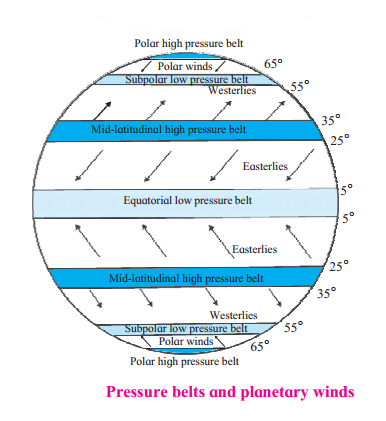
5. How does a high-pressure belt get formed near 30 ° parallel? Why does this region have hot deserts?
Answer:
(i) The heated air from the equatorial region becomes lighter, starts ascending and after reaching higher altitudes, moves towards the polar region, i.e., towards the North and the South Pole.
(ii) Due to low temperatures at the higher altitudes, the air cools down and becomes heavier. This heavier air descends down in both the hemispheres in the region between 25° to 35° parallels.
(iii) This leads to the formation of high pressures belts in these parallels of latitudes in both the hemispheres.
(iv) This air is dry, hence the region does not get rainfall. Consequently, most of the hot deserts on the earth are found in these regions.
6. Draw a neat diagram showing pressure belts. Label the diagram.
Answer:
Class 7 Geography Chapter 4 Air Pressure InText Questions and Answers
Formative Assessment
Can you tell?
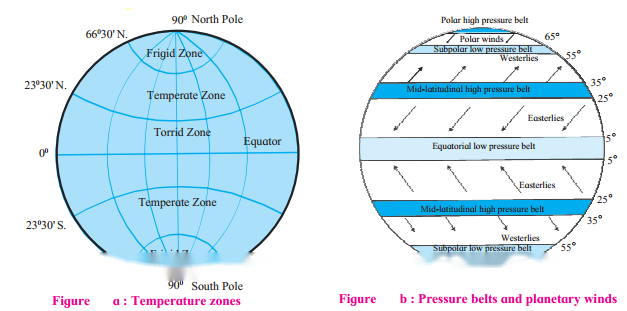
Observe the diagram Fig. (a) and (b) carefully and answer the following questions:
Question 1.
Which pressure belt is mainly found in the Tropics?
Answer:
Equatorial low pressure belt is mainly found in the tropics.
Observe the map given above and study the distribution of air pressure and answer the following
Question 1.
The nature of the isobars.
Answer:
The isobars are joining places of equal air pressure on the map.
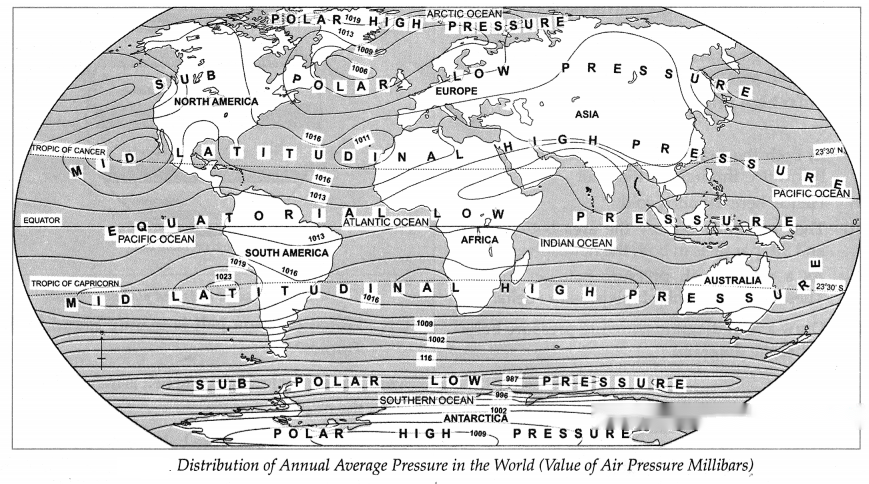
(ii) Closely spaced isobars indicate large pressure changes over a small area. Widely spaced isobars indicate gentle or gradual pressure change.
(iii) In the southern hemisphere, the isobars extend in east-west direction. The distance between the isobars is fairly constant over the oceans & so the isobars are fairly parallel to each other.
Use your brainpower !
Try this:
Question 2
Maharashtra Board Solution
Did the flying lantern start ascending immediately after the candle was lit?
Solution & Step-by-Step Answer:
block bg-white dark:bg-slate-900/80 border-l-4 border-emerald-500 rounded-r-xl p-5 my-3 shadow-xs border border-slate-200/60 dark:border-slate-800">
Solution & Step-by-Step Answer:
Yes
Question 2
Maharashtra Board Solution
What would have happened to the flying lantern had the candle got extinguished after the lantern had gone up in the air?
Solution & Step-by-Step Answer:
The lantern would have fallen back on the earth.
Give it a try:
Question 1
Maharashtra Board Solution
Study the temperative distribution map given in your std VI textbook and the pressure distribution map in this lesson to find the correlation between air temperature and air pressure.
Solution & Step-by-Step Answer:
Class 7 Geography Chapter 4 Air Pressure Additional Important Questions and Answers Fill in the blanks choosing the correct option from the bracket:
Question 1
Maharashtra Board Solution
Pressure belts oscillates between ______ parallels. (5° to 7°, 10° to 20°, 80° and 90°, 25° to 30°)
Solution & Step-by-Step Answer:
5° to 7°
Question 2
Maharashtra Board Solution
The instrument used to measure air pressure is ______.(barometer, thermometer, hygrometer, seismometer)
Solution & Step-by-Step Answer:
barometer
Question 3
Maharashtra Board Solution
In both the polar regions, the temperature is below ________ throughout the year. (5°C, 0°C, 7°C, 6°C)
Solution & Step-by-Step Answer:
0°C
Question 4
Maharashtra Board Solution
The line that joins the places of equal pressure on the map is called an _______. (isotherm, isohytes, millibars, isobar)
Solution & Step-by-Step Answer:
isobar
Match the following:
Question 1
Maharashtra Board Solution
|
A (Pressure Belt) | B (Parallels) |
(1) Sub Polar low pressure(2) Mid latitudinal high pressure(3) Polar high pressure(4) Equatorial low pressure | (a) 25° to 35°(b) 5°N and 5°S(c) 55° to 65°(d) 80° to 90° |
1 – c
2 – a
3 – d
4 – b
Fill in the blanks:
Question 1
Maharashtra Board Solution
The latitudinal extent of the temperate zones is much _____ while belts are narrower.
Solution & Step-by-Step Answer:
Larger
Question 2
Maharashtra Board Solution
The extent of air pressure belt is upto ______ parallel.
Solution & Step-by-Step Answer:
10°
Question 3
Maharashtra Board Solution
Pressure belts are formed between the _______ and the pole.
Solution & Step-by-Step Answer:
Equator
Question 4
Maharashtra Board Solution
The sun rays fall perpendicular between the ______and ________.
Solution & Step-by-Step Answer:
Tropic of Cancer, Tropic of Capricorn
Question 5
Maharashtra Board Solution
Due to the earths curvature, the area betweentwo parallels gets ______ as we move towards the poles.
Solution & Step-by-Step Answer:
reduced
Question 6
Maharashtra Board Solution
The air pressure at sea level is ______ millibars.
Solution & Step-by-Step Answer:
1013.2
State whether the following statements are true or false:
Question 1
Maharashtra Board Solution
Air pressure is uniform on all places on the earth’s surface.
Solution & Step-by-Step Answer:
false
Question 2
Maharashtra Board Solution
Whenever the temperature is high, the air pressure is also high.
Solution & Step-by-Step Answer:
false
Question 3
Maharashtra Board Solution
The heat received from the sun, is uneven in different regions.
Solution & Step-by-Step Answer:
true
Question 4
Maharashtra Board Solution
In both the polar regions, the temperature is low throughout the year.
Solution & Step-by-Step Answer:
true
Question 5
Maharashtra Board Solution
Air pressure is measured in units of millimetres.
Solution & Step-by-Step Answer:
false
Answer the following questions in one to two sentence:
Question 1
Maharashtra Board Solution
Which factors influence air pressure?
Solution & Step-by-Step Answer:
The altitude of a region, temperature of the air and the amount of water vapour in the air are some factors influencing air pressure.
Question 2
Maharashtra Board Solution
What is the extent of air pressure belt?
Solution & Step-by-Step Answer:
The extent of air pressure belt is generally upto 10° parallel.
Question 3
Maharashtra Board Solution
What is the latitudinal extent of temperate zone?
Solution & Step-by-Step Answer:
The latitudinal extent of temperate zone is from 23°30’N to 66°30’N and 23° 30’S to 66° 30’S.
Question 4
Maharashtra Board Solution
What is the temperature in the polar region?
Solution & Step-by-Step Answer:
In both the polar regions, the temperature is below 0°C throughout the year.
Question 5
Maharashtra Board Solution
Why do all things in and on the earth stay earth bound?
Solution & Step-by-Step Answer:
All things in and on the earth stay bound due to the earth’s gravity.
Question 6
Maharashtra Board Solution
Why are temperature zones created on the surface of the earth?
Solution & Step-by-Step Answer:
The heat received from the sun is uneven in different regions. Hence the distribution of the temperature is uneven from the equator to the poles. As a result, temperature zones are created.
Question 7
Maharashtra Board Solution
Most of the hot deserts on the earth are found in which region?
Solution & Step-by-Step Answer:
Most of the hot deserts on the earth are found in the mid latitudinal high pressure belt ie; between 25° to 30° parallels in both hemispheres.
Give reasons:
Question 1
Maharashtra Board Solution
Air pressure is maximum at sea level.
Solution & Step-by-Step Answer:
Question 2
Maharashtra Board Solution
A low pressure belt is formed near the equator.
Solution & Step-by-Step Answer:
Question 3
Maharashtra Board Solution
High pressure belt is formed near the polar region.
Solution & Step-by-Step Answer:
Question 4
Maharashtra Board Solution
Low pressure belt is observed between 55° and 65° parallels in both the hemispheres.
Solution & Step-by-Step Answer:
Question 5
Maharashtra Board Solution
Temperature and air pressure are closely related.
Solution & Step-by-Step Answer:
Question 6
Maharashtra Board Solution
Most of the hot deserts on the earth are found in mid-latitudinal high pressure belts.
Solution & Step-by-Step Answer:
Give short answers to the following questions:
Question 1
Maharashtra Board Solution
What are the effects of air pressure?
Solution & Step-by-Step Answer:
Air pressure has the following effects.
Question 2
Maharashtra Board Solution
What is the difference between the temperature zones and pressure belts?
Solution & Step-by-Step Answer:
(i) The difference between the temperature zones & pressure belts is that the latitudinal extent of temperature zones is much larger while pressure belts are narrower.
(ii) For example, the Temperate zone extends from 23°30′ to 66°30′ in both hemisphere. Compared to this the pressure belt has limited extent which is generally upto 10° parallel. (iii) Also the temperature zones are continuous & spread from the equator to the poles from Torrid to Frigid. (iv) Pressure belts are not continuous & areas of high & low pressure are found in different regions from the equator to the poles.
Question 3
Maharashtra Board Solution
How does a high pressure belt get formed near 30° parallel? Why does this region have hot deserts?
Solution & Step-by-Step Answer:
(i) The heated air from the equatorial region becomes lighter, starts ascending and after reaching higher altitudes, moves towards the polar region, i.e., towards the North and the South Pole.
(ii) Due to low temperatures at the higher altitudes, the air cools down and becomes heavier. This heavier air descends down in both the hemispheres in the region between 25° to 35° parallels. (iii) This leads to the formation of high pressures belts in these parallels of latitudes in both the hemispheres. (iv) This air is dry, hence the region does not get rainfall. Consequently, most of the hot deserts on the earth are found in these regions. Think about it:
Question 1
Maharashtra Board Solution
What will be the effect on air pressure if the temperature drops? Why?
Solution & Step-by-Step Answer:
If the temperature drops, the air pressure will increase as the air becomes heavy.
|