Maharashtra State Board Class 7 Geography Solutions Chapter 3 Tides
Class 7 Geography Chapter 3 Tides Textbook Questions and Answers
1. Prepare a chain by matching the following:
Group ‘A’ | Group ‘B’ | Group ‘C’ |
(1) Waves | (a) 8thphase of the moon (Quarter) | (i) Objects get thrown towards the outer side. |
(2) Centrifugal force | (b) Newmoon day | (ii) Highest high tide occurs on this day. |
(3) Gravitational force | (c) Rotation of the earth | (iii) These are also generated due to earthquakes and volcanoes. |
(4) Spring Tide | (d) The moon, the sun and the earth | (iv) The forces of the sun and the moon operate in different directions. |
(5) Neap tide | (e) Wind | (v) Operates in the direction towards the centre of the earth. |
1 – e – iii
2 – c – i
3 – d – v
4 – b – ii
5 – a – iv
2. Give geographical reasons:
Question 1
Maharashtra Board Solution
Tides are influenced more by the moon than the sun.
Solution & Step-by-Step Answer:
Question 2
Maharashtra Board Solution
At some places along the coast, the low lying areas turn into lagoons or marshy lands.
Solution & Step-by-Step Answer:
(i) Generally the areas along the sea coast are low lying and get flooded easily by the sea water during high tide.
(ii) This leads to accumulation of sea water over a long period of time leading to formation of swamps & marshes. (iii) The tides help in maintaining the mangroves and the coastal biodiversity here. (iv) Certain areas near the sea coast being low lying & waters being shallow also lead to sediment deposition by sea waves leading to formation of lagoons. (v) In this way, at some places along the coast, the low lying areas turn into lagoons or marshy lands.
Question 3
Maharashtra Board Solution
Place located on the opposite meridian experiencing high or low tide will also experience high or low tide respectively.
Solution & Step-by-Step Answer:
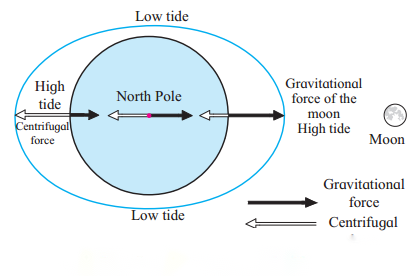
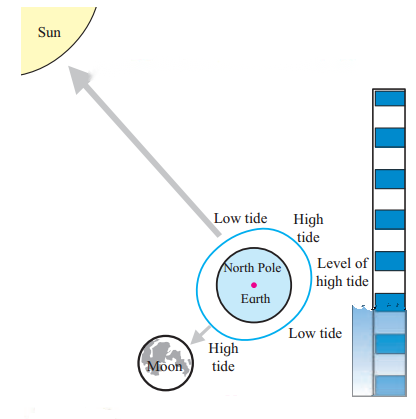
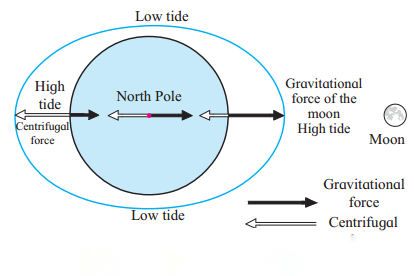
(i) The gravitational force of moon, the sun & the earth and the centrifugal force generated due to the rotation of the earth are two major factors responsible for the occurrence of tides.
(ii) When a place (meridian) faces the moon the gravitational force of the moon exceeds the centrifugal force of the earth leading to high tide here as the water is pulled towards the moon. (iii) At the same time the place on the earth located at the opposite meridian to the place experiencing high tide, the centrifugal force of the earth exceeds the gravitational force of the moon. Thus, the water is pulled in the direction away from the moon leading to high tide. (iv) The water required for the high tide moves in from places that are at right angles to those having high tides causing a low tide at those places. (v) Thus, place located on the opposite meridian to the place experiencing high or low tide will also experience high or low tide respectively. 3. Answer in brief:
Question 1
Maharashtra Board Solution
If there is high tide at 7 am, find the timings of the next high and low tides on the same day at a given place.
Solution & Step-by-Step Answer:
Question 2
Maharashtra Board Solution
If at Mumbai (73° E meridian), there is high tide at 1.00 pm on Thursday, then on which other meridian will there be a high tide too? State with reasons.
Solution & Step-by-Step Answer:
The other meridian which will experience high tide will be 107°W (180°-73°) because it is exactly 180° opposite from 73°E.
Question 3
Maharashtra Board Solution
Explain the reasons for the generation of waves.
Solution & Step-by-Step Answer:
4. In what way will the following depend on the tides:
Question 1
Maharashtra Board Solution
Swimming:
Solution & Step-by-Step Answer:
A lack of an understanding of the timings of high and low tides may cause accidents to swimmers entering the sea.
Question 2
Maharashtra Board Solution
Steering a ship:
Solution & Step-by-Step Answer:
Ships can move up to the ports during high tide.
Question 3
Maharashtra Board Solution
Fishing:
Solution & Step-by-Step Answer:
With the high tide, fish moves into the creeks and this helps the fishing activity.
Question 4
Maharashtra Board Solution
Salt Pans:
Solution & Step-by-Step Answer:
During high tide, seawater can be stored in salt pans from which salt can be obtained.
Question 5
Maharashtra Board Solution
Going to coastal areas for trips:
Solution & Step-by-Step Answer:
Plan for going to trips after full moon or new moon day. Also one must have details about the timings of the tides for better enjoyment.
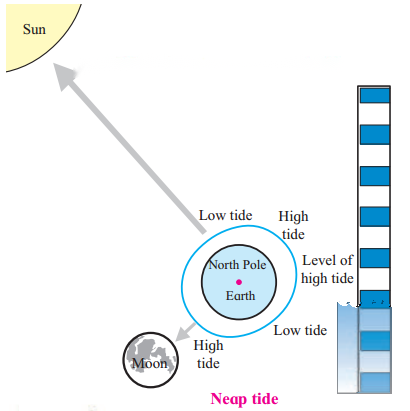
5. Observe figure of neap tide and answer the following questions:
Question 2
Maharashtra Board Solution
What are the relative positions of the moon, the sun and the earth?
Solution & Step-by-Step Answer:
The moon, the earth and the sun make an angle of 90° (right angle)
Question 3
Maharashtra Board Solution
What effect will it have on the tides?
Solution & Step-by-Step Answer:
It will lead to neap tide. Due to such conditions during high tide the water level will rise less than usual while during low tide water level will fall less than usual.
6. Differentiate between:
Question 1
Maharashtra Board Solution
High tide and low tide:
Solution & Step-by-Step Answer:
Question 2
Maharashtra Board Solution
Spring tide and neap tide.
Solution & Step-by-Step Answer:
7. Describe the positive and negative effects of tides: The negative effects of tides are as follows: Activities: Class 7 Geography Chapter 3 Tides InText Questions and Answers Differentiate between:
Question 1
Maharashtra Board Solution
Centrifugal force and Gravitational
Solution & Step-by-Step Answer:
Write short notes:
Question 1
Maharashtra Board Solution
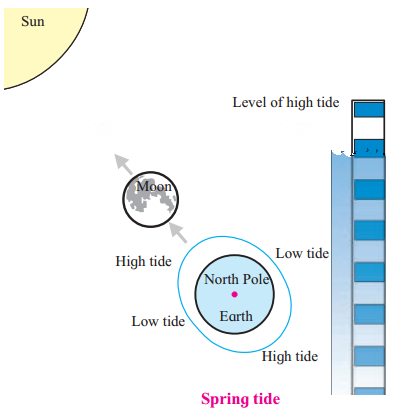
Spring tide
Solution & Step-by-Step Answer:
(i) On new moon & full moon days, the gravitational pull of the sun and the moon act in the same direction due to which the total pull increases.
(ii) Hence, the tide on these days is much higher than the average high tide. (iii) This is known as spring tide.
Question 2
Maharashtra Board Solution
Neap tide
Solution & Step-by-Step Answer:
(i) While revolving around the earth, the moon makes a right angle with respect to the earth and the sun, twice a month.
(ii) This position occurs on the first and third quarter of each month. On both these days the forces of both the sun & the moon operate at right angles on the earth. (iii) At the places where the sun causes high tide, the gravitational pull of the moon which is at right angles also acts on the water. (iv) Due to such conditions the water level rise is less than usual at the time of high tide. Similarly, fall in water level is less than usual at the time of low tide. (v) Such tides are called neap tides.
Question 3
Maharashtra Board Solution
Waves
Solution & Step-by-Step Answer:
Question 4
Maharashtra Board Solution
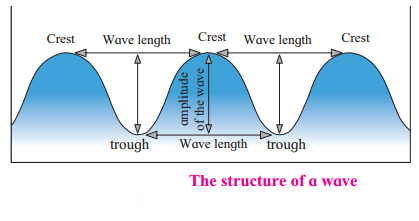
Struture of the waves
Solution & Step-by-Step Answer:
(i) The sea water gets pushed up & down because of the wind. The raised up portion of the wave is called crest & the depressed one is called trough.
(ii) The vertical distance between a crest and the following trough is called the amplitude of the wave whereas the distance between two successive crests or troughs is called wave length. (iii) The wave length, its amplitude & its velocity depend on the velocity of the wind. Formative Assessment:
Question 1
Maharashtra Board Solution
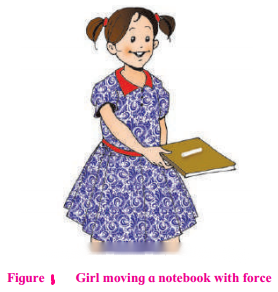
In which direction will the piece of chalk fall? (fig. 1)
Solution & Step-by-Step Answer:
The chalk will fall to the right.
Question 2
Maharashtra Board Solution
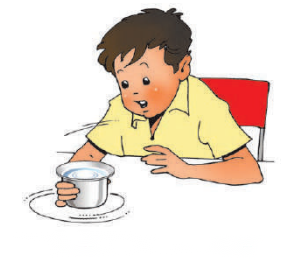
Where did the water in the glass show a bulge? (fig. 2)
Solution & Step-by-Step Answer:
At the sides of the glass.
Question 3
Maharashtra Board Solution
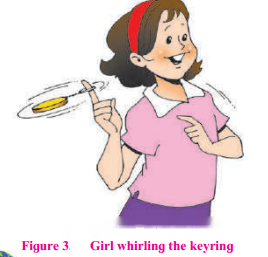
What effect did the movement have on the things attached to the keyring? (fig. 3)
Solution & Step-by-Step Answer:
The things attached to the keyring will move round.
Question 4
Maharashtra Board Solution
What happened to the water in the container and the mixer? (fig. 1)
Solution & Step-by-Step Answer:
The water will swirl round forming a bulge at the sides and a depression in the centre.
Question 5
Maharashtra Board Solution
Which forces could be operating in activities listed above?
Solution & Step-by-Step Answer:
In the first activity (fig. 1) gravitational force acted and in the fig. 2, fig. 3 centrifugal force.
Question 6
Maharashtra Board Solution
In the following activities, which force is greater, centrifugal or gravitational?
Solution & Step-by-Step Answer:
The centrifugal force was greater than the gravitational force.
Can you tell?
Question 2
Maharashtra Board Solution
Which force is applied when the moon is closer to the earth?
Solution & Step-by-Step Answer:
Gravitational force becomes more effective than that of the sun when the moon is closer to the earth.
Question 3
Maharashtra Board Solution
If it is high tide those having high tide at 0° and 180° meridian then at which meridians will low tide occur?
Solution & Step-by-Step Answer:
The meridians that are at right angle to those having high tide will experience low tide at the same time ie. at 90°E & 90°W.
Class 7 Geography Chapter 3 Tides Additional Important Questions and Answers Fill in the blanks choosing the correct options from the brackets:
Question 1
Maharashtra Board Solution
Due to rotation, the force that works away from the centre of the earth is the ______force. (gravitational, rotational, centrifugal)
Solution & Step-by-Step Answer:
centrifugal
Question 2
Maharashtra Board Solution
Neap tide occurs on the days of the ______ and _______ quarter of each month. (first, second, third)
Solution & Step-by-Step Answer:
first, third
Question 3
Maharashtra Board Solution
The tidal range in open seas is ______ cms. (20, 30, 40)
Solution & Step-by-Step Answer:
30
Question 4
Maharashtra Board Solution
The highest tidal range in the world is observed at _______.(Bay of Fundy, Bay of Biscay, Bay of Bengal)
Solution & Step-by-Step Answer:
Bay of Fundy
Question 5
Maharashtra Board Solution
The main reason for wave generation is ______ (wind, gravitational force, centrifugal force)
Solution & Step-by-Step Answer:
wind
Question 6
Maharashtra Board Solution
The raised up portion of a wave is called a _______.(trough, wave length, crest)
Solution & Step-by-Step Answer:
crest
Question 7
Maharashtra Board Solution
The depressed portion of a wave is called a ______. (trough, wave length, crest)
Solution & Step-by-Step Answer:
trough
Question 8
Maharashtra Board Solution
The vertical distance between a crest and a trough is called the _____.(wave length, amplitude, tide)
Solution & Step-by-Step Answer:
amplitude
Question 9
Maharashtra Board Solution
The distance between a crest or trough is called _____ (amplitude, wave length, tide)
Solution & Step-by-Step Answer:
wave length
Question 10
Maharashtra Board Solution
Tall sea waves caused by earthquakes below the floor of the sea are called _____.(cyclones, tsunamis, eruption)
Solution & Step-by-Step Answer:
tsunamis
Match the following:
Question 1
Maharashtra Board Solution
|
‘A’ | ‘B’ |
(1) Bay of Fundy | (a) 1100 cm |
1 – c
2- a
3 – d
4 – b
Fill in the blanks:
Question 1.
High and low tides are _______ phenomena.
Answer:
Natural
Question 2
Maharashtra Board Solution
_________ are movements of sea water occurring daily and regularly.
Solution & Step-by-Step Answer:
Tides
Question 3
Maharashtra Board Solution
Any object on the surface of the earth remains at the place due to the ______ force.
Solution & Step-by-Step Answer:
Gravitational
Question 4
Maharashtra Board Solution
The meridians that are at right angles to those having high, tide will experience tide _______.
Solution & Step-by-Step Answer:
Low
Question 5
Maharashtra Board Solution
On the days of the first and the third quarter, the high tide is at its _____.
Solution & Step-by-Step Answer:
Minimum
Question 6
Maharashtra Board Solution
On new moon and full moon days, the gravitational pull of the sun and the moon acting the ______ direction.
Solution & Step-by-Step Answer:
Same
Question 7
Maharashtra Board Solution
At every ______ a cycle of high tide and low tide gets completed.
Solution & Step-by-Step Answer:
12 hrs & 25 min
Name the following:
Question 1
Maharashtra Board Solution
Movement of sea water.
Solution & Step-by-Step Answer:
Tides.
Question 2
Maharashtra Board Solution
Two forces directly related with tides.
Solution & Step-by-Step Answer:
Gravitational and Centrifugal forces.
Question 3
Maharashtra Board Solution
Two types of tide.
Solution & Step-by-Step Answer:
Spring tide and Neap tide.
Question 4
Maharashtra Board Solution
The difference in the water level of the high tide and low tide.
Solution & Step-by-Step Answer:
Tidal range.
Question 5
Maharashtra Board Solution
The region with highest tidal range in India.
Solution & Step-by-Step Answer:
The Gulf of Khambhat.
Question 6
Maharashtra Board Solution
Tall waves caused by earthquakes in the shallow waters near the coast, which are very destructive.
Solution & Step-by-Step Answer:
Tsunami.
Question 7
Maharashtra Board Solution
Place where tsunami waves were generated in 2004.
Solution & Step-by-Step Answer:
Sumatra islands of Indonesia.
Question 8
Maharashtra Board Solution
Type of tide occuring on full moon day.
Solution & Step-by-Step Answer:
Spring tide.
Question 9
Maharashtra Board Solution
Type of tide occuring when sun and the moon are at right angles to each other.
Solution & Step-by-Step Answer:
Neap tide.
Question 10
Maharashtra Board Solution
Distance between two successive crests or troughs.
Solution & Step-by-Step Answer:
Wavelength.
Define the following:
Question 1
Maharashtra Board Solution
Tide:
Solution & Step-by-Step Answer:
The alternate rising and falling of the sea water after a specific period is called tide.
Question 2
Maharashtra Board Solution
Centrifugal force:
Solution & Step-by-Step Answer:
Due to the earth’s rotation, the earth gets a type of power or force. This force works away from the centre. It is called the centrifugal force.
Question 3
Maharashtra Board Solution
Tidal range:
Solution & Step-by-Step Answer:
The difference in the water level of the high tide and low tide is called tidal range.
Question 4
Maharashtra Board Solution
Waves:
Solution & Step-by-Step Answer:
The sea water gets pushed by the wind and so ripples are generated on the water surface. These are called waves.
Question 5
Maharashtra Board Solution
Amplitude of the wave:
Solution & Step-by-Step Answer:
The vertical distance between a crest and the following trough is called the amplitude of the wave.
Question 6
Maharashtra Board Solution
Wave length:
Solution & Step-by-Step Answer:
The wave length is the distance between two successive crests or troughs.
Write whether the following statements are true or false:
Question 1
Maharashtra Board Solution
The gravitational force is many times greater than the centrifugal force.
Solution & Step-by-Step Answer:
True
Question 2
Maharashtra Board Solution
Spring tides are lower than average high tides.
Solution & Step-by-Step Answer:
False
Question 3
Maharashtra Board Solution
Centrifugal force is generated due to the revolution of the earth.
Solution & Step-by-Step Answer:
False
Question 4
Maharashtra Board Solution
When there is high tide at 0° meridian, the 180° meridian also experiences high tide.
Solution & Step-by-Step Answer:
True
Question 5
Maharashtra Board Solution
Tides occur due to the relative positions of the moon, the sun and the earth.
Solution & Step-by-Step Answer:
True
Question 6
Maharashtra Board Solution
The tides clean the waste and hence the coastal areas become clean.
Solution & Step-by-Step Answer:
True
Question 7
Maharashtra Board Solution
The tides worsen the maintaining of mangroves and the coastal biodiversity.
Solution & Step-by-Step Answer:
False
Question 8
Maharashtra Board Solution
Generation of waves is a natural and regularly occurring phenomenon.
Solution & Step-by-Step Answer:
True
Give geographical reasons:
Question 1
Maharashtra Board Solution
Any object on the surface of the earth remains at the place where it exists.
Solution & Step-by-Step Answer:
Question 2
Maharashtra Board Solution
On new moon and full moon days the tides are higher than average.
Solution & Step-by-Step Answer:
Question 3
Maharashtra Board Solution
Neap tides are a little lower than average high tides.
Solution & Step-by-Step Answer:
Answer in brief:
Question 1
Maharashtra Board Solution
Which factors are responsible for the occurrence of tides?
Solution & Step-by-Step Answer:
The following factors are responsible for the occurrence of tides.
Draw a neat labelled diagram of:
Question 1
Maharashtra Board Solution
The structure of a wave:
Solution & Step-by-Step Answer:
Question 2
Maharashtra Board Solution
Springtide:
Solution & Step-by-Step Answer:
Question 3
Maharashtra Board Solution
Neap tide:
Solution & Step-by-Step Answer:
Question 4
Maharashtra Board Solution
Occurrence of tides:
Solution & Step-by-Step Answer:
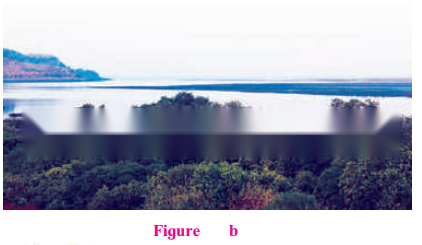
Observe the following pictures and answer the following questions given below and discuss:
Question 2
Maharashtra Board Solution
Observe and note the spread of water seen in both the photographs.
Solution & Step-by-Step Answer:
The level of water is higher in the first picture and lower in the second.
Question 3
Maharashtra Board Solution
What is this natural event called?
Solution & Step-by-Step Answer:
This natural event is called tide.
Try this: Take a wide open large dish.
Question 1
Maharashtra Board Solution
Is it possible to generate waves without touching or shoving the dish? Try doing so.
Solution & Step-by-Step Answer:
By blowing air with your mouth on the water surface of the dish.
Question 2
Maharashtra Board Solution
In what different ways can you generate waves in the dish?
Solution & Step-by-Step Answer:
|