Maharashtra State Board 12th Physics Solutions Chapter 11 Magnetic Materials
1. Choose the correct option.
i) Intensity of magnetic field of the earth at the point inside a hollow iron box is.
(A) less than that outside
(B) more than that outside
(C) same as that outside
(D) zero
Answer:
(D) zero
ii) Soft iron is used to make the core of transformer because of its
(A) low coercivity and low retentivity
(B) low coercivity and high retentivity
(C) high coercivity and high retentivity
(D) high coercivity and low retentivity
Answer:
(A) low coercivity and low retentivity
iii) Which of the following statements is correct for diamagnetic materials?
(A) µr< 1
(B) χ is negative and low
(C) χ does not depend on temperature
(D) All of above
Answer:
(D) All of above
iv) A rectangular magnet suspended freely has a period of oscillation equal to T. Now it is broken into two equal halves ( each having half of the original length) and one piece is made to oscillate freely. Its period of oscillation is T′, the ratio of T′ / T is.
(A)
(B)
(C) 2
(D)
Answer:
(B)
v) A magnetising field of 360 Am -1 produces a magnetic flux density (B ) = 0.6 T in a ferromagnetic material. What is its permeability in Tm A-1?
(A)
(B) 300
(C)
(D) 600
Answer:
(C)
2 Answer in brief.
i) Which property of soft iron makes it useful for preparing electromagnet?
Answer:
An electromagnet should become magnetic when a current is passed through its coil but should lose its magnetism once the current is switched off. Hence, the ferromagnetic core (usually iron-based) used for an electromagnet should have high permeability and low retentivity, i.e., it should be magnetically ‘soft’.
ii) What happens to a ferromagnetic material when its temperature increases above curie temperature?
Answer:
A ferromagnetic material is composed of small regions called domains. Within each domain, the atomic magnetic moments of nearest-neighbour atoms interact strongly through exchange interaction, a quantum mechanical phenomenon, and align themselves parallel to each other even in the absence of an external magnetic field. A domain is, therefore, spontaneously magnetized to saturation.
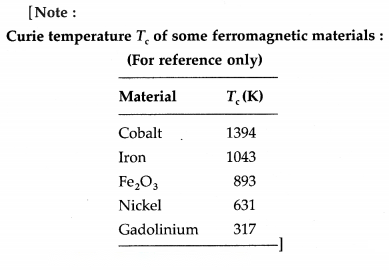
The material retains its domain structure only up to a certain temperature. On heating, the increased thermal agitation works against the spontaneous domain magnetization. Finally, at a certain critical temperature, called the Curie point or Curie temperature, thermal agitation overcomes the exchange forces and keeps the atomic magnetic moments randomly oriented. Thus, above the Curie point, the material becomes paramagnetic. The ferromagnetic to paramagnetic transition is an order to disorder transition. When cooled below the Curie point, the material becomes ferromagnetic again.
iii) What should be retentivity and coercivity of permanent magnet?
Answer:
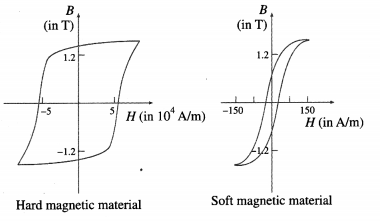
A permanent magnet should have a large zero-field magnetization and should need a very large reverse field to demagnetize. In other words, it should have a very broad hysteresis loop with high retentivity and very high coercivity.
iv) Discuss the Curie law for paramagnetic material.
Answer:
Curie’s law : The magnetization of a paramagnetic material is directly proportional to the external magnetic field and inversely proportional to the absolute temperature of the material.
If a paramagnetic material at an absolute temperature T is placed in an external magnetic field of induction , the magnitude of its magnetization
Mz∝ ∴ Mz= C
where the proportionality constant C is called the Curie constant.
[Notes : (1) The above law, discovered experimentally in 1895 by Pierre Curie (1859-1906) French physcist, is true only for values of Bext/ T below about 0.5 tesla per kelvin.
(2) [C] = [Mz∙ T] / [Bext] = [L-1I ∙] /[MT-2I-1]
= [M-1L-1T2I2],
wheredenotes the dimension of temperature.]


v) Obtain and expression for orbital magnetic moment of an electron rotating about the nucleus in an atom.
Answer:
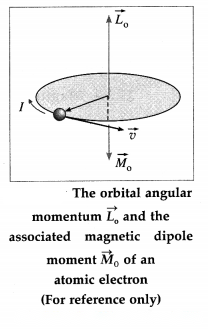
In the Bohr model of a hydrogen atom, the electron of charge – e performs a uniform circular motion around the positively charged nucleus. Let r, v and T be the orbital radius, speed and period of motion of the electron. Then,
T = …………….. (1)
Therefore, the orbital magnetic moment asso-ciated with this orbital current loop has a magnitude,
I = …………… (2)
Therefore, the magnetic dipole moment associated with this electronic current loop has a magnitude
M0= current × area of the loop
= I(πr2) = × πr2= evr ……………… (3)
Multiplying and dividing the right hand side of the above expression by the electron mass me,
M0= (mevr) = L0……………. (4)
where L0= mevr is the magnitude of the orbital angular momentum of the electron. is opposite to .
∴ ……………. (5)
which is the required expression.
According to Bohr’s second postulate of stationary orbits in his theory of hydrogen atom, the angular momentum of the electron in the nth stationary orbit is equal to n , where h is the Planck constant and n is a positive integer. Thus, for an orbital electron,
L0= mevr = …………… (6)
Substituting for L0in Eq. (4),
M0=
For n = 1, M0=
The quantity is a fundamental constant called the Bohr magneton,
µB∙ µB= 9.274 × 10⁻²⁴J/T (or A∙m2) = 5.788 × 10⁻⁵eV/T.
[ Notes : (1) Magnetic dipole moment is conventionally denoted by µ. (2) The magnetic moment of an atom is expressed in terms of Bohr magneton (vµB). (3) According to quantum mechanics, an atomic electron also has an intrinsic spin angular momentum and an associated spin magnetic moment of magnitude µ5. It is this spin magnetic moment that gives rise to magnetism in matter. (4) The total magnetic moment of the atom is the vector sum of its orbital magnetic moment and spin magnetic moment.]
vi) What does the hysteresis loop represents?
Answer:
A magnetic hysteresis loop is a closed curve obtained by plotting the magnetic flux density B of a ferromagnetic material against the corresponding magnetizing field H when the material is taken through a complete magnetizing cycle. The area enclosed by the loop represents the hysteresis loss per unit volume in taking the material through the magnetizing cycle.
vii) Explain one application of electromagnet.
Answer:
Applications of an electromagnet:
(b) µr= 1 + χm
∴ The magnetic susceptibility of the material,
χm= µr– 1 = 199 – 1 = 198
(c) χm=
The magnetization of the rod,
Mz= χmH = 198 × 4000 = 7.92 × 10⁵A/m
∴ W2 = MB (cos 0°- cos 60°)
= MB(1 – )
= 0.5MB
∴ W1= 2W2= MB
Given W1= nW2. Therefore n = 2.
(b) The maximum orientation energy per atom is
Um= -μB cos 180° = μB
= (1.5 × 10⁻²³) (3) =
= 2.8 × 10⁻⁴eV
The average thermal energy of each atom,
E = kBT
where kBis the Botzmann constant.
∴ E = 1.5(1.38 × 10⁻²³)(300)
= 6.21 × 10⁻²¹J =
= 3.9 × 10⁻²eV
Since the thermal energy of randomization is about two orders of magnitude greater than the magnetic potential energy of orientation, saturation magnetization will not be achieved at 300 K.
Without the added weight at one end, the needle will dip in the direction of the resultant magnetic field inclined with the horizontal. The torque due to the added weight about the vertical axis through the centre balances the torque of the couple due to the vertical component of the Earth’s magnetic field.
∴ (Mg) = (qmBv) L
The vertical component of the Earth’s magnetic field,
Bv= = 4.9 × 10⁻⁵T

12th Physics Digest Chapter 11 Magnetic Materials Intext Questions and Answers
Activity (Textbook Page No. 251)
Take another bar magnet and bring it near the suspended magnet resting in the magnetic meridian. Observe the interaction between the like and unlike poles of the two magnets facing each other. Does the suspended magnet rotate continuously or rotate through certain angle and remain stable? Note down your observations and conclusions.
Do you know (Textbook Page No. 255)
Effective magneton numbers for iron group ions (No. of Bohr magnetons)
Ion | Electron configuration | Magnetic moment (in terms of /iB) |
Fe3+ | [Ar] 3s23p63d5 | 5.9 |
Fe2+ | [Ar] 3s23p63d6 | 5.4 |
Co2+ | [Ar] 3s23p63d7 | 4.8 |
n2+ | [Ar] 3s23p63d8 | 3.2 |
(Courtsey: Introduction to solid state physics by Charles Kittel, pg. 306 )
These magnetic moments are calculated from the experimental value of magnetic susceptibility. In several ions the magnetic moment is due to both orbital and spin angular momenta.
Answer:
In terms of Bohr magneton (µB), the effective magnetic moments of some iron group ions are as follows. In several cases, the magnetic moment is due to both orbital and spin angular momenta.
Ion | Configuration | Effective magnetic moment in terms of Bohr magneton (B.M) (Expreimental values) |
Fe3+ | 3d5 | 5.9 |
Fe2+ | 3d6 | 5.4 |
Co2+ | 3d7 | 4.8 |
n2+ | 3d8 | 3.2 |
Remember this (Textbook Page No. 256)
Magnetic Susceptibility (χ) is the indicator of measure of the response of a given material to the external applied magnetic field. In other words it indicates as to how much magnetization will be produced in a given substance when kept in an external magnetic field. Again it is analogous to electrical susceptibility. This means when the substance is kept in a magnetic field, the atomic dipole moments either align or oppose the external magnetic field. If the atomic dipole moments of the substance are opposing the field, χ is observed to be negative, and if the atomic dipole moments align themselves in the direction of field, χ is observed to be positive. The number of atomic dipole moments of getting aligned in the direction of the applied magnetic field is proportional to χ. It is large for soft iron (χ >1000).
Magnetic permeability is analogous to electric permittivity, both indicating the extent to which a material permits a field to pass through or permeate into the material. For a superconductor, χ = -1 which makes µ = 0, so that a superconductor does not allow magnetic field lines to pass through it.
Magnetic susceptibility (χ). analogous to electrical susceptibility, is a measure of the response of a given material to an applied magnetic field. That is, it indicates the extent of the magnetization produced in the material when it is placed in an external magnetic field. χ is positive when the atomic dipole moments align themselves in the direction of the applied field; χ is negative when the atomic dipole moments align antiparallel to the field. χ is large for soft iron (χ > 1000).
Use your brain power (Textbook Page No. 259)
Question 1
Maharashtra Board Solution
Classify the following atoms as diamagnetic or paramagnetic. H, O, Zn, Fe, F, Ar, He (Hint : Write down their electronic configurations) Is it true that all substances with even number of electrons are diamagnetic?
Solution & Step-by-Step Answer:
It can be seen that all substances with an even number of electrons are not necessarily diamagnetic. Do you know (Textbook Page No. 260)
Question 1
Maharashtra Board Solution
Exchange Interaction: This exchange interaction in stronger than usual dipole-dipole interaction by an order of magnitude. Due to this exchange interaction, all the atomic dipole moments in a domain get aligned with each other. Find out more about the origin of exchange interaction.
Solution & Step-by-Step Answer:
Exchange Interaction : Quantum mechanical exchange interaction be-tween two neighbouring spin magnetic moments in a ferromagnetic material arises as a consequence of the overlap between the magnetic orbitals of two adjacent atoms. The exchange interaction in particular for 3d metals is stronger than the dipole-dipole interaction by an order of magnitude. Due to this, all the atomic dipole moments in a domain get aligned with each other and each domain is spontaneously magnetized to saturation. (Quantum mechanics and exchange interaction are beyond the scope of the syllabus.)
Use your brain power (Textbook Page No. 262)
Question 1
Maharashtra Board Solution
What does the area inside the curve B – H (hysteresis curve) indicate?
Solution & Step-by-Step Answer:
A magnetic hysteresis loop is a closed curve obtained by plotting the magnetic flux density B of a ferromagnetic material against the corresponding magnetizing field H when the material is taken through a complete magnetizing cycle. The area enclosed by the loop represents the hysteresis loss per unit volume in taking the material through the magnetizing cycle.
Do you know (Textbook Page No. 262)
Question 1
Maharashtra Board Solution
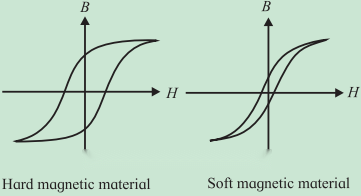
What is soft magnetic material? Soft ferromagntic materials can be easily magnetized and demagnetized. Hysteresis loop for hard and soft ferramagnetic materials.
Solution & Step-by-Step Answer:
A soft magnetic material, usually iron-based, has high permeability, low retentivity and low coercivity. In other words, it does not have appreciable hysteresis, i.e., its hysteresis loop is very narrow. Such a material magnetizes and demagnetizes more easily, by small external fields.
Do you know (Textbook Page No. 263)
Question 1
Maharashtra Board Solution
There are different types of shielding available like electrical and accoustic shielding apart from magnetic shielding discussed above. Electrical insulator functions as an electrical barrier or shield and comes in a wide array of materials. Normally the electrical wires used in our households are also shielded. In case of audio recording it is necessary to reduce other stray sound which may interfere with the sound to be recorded. So the recording studios are sound insulated using acoustic material.
Solution & Step-by-Step Answer:
There are different types of shielding, such as electrical, electromagnetic. magnetic, RF (radio fre quency) and acoustic, to shield a given space or sensitive instrument from unwanted fields of each type.
|