Maharashtra State Board 12th Physics Solutions Chapter 12 Electromagnetic Induction
1. Choose the correct option.
i) A circular coil of 100 turns with a cross-sectional area (A) of 1 m2is kept with its plane perpendicular to the magnetic field (B) of 1 T. What is the magnetic flux linkage with the coil?
(A) 1 Wb
(B) 100 Wb
(C) 50 Wb
(D) 200 Wb
Answer:
(B) 100 Wb
ii) A conductor rod of length (l) is moving with velocity (v) in a direction normal to a uniform magnetic field (B). What will be the magnitude of induced emf produced between the ends of the moving conductor?
(A) BLv
(B) BLv2
(C) Blv
(D)
Answer:
(A) BLv
iii) Two inductor coils with inductance 10 mH and 20 mH are connected in series. What is the resultant inductance of the combination of the two coils?
(A) 20 mH
(B) 30 mH
(C) 10 mH
(D) mH
Answer:
(A) 20 mH
iv) A current through a coil of self inductance 10 mH increases from 0 to 1 A in 0.1 s. What is the induced emf in the coil?
(A) 0.1 V
(B) 1 V
(C) 10 V
(D) 0.01 V
Answer:
(A) 0.1 V
v) What is the energy required to build up a current of 1 A in an inductor of 20 mH?
(A) 10 mJ
(B) 20 mJ
(C) 20 J
(D) 10 J
Answer:
(A) 10 mJ
2. Answer in brief.
i) What do you mean by electromagnetic induction? State Faraday’s law of induction.
Answer:
The phenomenon of production of emf in a conductor or circuit by a changing magnetic flux through the circuit is called electromagnetic induction.
Faraday’s laws of electromagnetic induction :
(1) First law ; Whenever there is a change in the magnetic flux associated with a circuit, an emf is induced in the circuit.
(2) Second law : The magnitude of the induced emf is directly proportional to the time rate of change of magnetic flux through the circuit.
[Note : The phenomenon was discovered in 1830 by Joseph Henry (1797-1878), US physicist, and independently in 1832 by Michael Faraday (1791 -1867), British chemchemist and physicist.]
ii) State and explain Lenz’s law in the light of principle of conservation of energy.
Answer:
Lenz’s law : The direction of the induced current is such as to oppose the change that produces it.
The change that induces a current may be (i) the motion of a conductor in a magnetic field or (ii) the change of the magnetic flux through a stationary circuit.
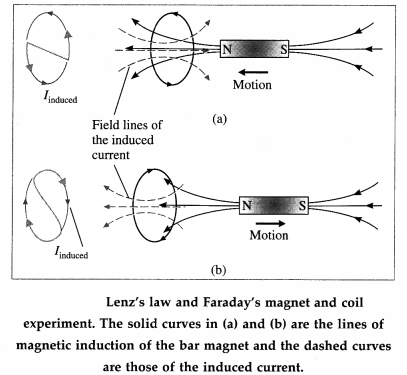
Explanation : Consider Faraday’s magnet-and- coil experiment. If the bar magnet is moved towards the coil with its N-pole facing the coil, as in Fig., the number of magnetic lines of induction (pointing to the left) through the coil increases. The induced current in the coil sets up a magnetic field of its own pointing to the right (as given by Amperes right-hand rule) to oppose the growing flux due to the magnet. Hence, to move the magnet towards the coil against this repulsive flux of the induced current, we must do work. The work done shows up as electric energy in the coil.
When the magnet is withdrawn, with its N-pole still facing the coil, the number of magnetic lines of induction (pointing left) through the coil decreases. The induced current reverses its direction to supplement the decreasing flux with its own, as shown in Fig.. Facing the coil along the magnet, the induced current is in the clockwise sense. The electric energy in the coil comes from the work done to withdraw the magnet, now against an attractive force. Thus, we see that Lenz’s law is a consequence of the law of conservation of energy.
[Note : The above law was discovered by Heinrich Friedrich Emil Lenz (1804-65), Russian physicist.]
iii) What are eddy currents? State applications of eddy currents.
Answer:
Whenever a conductor or a part of it is moved in a magnetic field “cutting” magnetic field lines, or placed in a changing magnetic field, the free electrons in the bulk of the metal start circulating in closed paths equivalent to current-carrying loops. These loop currents resemble eddies in a fluid stream and are hence called eddy or Foucault currents [after Jean Bernard Leon Foucault (1819-68), French physicist, who first detected them].
Applications :
(1) Dead-beat galvanometer : A pivoted moving-coil galvanometer used for measuring current has the coil wound on a light aluminium frame. The rotation of the metal frame in magnetic field produces eddy currents in the frame which opposes the rotation and the coil is brought to rest quickly. This makes the galvanometer dead-beat.
(2) Electric brakes : When a conducting plate is pushed into a magnetic field, or pulled out, very quickly, the interaction between the eddy currents in the moving conductor and the field retards the motion. This property of eddy currents is used as a method of braking in vehicles.
iv) If the copper disc of a pendulum swings between the poles of a magnet, the pendulum comes to rest very quickly. Explain the reason. What happens to the mechanical energy of the pendulum?
Answer:
As the copper disc enters and leaves the magnetic field, the changing magnetic flux through it induces eddy current in the disc. In both cases, Fleming’s right hand rule shows that opposing magnetic force damps the motion. After a few swings, the mechanical energy becomes zero and the motion comes to a stop.
Joule heating due to the eddy current warms up the disc. Thus, the mechanical energy of the pendulum is transformed into thermal energy.
v) Explain why the inductance of two coils connected in parallel is less than the inductance of either coil.
Answer:
Assuming that their mutual inductance can be ignored, the equivalent inductance of a parallel combination of two coils is given by
or Lparallel=
Hence, the equivalent inductance is less than the inductance of either coil.
Consider an infinitesimal element of radial thickness dr at a distance r from the rotation axis. In one rotation, the area traced by the element is dA = 2πrdr. Therefore, the time rate at which the element traces out the area is
= frequency of rotation x dA = fdA
where f = is the frequency of rotation.
.’. (2 πr dr) = ωr dr
The total emf induced between the axle and the rim of the rotating disc is
For anticlockwise rotation in pointing down, the axle is at a higher potential.
(b) The time rate at which a given radius cuts magnetic flux
= = B f(πr2)
= (0.2)(5.656) = 1.131 Wb/s
(c) The magnitude of the induced emf,
|e| = = 1.131 V
(b) Flux per unit turn through the coils of the solenoid, Φm= BA
Since the coil C is wound tightly over the solenoid, the flux linkage of C is
NCΦm= NCBA = (150)(5.656 × 10⁻³)(25 × 10-4)
= 2.121 × 10⁻³Wb = 2.121 mWb
(c) Initial flux through coil C,
Φi= NCΦm= 2.121 × 10⁻³Wb
Reversing the current in the solenoid reverses the flux through coil C, the magnitude remaining the same. But since the flux enters through the other face of the coil, the final flux through C is Φf= -2.121 × 10⁻³Wb
Therefore, the average emf induced in coil C,
e =
= 2 × 4.242 × 10-3= 8.484 × 10⁻³V = 8.484 mV
(b) Self inductance of the toroid,
L = µ02πRn2A = µ0n2lA = µ0n2l(πr2)
= (4π × 10-7)(104)2(1) [π(5 × 10⁻³)2]
= π2× 10-3= 9.87 × 10⁻³H = 9.87 mH
12th Physics DigestChapter 12 Electromagnetic induction Intext Questions and Answers
Do you know (Textbook Page No. 274)
Use your brain power (Textbook Page No. 282)
Use your brain power (Textbook Page No. 284)
Do you know (Textbook Page No. 285)
Faraday’s second law of electromagnetic induction is referred by some as the “flux rule”.