Latest Maharashtra State Board (SSC & HSC) 2026-27 Syllabus Digest & Solutions Updated!
Class 12 (HSC Board)Biology2026-27 Syllabus

Chapter 9 Control and Co-ordination Solutions

Complete Maharashtra State Board Balbharati & Yuvakbharati textbook solutions for Chapter 9 Control and Co-ordination. Step-by-step solved exercises, numerical problems, and digest answers.

50 Solved Questions6 Diagrams2909 words

Maharashtra State Board 12th Biology Solutions Chapter 9 Control and Co-ordination

1. Multiple choice questions

Question 1 Maharashtra Board Solution
The nervous system of mammals uses both electrical and chemical means to send signals via neurons. Which part of the neuron receives impulse? (a) Axon (b) Dendron (c) Nodes of Ranvier (d) Neurilemma
Solution & Step-by-Step Answer:
(b) Dendron
Question 2 Maharashtra Board Solution
……………. is a neurotransmitter. (a) ADH (b) Acetyl CoA (c) Acetyl choline (d) Inositol
Solution & Step-by-Step Answer:
(c) Acetyl choline
Question 3 Maharashtra Board Solution
The supporting cells that produce myelin sheath in the PNS are ……………. (a) Oligodendrocytes (b) Satellite cells (c) Astrocytes (d) Schwann cells
Solution & Step-by-Step Answer:
(d) Schwann cells
Question 4 Maharashtra Board Solution
A collection of neuron cell bodies located outside the CNS is called ……………. (a) tract (b) nucleus (c) nerve (d) ganglion
Solution & Step-by-Step Answer:
(d) ganglion
Question 5 Maharashtra Board Solution
Receptors for protein hormones are located ……………. (a) in cytoplasm (b) on cell surface (c) in nucleus (d) on Golgi complex
Solution & Step-by-Step Answer:
(b) on cell surface
Question 6 Maharashtra Board Solution
If parathyroid gland of man Eire removed, the specific result will be ……………. (a) onset of aging (b) disturbance of Ca++ (c) onset of myxoedema (d) elevation of blood pressure
Solution & Step-by-Step Answer:
(b) disturbance of Ca++
Question 7 Maharashtra Board Solution
Hormone thyroxine, adrenaline and non¬adrenaline are formed from …………… (a) Glycine (b) Arginine (c) Ornithine (d) Tyrosine
Solution & Step-by-Step Answer:
(d) Tyrosine
Question 8 Maharashtra Board Solution
Pheromones are chemical messengers produced by animals and released outside the body. The odour of these substance affects ……………. (a) skin colour (b) excretion (c) digestion (d) behaviour
Solution & Step-by-Step Answer:
(d) behaviour
Question 9 Maharashtra Board Solution
Which one of the following is a set of discrete endocrine gland? (a) Salivary glands, thyroid, adrenal, ovary (b) Adrenal, testis, ovary, liver (c) Pituitary, thyroid, adrenal, thymus (d) Pituitary, pancreas, adrenal, thymus
Solution & Step-by-Step Answer:
(c) Pituitary, thyroid, adrenal, thymus
Question 10 Maharashtra Board Solution
After ovulation, Graafian follicle changes into ……………. (a) corpus luteum (b) corpus albicans (c) corpus spongiosum (d) corpus callosum
Solution & Step-by-Step Answer:
(a) corpus luteum
Question 11 Maharashtra Board Solution
Which one of the following pairs correctly matches a hormone with a disease resulting from its deficiency? (a) Parathyroid hormone – Diabetes insipidus (b) Luteinising hormone – Diabetes mellitus (c) Insulin – Hyperglycaemia (d) Thyroxine – Tetany
Solution & Step-by-Step Answer:
(c) Insulin – Hyperglycaemia
Question 12 Maharashtra Board Solution
……………. is in direct contact of brain in humans. (a) Cranium (b) Dura mater (c) Arachnoid (d) Pia mater
Solution & Step-by-Step Answer:
(d) Pia mater

2. Very very short answer questions.

Question 1 Maharashtra Board Solution
What is the function of red nucleus?
Solution & Step-by-Step Answer:
Red nucleus plays an important role in controlling posture and muscle tone, modifying some motor activities and motor coordination.
Question 2 Maharashtra Board Solution
What is the importance of corpora quadrigemina?
Solution & Step-by-Step Answer:
Corpora quadrigemina consists of 4 solid rounded structures, viz. superior and inferior colliculi. Superior colliculi control visual reflexes while inferior colliculi control auditory reflexes.
Question 3 Maharashtra Board Solution
What does the cerebellum of brain control?
Solution & Step-by-Step Answer:
Cerebellum of brain is an important centre which maintains equilibrium of body, posture, balancing orientation, moderation of voluntary movements and maintenance of muscle tone.
Question 4 Maharashtra Board Solution
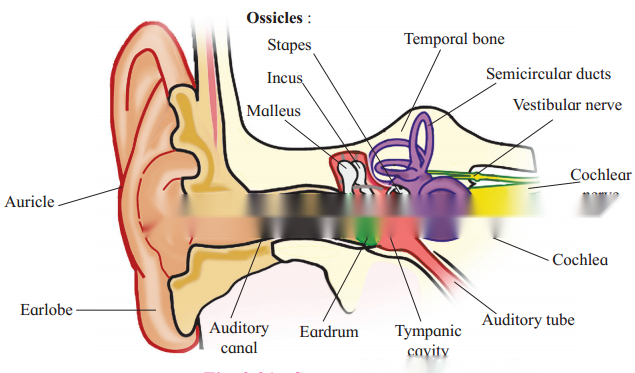
Name the three ear ossicles.
Solution & Step-by-Step Answer:
Malleus [hammer], incus [anvil] and stapes [stirrup].
Question 5 Maharashtra Board Solution
Name the anti abortion hormone.
Solution & Step-by-Step Answer:
Progesterone.
Question 6 Maharashtra Board Solution
Name an organ which acts as temporary endocrine gland.
Solution & Step-by-Step Answer:
Placenta. Corpus luteum in ovary.
Question 7 Maharashtra Board Solution
Name the type of hormones which bind to the DNA and alter the gene expression.
Solution & Step-by-Step Answer:
Steroid hormones.
Question 8 Maharashtra Board Solution
What is the cause of abnormal elongation of long bones of arms and legs and of lower jaw.
Solution & Step-by-Step Answer:
Hypersecretion of growth hormones in adults causes abnormal elongation of long bones of arms and legs and of lower jaw i.e. acromegaly.
Question 9 Maharashtra Board Solution
Name the hormone secreted by the pineal gland.
Solution & Step-by-Step Answer:
Melatonin.
Question 10 Maharashtra Board Solution
Which endocrine gland plays important, role in improving immunity?
Solution & Step-by-Step Answer:
The endocrine gland, thymus plays an important role in improving immunity.

3. Match the organism with the type of nervous system found in them.

Column A

Column B

(1) Neurons

(a) Earthworm

(2) Ladder type

(b) Hydra

(3) Ganglion

(c) Flatworm

(4) Nerve net

(d) Human

Answer:

Column A

Column B

(1) Neurons

(d) Human

(2) Ladder type

(c) Flatworm

(3) Ganglion

(a) Earthworm

(4) Nerve net

(b) Hydra

4. Very short answer questions.

Question 1 Maharashtra Board Solution
Describe the endocrine role of islets of Langerhans. OR Islets of Langerhans.
Solution & Step-by-Step Answer:
Endocrine cells of pancreas form groups of cells called Islets of Langerhans. There are four kinds of cells in islets of Langerhans which secrete hormones.
Question 2 Maharashtra Board Solution
Mention the function of testosterone?
Solution & Step-by-Step Answer:
Testosterone is a steroid sex hormone secreted by testes and cortex of adrenal glands. It controls the secondary sexual characters in males.
Question 3 Maharashtra Board Solution
Give symptoms of the disease caused by hyposecretion of ADH.
Solution & Step-by-Step Answer:
Polydipsia, i.e. frequent thirst and polyuria, i.e. frequent urination are the symptoms of the disease caused by hyposecretion of ADH.

5. Short answer questions

Question 1 Maharashtra Board Solution
Rakesh got hurt on his head when he fell down from his motorbike. Which inner membranes must have protected his brain? What other roles do they have to play
Solution & Step-by-Step Answer:
Question 2 Maharashtra Board Solution
Injury to medulla oblongata may prove fatal. OR Injury to medulla oblongata causes sudden death. Explain.
Solution & Step-by-Step Answer:
Question 3 Maharashtra Board Solution
Distinguish between the sympathetic and parasympathetic nervous system on the basis of the effect they have on: Heartbeat andUrinary Bladder.
Solution & Step-by-Step Answer:

Sympathetic Nervous System

Parasympathetic

Nervous System

(1) Heartbeat

Increases

Decreases

(2) Urinary bladder

Relaxes and stores urine

Contracts causing micturition

Question 4 Maharashtra Board Solution
While holding a tea cup Mr. Kothari’s hands rattle. Which disorder he may be suffering from and what is the reason for this?
Solution & Step-by-Step Answer:
Question 5 Maharashtra Board Solution
List the properties of the nerve fibres.
Solution & Step-by-Step Answer:
Question 6 Maharashtra Board Solution
How does tongue detect the sensation of taste?
Solution & Step-by-Step Answer:
Question 7 Maharashtra Board Solution
State the site of production and function of Secretin, Gastrin and Cholecystokinin.
Solution & Step-by-Step Answer:

Hormone

Site of production

Functions

1. Secretin

Duodenal mucosa

Stimulates secretion of pancreatic juice and bile from pancreas and liver respectively.

2. Gastrin

Gastric mucosa

Stimulates gastric glands to secrete gastric juice.

3. Cholecystokinin

Duodenal mucosa

Stimulates pancreas and gall bladder to release pancreatic enzymes and bile respectively.

Question 8 Maharashtra Board Solution
An adult patient suffers from low heart rate, low metabolic rate and low body temperature. He also lacks alertness, intelligence and initiative. What can be this disease? What can be its cause and cure ?
Solution & Step-by-Step Answer:
Question 9 Maharashtra Board Solution
Where is the pituitary gland located? Enlist the hormones secreted by anterior pituitary.
Solution & Step-by-Step Answer:
The pituitary gland is attached to hypothalamus on the ventral surface of brain. It is lodged in a bony depression called sella turcica of sphenoid bone. For names of hormones:

Gonadotropins-

Question 10 Maharashtra Board Solution
Explain how the adrenal medulla and sympathetic nervous system function as a closely integrated system.
Solution & Step-by-Step Answer:
Question 11 Maharashtra Board Solution
Name the secretion of alpha, beta and delta cells of islets of Langerhans. Explain their role.
Solution & Step-by-Step Answer:

Pancreatic islet cells

Secretion

Functions

1. Alpha cells

Glucagon

Stimulates glycogenolysis in the liver

2. Beta cells

Insulin

Stimulates glycogenesis in the liver and muscles

3. Delta cells

Somatostatin

Inhibits the secretion of glucagon and insulin. It also decreases the gastric secretions, motility and absorption in digestive tract.

Question 12 Maharashtra Board Solution
Which are the two types of goitre? What are their causes?
Solution & Step-by-Step Answer:
(1) Goitre is the enlargement of thyroid gland. It is easily visible at the base of neck when a person is suffering from it.

(2) Goitre is of two types.

Question 13 Maharashtra Board Solution
Name the ovarian hormone and give their functions.
Solution & Step-by-Step Answer:

Hormone

Functions

Oestrogen

It is responsible for secondary sexual characters in female.

Progesterone

Essential for thickening of uterine endometrium, thus preparing the uterus for implantation of fertilized ovum. It is responsible for development of mammary glands during pregnancy. It inhibits uterine contractions during pregnancy.

Relaxin

It relaxes the cervix of the pregnant female and ligaments of pelvic girdle during parturition.

Inhibin

It inhibits the FSH and GnRH production.

6. Answer the following.

Complete the table.

Location

Cell type

Function

PNS

————-

Produce myelin sheath.

PNS

Satellite cells

————-

————

Oligodendrocytes

Form myelin sheath around central axon.

CNS

————

Pathogens are destroyed by phagocytosis. (Phagocytose)

CNS

————

Form the epithelial lining of brain cavities and central canal.

Answer:

Location

Cell type

Function

PNS

Schwann cells

Produce myelin sheath.

PNS

Satellite cells

Supply nutrients to surrounding neurons, protect and cushion nearby neurons.

CNS

Oligodendrocytes

Form myelin sheath around central axon.

CNS

Microglia

Pathogens are destroyed by phagocytosis. (Phagocytose)

CNS

Ependyma

Form the epithelial lining of brain cavities and central canal.

7. Long answer questions.

Question 1 Maharashtra Board Solution
Explain the process of conduction of nerve impulses up to development of action potential.
Solution & Step-by-Step Answer:
Question 2 Maharashtra Board Solution
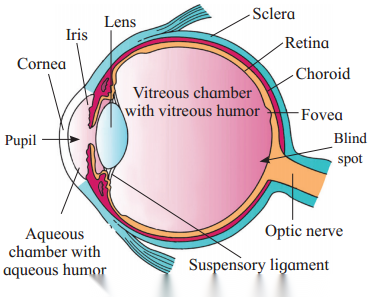
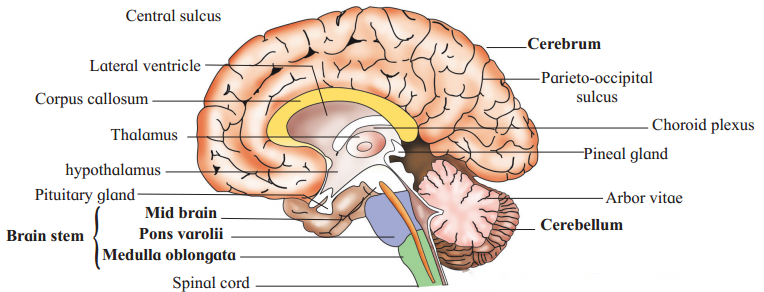
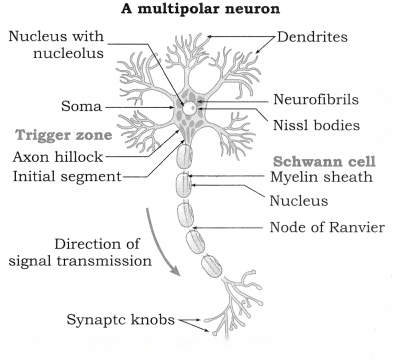
Draw the neat labelled diagrams. a. Human ear.
Solution & Step-by-Step Answer:

b. Sectional view of human eye.
Answer:
c. Draw the neat labelled diagram of sagittal section or L.S. of human brain
Answer:
d. Draw the neat labelled diagram of Multipolar Neuron.
Answer:
Question 3 Maharashtra Board Solution
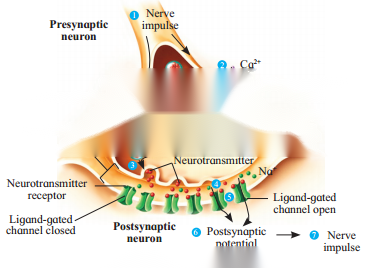
Answer the questions after observing the diagram given below. a. What do the synaptic vesicles contain?
Solution & Step-by-Step Answer:
Synaptic vesicles contain a neurotransmitter – acetyl choline.

b. What process is used to release the neurotransmitter ?
Answer:
Exocytosis.

c. What should be the reason for the next impulse to be conducted?
Answer:
Removal of neurotransmitter by the action of acetyl cholinesterase.

d. Will the impulse be carried by post synaptic membrane even if one pre-synaptic neuron is there?
Answer:
As far as impulse is transmitted by pre-synaptic neuron, it will be received by post-synaptic neuron.

e. Can you name the channel responsible for their transmission?
Answer:
Ca++channel
Question 4 Maharashtra Board Solution
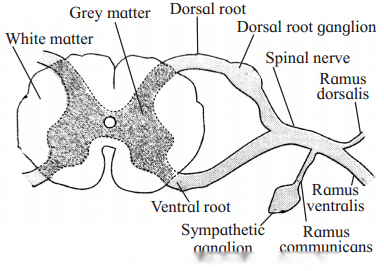
Explain the Reflex Pathway with the help of a neat labelled diagram. OR With the help of a neat and labelled diagram, describe reflex arc.
Solution & Step-by-Step Answer:
I. Reflex action : Reflex action Is defined as a quick, automatic involuntary and often unconscious action brought about when the receptors are stimulated by external or internal stimuli.

II. Reflex arc : Reflex actions are controlled by CNS. Reflex arc is the structural or functional unit of reflex action. Simple reflex arc is formed of the following five components.
(1) Receptor organ : The sensory part that receives the stimulus is called receptor organ. It can be any sense organ that receives the stimulus and converts it into the impulse, e.g. skin, eye, ear, tongue, nasal epithelium, etc.

(2) Sensory neuron or afferent neuron:
Sensory part carrying impulse from receptor organ to CNS is called sensory neuron. Its cyton is located in dorsal root ganglion. Its dendron is long and connected to receptor while the axon enters in the grey matter of spinal cord to form a synapse.

(3) Association, adjustor or intermediate neuron : It is present in the grey matter of spinal cord. Receiving impulse from sensory neuron, interpreting it and generating motor impulse are done by association neuron.
(4) Motor neuron (effector) : The cyton of motor neuron is present in the ventral horn of grey matter and axon travels through ventral root. It conducts motor impulse from spinal cord to effector organ.

(5) Effector organ : Effector organ is a specialized part of the body which is excited by receiving the motor impulse. It gives proper response to the stimulus, e.g. muscles or glands. The path of reflex action is followed by the unidirectional impulse. It originates in the receptor organ and ends in effector organ through CNS.

Question 5 Maharashtra Board Solution
Krishna was going to school and on the way he saw a major bus accident. His heartbeat increased and hands and feet become cold. Name the part of the nervous system that had a role to play in this reaction.
Solution & Step-by-Step Answer:
Question 6 Maharashtra Board Solution
What will be the effect of thyroid gland atrophy on the human body?
Solution & Step-by-Step Answer:
Question 7 Maharashtra Board Solution
Write the names of hormones and the glands secreting them for the regulation of following functions (a) Growth of thyroid and secretion of thyroxine.
Solution & Step-by-Step Answer:
TSH by adenohypophysis.

(b) Helps in relaxing pubic ligaments to facilitate easy birth of young ones.
Answer:
Relaxin by degenerating corpus luteum of the ovary.

(c) Stimulate intestinal glands to secrete intestinal juice.
Answer:
Secretin by duodenal mucosa.

(d) Controls calcium level in the blood.
Answer:
Calcitonin [hypocalcemic hormone] by thyroid and parathormone [ hypercalcemic hormone] by parathyroid glands.

(e) Controls tubular absorption of water in kidneys.
Answer:
ADH by hypothalamus.

(f) Urinary elimination of water.
Answer:
Atrial natriuretic factor by atria of heart.

(g) Sodium and potassium ion metabolism.
Answer:
Aldosterone by adrenal cortex.

(h) Basal Metabolic rate.
Answer:
T3and T4by thyroid gland.

(I) Uterine contraction.
Answer:
Oxytocin by hypothalamus.

(j) Heartbeat and blood pressure.
Answer:
Adrenaline, non-adrenaline [stimulation] and acetylcholine [inhibition] by adrenal medulla.

(k) Secretion of growth hormone.
Answer:
GHRF by hypothalamus.

(l) Maturation of Graafian follicle.
Answer:
FSH by anterior pituitary.

Question 8 Maharashtra Board Solution
Explain the role of hypothalamus and pituitary as a coordinated unit in maintaining homeostasis.
Solution & Step-by-Step Answer:

Following are the releasing and inhibiting factors produced by hypothalamus:

Question 9 Maharashtra Board Solution
What is adenohypophysis ? Name the hormones secreted by it.
Solution & Step-by-Step Answer:

It secretes following hormones:

Gonadotropins-

Question 10 Maharashtra Board Solution
Describe, in brief, an account of disorders of adrenal gland.
Solution & Step-by-Step Answer:
(1) Disorders of adrenal cortical secretions are caused due to hyposecretion and hypersecretion of adrenal corcoid hormones.

(2) Hyposecretion of corticosteroids causes Addison’s disease.

(3) The symptoms of Addison’s disease are low blood sugar, low body temperature, feeble heart action, low BR acidosis, low Na+and K+concentration in plasma, excessive loss of Na+and water in urine, impaired kidney functioning and kidney failure, etc. it leads to weight loss, general weakness, nausea, vomiting and diarrhoea.

(4) Hypersecretion of corticoids causes Cushing’s disease.

(5) The symptoms of Cushing’s disease are high blood sugar level, glucosuria, alkalosis, enhancement of total quantity of electrolytes in extracellular fluid, polydipsia, increased BR muscle paralysis, obesity, wasting of limb muscles, etc.

Question 11 Maharashtra Board Solution
Explain action of steroid hormones and proteinous hormones. OR Explain the mode of action of steroid hormones.
Solution & Step-by-Step Answer:
The hormones always act on their target organs or tissues to induce their effects. The target tissues have specific binding sites or receptor sites which contain hormone receptors. I. Steroid hormones:

II. Protein hormones:

Question 12 Maharashtra Board Solution
Describe in brief an account of disorders of the thyroid. OR What are the functional disorders of thyroid gland? Describe in brief.
Solution & Step-by-Step Answer:
Disorders of thyroid gland are of three types, viz. hypothyroidism, hyperthyroidism and simple goitre. (1) Hypothyroidism : Hypothyroidism is deficient secretion of thyroxine. This hyposecretion causes two types of disorders, viz. cretinism in children and myoxedema in adults. (i) Cretinism : Hyposecretion of thyroxine in childhood causes cretinism. The symptoms of cretinism are retardation of physical and mental growth.

(ii) Myxoedema : Deficiency of thyroxine in adults causes this disorder. It is also referred to as Gull’s disease. Symptoms are thickening and puffiness of the skin and subcutaneous tissue particularly of face and extremities. Patients with low BMR. It also causes mental dullness, loss of memory, slow action.

(2) Hyperthyroidism : Excessive secretion of thyroxine causes exophthalmic goitre or Grave’s disease. There is slight enlargement of thyroid gland. It increases BMR, heart rate, pulse rate and BE Reduction in body weight due to rapid oxidation, nervousness, irritability. Peculiar symptom is exophthalmos, i.e. bulging of eyeballs with staring look and less blinking. This is caused by deposition of fats behind the eye balls in eye sockets. There is muscular weakness and loss of weight.

(3) Simple goitre (Iodine deficiency goitre) : Simple goitre occurs due to deficiency of iodine in diet or drinking water. Simple goitre causes enlargement of thyroid gland. Thyroid gland in an attempt to get more iodine from the blood, swells due to increased blood supply. Prevention of goitre can be done by administering iodized table salt. It is also called endemic goitre as it is common in hilly areas.