Maharashtra State Board 12th Biology Solutions Chapter 8 Respiration and Circulation
1. Multiple choice questions
2. Match the columns
Respiratory surface | Organism |
(1) Plasma membrane | (a) Insect |
(2) Lungs | (b) Salamander |
(3) External gills | (c) Bird |
(4) Internal gills | (d) Amoeba |
(5) Trachea | (e) Fish |
Respiratory surface | Organism | ||||||||||||||||||||||||||||||||||||||||||||||||||||||||||||||||
(1) Plasma membrane | (d) Amoeba | ||||||||||||||||||||||||||||||||||||||||||||||||||||||||||||||||
(2) Lungs | (c) Bird | ||||||||||||||||||||||||||||||||||||||||||||||||||||||||||||||||
(3) External gills | (b) Salamander | ||||||||||||||||||||||||||||||||||||||||||||||||||||||||||||||||
(4) Internal gills | (e) Fish | ||||||||||||||||||||||||||||||||||||||||||||||||||||||||||||||||
(5) Trachea | (a) Insect 3. Very Short Answer Questions
Question 1
Maharashtra Board Solution
Why does trachea have ‘C’-shaped rings of cartilage?
Solution & Step-by-Step Answer:
Trachea is supported by ‘C’-shaped rings of J cartilage which prevent it from collapsing and always keep it open.
Question 2
Maharashtra Board Solution
Why is respiration in insect called direct respiration?
Solution & Step-by-Step Answer:
Respiration in insect is called direct because tracheal tubes exchange O2 and CO2 directly with the haemocoel which then exchange them with tissues.
Question 3
Maharashtra Board Solution
Why is gas exchange very rapid at alveolar level? OR Why does gas exchange in the alveolar region very rapid?
Solution & Step-by-Step Answer:
Gas exchange is very rapid at alveolar level because numerous alveoli (about 700 millions) in the lungs provide large surface area for gaseous exchange.
Question 4
Maharashtra Board Solution
Name the organ which prevents the entry of food into the trachea while eating.
Solution & Step-by-Step Answer:
Epiglottis prevents the entry of food into trachea while eating.
4. Short Answer Questions
Question 1
Maharashtra Board Solution
Why is it advantageous to breathe through the nose than through the mouth?
Solution & Step-by-Step Answer:
Breathing through nose is better than breathing through the mouth because of the following reasons:
Question 2
Maharashtra Board Solution
Identity the incorrect statement and correct it. (a) A respiratory surface area should have a. large surface area. (b) A respiratory surface area should be kept dry. (c) A respiratory surface area should be thin, may be 1 mm or less.
Solution & Step-by-Step Answer:
Statement (a) and statement (c) are correct whereas statement (b) is incorrect. A respiratory surface area should be kept moist, is the correct statement.
Question 3
Maharashtra Board Solution
Given below are the characteristics of some modified respiratory movement. Identify them. a. Spasmodic contraction of muscles of expiration and forceful expulsion of air through nose and mouth.
Solution & Step-by-Step Answer:
Sneezing
b. An inspiration followed by many short convulsive expiration accompanied by facial expression.
Question 4
Maharashtra Board Solution
Blood plasma.
Solution & Step-by-Step Answer:
Question 5
Maharashtra Board Solution
Blood clotting/Coagulation of blood. OR Explain blood clotting in short.
Solution & Step-by-Step Answer:
Question 6
Maharashtra Board Solution
Describe pericardium.
Solution & Step-by-Step Answer:
Question 7
Maharashtra Board Solution
Describe valves in the human heart.
Solution & Step-by-Step Answer:
Human heart has following main valves:
Question 8
Maharashtra Board Solution
What is the role of papillary muscles and chordae tendinae in human heart?
Solution & Step-by-Step Answer:
Question 9
Maharashtra Board Solution
Explain in brief the factors affecting blood pressure.
Solution & Step-by-Step Answer:
5. Give Scientific Reason
Question 1
Maharashtra Board Solution
Closed circulation is more efficient than open circulation.
Solution & Step-by-Step Answer:
Question 2
Maharashtra Board Solution
Human heart is called as myogenic and autorhythmic?
Solution & Step-by-Step Answer:
Question 3
Maharashtra Board Solution
In human heart, the blood flows only in one direction.
Solution & Step-by-Step Answer:
Question 4
Maharashtra Board Solution
Arteries are thicker than veins.
Solution & Step-by-Step Answer:
Question 5
Maharashtra Board Solution
Left ventricle is thick than all other chambers of heart. OR Left ventricle has thicker wall than the right ventricle.
Solution & Step-by-Step Answer:
6. Distinguish Between
Question 1
Maharashtra Board Solution
Open circulation and Closed circulation
Solution & Step-by-Step Answer:
Question 2
Maharashtra Board Solution
Arteries and veins.
Solution & Step-by-Step Answer:
Question 3
Maharashtra Board Solution
Blood and Lymph.
Solution & Step-by-Step Answer:
Question 4
Maharashtra Board Solution
Blood capillary and Lymph capillary.
Solution & Step-by-Step Answer:
Question 5
Maharashtra Board Solution
Intrinsic and Extrinsic process of clotting.
Solution & Step-by-Step Answer:
7. Long Answer Questions
Question 1
Maharashtra Board Solution
Smita was working in a garage with the doors closed and automobiles engine running. After some time she felt breathless and fainted. What would be the reason? How can she be treated OR While working with the car engine in a closed garage, John suddenly felt dizzy and fainted what is the possible reason?
Solution & Step-by-Step Answer:
The breathless persons can be treated by following method:
Question 2
Maharashtra Board Solution
Shreyas went to a garden on a wintry morning. When he came back, he found it difficult to breath and stated wheezing. What could be the possible condition and how can he be treated?
Solution & Step-by-Step Answer:
(1) It indicates that Shreyas might be suffering from allergic reactions. He may have come in contact with allergens such as pollen, dust, pet dander or other environmental substances on his way in the garden. Or Shreyas may be already a patient of Asthma and his symptoms may have aggrevated due to wintry climate.
(2) If a person is allergic to a substance, such as pollen, his immune system reacts to the substance as if it was foreign and harmful, and tries to destroy it. (3) The body reacts to these allergens by making and releasing substances known as IgE antibodies. These IgE antibodies attach to most cells in the body which release histamine. Histamine is the main substance responsible for pollen allergy symptoms such as difficulty in breathing, wheezing, sneezing, itchy throat, etc. (4) Treatment : There are several drugs to treat the allergic reactions:
Question 3
Maharashtra Board Solution
Why can you feel a pulse when you keep a finger on the wrist or neck but not when you keep them on a vein?
Solution & Step-by-Step Answer:
(1) When the heart contracts, it creates pressure that pushes blood out of heart. This pressure acts like a wave. This “wave” of pressure is the pulse you feel. But this pressure is not constant.
(2) When the heart pumps the blood out of it at the time of systole, there is maximum pressure in the arteries. This pressure weakens considerably when it reaches capillaries, and so the veins which are away from the heart are under less pressure. Due to low pressure veins have valves to prevent backflow of blood. (3) The pressure in the arteries can be felt every time the heart beats, especially in arteries which come to surface of the body like that of the wrist and neck but not in veins. (4) The pressure in veins is always weaker than in arteries, resulting in a weaker pulse to the point that it is undetectable by touch (5) Owing to this, when we keep finger on the arteries of wrist or neck, we feel a pulse but not when we keep it on a vein.
Question 4
Maharashtra Board Solution
A man’s pulse rate is 68 and cardiac output is 5500 cm3. Find the stroke volume.
Solution & Step-by-Step Answer:
Cardiac output is the volume of blood pumped out per min for a normal adult human being it is calculated as follows: Cardiac output = Heart rate × Stroke volume Given : Cardiac output = 5500 cm³ Pulse rate = Heart rate = 68 By using these values stroke volume of is calculated as follows: ∴ Cardiac output = Heart rate × Stroke volume ∴ Stroke volume = Cardiac output/Heart rate = 5500/68 = Approx. 80. ∴ Stroke volume is 80 ml.
Question 5
Maharashtra Board Solution
Which blood vessel leaving from the heart will have the maximum content of oxygen and why?
Solution & Step-by-Step Answer:
Question 6
Maharashtra Board Solution
If the duration of the atrial ‘systole is 0.1 second and that of complete diastole is 0.4 second, then how does one cardiac cycle complete in 0.8 second?
Solution & Step-by-Step Answer:
Question 7
Maharashtra Board Solution
How is blood kept moving in the large veins of the legs?
Solution & Step-by-Step Answer:
1. When heart undergoes systole, it pushes the blood with pressure in aorta. This pressure moves the entire circulation of the blood throughout the body. Aorta gives rise to dorsal aorta after supplying to upper parts of body. Then it divides into two arteries which enter two legs. The blood is forced to move in the legs due to blood pressure and also aided by gravity.
2. In addition, the muscles in legs help transport blood back to our heart. As the muscles of our body contract and relax to move our limbs, they squeeze the blood in veins and the blood is then pushed towards the heart. 3. The veins in legs also have valves to keep this process going and prevent blood from flowing back down towards the feet. 4. In this way blood is kept moving in the large veins of the legs.
Question 8
Maharashtra Board Solution
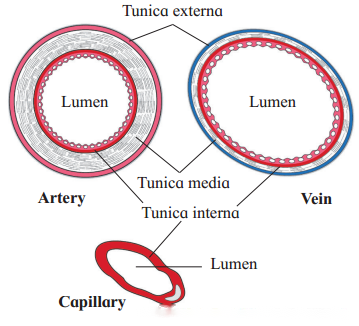
Describe histological structure of artery, vein and capillary.
Solution & Step-by-Step Answer:
Histological structure of artery and vein.
Histology of Capillaries:
Question 9
Maharashtra Board Solution
What is blood pressure? How is it measured? Explain factors affecting blood pressure.
Solution & Step-by-Step Answer:
1. Blood pressure:
2. Measurement of blood pressure: 3. Factors affecting blood pressure:
Question 10
Maharashtra Board Solution
Describe human blood and give its functions.
Solution & Step-by-Step Answer:
Blood Composition:
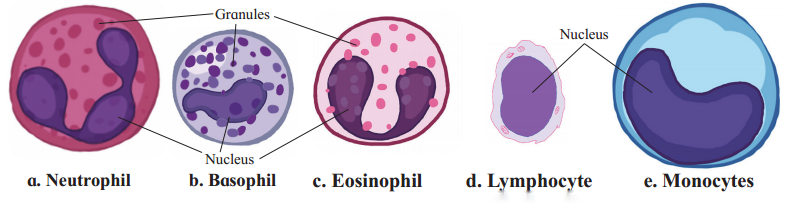
(5) Red blood corpuscles or Erythrocytes: Functions of RBCs: (6) White blood corpuscles / Leucocytes:
2. Their size ranges between 8 to 15 pm. Total WBC count is 5000 to 9000 WBCs/cu mm of blood. The average life span of a WBC is about 3 to 4 days. 3. They are formed by leucopoiesis in red bone marrow, spleen, lymph nodes, tonsils, thymus and Payer’s patches, whereas the dead WBCs are destroyed by phagocytosis in blood, liver and lymph nodes. 4. Leucocytes are mainly divided into two types, viz., granulocytes and agranulocytes. 5. Granulocytes : Granulocytes are cells with granular cytoplasm and lobed nucleus. Based on their staining properties and shape of nucleus, they are of three types, viz. neutrophils, eosinophils and basophils. (I) Neutrophils: (II) Eosinophils or acidophils: (III) Basophils: 6. Agranulocytes : There are two types of agranulocytes, viz. monocytes and lymphocytes. Agranulocytes do not show cytoplasmic granules and their nucleus is not lobed. They are of two types, viz. lymphocytes and monocytes. (II) Monocytes: (7) Thrombocytes/Platelets: (8) Functions of blood: |