Maharashtra State Board 12th Biology Solutions Chapter 7 Plant Growth and Mineral Nutrition
1. Multiple choice questions
Solution & Step-by-Step Answer:
(c) Gibberellins
Solution & Step-by-Step Answer:
(c) Xylem
Solution & Step-by-Step Answer:
(b) leaf fall and dormancy
Solution & Step-by-Step Answer:
(b) Ethylene
Solution & Step-by-Step Answer:
(b) Definite photoperiod
Solution & Step-by-Step Answer:
(b) dark/night
Solution & Step-by-Step Answer:
(d) Soybean
Solution & Step-by-Step Answer:
(c) obtained from soil
Solution & Step-by-Step Answer:
(b) biosynthesis of 3-LAA
Solution & Step-by-Step Answer:
(b) death of tissue
Solution & Step-by-Step Answer:
(d) denitrification
Solution & Step-by-Step Answer:
(d) 16
2. Very short answer questions
Solution & Step-by-Step Answer:
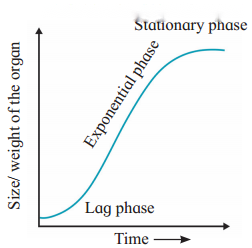
The three phases of growth are phase of cell division, phase of cell enlargement and phase of cell maturation.
Solution & Step-by-Step Answer:
Full form is Indole Acetic Acid.
Solution & Step-by-Step Answer:
In plants the growth is indeterminate and takes place throughout the life at specific regions having meristems.
Solution & Step-by-Step Answer:
Abscissic acid.
Solution & Step-by-Step Answer:
Anaerobic bacteria can convert nitrates of soil back into nitrogen gas. That process performed by denitrifying bacteria is denitrification.
Solution & Step-by-Step Answer:
Nitrobacter.
Solution & Step-by-Step Answer:
In rosette plants like beet and cabbage, bolting, i.e. elongation of internodes before flowering is observed due to effect of gibberellins.
Solution & Step-by-Step Answer:
The response of plant to the influence of low temperature on flowering in plants is called vernalization.
Solution & Step-by-Step Answer:
The response of plant to the influence of light for initiation of flowering is known as photoperiodism.
Solution & Step-by-Step Answer:
There are three phases of growth and the total time required for all phases to occur is called grand period of growth.
3. Short Answer Questions
Solution & Step-by-Step Answer:
(ii) Redifferentiation
Answer:
Solution & Step-by-Step Answer:
Arithmetic growth | Geometric growth |
1. In arithmetic growth only one daughter cell continues to divide, while the other undergoes differentiation and maturation. | 1. In geometric growth both the daughter cells continue to divide and redivide again and again. |
2. Rate of growth is constant. | 2 Rate growth is initially slow but later on rapid rate. |
3. Linear curve is obtained. | 3. Exponential curve is obtained. |
4. Mathematical expression is
Lt= Lo + rt whereLt= length of time ‘t’
Lo= Length at time zero
rt= growth rate, t = time of growth | 4. Mathematical expression is
Wt= Woe rtwhere,
Wt= final size,
Wo = initial size, r = growth rate, t = time of growth E = base of natural logarithm |
5. e.g. Elongation of root | 5. e.g. Divisions of zygote during embryo development. |
Solution & Step-by-Step Answer:
(a) Nitrogen: Role : Constituent of proteins as amino acids, nucleic acids, vitamins, hormones, coenzymes, ATP and chlorophyll molecule. Deficiency symptoms : stunted growth and chlorosis.
(b) Phosphorus:
Role : Constituent of cell membrane, certain proteins, nucleic acids and nucleotides, required for all phosphorylation reactions.
Deficiency symptoms : Poor growth, leaves dull green
(c) Potassium :
Role : Determination of anion – cation balance in cell, necessary for protein synthesis, involved in formation of cell membrane, opening and closing of stomata, activates enzymes, helps in maintenance of turgidity of cells.
Deficiency symptom : Yellow edges in leaves, premature death.
Solution & Step-by-Step Answer:
The plants which flower when the day length or light period is shorter than the critical photoperiod are called short day plants or SDP SDPs usually flower during winter and late summer. Examples – Dahlia, Aster, Tobacco, Chrysanthemum, Soybean (Glycine max) and Cocklebur (Xanthium).
Solution & Step-by-Step Answer:
A low temperature or chilling treatment that induces early flowering in plants is known as vernalization.
Significance:
4. Long answer questions
Solution & Step-by-Step Answer:
Solution & Step-by-Step Answer:
1. Short day plants : Plants that flower under short day length conditions are called short day plants. Plants such as Dahlia, Xanthium, Soybean, Aster, Tobacco and Chrysanthemum are short day plants or SDR. Short day plants require a long uninterrupted dark period for flowering. Therefore, they are also called long night plants.
2. Long day plants : Plants that flower only when they are exposed to light period longer than their critical photoperiod are called long day plants or LDP Long day plants require a short dark or night period for flowering. Hence, they are also called short night plants. Plants such as radish, spinach, wheat, poppy, cabbage, pea, sugar beet, etc. are long day plants.
3. Day neutral plants : Plants in which the flowering is not affected by the day length period are called day neutral plants or DNP or photoneutral plants. Plants such as cucumber, sunflower, cotton, balsam, maize, tomato, etc. are day neutral plants.
Solution & Step-by-Step Answer:
Solution & Step-by-Step Answer: