Maharashtra State Board 11th Maths Solutions Chapter 9 Probability Ex 9.2
Solution & Step-by-Step Answer:
When a 6 faced die and a 5 faced die are thrown, the sample space is S = {(1, 1), (1, 2), (1, 3), (1, 4), (1, 5), (2, 1), (2, 2), (2, 3), (2, 4), (2, 5), (3, 1), (3, 2), (3, 3), (3, 4), (3, 5), (4, 1), (4, 2), (4, 3), (4,4), (4, 5), (5, 1), (5, 2), (5, 3), (5, 4), (5, 5), (6, 1), (6, 2), (6, 3), (6, 4), (6, 5)} ∴ n(S) = 30 Let event A: The sum of the numbers on the upper faces of the dice is divisible by 2. A = {(1, 1), (1, 3), (1, 5), (2, 2), (2, 4), (3, 1), (3, 3), (3, 5), (4, 2), (4, 4), (5, 1), (5, 3), (5, 5), (6, 2), (6, 4)} ∴ n(A) = 15 ∴ P(A) = Let event B: Sum of the numbers on the upper faces of the dice is divisible by 3. B = {(1, 2), (1, 5), (2, 1), (2, 4), (3, 3), (4, 2), (4, 5), (5, 1), (5, 4), (6, 3)} ∴ n(B) = 10 ∴ P(B) = Now, A ∩ B = {(1, 5), (2,4), (3, 3), (4, 2), (5, 1)} ∴ n(A ∩ B) = 5 ∴ P(A ∩ B) = ∴ Required probability P(A ∪ B) = P(A) + P(B) – P(A ∩ B) = = =
Solution & Step-by-Step Answer:
One card can be drawn from the pack of 52 cards in = 52 ways. ∴ n(S) = 52 The pack of 52 cards consists of 26 red and 26 black cards. (i) Let event A: A red card is drawn. ∴ Red card can be drawn in = 26ways ∴ n(A) = 26 ∴ P(A) = Let event B: A black card is drawn. ∴ Black card can be drawn in = 26 ways. ∴ n(B) = 26 ∴ P(B) = Since A and B are mutually exclusive events, P(A ∩ B) = 0 ∴ Required probability P(A ∪ B) = P(A) + P(B) = = 1
(ii) Let event A: A black card is drawn.
∴ Black card can be drawn in = 26 ways.
n(A) = 26
n(A) 26 n(S) ~ 52
Let event B: A face card is drawn.
There are 12 face cards in the pack of 52 cards.
∴ 1 face card can be drawn in = 12 ways.
∴ n(B) = 12
∴ P(B) =
There are 6 black face cards.
∴ n(A ∩ B) = 6
∴ P(A ∩ B) =
∴ Required probability
P(A ∪ B) = P(A) + P(B) – P(A ∩ B)
=
=
=
Solution & Step-by-Step Answer:
Let event A: The girl cracks the National Level exam. ∴ P(A) = 0.42 Let event B: The girl cracks the State Level exam. ∴ P(B) = 0.54 Also, P(A ∩ B) = 0.11 (i) P(the girl cracks at least one of the two exams) P(A ∪ B) = P(A) + P(B) – P(A ∩ B) = 0.42 + 0.54 – 0.11 = 0.85
(ii) P(the girl cracks only one of the two exams)
= P(A) – P(B) – 2P(A ∩ B)
= 0.42 + 0.54 – 2(0.11)
= 0.74
(iii) P(the girl cracks none of the exams)
= P(A’ ∩ B’)
= P(A ∪ B)’
= 1 – P(A ∪ B)
= 1 – 0.85
= 0.15
Solution & Step-by-Step Answer:
Out of the 75 tickets, one ticket can be drawn in = 75 ways. ∴ n(S) = 75 (i) Let event A: The number on the ticket is a perfect square. ∴ A = {1, 4, 9, 16, 25, 36, 49, 64} ∴ n(A) = 8 ∴ P(A) = Let event B: The number on the ticket is divisible by 4. ∴ B = {4, 8, 12, 16, 20, 24, 28, 32, 36, 40, 44, 48, 52, 56, 60, 64, 68, 72} ∴ n(B) = 18 ∴ P(B) = Now, A ∩ B = {4, 16, 36, 64} ∴ n(A ∩ B) = 4 ∴ P(A ∩ B) = ∴ Required probability P(A ∪ B) = P(A) + P(B) – P(A ∩ B) = =
(ii) Let event A: The number on the ticket is a prime number.
∴ A = {2, 3, 5, 7, 11, 13, 17, 19, 23, 29, 31, 37, 41, 43, 47, 53, 59, 61, 67, 71, 73}
∴ n(A) = 21
∴ P(A) =
Let event B: The number is greater than 40.
∴ B = {41, 42, 43, 44, 45, 46, 47, 48, 49, 50, 51, 52, 53, 54, 55, 56, 57, 58, 59, 60, 61, 62, 63, 64, 65, 66, 67, 68, 69, 70, 71, 72, 73, 74, 75}
∴ n(B) = 35
∴ P(B) =
Now,
A ∩ B = {41, 43, 47, 53, 59, 61, 67, 71, 73}
∴ n(A ∩ B) = 9
∴ n(A ∩ B) =
∴ Required probability
P(A ∪ B) = P(A) + P(B) – P(A ∩ B)
=
=
Solution & Step-by-Step Answer:
Let event A: The student will pass in French. ∴ P(A) = 0.64 Let event B: The student will pass in Sociology. ∴ P(B) = 0.45 Also, P(A ∩ B) = 0.40 ∴ Required probability P(A ∪ B) = P(A) + P(B) – P(A ∩ B) = 0.64 + 0.45 – 0.40 = 0.69
Solution & Step-by-Step Answer:
When two dice are thrown, the sample space is S = {(1, 1), (1, 2), (1, 3), (1, 4), (1, 5), (1, 6), (2, 1), (2, 2), (2, 3), (2, 4), (2, 5), (2, 6), (3, 1), (3, 2), (3, 3), (3, 4), (3, 5), (3, 6), (4, 1), (4, 2), (4, 3), (4, 4), (4, 5), (4, 6), (5, 1), (5, 2), (5, 3), (5, 4), (5, 5), (5, 6), (6, 1), (6, 2), (6, 3), (6, 4), (6, 5), (6, 6)} ∴ n(S) = 36 Let event A: The number on the upper face of the first die is 3. ∴ A = {(3, 1), (3, 2), (3, 3), (3, 4), (3, 5), (3, 6)} ∴ n(A) = 6 ∴ P(A) = Let event B: Sum of the numbers on their upper faces is 6. ∴ B = {(1, 5), (2, 4), (3, 3), (4, 2), (5, 1)} ∴ n(B) = 5 ∴ P(B) = Now, A ∩ B = {(3, 3)} ∴ n(A ∩ B) = 1 ∴ P(A ∩ B) = ∴ Required probability P(A ∪ B) = P(A) + P(B) – P(A ∩ B) = = =
Solution & Step-by-Step Answer:
Here, P(A) = , P(B) = , P(A ∪ B) = (a) P(A ∪ B) = P(A) + P(B) – P(A ∩ B) ∴ P(A ∩ B) = P(A) + P(B) – P(A ∪ B) = =
(b) P(A’ ∩ B’) = P(A ∪ B)’
= 1 – P(A ∪ B)
= 1 –
=
(c) P(A’ ∪ B’) = P(A ∩ B)’
= 1 – P(A ∩ B)
= 1 –
=
Solution & Step-by-Step Answer:
Here, P(A ∪ B) = , P(A ∩ B) = , P(B’) = P(B) = 1 – P(B’) = 1 – = Since P(A ∪ B) = P(A) + P(B) – P(A ∩ B) = P(A) + ∴ = P(A) + ∴ P(A) = =
Solution & Step-by-Step Answer:
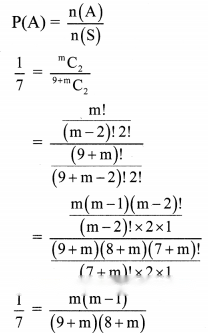
Total number of balls in the bag = 5 + 4 + m = 9 + m Two balls are selected from (9 + m) balls in ways. ∴ n(S) = Let event A: The two balls selected are green. ∴ 2 balls can be selected from m balls in ways. ∴ n(A) = (9 + m)(8 + m) = 7m(m – 1) 72 + 9m + 8m + m2 = 7m2 – 7m 6m2 – 24m – 72 = 0 m2 – 4m – 12 = 0 (m – 6)(m + 2) = 0 m = 6 or m = -2 Since number of balls cannot be negative, m ≠ -2 ∴ m = 6
Solution & Step-by-Step Answer:
The group consists of 4 men, 4 women and 3 children, i.e., 4 + 4 + 3 = 11 persons. 4 persons are to be selected from this group. ∴ 4 persons can be selected from 11 persons in ways. ∴ n(S) = (i) Let event A: No child is selected. ∴ 4 persons can be selected from 4 men and 4 women, i.e., from 8 persons in ways. ∴ n(A) =
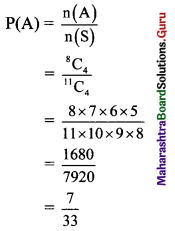
(ii) Let event B: Exactly 2 men are selected.
∴ 2 men are selected from 4 men in ways, and remaining 2 persons are selected from 7 persons (i.e., 4 women and 3 children) in ways.

Solution & Step-by-Step Answer:
One number can be drawn at random from the numbers 1 to 50 in = 50 ways. ∴ n(S) = 50 Let event A: The number drawn is divisible by 2. ∴ A = {2, 4, 6, 8, 10, …, 48, 50} ∴ n(A) = 25 ∴ P(A) = Let event B: The number drawn is divisible by 3. B = {3, 6, 9, 12, …, 48} ∴ n(B) = 16 ∴ P(B) = Let event C: The number drawn is divisible by 10. C = {10, 20, 30, 40, 50} ∴ n(C) = 5 ∴ P(C) = Now, A ∩ B = {6, 12, 18, 24, 30, 36, 42, 48} ∴ n(A ∩ B) = 8 ∴ P(A ∩ B) = B ∩ C = {30} ∴ n(B ∩ C) = 1 ∴ P(B ∩ C) = A ∩ C = {10, 20, 30, 40, 50} ∴ n(A ∩ C) = 5 ∴ P(A ∩ C) = A ∩ B ∩ C = {30} ∴ n(A ∩ B ∩ C) = 1 ∴ P(A ∩ B ∩C) = ∴ P(the number is divisible by 2 or 3 or 10) P(A ∪ B ∪ C) = P(A) + P(B) + P(C) – P(A ∩ B) – P(B ∩ C) – P(A ∩ C) + P(A ∩ B ∩ C) = =