Maharashtra State Board 11th Maths Solutions Chapter 9 Probability Ex 9.3
Solution & Step-by-Step Answer:
Total number of marbles = 3 + 4 = 7 Let event A: The first marble drawn is red. ∴ P(A) = Let event B: The second marble drawn is blue. Since the first red marble is not replaced in the bag, we now have 6 marbles out of which 4 are blue. ∴ Probability that the second marble is blue under the condition that the first red marble is not replaced in the bag = P(B/A) = ∴ Required probability = P(A ∩ B) = P(B/A). P(A) = =
Alternate Method:
Total number of marbles = 3 + 4 = 7
Two marbles are drawn at random without replacement.
∴ n(S) = = 7 × 6 = 42
Let event A: The first marble is red and second marble is blue.
First red marble can be drawn from 3 red marbles in ways and second blue marble can be drawn from 4 blue marbles in ways.
∴ n(A) = = 3 × 4 = 12
∴ P(A) =
Solution & Step-by-Step Answer:
Total number of pencils = 5 + 7 = 12 Let event A: The first pencil chosen is yellow. ∴ P(A) = Let event B: The second pencil chosen is yellow. Since the first yellow pencil is not replaced in the box, we now have 11 pencils, out of which 6 are yellow. ∴ Probability that the second pencil is yellow under the condition that the first yellow pencil is not replaced in the box = P(B/A) = = Required probability = P(A ∩ B) = P(B/A). P(A) = =
Solution & Step-by-Step Answer:
One vehicle is selected from 40 vehicles. Let event A: The selected vehicle is red. There are total of 18 red vehicles. ∴ P(A) = Let event B: The selected vehicle is a truck. There are total of 6 trucks. Since 2 trucks are red, they are common between A and B. ∴ P(A ∩ B) = ∴ Probability that the selected vehicle is a truck under the condition that it is red = P(B/A) = = =
Solution & Step-by-Step Answer:
In a pack of 52 cards, there are 13 diamond cards. Let event A: The first card drawn is a diamond card. ∴ P(A) = (i) Let event B: The second card drawn is a diamond card. Since the first diamond card is kept aside, we now have 51 cards, out of which 12 are diamond cards. Probability that the second card is a diamond card under the condition that the first diamond card is kept aside in the pack = P(B/A) = ∴ Required probability = P(A ∩ B) = P(B/A). P(A) = =
(ii) Let event B: The second card drawn is a diamond card.
Since the first diamond card is replaced in the pack, we now again have 52 cards, out of which 13 are diamond cards.
∴ Probability that the second card is a diamond card under the condition that the first diamond card is replaced in the pack = P(B/A) =
Required probability = P(A ∩ B)
= P(B/A). P(A)
=
=
Solution & Step-by-Step Answer:
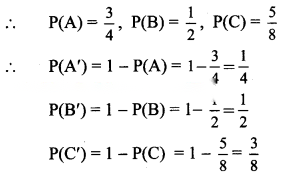
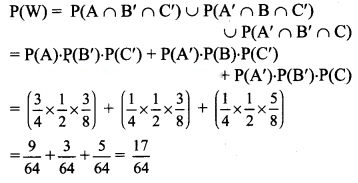
Let event A: A can hit the target, event B: B can hit the target, event C: C can hit the target. Since A, B, C are independent events, A’, B’, C’ are also independent events. (a) Let event W: Target is hit exactly by one of them.
(b) Let event X: Target is not hit by any one of them.
∴ P(X) = P(A’ ∩ B’ ∩ C’)
= P(A’) P(B’) P(C’)
=
=
(c) Let event Y: Target is hit.
∴ P(Y) = 1 – P(target is not hit by any one of them)
= 1 –
=
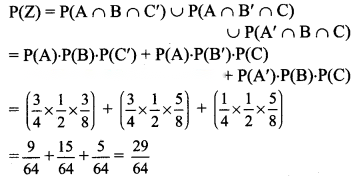
(d) Let event Z: Target is hit by exactly two of them.
Solution & Step-by-Step Answer:
Let event A: Student X solves the problem in dynamics, event B: Student Y solves the problem in dynamics. ∴ P(A) = , P(B) = ∴ P(A’) = 1 – P(A) = 1 – = P(B’) = 1 – P(B) = 1 – = Since A and B are independent events, A’ and B’ are also independent events. (i) Let event C: Problem is not solved. ∴ P(C) = P(A’ ∩ B’) = P(A’). P(B’) = =
(ii) Let event D: Problem is solved.
Problem can be solved if at least one of the two students solves the problem.
∴ P(D) = P(at least one student solves the problem)
= 1 – P(no student solves the problem)
= 1 – P(A’ ∩ B’)
= 1 – P(A’) P(B’)
= 1 –
= 1 –
=
(iii) Let event E: The problem is solved exactly by one of them.
∴ P(E) = P(A’ ∩ B) ∪ P(A ∩ B’)
= P(A’). P(B) + P(A). P(B’)
=
=
=
Solution & Step-by-Step Answer:
Let event A : A speaks the truth, event B : B speaks the truth. ∴ P(A) = and P(B) = P(A’) = 1 – P(A) = 1 – = and P(B’) = 1 – P(B) = 1 – = ∴ P(A and B contradict each other) = P(A speaks the truth and B lies) + P (A lies and B speaks the truth) = P(A ∩ B’) + P(A’ ∩ B) = P(A) P(B’) + P(A’) P(B) = = =
Solution & Step-by-Step Answer:
(a) Let event A: The patient was satisfied, event B: The patient had throat surgery. Given, n(S) = 200 n(A ∩ B) = 70 ∴ P(A ∩ B) = n(B) = 95 ∴ P(B) = ∴ Required probability = P(A / B) = = = =
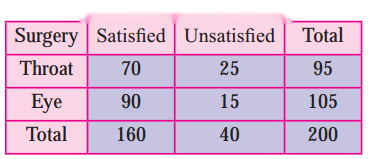
Check:
Reduce the sample space to the set of throat patients only.
n(S) = 95
Let E : Patient had satisfactory throat surgery.
n(E) = 70
∴ P(E) =
(b) Let event C : The patient was unsatisfied,
event D : The patient had a eye surgery.
Given, n(S) = 200
n(C ∩ D) = 15
∴ P(C ∩ D) =
n(D) = 105
∴ P(D) =
Required probability = P(C / D)
=
=
=
(c) Let event F : The patient had a throat surgery,
event G : The patient was unsatisfied.
Given, n(S) = 200
n(F ∩ G) = 25
∴ P(F ∩ G) =
n(G) = 40
∴ P(G) =
∴ Required probability = P(F / G)
=
=
=
Solution & Step-by-Step Answer:
When two dice are thrown, the sample space is S = {(1, 1), (1, 2), (1, 3), (1, 4), (1, 5), (1, 6), (2, 1), (2, 2), (2, 3), (2, 4), (2, 5), (2, 6), (3, 1), (3, 2), (3, 3), (3, 4), (3, 5), (3, 6), (4, 1), (4, 2), (4, 3), (4, 4), (4, 5), (4, 6), (5, 1), (5, 2), (5, 3), (5, 4), (5, 5), (5, 6), (6, 1), (6, 2), (6, 3), (6, 4), (6, 5), (6, 6)} ∴ n(S) = 36 Let event A: Getting 6 on the first die. ∴ A = {(6, 1), (6, 2), (6, 3), (6, 4), (6, 5), (6, 6)} ∴ n(A) = 6 ∴ P(A) = Let event B : Gettting 2 on the second die. ∴ B = {(1, 2), (2, 2), (3, 2), (4, 2), (5, 2), (6, 2)} ∴ n(B) = 6 ∴ P(B) = Now, A ∩ B = {(6, 2)} ∴ n(A ∩ B) = 1 ∴ P(A ∩ B) = …..(i) P(A) × P(B) = ……..(ii) From (i) and (ii), we get P(A ∩ B) = P(A) × P(B) ∴ A and B are independent events.
Solution & Step-by-Step Answer:
Let event A: The man will be alive till 70. ∴ P(A) = Let event B: The wife will be alive till 65. ∴ P(B) = ∴ P(A’) = 1 – P(A) = 1 – = P(B’) = 1 – P(B) = 1 – = Since A and B are independent events, A’ and B’ are also independent events. (a) Let event C : Both man and his wife will be alive. ∴ P(C) = P(A ∩ B) = P(A). P(B) = =
(b) Let event D: Exactly one of them will be alive.
∴ P(D) = P(A’ ∩ B) + P(A ∩ B’)
= P(A’). P(B) + P(A). P(B’)
=
=
=
(c) Let event E: None of them will be alive.
∴ P(E) = P(A’ ∩ B’) = P(A’). P(B’)
=
=
(d) Let event F: At least one of them will be alive.
∴ P(F) = 1 – P(none of them will be alive)
= 1 –
=
Solution & Step-by-Step Answer:
Total number of balls = 10 + 15 = 25 (a) Let event A: First ball drawn is red. ∴ P(A) = Let event B: Second ball drawn is green. Since the first red ball is not replaced in the box, we now have 24 balls, out of which 15 are green. ∴ Probability that the second ball is green under the condition that the first red ball is not replaced in the box = P(B/A) = ∴ Required probability = P(A ∩ B) = P(B/A). P(A) = =
(b) To find the probability that one ball is red and the other is green, there are two possibilities:
First ball is red and second ball is green.
OR
The first ball is the green and the second ball is red.
From above, we get
P(First ball is red and second ball is green) =
Similarly,
P(First ball is green and second ball is red) =
∴ Required probability = P(First ball is red and second ball is green) + P(First ball is green and second ball is red)
= +
=
Solution & Step-by-Step Answer:
(a) Let event A: A yellow ball is drawn from each bag. Probability of drawing one yellow ball from total 8 balls of first bag and that of drawing one yellow ball out of total 10 balls of second bag is P(A) = = Let event B: A brown ball is drawn from each bag. Probability of drawing one brown ball out of total 8 balls of first bag and that of drawing one brown ball out of total 10 balls of second bag is P(B) = = Since both the events are mutually exclusive events, P(A ∩ B) = 0 ∴ P(both the balls are of the same colour) = P(both are of yellow colour) or P(both are of brown colour) = P(A) + P(B) = =
(b) P(both the balls are of different colour) = 1 – P(both the balls are of the same colour)
= 1 –
=
Solution & Step-by-Step Answer:
Total number of balls in the um = 4 + 5 + 6 = 15 Two balls are drawn from 15 balls without replacement. ∴ n(S) = = 15 × 14 = 210 Let event A: At least one ball is black. i.e., the first ball is black, and the second ball is non-black or the first ball is non-black and the second ball is black, or both the first and second balls are black. ∴ n(A) = = 4 × 11 + 11 × 4 + 4 × 3 = 100 ∴ P(A) = =
Check:
Required probability = 1 – P(no black ball in two balls)
= 1 –
Solution & Step-by-Step Answer:
When three fair coins are tossed, the sample space is S = {HHH, HHT, HTH, HTT, THH, THT, TTH, TTT} ∴ n(S) = 8 Let event A: Getting three heads. ∴ A = {HHH} Let event B: Getting at least two heads. ∴ B = {HHT, HTH, THH, HHH} ∴ n(B) = 4 ∴ P(B) = Now, A ∩ B = {HHH} ∴ n(A ∩ B) = 1 ∴ P(A ∩ B) = ∴ Probability of getting three heads, given that at least two coins show heads, is given by P(A/B) = = =
Solution & Step-by-Step Answer:
In a pack of52 cards, there are 12 face cards. Let event A: The first card drawn is a face card. ∴ P(A) = Let event B: The second card drawn is a face card. Since the first card is not replaced in the pack, we now have 51 cards, out of which 11 are face cards. ∴ Probability that the second card is a face card under the condition that the first card is not replaced in the pack = P(B/A) = ∴ Required probability = P(A ∩ B) = P(B/A). P(A) = =
Solution & Step-by-Step Answer:
Let event C1: The first ball drawn is red and from bag A, event D1: The first ball drawn is white and from bag A, event E1: The first ball drawn is red and from bag B, event F1: The first ball drawn is white and from bag B, event C2: Second ball drawn is red and from bag B, event D2: Second ball drawn is white and from bag B, event E2: Second ball drawn is red and from bag A, event F2: Second ball drawn is white and from bag A, event G: Selecting bag A in the first place, event H: Selecting bag B in the first place. P(G) = P(H) = Let event X: Both the balls drawn are of same colour. ∴ P(X) = P(G) × P (X/G) + P(H) × P(X/H) …….(i) If bag A is selected in first place, then In bag A, we have 5 balls, out of which 3 are red. Probability of getting first red ball from bag A = P(C1) = Since first red ball is put into the bag B, we now have 8 balls in bag B, out of which 3 are red. ∴ Probability of getting second red ball from bag B. P(C2/C1) = Similarly, probability of getting first white ball from bag A = P(D1) = and probability of getting second white ball form bag B = P(D2/D1) = ∴ P(X/G) = P(C1) P(C2/C1) + P(D1) P(D2/D1) = = …..(ii) Similarly, P(X/H) = P(E1) P(E2/E1) + P(F1) P(F2/F1) = = ………(iii) From (i), (ii), (iii), Required probability = = =
Solution & Step-by-Step Answer:
Let, event A: The first ball drawn is white event B: Second ball drawn is white. P(A) = After drawing the first ball, without replacing it into the bag a second ball is drawn from the remaining 7 balls. ∴ P(B/A) = ∴ P(Both balls are white) = P(A ∩ B) = P(A). P(B/A) = × =
Solution & Step-by-Step Answer:
A family has two children. ∴ Sample space S = {BB, BG, GB, GG} ∴ n(S) = 4 Let event A: At least one of the children is a girl. ∴ A = {GG, GB, BG} ∴ n(A) = 3 ∴ P(A) = Let event B: Both children are girls. ∴ B = {GG} ∴ n(B) = 1 ∴ P(B) = Also, A ∩ B = B ∴ P(A ∩ B) = P(B) = ∴ Required probability = P(B/A) = = =