Maharashtra State Board 11th Maths Solutions Chapter 9 Probability Ex 9.1
(b) B : Two pens of the same colour are not selected.
B = {RG, RB, RP, GR, GB, GP, BR, BG, BP, PR, PG, PB}
(b) B : Getting a prime number.
∴ B = {(H, 2), (H, 3), (H, 5), (T, 2), (T, 3), (T, 5)}
(c) C : Getting a head and a perfect square.
∴ C = {(H, 1), (H, 4)}
(b) 5 letters have to be placed in 5 envelopes in such a way that no envelope is empty.
∴ The first letter can be placed into 5 envelopes in 5 different ways, the second letter in 4 ways.
Similarly, the third, fourth and fifth letters can be placed in 3 ways, 2 ways and 1 way, respectively.
∴ Total number of ways = 5!
= 5 × 4 × 3 × 2 × 1
= 120
∴ n(S) = 120
(c) 6 books can be arranged on a shelf in = 6! ways.
∴ n(S) = 6! = 6 × 5 × 4 × 3 × 2 × 1 = 720
(d) 3 tickets are drawn at random from 20 tickets.
∴ 3 tickets can be selected in ways.
∴ n(S) = = 1140
(b) B: Sum of the numbers on two dice is 7.
∴ B = {(1, 6), (2, 5), (3, 4), (4, 3), (5, 2), (6, 1)}
(c) C: Odd number on the first die.
∴ C = {(1, 1), (1, 2), (1, 3), (1, 4), (1, 5), (1, 6), (3, 1), (3, 2), (3, 3), (3, 4), (3, 5), (3, 6), (5, 1), (5, 2), (5, 3), (5, 4), (5, 5), (5, 6)}
(d) D: Even number on the first die.
∴ D = {(2, 1), (2, 2), (2, 3), (2, 4), (2, 5), (2, 6), (4, 1), (4, 2), (4, 3), (4, 4), (4, 5), (4, 6), (6, 1), (6, 2), (6, 3), (6, 4), (6, 5), (6, 6)}
(e) A and B are mutually exclusive events as A ∩ B = Φ.
A ∪ B = {(1, 2), (1, 3), (1, 5), (1, 6), (2, 1), (2, 2), (2, 4), (2, 5), (2, 6), (3, 1), (3, 3), (3, 4), (3, 5), (3, 6), (4, 2), (4, 3), (4, 4), (4, 5), (5, 1), (5, 2), (5, 3), (5, 4), (6, 1), (6, 2), (6, 3), (6, 6)} ≠ S
∴ A and B are not exhaustive events as A ∪ B ≠ S.
(f) C and D are mutually exclusive events as C ∩ D = Φ.
C ∪ D = {(1, 1), (1, 2), (1, 3), (1, 4), (1, 5), (1, 6), (2, 1), (2, 2), (2, 3), (2, 4), (2, 5), (2, 6), (3, 1), (3, 2), (3, 3), (3, 4), (3, 5), (3, 6), (4, 1), (4, 2), (4, 3), (4, 4), (4, 5), (4, 6), (5, 1), (5, 2), (5, 3), (5, 4), (5, 5), (5, 6), (6, 1), (6, 2), (6, 3), (6, 4), (6, 5), (6, 6)} = S
∴ C and D are exhaustive events.
(b) If the two cards are drawn without replacement, then the sample space is
S = {(5, 6), (5, 7), (5, 8), (6, 5), (6, 7), (6, 8), (7, 5), (7, 6), (7, 8), (8, 5), (8, 6), (8, 7)}
(b) Let event B: Sum of the numbers on uppermost face is at least 8 (i.e., 8 or more than 8)
∴ B = {(2, 6), (3, 5), (3, 6), (4, 4), (4, 5), (4, 6), (5, 3), (5, 4), (5, 5), (5, 6), (6, 2), (6, 3), (6, 4), (6, 5), (6, 6)}
∴ n(B) = 15
∴ P(B) =
(c) Let event C: First throw gives a multiple of 2 and second throw gives a multiple of 3.
∴ C = {(2, 3), (2, 6), (4, 3), (4, 6), (6, 3), (6, 6)}
∴ n(C) = 6
∴ P(C) =
(d) Let event D: The product of the numbers on uppermost face is 12.
∴ D = {(2, 6), (3, 4), (4, 3), (6, 2)}
∴ n(D) = 4
∴ P(D) =
(a) Let event A: Out of the two cards drawn, one is a face card and the other is an ace card.
There are 12 face cards and 4 ace cards in a pack of 52 cards.
∴ One face card can be drawn from 12 face cards in ways and one ace card can be drawn from 4 ace cards in ways.
∴ n(A) =
∴ P(A) =
(b) Let event B: Out of the two cards drawn, one is club and the other is a diamond card.
There are 13 club cards and 13 diamond cards.
∴ One club card can be drawn from 13 club cards in ways and one diamond card can be drawn from 13 diamond cards in ways.
∴ n(B) =
∴ P(B) =
(c) Let event C: Both the cards drawn are of the same suit.
A pack of 52 cards consists of 4 suits each containing 13 cards.
∴ 2 cards can be drawn from the same suit in ways.
∴ n(C) =
∴ P(C) =
(d) Let event D: Both the cards drawn are red.
There are 26 red cards in the pack of 52 cards.
∴ 2 cards can be drawn from them in ways.
∴ n(D) =
∴ P(D) =
(e) Let event E: Out of the two cards drawn, one is heart and other is non-heart.
There are 13 heart cards in a pack of 52 cards, i.e., 39 cards are non-heart.
∴ One heart card can be drawn from 13 hdart cards in ways and one non-heart card can be drawn from 39 cards in ways.
∴ n(E) =
∴ P(E) =
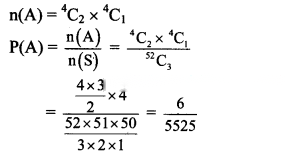
(a) Let event A: Out of the three cards drawn, 2 are queens and 1 is an ace card.
There are 4 queens and 4 aces in a pack of 52 cards.
∴ 2 queens can be drawn from 4 queens in ways and 1 ace can be drawn out of 4 aces in ways.
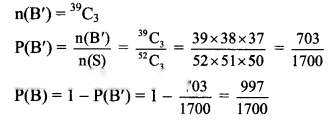
(b) Let event B: Out of the three cards drawn, at least one is a diamond.
∴ B’ is the event that all 3 cards drawn are non-diamond cards.
In a pack of 52 cards, there are 39 non-diamond cards.
∴ 3 non-diamond cards can be drawn in ways.
(c) Let event C: All the cards drawn are from the same suit.
A pack of 52 cards consists of 4 suits each containing 13 cards.
∴ 3 cards can be drawn from the same suit in ways.

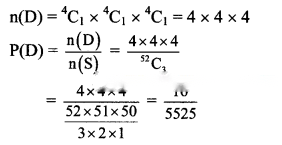
(d) Let event D: The cards drawn are a king, a queen, and a jack.
There are 4 kings, 4 queens and 4 jacks in a pack of 52 cards.
∴ 1 king can be drawn from 4 kings in ways,
1 queen can be drawn from 4 queens in ways and
1 jack can be drawn from 4 jacks in ways.
(a) Let event A: Ball drawn is red.
There are total 10 red balls.
∴ 1 red ball can be drawn from 10 red balls in ways.
∴ n(A) = = 10
∴ P(A) =
(b) Let event B: The ball drawn is blue or black.
There are 4 blue and 6 black balls.
∴ 1 blue ball can be drawn from 4 blue balls in ways
or 1 black ball can be drawn from 6 black balls in ways.
∴ n(B) = + = 4 + 6 = 10
∴ P(B) =
(c) Let event C: Ball drawn is not black,
i.e., ball drawn is red or blue.
There are total 14 red and blue balls.
∴ 1 ball can be drawn from 14 balls in ways.
∴ n(C) = = 14
∴ P(C) =
(a) Let event A: Number on the ticket is divisible by 6.
∴ A = {6, 12, 18, 24, 30, 36, 42, 48, 54, 60, 66, 72}
∴ n(A) = 12
∴ P(A) =
(b) Let event B: Number on the ticket is a perfect square.
∴ B = (1, 4, 9, 16, 25, 36, 49, 64}
∴ n(B) = 8
∴ P(B) =
(c) Let event C: Number on the ticket is a prime number.
∴C = {2, 3, 5, 7, 11, 13, 17, 19, 23, 29, 31, 37, 41, 43, 47, 53, 59, 61, 67, 71, 73}
(d) Let event D: Number on the ticket is divisible by 3 and 5,
i.e., divisible by L.C.M. of 3 and 5,
i.e., 15.
∴D = {15, 30, 45, 60, 75}
∴ n(D) = 5
∴ P(D) =
(ii) 2 balls can be drawn from 9 balls without replacement in ways.
∴ n(S) = = 9 × 8 = 72
2 red balls can be drawn from 5 red balls without replacement in ways.
∴ n(B) = = 5 × 4 = 20
∴ P(B) =
(i) Let event A: The room is dark.
For event A to happen the bulbs should be selected from the 6 defective bulbs. This can be done in ways.
∴ n(A) =
∴ P(A) =
(ii) Let event A’: The room is lit.
∴ P(Room is lit) = 1 – P(Room is not lit)
∴ P(A’) = 1 – P(A) = 1 – =
(b) Let event B: Vowels are never together.
4 consonants create 5 gaps, in which vowels are arranged.
Consider the following arrangement of consonants
_C_C_C_C_
2 vowels can be arranged in 5 gaps in ways.
Also 4 consonants can be arranged among themselves in = 4! ways.
∴ n(B) = 4! ×
∴ P(B) =
(iii) Let event C: Word begin with O and end with T.
Thus first and last letters can be arranged in one way each and the remaining 4 letters can be arranged in = 4! ways
∴ n(C) = 4! × 1 × 1 = 4!
∴ P(C) =
(d) Let event D: Word starts with a vowel and ends with a consonant.
There are 2 vowels and 4 consonants in the word MOTHER.
∴ The first place can be arranged in 2 different ways and the last place can be arranged in 4 different ways.
Now, the remaining 4 letters (3 consonants and 1 vowel) can be arranged in = 4! ways.
∴ n(D) = 2 × 4 × 4!
∴ P(D) =
(ii) Let event B: Out of 3 balls drawn, one is black and two are red.
There are 7 black and 4 red balls.
∴ One black ball can be drawn from 7 black balls in ways and 2 red balls can be drawn from 4 red balls in ways.
∴ n(A) =
∴ P(A) =