Maharashtra State Board 11th Maths Solutions Chapter 6 Functions Ex 6.2
(ii) (f – g) (2) = f(2) – g(2)
= [3(2) + 5] – [6(2) – 1]
= 6 + 5 – 12 + 1
= 0
(iii) (fg) (3) = f (3) g(3)
= [3(3) + 5] [6(3) – 1]
= (14) (17)
= 238
(iv)
Domain = R – {}
(ii) (gof) (x) = g(f(x))
= g(2x2+ 3)
= 5(2x + 3) – 2
= 10x2+ 13
(iii) (fof) (x) = f(f(x))
= f(2x2+ 3)
= 2(2x2+ 3)2+ 3
= 2(4x4+ 12x2+ 9) + 3
= 8x4+ 24x2+ 21
(iv) (gog) (x) = g(g(x))
= g(5x – 2)
= 5(5x – 2) – 2
= 25x – 12
(ii) f(x) = x3+ 4
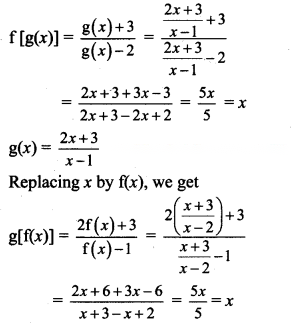
Replacing x by g(x), we get
f[g(x)] = [g(x)]3+ 4
=
= x – 4 + 4
= x
g(x) =
Replacing x by f(x), we get
g[f(x)] = = x
Here, f[g(x)] = x and g[f(x)] = x
∴ f and g are inverse functions of each other.
(iii) f(x) =
Replacing x by g(x), we get
Here, f[g(x)] = x and g[f(x)] = x.
∴ f and g are inverse functions of each other.
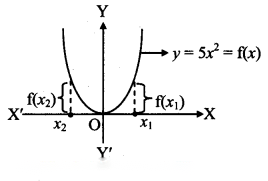
(ii) f(x) = 8 = y (say)
For every value of x, the value of the function f is the same.
∴ f is not one-one i.e. (many-one) function.
∴ f does not have the inverse.
(iii) f(x) =
Let f(x1) = f(x2)
∴
∴ x1= x2
∴ f is a one-one function.
f(x) = = y (say)
∴ x =
∴ For every y, we can get x
∴ f is an onto function.
∴ x = = f-1(y)
Replacing y by x, we get
f-1 (x) =
(iv) f(x) =
Let f(x1) = f(x2)
∴
∴ x1= x2
∴ f is a one-one function.
f(x) = = y, (say) y ≥ 0
Squaring on both sides, we get
y2= 4x + 5
∴ x =
∴ For every y we can get x.
∴ f is an onto function.
∴ x = = f-1(y)
Replacing y by x, we get
f-1(x) =
(v) f(x) 9x3+ 8
Let f(x1) = f(x2)
∴
∴ x1= x2
∴ f is a one-one function.
∴ f(x) = 9x3+ 8 = y, (say)
∴ x =
∴ For every y we can get x.
∴ f is an onto function.
∴ x = = f-1(y)
Replacing y by x, we get
f-1(x) =
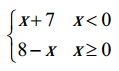
(vi) f(x) = x + 7, x < 0
= 8 – x, x ≥ 0
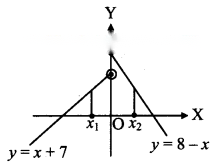
We observe from the graph that for two values of x, say x1, x2the values of the function are equal.
i.e. f(x1) = f(x2)
∴ f is not one-one (i.e. many-one) function.
∴ f does not have inverse.
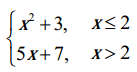
(ii) f(2) = 22+ 3
= 4 + 3
= 7
(iii) f(0) = 02+ 3 = 3
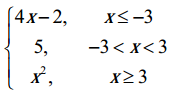
(ii) f(-3) = 4(-3) – 2
= -12 – 2
= -14
(iii) f(1) = 5
(iv) f(5) = 52= 25
(ii) f(-5) = 2 |-5| + 3(-5)
= 2(5) – 15 …..[∵ |x| = -x, x < 0]
= 10 – 15
= -5
(ii) f(0.5) = 4[0.5] – 3
= 4(0) – 3 ………[∵ 0 ≤ 0.5 < 1, [0.5] = 0]
= -3
(iii) = f(-2.5)
= 4[-2.5] – 3
= 4(-3) – 3 …….[∵-3 ≤ -2.5 ≤ -2, [-2.5] = -3]
= -15
(iv) f(2π) = 4[2π] – 3
= 4[6.28] – 3 …..[∵ π = 3.14]
= 4(6) – 3 …….[∵ 6 ≤ 6.28 < 7, [6.28] = 6]
= 21
(ii) {} = – = – 0 =
f() = 2{} + 5()
= 2() +
=
= 1.75
(iii) {-1.2} = -1.2 – [-1.2] = -1.2 + 2 = 0.8
f(-1.2) = 2{-1.2} + 5(-1.2)
= 2(0.8) + (-6)
= -4.4
(iv) {-6} = -6 – [-6] = -6 + 6 = 0
f(-6) = 2{-6} + 5(-6)
= 2(0) – 30
= -30
(ii) |x – 4| + |x – 2| = 3 …..(i)
Case I: x < 2
Equation (i) reduces to
4 – x + 2 – x = 3 …….[x < 2 < 4, x – 4 < 0, x – 2 < 0]
∴ 6 – 3 = 2x
∴ x =
Case II: 2 ≤ x < 4
Equation (i) reduces to
4 – x + x – 2 = 3
∴ 2 = 3 (absurd)
There is no solution in [2, 4)
Case III: x ≥ 4
Equation (i) reduces to
x – 4 + x – 2 = 3
∴ 2x = 6 + 3 = 9
∴ x =
∴ x = , are solutions.
The solution set = {, }
(iii) x2+ 7|x| + 12 = 0
∴ (|x|)2+ 7|x| + 12 = 0
∴ (|x| + 3) (|x| + 4) = 0
∴ There is no x that satisfies the equation.
The solution set = { } or Φ
(iv) |x| ≤ 3 The solution set of |x| ≤ a is -a ≤ x ≤ a
∴ The required solution is -3 ≤ x ≤ 3
∴ The solution set is [-3, 3]
(v) 2|x| = 5
∴ |x| =
∴ x = ±
(vi) [x + [x + [x]]] = 9
∴ [x + [x] + [x] ] = 9 …….[[x + n] = [x] + n, if n is an integer]
∴ [x + 2[x]] = 9
∴ [x] + 2[x] = 9 …..[[2[x] is an integer]]
∴ [x] = 3
∴ x ∈ [3, 4)
(vii) {x} > 4
This is a meaningless statement as 0 ≤ {x} < 1
∴ The solution set = { } or Φ
(viii) {x} = 0
∴ x is an integer
∴ The solution set is Z.
(ix) {x} = 0.5
∴ x = ….., -2.5, -1.5, -0.5, 0.5, 1.5, …..
∴ The solution set = {x : x = n + 0.5, n ∈ Z}
(x) 2{x} = x + [x]
= [x] + {x} + [x] ……[x = [x] + {x}]
∴ {x} = 2[x]
R.H.S. is an integer
∴ L.H.S. is an integer
∴ {x} = 0
∴ [x] = 0
∴ x = 0