Maharashtra State Board 11th Maths Solutions Chapter 6 Functions Miscellaneous Exercise 6
(I) Select the correct answer from the given alternatives.
Solution & Step-by-Step Answer:
(B) 5 Hint: log (5x – 9) – log (x + 3) = log 2 ∴ = 2 ∴ 3x = 9 + 6 ∴ x = 5
Solution & Step-by-Step Answer:
(B) 1010 Hint: log10 log10 log10 x = 0 ∴ log10 (log10 (x)) = 100 = 1 ∴ log10 x = 101 = 10 ∴ x = 1010
Solution & Step-by-Step Answer:
(B) 4 Hint: 2 log2 x = 4, x > 0 ∴ log2 (x2) = 4 ∴ x2 = 16 ∴ x = ±4 ∴ x = 4
Solution & Step-by-Step Answer:
(A), (B), (C), (D) Hint: ∴ ∴ 4 log 2 [log x + log 2] + (6 log 2) (2 log x) = 3 (2 log x) (log 2 + log x) Let log 2 = a, log x = t. Then ∴ 4at + 4a2 + 12at = 6at + 6t2 ∴ 6t2 – 10at – 4a2 = 0 ∴ 3t2 – 5at – 2a2 = 0 ∴ (3t + a) (t – 2a) = 0 ∴ t = a, 2a ∴ log x = , log (22) ∴ x = , 4 ∴ x = , 4
Solution & Step-by-Step Answer:
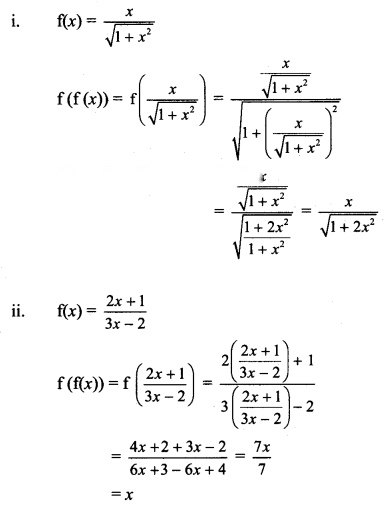
(C) x Hint:
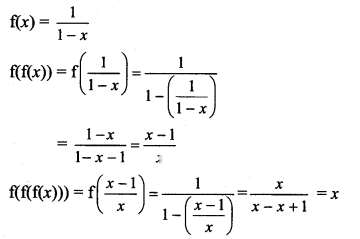
Solution & Step-by-Step Answer:
(A) {2} Hint:

Solution & Step-by-Step Answer:
(A) Hint: f(x) = = y, say. then 2x + 1 = y(1 – 3x) ∴ y – 1 = x(2 + 3y) ∴ x = = f-1 (y) ∴ f-1 (x) =
Solution & Step-by-Step Answer:
(B) 0 Hint: f(x) = 2x2 + bx + c f(0) = 3 ∴ 2(0) + b(0) + c = 3 ∴ c = 3 ……..(i) ∴ f(2) = 1 ∴ 2(4) + 2b + c = 1 ∴ 2b + c = -7 ∴ 2b + 3 = -7 …..[From (i)] ∴ b = -5 ∴ f(x) = 2x2 – 5x + 3 ∴ f(1) = 2(1)2 – 5(1) + 3 = 0
Solution & Step-by-Step Answer:
(C) R – Z Hint: f(x) = For f to be defined, {x} ≠ 0 ∴ x cannot be integer. ∴ Domain = R – Z
Solution & Step-by-Step Answer:
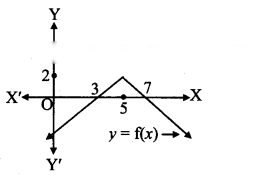
(B) R, (-∞, 2] Hint: f(x) = 2 – |x – 5| = 2 – (5 – x), x < 5 = 2 – (x – 5), x ≥ 5 ∴ f(x) = x – 3, x < 5 = 7 – x, x ≥ 5 Domain = R, Range (from graph) = (-∞, 2]
(II) Answer the following:
Solution & Step-by-Step Answer:
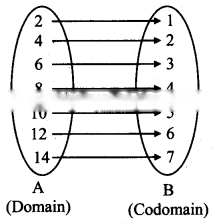
(i) {(2, 1), (4, 2), (6, 3), (8, 4), (10, 5) (12, 6), (14, 7)} Every element of set A has been assigned a unique element in set B ∴ Given relation is a function Domain = {2, 4, 6, 8, 10, 12, 14}, Range = {1, 2, 3, 4, 5, 6, 7}
(ii) {(0, 0), (1, 1), (1, -1), (4, 2), (4, -2) (9, 3), (9, -3) (16, 4), (16, -4)}
∵ (1, 1), (1, -1) ∈ the relation
∴ Given relation is not a function.
As element 1 of the domain has not been assigned a unique element of co-domain.
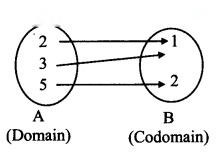
(iii) {(2, 1), (3, 1), (5, 2)}
Every element of set A has been assigned a unique element in set B.
∴ Given relation is a function.
Domain = {2, 3, 5}, Range = {1, 2}
Solution & Step-by-Step Answer:
(i) f: R → R, defined by f(x) = x2 + 5 Note that f(-x) = f(x) = x2 + 5 ∴ f is not one-one (i.e., many-one) function.
(ii) f: R – {3} → R, defined by f(x) =
Let f(x1) = f(x2)
∴
∴ 5x1x2– 15x1+ 7x2– 21 = 5x1x2– 15x2+ 7x1– 21
∴ 22(x1– x2) = 0
∴ x1= x2
∴ f is a one-one function.
Solution & Step-by-Step Answer:
(i) f(x) = 6x – 7 = y (say) (x, y ∈ Z) ∴ x = Since every integer y does not give integer x, f is not onto.
(ii) f(x) = x2+ 3 = y (say)
(x, y ∈ R)
Clearly y ≥ 3 …..[x2≥ 0]
∴ All the real numbers less than 3 from codomain R, have not been pre-assigned any element from the domain R.
∴ f is not onto.
Solution & Step-by-Step Answer:
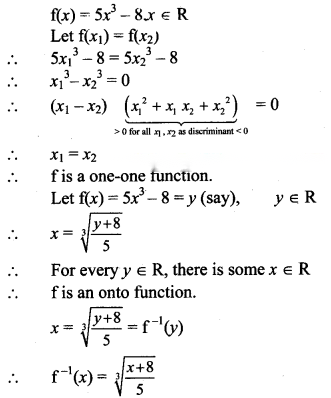
Solution & Step-by-Step Answer:
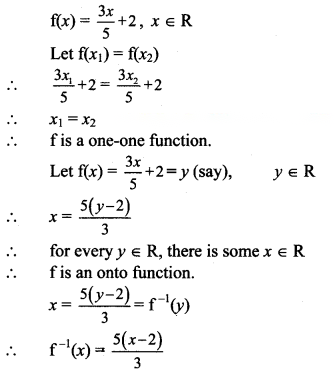
Solution & Step-by-Step Answer:
f(x) = 4x + 5, -4 ≤ x < 0 f(-1) = 4(-1) + 5 = -4 + 5 = 1 f(-2) = 4(-2) + 5 = -8 + 5 = -3 x = 0 ∉ domain of f ∴ f(0) does not exist.
Solution & Step-by-Step Answer:
(i) f(x) = 3 ∴ 5 – x = 3 ∴ x = 5 – 3 = 2
(ii) f(x) = 5
∴ 5 – x = 5
∴ x = 0
Solution & Step-by-Step Answer:
f(x) = 3x4 – 5x2 + 7 ∴ f(x – 1) = 3(x – 1)4 – 5(x – 1)2 + 7 = 3(x4 – 4C1 x3 + 4C2 x2 – 4C3 x + 4C4) – 5(x2 – 2x + 1) + 7 = 3(x4 – 4x3 + 6x2 – 4x + 1) – 5(x2 – 2x + 1) + 7 = 3x4 – 12x3 + 18x2 – 12x + 3 – 5x2 + 10x – 5 + 7 = 3x4 – 12x3 + 13x2 – 2x + 5
Solution & Step-by-Step Answer:
f(x) = 3x + a, f(1) = 7 ∴ 3(1) + a = 7 ∴ a = 7 – 3 = 4 ∴ f(x) = 3x + 4 ∴ f(4) = 3(4) + 4 = 12 + 4 = 16
Solution & Step-by-Step Answer:
f(x) = ax2 + bx + 2 f(1) = 3 ∴ a(1)2 + b(1) + 2 = 3 ∴ a + b = 1 ….(i) f(4) = 42 ∴ a(4)2 + b(4) + 2 = 42 ∴ 16a + 4b = 40 Dividing by 4, we get 4a + b = 10 …..(ii) Solving (i) and (ii), we get a = 3, b = -2
Solution & Step-by-Step Answer:
(i) f = {(1, 3), (2, 4), (3, 5), (4, 6)} g = {(3, 6), (4, 8), (5, 10), (6, 12)} ∴ f(1) = 3, g(3) = 6 f(2) = 4, g(4) = 8 f(3) = 5, g(5)=10 f(4) = 6, g(6) = 12 (gof) (x) = g (f(x)) (gof)(1) = g(f(1)) = g(3) = 6 (gof)(2) – g(f(2)) = g(4) = 8 (gof)(3) = g(f(3)) = g(5) = 10 (gof)(4) = g(f(4)) = g(6) = 12 ∴ gof = {(1, 6), (2, 8), (3, 10), (4, 12)}
(ii) f = {(1, 1), (2, 4), (3, 4), (4, 3)}
g = {(1, 1), (3, 27), (4, 64)}
f(1) = 1, g(1) = 1
f(2) = 4, g(3) = 27
f(3) = 4, g(4) = 64
f(4) = 3
(gof) (x) = g(f(x))
(gof) (1) = g(f(1)) = g(1) = 1
(gof) (2) = g(f(2)) = g(4) = 64
(gof) (3) = g(f(3)) = g(4) = 64
(gof) (4) = g(f(4)) = g(3) = 27
∴ gof = {(1, 1), (2, 64), (3, 64), (4, 27)}
Solution & Step-by-Step Answer:
(i) f(x) = x2 + 5, g(x) = x – 8 (fog) (x) = f(g(x)) = f(x – 8) = (x – 8)2 + 5 = x2 – 16x + 64 + 5 = x2 – 16x + 69 (gof) (x) = g(f(x)) = g(x2 + 5) = x2 + 5 – 8 = x – 3
(ii) f(x) = 3x – 2, g(x) = x2
(fog) (x) = f(g(x)) = f(x2) = 3x2– 2
(gof) (x) = g(f(x))
= g(3x – 2)
= (3x – 2)2
= 9x2– 12x + 4
(iii) f(x) = 256x4, g(x) = √x
(fog) (x) = f(g(x)) = f (√x) = 256 (√x)4= 256x2
(gof) (x) = g(f(x)) = g(256x4) = = 16x2
Solution & Step-by-Step Answer:
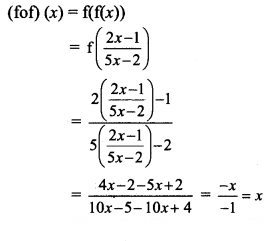
Solution & Step-by-Step Answer:
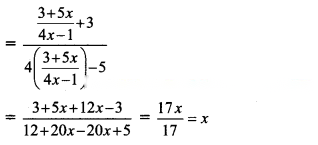
f(x) = , g(x) = (fog)(x) = f(g(x)) = f()
Solution & Step-by-Step Answer:
f(x) = , x ≠ 2 ∴ f(x) = x + 2, x ≠ 2 and g(x) = x + 2, The domain of f = R – {2} The domain of g = R Here, f and g have different domains. ∴ f ≠ g
Solution & Step-by-Step Answer:
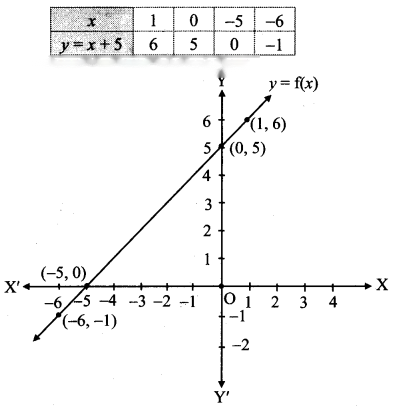
f(x) = x + 5
Solution & Step-by-Step Answer:
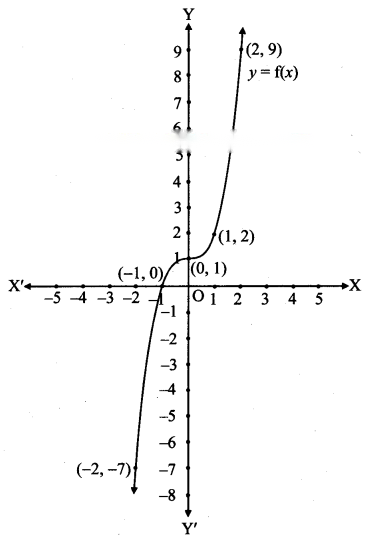
Let y = f(x) = x3 + 1

Solution & Step-by-Step Answer:
L.H.S. = log(1 + 2 + 3) = log 6 R.H.S. = log 1 + log 2 + log 3 = 0 + log (2 × 3) = log 6 ∴ L.H.S. = R.H.S.
Solution & Step-by-Step Answer:
x = = = 23 ….[ = b] = 8
Solution & Step-by-Step Answer:
L.H.S. = log| + x| + log| – x| = = log|x2 + 1 – x2| = log 1 = 0 = R.H.S.
Solution & Step-by-Step Answer:
Solution & Step-by-Step Answer:
log (log x4) – log (log x) = log (4 log x) – log (log x) …..[log mn = n log m] = log 4 + log (log x) – log (log x) …..[log (mn) = log m + log n] = log 4
Solution & Step-by-Step Answer:
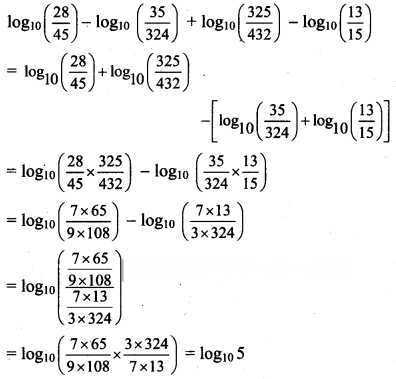
Solution & Step-by-Step Answer:
log () = (log a + log b) ∴ 2 log () = log a + log b ∴ log = log ab ∴ = ab ∴ a2 + 2ab + b2 = 4ab ∴ a2 + 2ab – 4ab + b2 = 0 ∴ a2 – 2ab + b2 = 0 ∴ (a – b)2 = 0 ∴ a – b = 0 ∴ a = b
Solution & Step-by-Step Answer:
b2 = ac Taking log on both sides, we get log b2 = log ac ∴ 2 log b = log a + log c ∴ log a + log c = 2 log b
Solution & Step-by-Step Answer:
logx (8x – 3) – logx 4 = 2 ∴ = 2 ∴ x2 = ∴ 4x2 = 8x – 3 ∴ 4x2 – 8x + 3 = 0 ∴ 4x2 – 2x – 6x + 3 = 0 ∴ 2x(2x – 1) – 3(2x – 1) = 0 ∴ (2x – 1)(2x – 3) = 0 ∴ 2x – 1 = 0 or 2x – 3 = 0 ∴ x = or x =
Solution & Step-by-Step Answer:
a2 + b2 = 7ab a2 + 2ab + b2 = 7ab + 2ab (a + b)2 = 9ab = ab = ab Taking log on both sides, we get log = log (ab) 2 log = log a + log b Dividing throughout by 2, we get
Solution & Step-by-Step Answer:
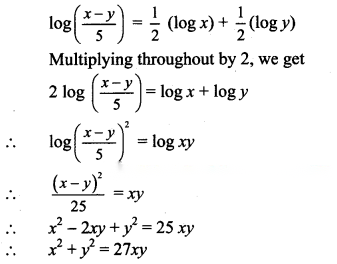
Solution & Step-by-Step Answer:
log3 [log2 (log3 x)] = 1 ∴ log2 (log3 x) = 31 ∴ log3 x = 23 ∴ log3 x = 8 ∴ x = 38 ∴ x = 6561
Solution & Step-by-Step Answer:
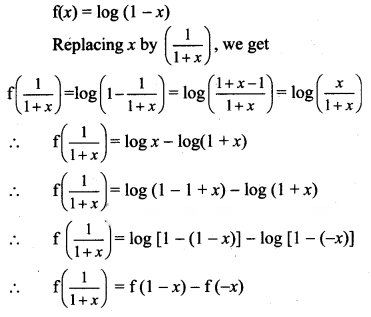
Solution & Step-by-Step Answer:
We have to prove that, < log10 3 < i.e., to prove that < log10 3 and log10 3 < i.e., to prove that 2 < 5 log10 3 and 2 log10 3 < 1 i.e., to prove that 2 log10 10 < 5 log10 3 and 2 log10 3 < log10 10 ……[∵ loga a = 1] i.e., to prove that log10 102 < log10 35 and log10 32 < log10 10 i.e., to prove that 102 < 35 and 32 < 10 i.e., to prove that 100 < 243 and 9 < 10 which is true ∴ < log10 3 <
Solution & Step-by-Step Answer:
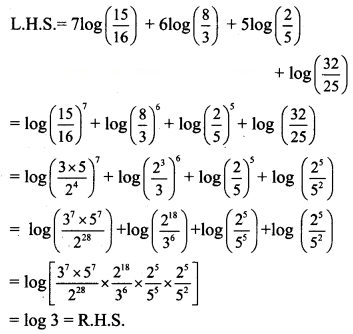
Solution & Step-by-Step Answer:
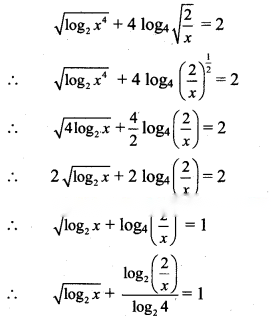
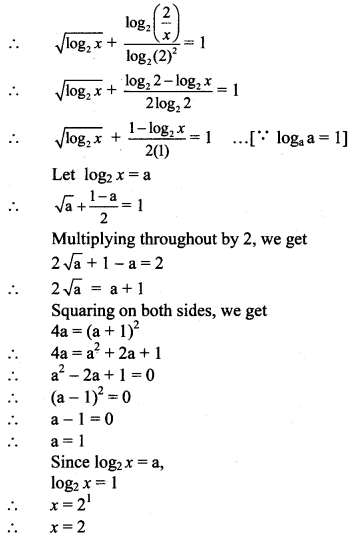
Solution & Step-by-Step Answer:
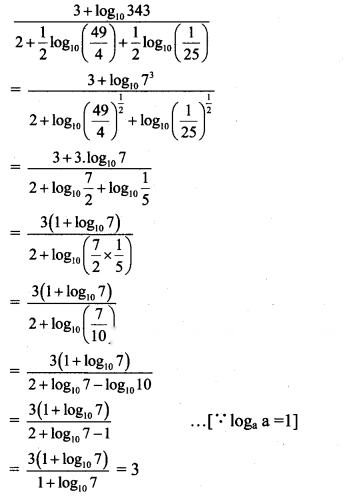
Solution & Step-by-Step Answer:
Let = k ∴ log a = k(x + y – 2z), log b = k(y + z – 2x), log c = k(z + x – 2y) log a + log b + log c = k(x + y – 2z) + k(y + z – 2x) + k(z + x – 2y) = k(x + y – 2z + y + z – 2x + z + x – 2y) = k(0) = 0 ∴ log (abc) = log 1 …….[∵ log 1 = 0] ∴ abc = 1
Solution & Step-by-Step Answer:

Solution & Step-by-Step Answer:
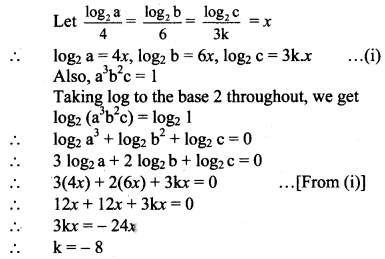
Solution & Step-by-Step Answer:
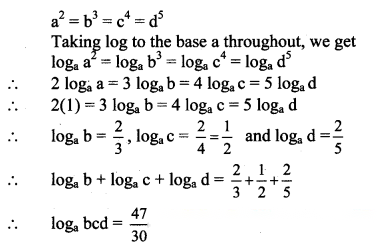
Solution & Step-by-Step Answer:
(i) 1 < |x – 1| < 4 ∴ -4 < x – 1 < -1 or 1 < x – 1 < 4 ∴ -3 < x < 0 or 2 < x < 5 ∴ Solution set = (-3, 0) ∪ (2, 5)
(ii) |x2– x – 6| = x + 2 …..(i)
R.H.S. must be non-negative
∴ x ≥ -2 …..(ii)
|(x – 3) (x + 2)| = x + 2
∴ (x + 2) |x – 3| = x + 2 as x + 2 ≥ 0
∴ |x – 3| = 1 if x ≠ -2
∴ x – 3 = ±1
∴ x = 4 or 2
∴ x = -2 also satisfies the equation
∴ Solution set = {-2, 2, 4}
(iii) |x2– 9| + |x2– 4| = 5
∴ |(x – 3) (x + 3)| + |(x – 2) ( x + 2)| = 5 ………(i)
Case I: x < -3
Also, x < -2, x < 2, x < 3
∴ (x – 3) (x + 3) > 0 and (x – 2) (x + 2) > 0
Equation (i) reduces to
x2– 9 + x2– 4 = 5
∴ 2x2= 18
∴ x = -3 or 3 (both rejected as x < -3)
Case II: -3 ≤ x < -2
As x < -2, x < 3
∴ (x – 3) (x + 3) < 0, (x – 2) (x + 2) > 0
Equation (i) reduces to
-(x2– 9) + x2– 4 = 5
∴ 5 = 5 (true)
-3 ≤ x < -2 is a solution ….(ii)
Case III: -2 ≤ x < 2 As x > -3, x < 3
∴ (x – 3) (x + 3) < 0,
(x – 2) (x + 2) < 0
Equation (i) reduces to
9 – x2+ 4 – x2 = 5
∴ 2x2= 13 – 5
∴ x2= 4
∴ x = -2 is a solution …..(iii)
Case IV: 2 ≤ x < 3 As x > -3, x > -2
∴ (x – 3) (x + 3) < 0, (x – 2) (x + 2) > 0
Equation (i) reduces to
9 – x2+ x2– 4 = 5
∴ 5 = 5 (true)
∴ 2 ≤ x < 3 is a solution ……(iv)
Case V: 3 ≤ x As x > -3, x > -2, x > 2
∴ (x + 3) (x – 3) > 0,
(x – 2) (x + 2) > 0
Equation (i) reduces to
x2– 9 + x2– 4 = 5
∴ 2x2= 18
∴ x2= 9
∴ x = 3 …..(v)
(x = -3 rejected as x ≥ 3)
From (ii), (iii), (iv), (v), we get
∴ Solution set = [-3, -2] ∪ [2, 3]
(iv) -2 < [x] ≤ 7
∴ -2 < x < 8
∴ Solution set = (-2, 8)
(v) 2[2x – 5] – 1 = 7
∴ [2x – 5] = = 4
∴ [2x] – 5 = 4
∴ [2x] = 9
∴ 9 ≤ 2x < 10
∴ ≤ x < 5
∴ Solution set = [, 5)
(vi) [x]2– 5[x] + 6 = 0
∴ ([x] – 3)([x] – 2) = 0
∴ [x] = 3 or 2
If [x] = 2, then 2 ≤ x < 3
If [x] = 3, then 3 ≤ x < 4
∴ Solution set = [2, 4)
(vii) [x – 2] + [x + 2] + {x} = 0
∴ [x] – 2 + [x] + 2 + {x} = 0
∴ [x] + x = 0 …..[{x} + [x] = x]
∴ x = 0
(viii)
L.H.S. = an integer
R.H.S. = an integer
∴ x = 6k, where k is an integer
Solution & Step-by-Step Answer:
(i) f(x) = For f to be defined, x ≠ -3, 2 ∴ Domain of f = (-∞, -3) ∪ (-3, 2) ∪ (2, ∞)
(ii) f(x) =
For f to be defined,
x – 3 ≥ 0, 5 – x > 0 and 5 – x ≠ 1
x ≥ 3, x < 5 and x ≠ 4
∴ Domain of f = [3, 4) ∪ (4, 5)
(iii) f(x) =
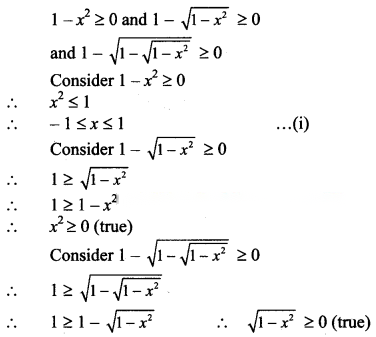
Equation (i) gives solution set = [-1, 1]
∴ Domain of f = [-1, 1]
(iv) f(x) = x!
∴ Domain of f = set of whole numbers (W)
(v) f(x) =
5 – x > 0, x – 1 ≥ 0, x – 1 ≤ 5 – x
∴ x < 5, x ≥ 1 and 2x ≤ 6
∴ x ≤ 3
∴ Domain of f = {1, 2, 3}
(vi) f(x) =
x – x2≥ 0
∴ x2– x ≤ 0
∴ x(x – 1) ≤ 0
∴ 0 ≤ x ≤ 1 …..(i)
5 – x ≥ 0
∴ x ≤ 5 …..(ii)
Intersection of intervals given in (i) and (ii) gives
Solution set = [0, 1]
∴ Domain of f = [0, 1]
(vii) f(x) =
For f to be defined,
log (x2– 6x + 6) ≥ 0
∴ x2– 6x + 6 ≥ 1
∴ x2– 6x + 5 ≥ 0
∴ (x – 5)(x – 1) ≥ 0
∴ x ≤ 1 or x ≥ 5 …..(i)
[∵ The solution of (x – a) (x – b) ≥ 0 is x ≤ a or x ≥ b, for a < b]
and x2– 6x + 6 > 0
∴ (x – 3)2> -6 + 9
∴ (x – 3)2> 3
∴ x < 3 – √3 0r x > 3 + √3 ……..(ii)
From (i) and (ii), we get
x ≤ 1 or x ≥ 5
Solution set = (-∞, 1] ∪ [5, ∞)
∴ Domain of f = (-∞, 1] ∪ [5, ∞)
Solution & Step-by-Step Answer:
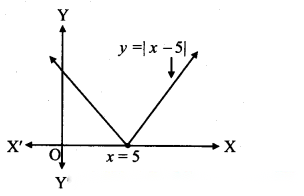
(i) f(x) = |x – 5| ∴ Range of f = [0, ∞)
(ii) f(x) = = y (say)
∴ x2y – x + 9y = 0
For real x, Discriminant > 0
∴ 1 – 4(y)(9y) ≥ 0
∴ y2≤
∴ ≤ y ≤
∴ Range of f = [, ]
(iii) f(x) = = y, (say)
∴ √x y + y = 1
∴ √x = ≥ 0
∴ ≤ 0
∴ o < y ≤ 1
∴ Range of f = (0, 1]
(iv) f(x) = [x] – x = -{x}
∴ Range of f = (-1, 0] …..[0 ≤ {x} < 1]
(v) f(x) = 1 + 2x + 4x
Since, 2x > 0, 4x > 0
∴ f(x) > 1
∴ Range of f = (1, ∞)
Solution & Step-by-Step Answer:
(i) f(x) = ex, g(x) = log x (fog) (x) = f(g(x)) = f(log x) = elog x = x (gof) (x) = g(f(x)) = g(ex) = log (ex) = x log e = x …..[∵ log e = 1]
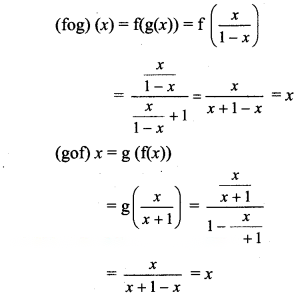
(ii) f(x) = , g(x) =
Solution & Step-by-Step Answer:
(i) g(x) = x2 + x – 2 (gof) (x) = 4x2 – 10x + 4 = (2x – 3)2 + (2x – 3) – 2 = g(2x – 3) = g(f(x)) ∴ f(x) = 2x – 3 (gof) (x) = 4x2 – 10x + 4 = (-2x + 2)2 + (-2x + 2) – 2 = g(-2x + 2) = g(f(x)) ∴ f(x) = -2x + 2
(ii) g(x) = 1 + √x
f(g(x)) = 3 + 2√x + x
= x + 2√x + 1 + 2
= (√x + 1)2+ 2
f(√x + 1) = (√x + 1)2+ 2
∴ f(x) = x2+ 2
Solution & Step-by-Step Answer: