Maharashtra State Board 11th Maths Solutions Chapter 6 Functions Ex 6.1
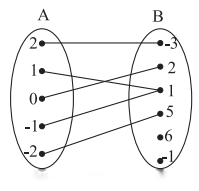
(b)
Solution:
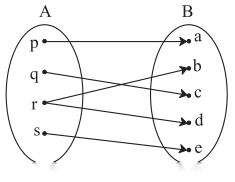
No.
Reason: An element of set A has been assigned more than one element from set B.
(c)
Solution:
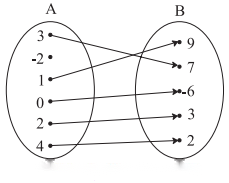
No.
Reason:
Not every element of set A has been assigned an image from set B.
(ii) {(1, 2), (2, -1), (3, 1), (4, 3)} represents a function.
Reason: Every element of set A has been assigned a unique image in set B.
(iii) {(1, 3), (4, 1), (2, 2)} does not represent a function.
Reason:
3 ∈ A does not have an image in set B.
(iv) {(1, 1), (2, 1), (3, 1), (4, 1)} represents a function
Reason: Every element of set A has been assigned a unique image in set B.
(ii) x + y2= 9
∴ y2= 9 – x
∴ y = ±
∴ For one value of x, there are two values of y.
∴ y is not a function of x.
(iii) x2– y = 25
∴ y = x2– 25
∴ For every value of x, there is a unique value of y.
∴ y is a function of x.
(iv) 2y + 10 = 0
∴ y = -5
∴ For every value of x, there is a unique value of y.
∴ y is a function of x.
(v) 3x – 6 = 21
∴ x = 9
∴ x = 9 represents a point on the X-axis.
There is no y involved in the equation.
So the given equation does not represent a function.
(ii) f (-3) = (-3)2– 3(-3) + 1
= 9 + 9 + 1
= 19
(iii) f() =
=
=
=
(iv) f(x + 1) = (x + 1)2– 3(x + 1) + 1
= x2+ 2x + 1 – 3x – 3 + 1
= x2– x – 1
(v) f(-x) = (-x)2 – 3(-x) + 1 = x2 + 3x + 1
(vi)
=
=
= h + 1
(ii) g(x) =
g(x) = 0
= 0
∴ 18 – 2x2= 0
∴ x2= 9
∴ x = ±3
(iii) g(x) = 6x2+ x – 2
g(x) = 0
∴ 6x2+ x – 2 = 0
∴ (2x – 1) (3x + 2) = 0
∴ 2x – 1 = 0 or 3x + 2 = 0
∴ x = or x =
(iv) g(x) = x3– 2x2– 5x + 6
= ( x- 1) (x2– x – 6)
= (x – 1) (x + 2) (x – 3)
g(x) = 0
∴ (x – 1) (x + 2) (x – 3) = 0
∴ x – 1 = 0 or x + 2 = 0 or x – 3 = 0
∴ x = 1, -2, 3
(ii) f(x) = √x – 3, g(x) = 5 – x
f(x) = g(x)
∴ √x – 3 = 5 – x
∴ √x = 5 – x + 3
∴ √x = 8 – x
on squaring, we get
x = 64 + x2– 16x
∴ x2– 17x + 64 = 0
∴ x =
∴ x =
∴ x =

(ii) g(x) =
Solution:
g(x) =
Function g is defined everywhere except at x = 2.
∴ Domain of g = R – {2}
Let y = g(x) =
∴ (x – 2) y = x + 4
∴ x(y – 1) = 4 + 2y
∴ For every y, we can find x, except for y = 1.
∴ y = 1 ∉ range of function g
∴ Range of g = R – {1}
(iii) h(x) =
Solution:
h(x) = , x ≠ -5
For x = -5, function h is not defined.
∴ x + 5 > 0 for function h to be well defined.
∴ x > -5
∴ Domain of h = (-5, ∞)
Let y =
∴ y > 0
Range of h = (0, ∞) or R+
(iv) f(x) =
Solution:
f(x) =
f is defined for all real x and the values of f(x) ∈ R
∴ Domain of f = R, Range of f = R
(v) f(x) =
Solution:
f(x) =
For f to be defined,
(x – 2)(5 – x) ≥ 0
∴ (x – 2)(x – 5) ≤ 0
∴ 2 ≤ x ≤ 5 ……[∵ The solution of (x – a) (x – b) ≤ 0 is a ≤ x ≤ b, for a < b]
∴ Domain of f = [2, 5]
(x – 2) (5 – x) = -x2+ 7x – 10
=
=
∴
Range of f = [0, ]
(vi) f(x) =
Solution:
f(x) =
For f to be defined,
≥ 0, 7 – x ≠ 0
∴ ≤ 0 and x ≠ 7
∴ 3 ≤ x < 7
Let a < b, ≤ 0 ⇒ a ≤ x < b
∴ Domain of f = [3, 7)
f(x) ≥ 0 … [∵ The value of square root function is non-negative]
∴ Range of f = [0, ∞)
(vii) f(x) =
Solution:
f(x) =
For f to be defined,
16 – x2≥ 0
∴ x2≤ 16
∴ -4 ≤ x ≤ 4
∴ Domain of f = [-4, 4]
Clearly, f(x) ≥ 0 and the value of f(x) would be maximum when the quantity subtracted from 16 is minimum i.e. x = 0
∴ Maximum value of f(x) = √16 = 4
∴ Range of f = [0, 4]
(ii) Diameter (d) = 2r
∴ r =
∴ Area (A) = πr2=
(iii) Circumference (C) = 2πr
∴ r =
Area (A) = πr2=
∴ A =
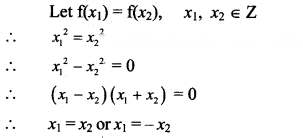
(ii) f : Z → Z given by f(x) = x2
Solution:
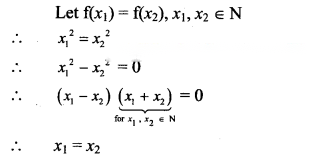
f: Z → Z given by f(x) = x2
∴ f is not injective.
(Example: f(-2) = 4 = f(2). So, -2, 2 have the same image. So, f is not injective.)
Since x2≥ 0,
f(x) ≥ 0
Therefore all negative integers of codomain are not images under f.
∴ f is not surjective.
(iii) f : R → R given by f(x) = x2
Solution:
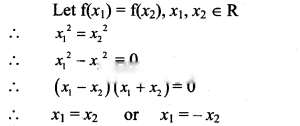
f : R → R given by f(x) = x2
∴ f is not injective.
f(x) = x2≥ 0
Therefore all negative integers of codomain are not images under f.
∴ f is not surjective.
(iv) f : N → N given by f(x) = x3
Solution:
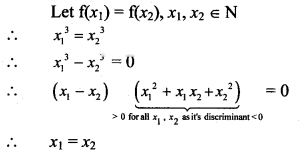
f: N → N given by f(x) = x3
∴ f is injective.
Numbers from codomain which are not cubes of natural numbers are not images under f.
∴ f is not surjective.
(v) f : R → R given by f(x) = x3
Solution:
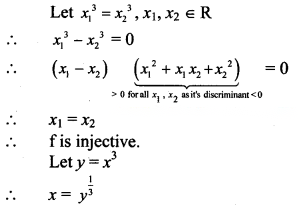
f: R → R given by f(x) = x3
∴ For every y ∈ R, there is some x ∈ R.
∴ f is surjective.
(ii) f(x) = log10(x2– 5x + 6)
x2– 5x + 6 = (x – 2) (x – 3)
f is defined, when (x – 2) (x – 3) > 0
∴ x < 2 or x > 3
Solution of (x – a) (x – b) > 0 is x < a or x > b where a < b
∴ Domain of f = (-∞, 2) ∪ (3, ∞)
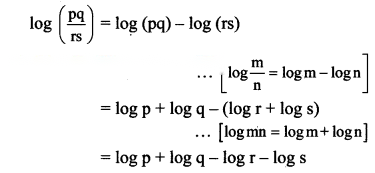
(b)
Solution:
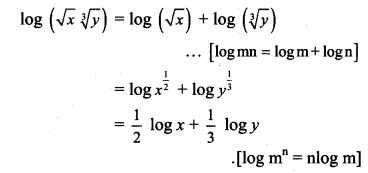
(c)
Solution:
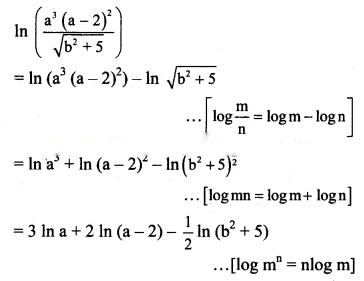
(d)
Solution:
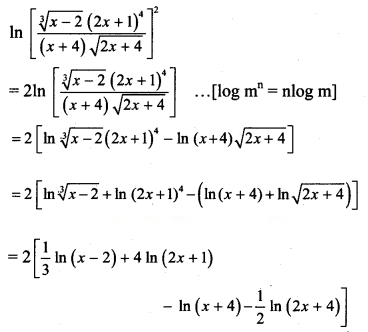
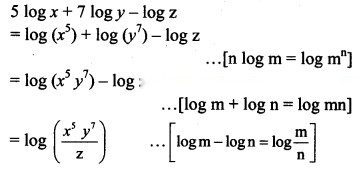
(ii) log(x – 1) + log(x)
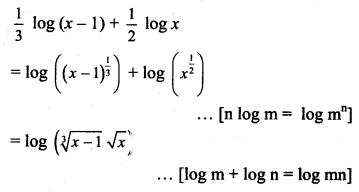
Solution:
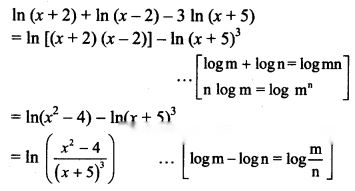
(iii) ln (x + 2) + ln (x – 2) – 3 ln (x + 5)
Solution:
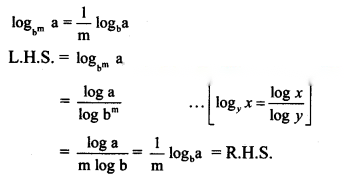
(b)
Solution:
(c)
Solution:
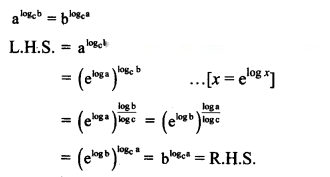
Question 25
Maharashtra Board Solution
Solve for x: (i) log 2 + log (x + 3) – log (3x – 5) = log 3
Solution & Step-by-Step Answer:
block bg-white dark:bg-slate-900/80 border-l-4 border-emerald-500 rounded-r-xl p-5 my-3 shadow-xs border border-slate-200/60 dark:border-slate-800">
Solution & Step-by-Step Answer:
log 2 + log (x + 3) – log (3x – 5) = log 3 ∴ log 2(x + 3) – log(3x – 5) = log 3 …..[∵ log m + log n = log mn] ∴ log = log 3 …..[∵ log m – log n = log ] ∴ = 3 ∴ 2x + 6 = 9x – 15 ∴ 7x = 21 ∴ x = 3
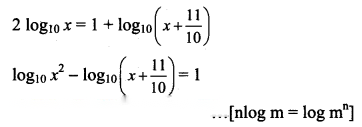
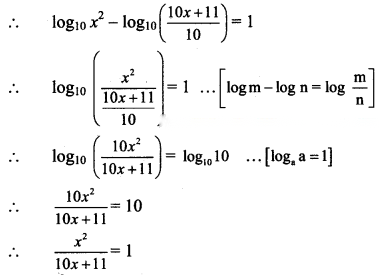
Check: (ii) 2log10x = 1 +
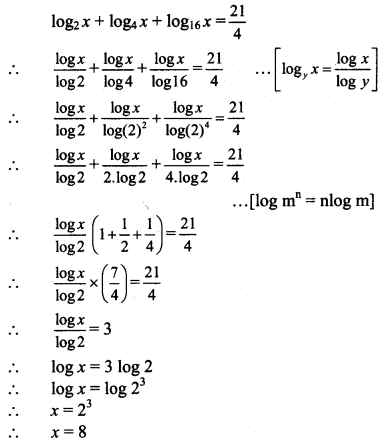
(iii) log2x + log4x + log16x =
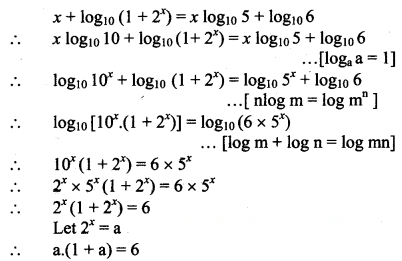
(iv) x + log10(1 + 2x) = x log105 + log106
Question 26
Maharashtra Board Solution
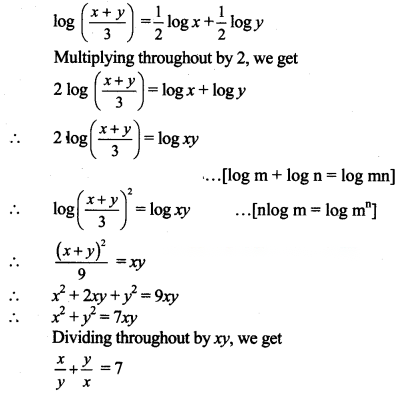
If log = log x + log y, show that = 7.
Solution & Step-by-Step Answer:
Question 27
Maharashtra Board Solution
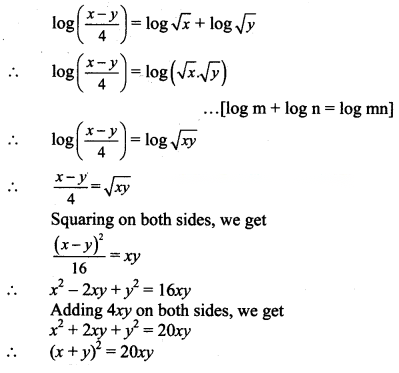
If log = log√x + log√y, show that (x + y)2 = 20xy.
Solution & Step-by-Step Answer:
Question 28
Maharashtra Board Solution
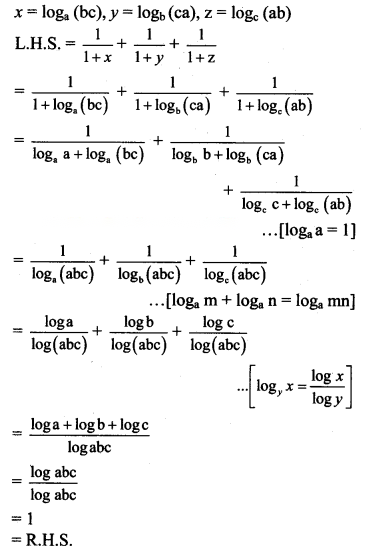
If x = logabc, y = logb ca, z = logc ab, then prove that = 1.
Solution & Step-by-Step Answer:
|