Maharashtra State Board 11th Maths Solutions Chapter 5 Sets and Relations Miscellaneous Exercise 5
(I) Select the correct answer from the given alternative.
Solution & Step-by-Step Answer:
(C) a ∈ A
Solution & Step-by-Step Answer:
(D) 24N Hint: 6N = {6x : x ∈ N} = {6, 12, 18, 24, 30, ……} 8N = {8x : x ∈ N} = {8, 16, 24, 32, ……} ∴ 6N ∩ 8N = {24, 48, 72, …..} = {24x : x ∈ N} = 24N
Solution & Step-by-Step Answer:
(D) 4 Hint: A = Φ ∴ n(A) = 0 ∴ n[P(A)] = 2n(A) = 20 = 1 ∴ n[P[P(A)]] = 2n[P(A)] = 21 = 2 ∴ n[P[P[P(A)]]] = 2n[P[P(A)]] = 22 = 4
Solution & Step-by-Step Answer:
(C) 60% Hint: Let C = Population travels by car B = Population travels by bus n(C) = 20%, n(B) = 50%, n(C ∩ B) = 10% n(C ∪ B) = n(C) + n(B) – n(C ∩ B) = 20% + 50% – 10% = 60%
Solution & Step-by-Step Answer:
(A) 432
Solution & Step-by-Step Answer:
(D) None of these
Solution & Step-by-Step Answer:
(C) Transitive Hint: For any a ∈ N, a ≯ a ∴ (a, a) ∉ R ∴ > is not reflexive. For any a, b ∈ N, if a > b, then b ≯ a. ∴ > is not symmetric. For any a, b, c ∈ N, if a > b and b > c, then a > c ∴ > is transitive.
Solution & Step-by-Step Answer:
(D) A subset of A × B
Solution & Step-by-Step Answer:
(D) Equivalence Hint: Let x ∈ R, then xx = x2 ∴ x is related to x. ∴ Given relation is reflexive. Letx = 0 and y = 2, then xy = 0 × 2 = 0 = x2 ∴ x is related to y. Consider, yx = 2 × 0 = 0 ≠ y2 ∴ y is not related to x. ∴ Given relation is not symmetric. Let x be related to y and y be related to z. ∴ xy = x2 and yz = y2 ∴ x = and z = = y …..[if y ≠ 0] Consider, xz = × y = x2 ∴ x is related to z. ∴ Given relation is transitive.
Solution & Step-by-Step Answer:
(D) 29
(II) Answer the following.
Solution & Step-by-Step Answer:
(i) Let A = {10, 20, 30, 40, 50} ∴ A = {x/x = 10n, n ∈ N and n ≤ 5}
(ii) Let B = {a, e, i, o, u}
∴ B = {x/x is a vowel of English alphabets}
(iii) Let C = {Sunday, Monday, Tuesday, Wednesday, Thursday, Friday, Saturday}
∴ C = {x/x is a day of a week}
Solution & Step-by-Step Answer:
U = {x/x ∈ N, 1 ≤ x ≤ 12} = {1, 2, 3, …., 12} A = {1, 4, 7, 10}, B = {2, 4, 6, 7, 11}, C = {3, 5, 8, 9, 12} (i) A ∪ B = {1, 2, 4, 6, 7, 10, 11}
(ii) B ∩ C = {}
(iii) A – B = {1, 10}
(iv) C’ = {1, 2, 4, 6, 7, 10, 11}
∴ B ∩ C’ = {2, 4, 6, 7, 11}
(v) A ∪ B ∪ C = {1, 2, 3, 4, 5, 6, 7, 8, 9, 10, 11, 12}
(vi) B ∪ C = {2, 3, 4, 5, 6, 7, 8, 9, 11, 12}
∴ A ∩ (B ∪ C) = {4, 7}
Solution & Step-by-Step Answer:
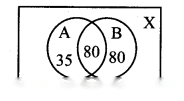
Let A = set of students who drink apple juice B = set of students who drink orange juice X = set of all students ∴ n(X) = 425, n(A) = 115, n(B) = 160, n(A ∩ B) = 80 No. of students who neither drink apple juice nor orange juice = n(A’ ∩ B’) = n(A ∪ B)’ = n(X) – n(A ∪ B) = 425 – [n(A) + n(B) – n(A ∩ B)] = 425 – (115 + 160 – 80) = 230
Solution & Step-by-Step Answer:
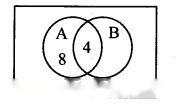
Let A = set of teachers who teach Mathematics B = set of teachers who teach Physics ∴ n(A ∪ B) = 20, n(A) = 12, n(A ∩ B) = 4 Since n(A ∪ B) = n(A) + n(B) – n(A ∩ B), 20 = 12 + n(B) – 4 ∴ n(B) = 12 ∴ Number of teachers who teach physics = 12
Solution & Step-by-Step Answer:
(i) A = {1, 2, 3} and B = {2, 4} A × A = {(1, 1), (1, 2), (1, 3), (2, 1), (2, 2), (2, 3), (3, 1), (3, 2), (3, 3)} A × B = {(1, 2), (1, 4), (2, 2), (2, 4), (3, 2), (3, 4)} B × A = {(2, 1), (2, 2), (2, 3), (4, 1), (4, 2), (4, 3)} B × B = {(2, 2), (2, 4), (4, 2), (4, 4)} ∴ (A × B) ∩ (B × A) = {(2, 2)}
(ii) A = {-1, 1}
∴ A × A × A = {(-1, -1, -1), (-1, -1, 1), (-1, 1, -1), (-1, 1, 1), (1, -1, -1), (1, -1, 1), (1, 1, -1), (1, 1, 1)}
Solution & Step-by-Step Answer:
A = {1, 2, 3}, B = {4, 5, 6} ∴ A × B = {(1, 4), (1, 5), (1, 6), (2,4), (2, 5), (2, 6), (3, 4), (3, 5), (3, 6)} (i) R1 = {(1, 4), (1, 5), (1, 6)} Since R1 ⊆ A × B, R1 is a relation from A to B. Domain (R1) = Set of first components of R1 = {1} Range (R1) = Set of second components of R1 = {4, 5, 6}
(ii) R2= {(1, 5),(2, 4),(3, 6)}
Since R2⊆ A × B,
R2is a relation from A to B.
Domain (R2) = Set of first components of R2= {1, 2, 3}
Range (R2) = Set of second components of R2= {4, 5, 6}
(iii) R3= {(1, 4), (1, 5), (3, 6), (2, 6), (3, 4)}
Since R3⊆ A × B,
R3is a relation from A to B.
Domain (R3) = Set of first components of R3= {1, 2, 3}
Range (R3) = Set of second components of R3= {4, 5, 6}
(iv) R4= {(4, 2), (2, 6), (5, 1), (2, 4)}
Since (4, 2) ∈ R4, but (4, 2) ∉ A × B,
R4⊄ A × B
∴ R4is not a relation from A to B.
Solution & Step-by-Step Answer:
(i) R = {(a, b) / a ∈ N, a < 5, b = 4} ∴ Domain (R) = {a / a ∈ N, a < 5} = {1, 2, 3, 4} Range (R) = {b / b = 4} = {4}
(ii) R = {(a, b) / b = |a – 1|, a ∈ Z, |a| < 3}
Since a ∈ Z and |a| < 3,
a < 3 and a > -3
∴ -3 < a < 3
∴ a = -2, -1, 0, 1, 2
b = |a – 1|
When a = -2, b = 3
When a = -1, b = 2
When a = 0, b = 1
When a = 1, b = 0
When a = 2, b = 1
Domain (R) = {-2, -1, 0, 1, 2}
Range (R) = {0, 1, 2, 3}
Solution & Step-by-Step Answer:
R : A → A, A = {1, 2, 3,4} (i) R = {(a, b)/a – b = 10} = { }
(ii) R = {(a, b) / |a – b| ≥ 0}
= {(1, 1), (1, 2), (1, 3), (1, 4), (2, 1), (2, 2), (2, 3), (2, 4), (3, 1), (3, 2), (3, 3), (3, 4), (4, 1), (4, 2), (4, 3), (4, 4)}
A × A = {(1, 1), (1, 2), (1, 3), (1, 4), (2, 1), (2, 2), (2, 3), (2, 4), (3, 1), (3, 2), (3, 3), (3, 4), (4, 1), (4, 2), (4, 3), (4, 4)}
∴ R = A × A
Solution & Step-by-Step Answer:
R = {(1, 1), (2, 2), (3, 3), (1, 2), (2, 3)} (i) Here, (x, x) ∈ R, for x ∈ {1, 2, 3} ∴ R is reflexive.
(ii) Here, (1, 2) ∈ R, but (2, 1) ∉ R.
∴ R is not symmetric.
(iii) Here, (1, 2), (2, 3) ∈ R,
But (1, 3) ∉ R.
∴ R is not transitive.
Solution & Step-by-Step Answer:
(i) Since 2 divides a – a, (a, a) ∈ R ∴ R is reflexive..
(ii) Let (a, b) ∈ R
Then 2 divides a – b
∴ 2 divides b – a
∴ (b, a) ∈ R
∴ R is symmetric.
(iii) Let (a, b) ∈ R, (b, c) ∈ R
Then a – b = 2m, b – c = 2n,
∴ a – c = 2(m + n), where m, n are integers.
∴ 2 divides a – c
∴ (a, c) ∈ R
∴ R is transitive.
Thus, R is an equivalence relation.
Solution & Step-by-Step Answer:
(i) Since |a – a| is even, ∴ (a, a) ∈ R ∴ R is reflexive.
(ii) Let (a, b) ∈ R
Then |a – b| is even
∴ |b – a| is even
∴ (b, a) ∈ R
∴ R is symmetric.
(iii) Let (a, b), (b, c) ∈ R
Then a – b = ±2m, b – c = ±2n
∴ a – c = ±2(m + n), where m, n are integers.
∴ (a, c) ∈ R
∴ R is transitive
Thus, R is an equivalence relation.
Solution & Step-by-Step Answer:
(i) a. Clearly (x, x) ∈ R ∴ R is reflexive.
b. If (x, y) ∈ R then (y, x) ∈ R.
∴ R is symmetric.
c. Let (x, y) ∈ R, (y, x) ∈ R.
Then x, y, and z are 3 books having the same number of pages.
∴ (x, z) ∈ R as x, z has the same number of pages.
∴ R is transitive.
Thus, R is an equivalence relation.
(ii) a. Since |a – a| is a multiple of 4,
(a, a) ∈ R
∴ R is reflexive.
b. Let (a, b) ∈ R
Then a – b = ±4m,
∴ b – a = ±4m, where m is an integer
∴ (b, a) ∈ R
∴ R is symmetric.
c. Let (a, b), (b, c) ∈ R
a – b = ± 4m, b – c = ± 4n,
∴ a – c = ±4(m + n), where m, n are integers
∴ (a, c) ∈ R
∴ R is transitive
Thus, R is an equivalence relation.
(iii) a. Since a = a
∴ (a, a) ∈ R
∴ R is reflexive.
b. Let (a, b) ∈ R Then a = b
∴ b = a
∴ (b, a) ∈ R
∴ R is symmetric.
c. Let (a, b), (b, c) ∈ R
Then, a = b, b = c
∴ a = c
∴ (a, c) ∈ R
∴ R is transitive.
Thus, R is an equivalence relation.