Maharashtra State Board Class 10 History Solutions Chapter 2 Historiography Indian Tradition
(2) …………………..…….. translated the Sanskrit text of ‘Hitopadesh’ in the German language.
(a) James Mill
(b) Friedrich Max Muller
(c) Mountstuart Elphinstone
(d) Sir John Marshall
Answer:
(b) Friedrich Max Muller
(B) Identify and write the wrong pair in the following set.
(1) ‘Who were the Shudras’ – subaltern History
(2) ‘Stri-Purush Tulana’ – Feminist writing
(3) ‘The Indian War of Independence 1857’ – Marxist History
(4) Grant Duff – Colonial History.
Answer:
(1) Right Pair: ‘Who were the Shudras’ – subaltern History
(2) Right Pair: ‘Stri-Purush Tulana’ – Feminist writing
(3) Wrong Pair: ‘The Indian War of Independence 1857’ – Marxist History
(4) Right Pair: Grant Duff – Colonial History.
Hence, writing of the regional history received momentum.
(2) Bakhar is an important type of historical documents.
Answer:
Hence, Bakhars are important type of historical document.
(2) What is the contribution of Itihasacharya V.K. Rajwade to historiography?
Answer:
Historian | Name of the Book |
James Mill | ‘The History of British India’ |
James Grant Duff | …………………………………………… |
…………………………………………… | ‘The History of India’ |
S.A. Dange | …………………………………………… |
…………………………………………… | ‘Who were the Shudras’ |
Historian | Name of the Book |
James Mill | The History of British India |
James Grant Duff | A History of Mahrattas |
Mountstuart Elphinstone | The History of India |
S. A. Dange | Primitive Communism to Slavery |
Dr. Babasaheb Ambedkar | Who Were the Shudras (b) Complete the following concept chart.
Question 5
Maharashtra Board Solution
Explain the following concepts. (1) Orientalist historiography.
Solution & Step-by-Step Answer:
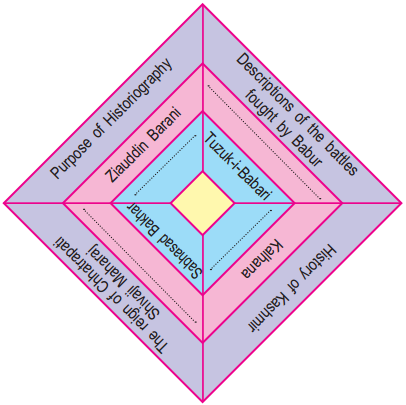
(2) Nationalistic historiography. (3) Subaltern history. Project Memory Map
Question 6
Maharashtra Board Solution
Complete the sentences by choosing a correct option: (a) The first written document found in India was inscribed during the rule of Emperor ………………... (a) Akbar (b) Harshavardhan (c) Ashoka Maurya (d) Aurangzeb
Solution & Step-by-Step Answer:
(c) Ashoka Maurya
(b) Banabhatta wrote King Harsha’s biography titled ………………… in the 7th century CE. (c) In the 12th century C.E., ………………… wrote a book ‘Rajtarangini’ about history of Kashmir. (d) The historians in the courts of Muslim rulers were influenced by ………………… historiography. (e) We get information about the rule of Chhatrapati Shivaji Maharaj from ………………... (f) ‘Bhausahebanchi Bakhar’ describes Battle of ………………... (g) The first book written by a British historian on Indian history is ………………... (h) Nilkanth Janardan Kirtane and V.K. Rajwade exposed the limitations in writings of ………………... (i) …………………, an Indian historian played a major role in establishing subaltern history as an important academic school of historiography. (j) The writings of British officials on India display strong influence of ………………... (k) The Nationalistic Historiography in Maharashtra was inspired by works of ………………... (l) The two volumes written by ……………….. on Indian history show impartial treatment of the subject. (m) ‘Primitive Communism to Slavery’, represents ……………….. the historiography. (n) ‘Stripurush Tulana’ was written by ……………….. is acknowledged as first feminist book in India.
Question 7
Maharashtra Board Solution
Identify the wrong pair and write it: (1) |
Name of the Book | Types of Historiography |
(1) Who were the | (a) Subaltern history |
Shudras | (July ’19) |
(2) Stripurush Tulana | (b) Feminist writing |
(3) The Indian War of Independence | (c) Marxist History |
(4) Grant Duff | (d) Colonial History |
Wrong pair: The Indian War of Independence – Marxist History.
(2)
Name of the Book | Historian | |||||||||||||||||||||
(1) The Rise of the Maratha Power | (a) Justice Mahadev Govind Ranade | |||||||||||||||||||||
(2) Marathyanchya Itihasachi Sadhane | (b) Vishnushastri Chiplunkar | |||||||||||||||||||||
(3) Maratha Riyasat | (c) Govind Sakharam Sardesai | |||||||||||||||||||||
(4) Gulamgiri | (d) Mahatma Phule Answer: (3)
Answer: (4)
Answer:
Question 8
Maharashtra Board Solution
Do as directed: (1)
Solution & Step-by-Step Answer:
(2)
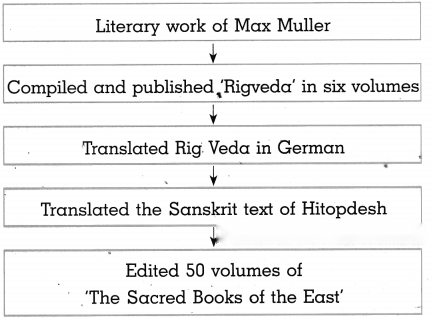
(3) Prepare a flow chart on Literary work of Max Muller:
Question 9
Maharashtra Board Solution
Explain the concepts: (a) Colonial Historiography:
Solution & Step-by-Step Answer:
Question 10
Maharashtra Board Solution
Write short notes: (a) Alexander Cunningham:
Solution & Step-by-Step Answer:
(b) James Mill: (c) Grant Duff: (d) Indian Feminist Historiography:
Question 11
Maharashtra Board Solution
Explain the following with reasons: (a) The history of Indian civilization dates back to 3rd millennium BCE.
Solution & Step-by-Step Answer:
(b) It became necessary to rethink of women’s position in history. Hence, it became necessary to rethink about the position of women in history. (c) Govind Sakharam Sardesai was addressed as ‘Riyasatkar’.
Question 12
Maharashtra Board Solution
Answer the following in 25-30 words: (a) Which things are included in the description by Emperor Babur in bis autobiography?
Solution & Step-by-Step Answer:
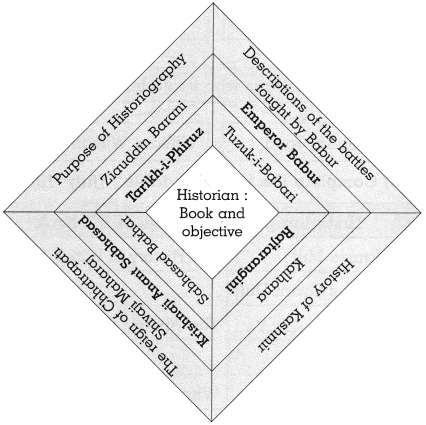
Babur, the founder of the Mughal empire, in his autobiography entitled Tuzuk-i-Babari describes:
(b) What is the contribution of Swatantryaveer Savarkar to nationalistic historiography? (c) Write about the contribution of Banabhatta in writing historiographies. (d) Write information on ‘Rajtarangini’. (e) Write about historiography in the post-independence period. (f) What are the objectives of writing history according to Ziauddin Barani? Thus, Ziauddin Barani holds important place as he expanded the scope of historiography. (g) What are the salient features of writings of historians in the courts of Mughal emperors? (h) Write about the importance of Tarabai Shinde in writing feminist historiography. *
Question 13
Maharashtra Board Solution
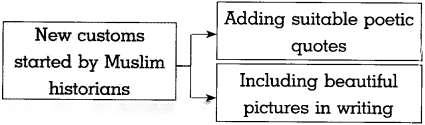
Read the given passage and answer the questions given below: (a) Complete the graphical presentation:
Solution & Step-by-Step Answer:
(b) What was considered more important by the historians in the Mughal Court? (c) Why is Abbul Fazl’s writing considered realistic?
Question 14
Maharashtra Board Solution
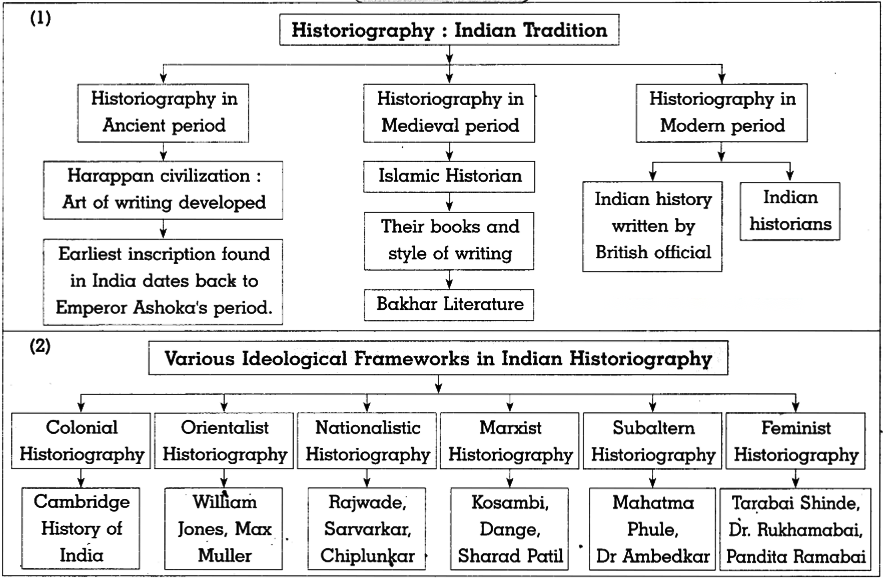
Write detailed answers to the following questions: (a) Write information about historiography in the ancient period of India.
Solution & Step-by-Step Answer:
(b) Explain the works of Dr. Babasaheb Ambedkar and Mahatma Phule in Subaltern History.
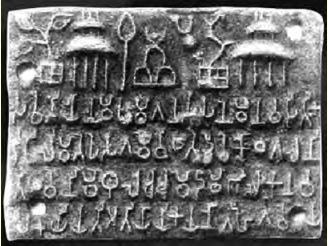
(a) Write a short note on Copper-plate inscriptions.
|