Maharashtra State Board Class 9 Science Solutions Chapter 18 Observing Space: Telescopes
Class 9 Science Chapter 18 Observing Space: Telescopes Textbook Questions and Answers
1. Fill in the blanks with the proper words.
a. The wavelength of visible light is between …………………..….. and …………………..…..
b. GMRT is used for …………………..….. waves.
c. A certain X-ray telescope is named after scientist …………………..…..
d. The first scientist to use a telescope for space observations …………………..…..
e. The biggest optical telescope in India is situated at …………………..…..
2. Form pairs
Column ‘A’ | Column ‘B’ |
(1) X-rays | (a) GMRT |
(2) Optical telescope | (b) ISRO |
(3) Indian radio telescope | (c) Hubble |
(4) Launching artificial-satellite | (d) Chandra |
Answer:
(1 – d),
(2 – c),
(3 – a),
(4 – b),
3. What are the difficulties in using ground-based optical telescopes? How are they overcome?
Answer:
Difficulties:
Solution:
4. Which type of telescopes can be made using a concave mirror, convex mirror, plane mirror, and a lens? Draw diagrams of these telescopes.
Answer:
5. Study the figure and answer the following questions:
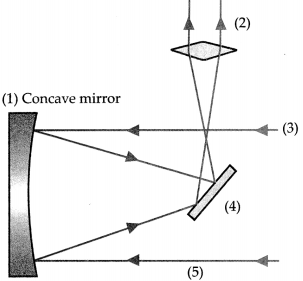
a. What type of telescope is shown in the figure?
b. Label the main parts of the telescope.
c. Which type of mirror does the telescope use?
d. What other type of telescope uses a curved mirror?
e. Explain the working of the above telescope.
Answer:
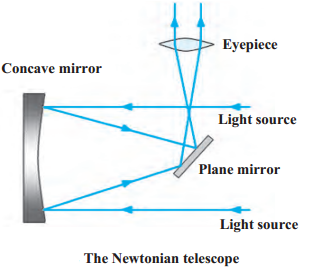
(a) The Newtonian telescope (Reflecting telescope)
(b)
(c) Concave mirror
(d) The Cassegrain telescope
(e) Working.
6. Answer the following questions.
a. Explain the construction of Galileo’s telescope.
Answer:
b. Explain the construction of a radio telescope.
Answer:
c. Why are optical telescopes located in uninhabited places on mountains?
Answer:
d. Why can an X-ray telescope not be based on the earth?
Answer:
Class 9 Science Chapter 18 Observing Space: Telescopes Intext Questions and Answers
Class 9 Science Chapter 18 Observing Space: Telescopes Additional Important Questions and Answers
Choose and write the correct options:
Match the columns:
Column ‘A’ | Column ‘B’ |
(1) X-rays | (a) GMRT |
(2) Optical telescope | (b) ISRO |
(3) Indian radio telescope | (c) Hubble |
(4) Launching artificial satellite | (d) Chandra |
(5) Radio waves | (e) telecommunication |
(6) INSAT and GSAT | (f) longer than 20cm |
(1 – d),
(2 – c),
(3 – a),
(4 – b),
(5 – f),
(6- e)
Question 2
Maharashtra Board Solution
Solution & Step-by-Step Answer:
(1 – e),
(2 – a), (3 – d), (4 – b), (5 – c) Define the following:
Question 1
Maharashtra Board Solution
Visible radiation
Solution & Step-by-Step Answer:
Light is an electromagnetic wave. Every wave has a characteristic wavelength. Our eyes can see only that light which has wavelengths between 400 nm to 800 nm. Such light is called visible radiation.
Question 2
Maharashtra Board Solution
Reflecting Telescope
Solution & Step-by-Step Answer:
When light falls on the mirror, it gets reflected. Telescopes that use concave mirrors are called reflecting telescope.
Question 3
Maharashtra Board Solution
Optical telescopes
Solution & Step-by-Step Answer:
Telescopes which are made from regular lenses and mirrors and used to see visible radiations coming from space are called optical telescopes.
Question 4
Maharashtra Board Solution
Refracting Telescopes
Solution & Step-by-Step Answer:
Light rays change their direction as they enter a lens from the atmosphere and again when they enter the atmosphere after passing through the lens. This is called refraction. The telescopes that use such lenses are called refracting telescopes.
Question 5
Maharashtra Board Solution
Radio telescopes
Solution & Step-by-Step Answer:
Many heavenly bodies emit radio waves in addition to visible radiation. A special type of telescope which is used to receive these rays are known as radio telescope.
Answer the following:
Question 1
Maharashtra Board Solution
How do refracting telescopes work?
Solution & Step-by-Step Answer:
Question 2
Maharashtra Board Solution
What are the difficulties in using refracting telescopes?
Solution & Step-by-Step Answer:
Question 3
Maharashtra Board Solution
How does a radio telescope work?
Solution & Step-by-Step Answer:
Question 4
Maharashtra Board Solution
What are the two types of reflecting telescopes?
Solution & Step-by-Step Answer:
Question 5
Maharashtra Board Solution
What is the purpose of launching X-Ray telescope Chandra?
Solution & Step-by-Step Answer:
Chandra was launched to study X-rays coming from heavenly objects. Special mirrors which. can reflect X-rays were used in this telescope.
Answer the following:
Question 1
Maharashtra Board Solution
State some of the satellites and their uses.
Solution & Step-by-Step Answer:
Question 2
Maharashtra Board Solution
What is the specialty of the artificial satellite Astrosat?
Solution & Step-by-Step Answer:
Answer in detail:
Question 1
Maharashtra Board Solution
Explain any two space observation telescope.
Solution & Step-by-Step Answer:
Hubble Telescope:
Chandra Telescope:
Question 2
Maharashtra Board Solution
Write short note : GMRT
Solution & Step-by-Step Answer:
|