Maharashtra State Board Class 9 Science Solutions Chapter 17 Introduction to Biotechnology
Class 9 Science Chapter 17 Introduction to Biotechnology Textbook Questions and Answers
1. Each of the following statements is wrong. Rewrite them correctly by changing either one or two words.
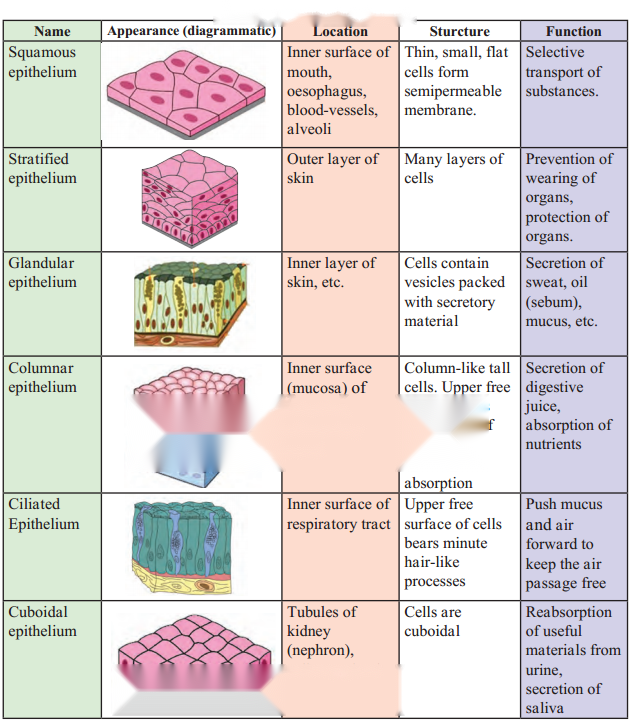
a. Simple squamous epithelium is present in the respiratory tract.
b. Glandular epithelium is present in kidneys.
c. Chlorenchyma helps the plant to float in water.
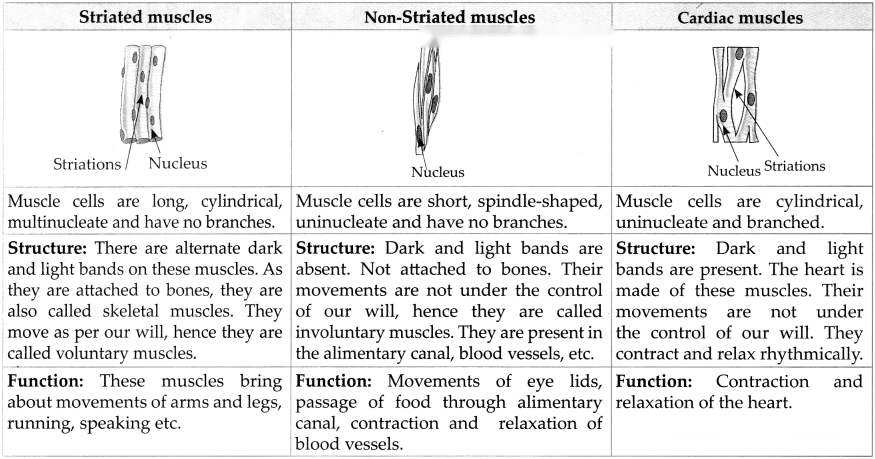
d. Striated muscles are also called involuntary muscles.
e. Chloroplast is present in permanent tissue.
Answer:
a. False. Ciliated columnar epithelium is present in respiratory tract.
b. False. Cuboidal epithelium is present in kidneys.
c. False. Aerenchyma helps the plant to float in water.
d. False. Striated muscles are also called voluntary muscles.
e. False. Chlorenchyma is present in permanent tissue.
2. Identify the odd word and explain why it is odd.
a. Xylem, phloem, permanent tissue, meristematic tissue.
Answer:
Meristematic tissue. It has the ability to divide whereas the others have lost the ability to divide.
b. Epithelium, Muscle fibre, nerve fibre, the epidermis.
Answer:
Epidermis. It is a plant tissue whereas the others are animal tissues.
c. Cartilage, bone, tendon, cardiac muscle.
Answer:
Cardiac muscle. It is a muscular tissue whereas the others are connective tissues.
3. Write the names of the following tissues.
a. Tissue lining inner surface of mouth.
Answer:
Squamous epithelium.
b. Tissue joining muscles and bones.
Answer:
Tendon
c. Tissue responsible for increasing height of plants.
Answer:
Apical meristem.
d. Tissue responsible for increasing girth of stem.
Answer:
Lateral meristem.
4. Write the differences.
Simple tissue and complex tissues in plants.
Answer:
Simple Tissue in plants | Complex Tissues in plants |
(i) They are made up of only one type of cells. | (i) They are made up of more than one type of cells. |
(ii) They are found in all parts of the plant. | (ii) They are found in the vascular regions of the plant. |
(iii) They perform different functions like storage | (iii) They mainly perform the function of |
of food, support, giving strength etc. | conduction of water and food. |
(iv) Examples – Parenchyma, Collenchyma, Sclerenchyma. | (iv) Example – Xylem and phloem. |
5. Write short notes.
a. Meristematic tissue.
Answer:
b. Xylem
Answer:
c. Striated muscles.
Answer:
d. Agro-complementary business.
Answer:
(i) The business that are complementary to agriculture and generate supplementary income for the farmers are called agro complementary business.
(ii) These include:
e. Genetic engineering
Answer:
f. Sericulture
Answer:
6. Explain the meaning of biotechnology and its impact on agricultural management with suitable examples.
Answer:
The techniques of bringing about improvements in living organisms by artificial genetic changes and by hybridization for the welfare of human beings, are together called biotechnology. Impact of biotechnology on agricultural management:
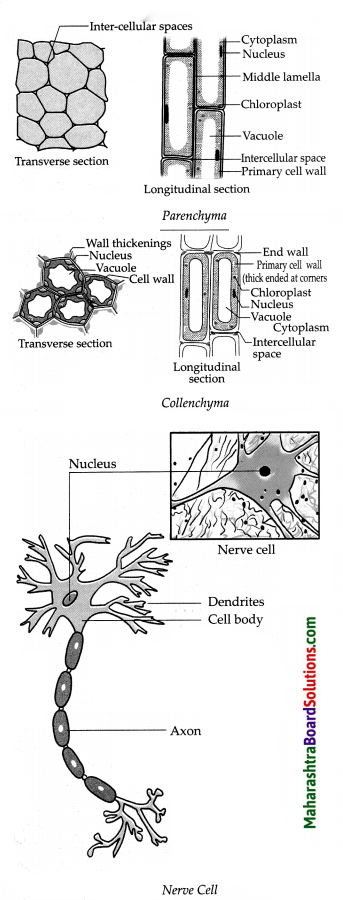
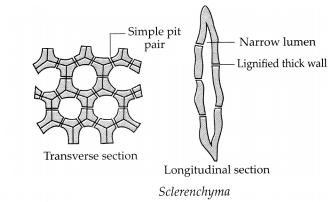
Draw neat and labelled diagrams of the following:
7. Which two main techniques are used in biotechnology? Why?
Answer:
8. Discuss ‘Agritourism’ in the class and write a project on an agrotourism centre nearby. Present it in the class in groups.
Answer:
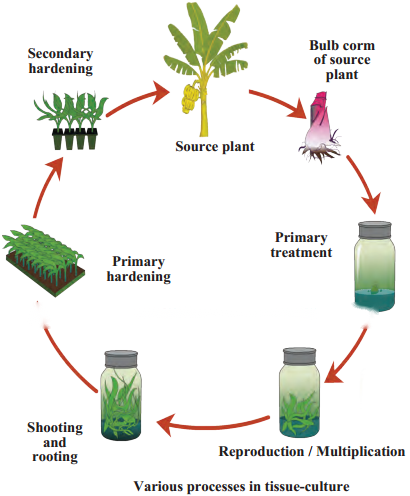
9. Define the term tissue and explain the concept of tissue culture.
Answer:
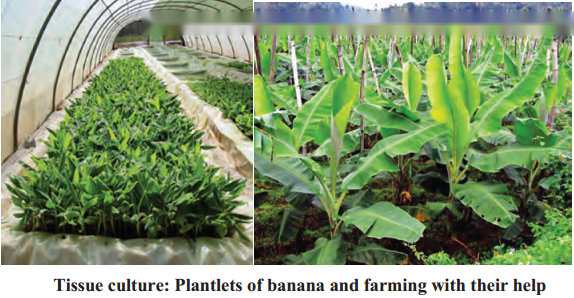
A group of cells having the same origin, same structure and same function is called tissue. Concept of tissue culture:
10. ‘Rearing of sheep is a livestock’. Justify this statement.
Answer:
Class 9 Science Chapter 17 Introduction to Biotechnology Intext Questions and Answers
It also helped to reduce the malpractices carried out by milk traders and merchants.
Answer the following questions:
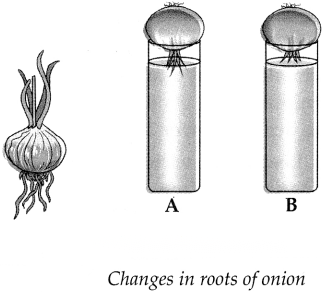
Length (cm) | Day 1 | Day 2 | Day 3 | Day 4 | Day 5 |
Flask A | |||||
Flask B |
(Students are expected to record their observation in the given table).
(a) Which onion has longer roots? Why?
Answer:
The onion in jar Ahas longer roots as it continues to grow due to the presence of meristematic tissue at root tip which had dividing cells.
(b) Why did the roots of the onion in jar B stop growing?
Answer:
The roots of onion in jar B stopped growing as the meristematic tissue present in the root tips were cut off.
Question 3
Maharashtra Board Solution
Take a fresh and fleshy leaf of Rhoeo, lily or any other plant. Pull and press it, tearing it obliquely in such a way that its transparent epidermis will be visible at the cut margins. Take the transparent epidermis with the forceps and keep it in dilute safranin
Solution & Step-by-Step Answer:
for 1 minute. Spread it on a slide, cover it with a cover-slip and observe it under a compound microscope. Answer:
Question 4
Maharashtra Board Solution
Establish your own plant nursery near your school or home. Prepare the seedlings of flowering plants, fruit plants, and ornamental plants being grown in your area. Can you start a business in the future with the help of this activity? Think it over.
Solution & Step-by-Step Answer:
(Students are expected to do this activity on their own.)
Yes, we can start a business of plant nursey in future. If sufficient land is available, the emerging field of agritourism would be a good business.
Question 5
Maharashtra Board Solution
Observe the skin of the back of your hand with the help of a magnifying lens. Do you see the closely attached squarish and pentagonal shapes?
Solution & Step-by-Step Answer:
Yes, we can see the squarish and pentagonal shapes. This is the stratified squamous epithelium present on the outer layer of skin.
Question 6
Maharashtra Board Solution
Observe a permanent slide of blood smear under a compound microscope. What did you see?
Solution & Step-by-Step Answer:
Question 7
Maharashtra Board Solution
Visit a modern cowshed nearby and record the following points – The number of cattle, their variety, total milk production, cleanliness in cattle-shed, arrangements for health care of cattle.
Solution & Step-by-Step Answer:
Students are expected to do this activity on their own.
Question 8
Maharashtra Board Solution
Collect more information about animal husbandry.
Solution & Step-by-Step Answer:
Question 9
Maharashtra Board Solution
Find out from the internet the average daily milk yield from local and exotic varieties of cow.
Solution & Step-by-Step Answer:
Question 10
Maharashtra Board Solution
Are the structure and functions of the bodies of plants and animals the same? No. The structure and functions of the bodies of plants and animals are not the same. Some differences between plants and animals:
Solution & Step-by-Step Answer:
Class 9 Science Chapter 17 Introduction to Biotechnology Additional Important Questions and Answers Choose and write the correct option:
Question 1
Maharashtra Board Solution
Protective coverings in the animal body are called tissues. (a) meristematic (b) muscular (c) epithelial (d) bone
Solution & Step-by-Step Answer:
(c) epithelial
Question 2
Maharashtra Board Solution
Epithelial tissue is present in (a) skin (b) inner surface of blood vessels (c) walls of the alveoli (d) all of these
Solution & Step-by-Step Answer:
(d) all of these
Question 3
Maharashtra Board Solution
helps in selective transport of substances. (a) Squamous epithelium (b) Stratified epithelium (c) Cuboidal epithelium (d) Columnar epithelium
Solution & Step-by-Step Answer:
(a) Squamous epithelium
Question 4
Maharashtra Board Solution
helps in secretion of digestive juice, absorption of nutrients. (a) Glandular epithelium (b) Columnar epithelium (c) Cuboidal epithelium (d) Ciliated epithelium
Solution & Step-by-Step Answer:
(b) Columnar epithelium
Question 5
Maharashtra Board Solution
supports internal organs (a) Areolar tissue (b) Adipose tissue (c) Lymph (d) Tendon
Solution & Step-by-Step Answer:
(a) Areolar tissue
Question 6
Maharashtra Board Solution
tissue helps in insulation, supply of
Solution & Step-by-Step Answer:
(b) Adipose tissue
Question 7
Maharashtra Board Solution
connect muscles to bones. (a) Ligaments (b) Tendons (c) Cartilages (d) Nerves
Solution & Step-by-Step Answer:
(b) Tendons
Question 8
Maharashtra Board Solution
join two bones to each other. (a) Cartilages (b) Tendons (c) Ligaments (d) Muscles
Solution & Step-by-Step Answer:
(c) Ligaments
Question 9
Maharashtra Board Solution
meristem increases the length of root and stem. (a) Intercalary (b) Apical (c) Lateral (d) Permanent
Solution & Step-by-Step Answer:
(b) Apical
Question 10
Maharashtra Board Solution
showed that cells and tissues can be grown ex vivo. (a) Frederick Campion Steward (b) Gregor Johann Mendel (c) Frederick Miescher (d) Robert Brown
Solution & Step-by-Step Answer:
(a) Frederick Campion Steward
Question 11
Maharashtra Board Solution
is an example of genetically modified maize. (a) Vaishali (b) Vistive Gold (c) MON 810 (d) Amflora
Solution & Step-by-Step Answer:
(c) MON 810
Question 12
Maharashtra Board Solution
is an exotic variety of cow. (a) Holstein (b) Gir (c) Sahiwal (d) Dangi
Solution & Step-by-Step Answer:
(a) Holstein
Question 13
Maharashtra Board Solution
is a layer chicken. (a) Brahma (b) Leghorn (c) Cochin (d) Aseel
Solution & Step-by-Step Answer:
(b) Leghorn
Question 14
Maharashtra Board Solution
is a broiler chicken. (a) Leghorn (b) Lehman (c) Aseel (d) Minorca
Solution & Step-by-Step Answer:
(c) Aseel
Question 15
Maharashtra Board Solution
is a broiler chicken. (a) Minroca (b) Ancona (c) Leghorn (d) Cochin
Solution & Step-by-Step Answer:
(d) Cochin
Question 16
Maharashtra Board Solution
Cartilage is found (a) all around the cells in body (b) in nose, ear, larynx, trachea (c) between the muscles and skin (d) around the blood vessels
Solution & Step-by-Step Answer:
(b) in nose, ear, larynx, trachea
Question 17
Maharashtra Board Solution
Which of the following is an exotic variety of COW? (a) Plymouth Rock (b) New Hampshire (c) Black Rock (d) Brown Swiss
Solution & Step-by-Step Answer:
(d) Brown Swiss
Question 18
Maharashtra Board Solution
epithelium is present in the inner surface of respiratory tract. (a) Stratified (b) Columnar (c) Ciliated (d) Cuboidal
Solution & Step-by-Step Answer:
(c) Ciliated
Question 19
Maharashtra Board Solution
Bones consist of osteocytes embedded in solid ground substance made up of (a) calcium bicarbonate (b) calcium carbonate (c) calcium phosphate (d) calcium sulphate
Solution & Step-by-Step Answer:
(c) calcium phosphate
Question 20
Maharashtra Board Solution
helps in growth of branches, formation of leaves and flowers. (a) Lateral meristem (b) Apical meristem (c) Intercalary meristem (d) Xylem
Solution & Step-by-Step Answer:
(c) Intercalary meristem
Question 21
Maharashtra Board Solution
tissue is present in the hard coat of seeds, outer covering of coconut. (a) Parenchyma (b) Xylem (c) Collenchyma (d) Sclerenchyma
Solution & Step-by-Step Answer:
(d) Sclerenchyma
Question 22
Maharashtra Board Solution
The cells of tissue are dead. (a) Parenchyma (b) Collenchyma (c) Sclerenchyma (d) All of these
Solution & Step-by-Step Answer:
(c) Sclerenchyma
Question 23
Maharashtra Board Solution
Cuboidal epithelium is found in (a) inner surface of mouth, blood vessels (b) inner layer of skin (c) tubules of kidney, salivary gland (d) inner surface of respiratory tract
Solution & Step-by-Step Answer:
(c) tubules of kidney, salivary gland
Find the odd man out:
Question 1
Maharashtra Board Solution
Cell body, muscle fibre, axon, dendrites.
Solution & Step-by-Step Answer:
Muscle fibre. It is a muscle cell whereas the others are parts of nerve cell.
Question 2
Maharashtra Board Solution
Tracheids, vessels, companion cells, xylem fibres.
Solution & Step-by-Step Answer:
Companion cells. It is an element of phloem whereas the others are elements of xylem.
Question 3
Maharashtra Board Solution
Sieve tubes, tracheids, phloem parenchyma, phloem fibres.
Solution & Step-by-Step Answer:
Tracheids. It is an element of xylem whereas the others are elements of phloem.
Question 4
Maharashtra Board Solution
Holstein, Brown swiss, Bombyx mori, Jersey.
Solution & Step-by-Step Answer:
Bombyx mori. It is a variety of silkworm whereas the others are varieties of cows.
Complete the analogy: (1) Inner surface of mouth : Squamous epithelium :: Inner surface of intestine : Match the columns:
Question 1
Maharashtra Board Solution
|
Column ‘A’ | Column ‘B’ |
(1) Squamous epithelium | (a) Secretion of digestive juice |
(2) Cuboidal epithelium | (b) Selective transport of substances |
(3) Columnar epithelium | (c) Protection of organs |
(4) Stratified epithelium | (d) Secretion of saliva |
(1 – b),
(2 – d),
(3 – a),
(4 – c)
Question 2
Maharashtra Board Solution
Solution & Step-by-Step Answer:
(1 – d),
(2 – C), (3 – a), (4 – h)
Question 3
Maharashtra Board Solution
|
Column ‘A’ | Column ‘B’ |
(1) Potato | (a) Vistive Gold |
(2) Maize | (b) Amflora |
(3) Soybean | (c) Vaishali |
(4) Tomato | (d) MON 863 |
(1-b),
(2-d),
(3-a),
(4-c)
Answer the following:
Question 1
Maharashtra Board Solution
Explain the different types of muscular tissues.
Solution & Step-by-Step Answer:
Question 2
Maharashtra Board Solution
Explain the types of complex permanent tissues.
Solution & Step-by-Step Answer:
State whether the following statements are true or false. Correct the false statement:
Question 1
Maharashtra Board Solution
Lateral meristem increase girth(diameter) of the root and stem.
Solution & Step-by-Step Answer:
True
Question 2
Maharashtra Board Solution
Due to use of seeds of GM crops, there is decrease in nutritive value and increase in loss of crops.
Solution & Step-by-Step Answer:
False. Due to use of seeds of GM crops there is improvement in nutritive value and decrease in loss of crops.
Question 3
Maharashtra Board Solution
In a bioreactor, cells can be grown in a more nutritive medium and protected from pathogens.
Solution & Step-by-Step Answer:
True
Question 4
Maharashtra Board Solution
Rare and endangered plants can be grown by tissue culture and can be protected from extinction.
Solution & Step-by-Step Answer:
True
Question 5
Maharashtra Board Solution
The silk thread is formed from the secretion of the sweat glands of silkworm.
Solution & Step-by-Step Answer:
False. The silk thread is formed from the secretion of the salivary glands of silkworm.
Question 6
Maharashtra Board Solution
Rhode Island Red, New Hampshire, Plymouth Rock, Black Rock are varieties of chicken reared for both eggs as well as meat.
Solution & Step-by-Step Answer:
True
Question 7
Maharashtra Board Solution
Phloem consists of thick-walled dead cells.
Solution & Step-by-Step Answer:
False. Phloem consists of living cells containing cytoplasm.
Question 8
Maharashtra Board Solution
Stratified squamous epithelium is present in inner surface of mouth, oesophagus, blood vessels and alveoli.
Solution & Step-by-Step Answer:
False. Stratified squamous epithelium is present in the outer layer of skin.
Question 9
Maharashtra Board Solution
Broiler chickens are raised for eggs.
Solution & Step-by-Step Answer:
False. Broiler chickens are raised for meat.
Question 10
Maharashtra Board Solution
Non-striated muscles bring about contraction and relaxation of heart.
Solution & Step-by-Step Answer:
False. Cardiac muscles bring about contraction and relaxation of heart.
Name the following:
Question 1
Maharashtra Board Solution
Tissue responsible for growth of branches, formation of leaves and flowers.
Solution & Step-by-Step Answer:
Intercalary meristem.
Question 2
Maharashtra Board Solution
Tissue that helps in insulation, supply of energy, storage of fats.
Solution & Step-by-Step Answer:
Adipose tissue.
Question 3
Maharashtra Board Solution
Tissue present in outer layer of skin.
Solution & Step-by-Step Answer:
Glandular epithelium.
Question 4
Maharashtra Board Solution
Tissue present in nose, ear, larynx, trachea.
Solution & Step-by-Step Answer:
Cartilage.
Question 5
Maharashtra Board Solution
Dead cells in xylem.
Solution & Step-by-Step Answer:
Tracheids, vessels and xylem fibres.
Question 6
Maharashtra Board Solution
Living cells in xylem.
Solution & Step-by-Step Answer:
Xylem parenchyma.
Question 7
Maharashtra Board Solution
Living cells in phloem.
Solution & Step-by-Step Answer:
Sieve tubes, companion cells, phloem parenchyma.
Question 8
Maharashtra Board Solution
Dead cells in phloem.
Solution & Step-by-Step Answer:
Phloem fibres.
Question 9
Maharashtra Board Solution
GM crops.
Solution & Step-by-Step Answer:
BT cotton, Amflora, Golden Rice.
Question 10
Maharashtra Board Solution
Local Indian varieties of cow.
Solution & Step-by-Step Answer:
Sahiwal, Sindhi, Lai kandhari, Devni, Khillari, Dangi.
Question 11
Maharashtra Board Solution
Exotic varieties of cow.
Solution & Step-by-Step Answer:
Jersey, Brown swiss, Holstein.
Question 12
Maharashtra Board Solution
Layers.
Solution & Step-by-Step Answer:
Leghorn, Minorca, Ancona, Lehman.
Question 13
Maharashtra Board Solution
Broilers.
Solution & Step-by-Step Answer:
Brahma, Long, Cochin, Aseel.
Question 14
Maharashtra Board Solution
Chickens reared for both eggs and meat.
Solution & Step-by-Step Answer:
Rhode Island Red, New Hampshire, Plymouth Rock, Black Rock.
Give scientific reason.
Question 1
Maharashtra Board Solution
Blood is a complex tissue.
Solution & Step-by-Step Answer:
Define the following:
Question 1
Maharashtra Board Solution
Tissue
Solution & Step-by-Step Answer:
A group of cells having the same origin, same structure and same function is called tissue.
Question 2
Maharashtra Board Solution
Differentiation
Solution & Step-by-Step Answer:
When cells acquire a specific structure, shape and location and perform a specific function, it is called differentiation.
Question 3
Maharashtra Board Solution
Biotechnology
Solution & Step-by-Step Answer:
The techniques of bringing about improvements in living organisms by artificial genetic changes and by hybridization for the welfare of human beings, are together called ‘Biotechnology’.
Question 4
Maharashtra Board Solution
Tissue culture
Solution & Step-by-Step Answer:
Ex vivo growth of cells or tissues in an aseptic and nutrient-rich medium’ is called tissue culture.
Write short notes
Question 1
Maharashtra Board Solution
Animal husbandry
Solution & Step-by-Step Answer:
Question 2
Maharashtra Board Solution
Poultry farming.
Solution & Step-by-Step Answer:
Distinguish between:
Question 1
Maharashtra Board Solution
Xylem and Phloem
Solution & Step-by-Step Answer:
Question 2
Maharashtra Board Solution
Striated muscles and Non-striated muscles.
Solution & Step-by-Step Answer:
Question 3
Maharashtra Board Solution
Cartilage and Bone
Solution & Step-by-Step Answer:
Answer the following questions:
Question 1
Maharashtra Board Solution
Close your eyes and try to identify different objects by feeling them with your hand. Why is it possible for you to identify things like a note-book, text-book, bench, compass-box, etc. only by touching them?
Solution & Step-by-Step Answer:
Answer in detail:
Question 1
Maharashtra Board Solution
Write the location, structure and function of following epithelial tissues: (a) Squamous epithelium (b) Stratified epithelium (c) Glandular epithelium (d) Columnar epithelium (e) Ciliated epithelium (f) Cuboidal epithelium
Solution & Step-by-Step Answer:
Question 2
Maharashtra Board Solution
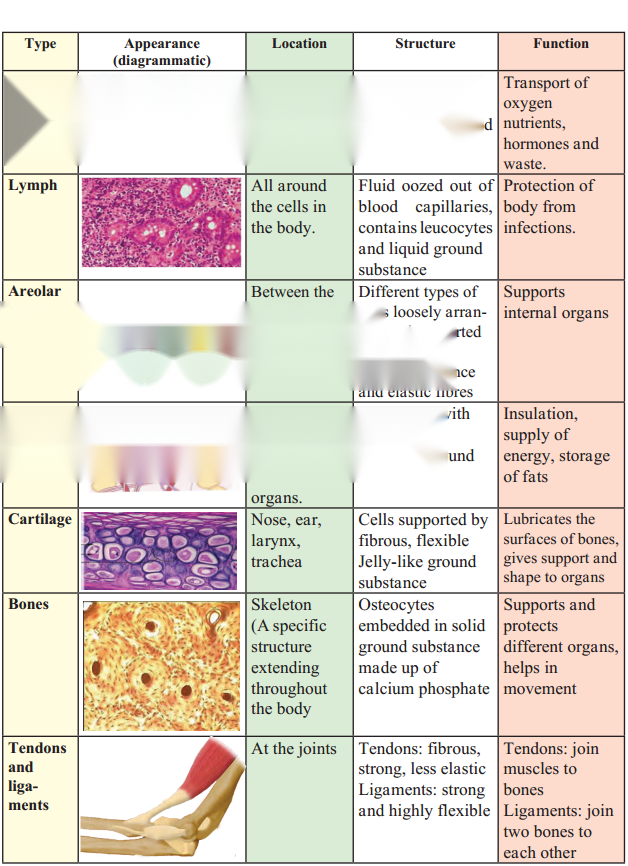
Write the structure and function of the following connective tissues: (a) Blood (b) Lymph (c) Areolar tissue (d) Adipose tissue (e) Cartilage (f) Bones (g) Tendons and ligaments
Solution & Step-by-Step Answer:
Question 2
Maharashtra Board Solution
Describe the structure of nervous tissue with the help of a neat labelled diagram.
Solution & Step-by-Step Answer:
Question 3
Maharashtra Board Solution
Explain the types of simple permanent tissues in plants.
Solution & Step-by-Step Answer:
Types of simple permanent tissues.
Question 4
Maharashtra Board Solution
Explain types, location and function of Meristematic tissue in tabular form:
Solution & Step-by-Step Answer:
Question 5
Maharashtra Board Solution
Explain the types of simple permanent tissues in plants.
Solution & Step-by-Step Answer:
Types of simple permanent tissues.
Question 6
Maharashtra Board Solution
Write down the applications of biotechnology (tissue culture) in floriculture, nurseries and forestry.
Solution & Step-by-Step Answer:
Applications of biotechnology (tissue culture) in floriculture, nurseries and foresty:
|