Maharashtra State Board Class 8 Science Solutions Chapter 9 Disaster Management
Class 8 Science Chapter 9 Disaster Management Textbook Questions and Answers
1. Answer the following in your own words.
Question a.
Explain the relation between continuous rains and landslide. Give reasons.
Answer:
Before the actual landslide, many changes occur in the surrounding hilly ground. The hard rocks develop cracks and crevices. These are natural changes but due to man-made activities, the cracks are widened due to erosion. These cracks make the big rocks to break into smaller stones. The cracks widen further due to excessive rainfall. These rocks further get eroded and they fall down along with soil from the slopes. The entire process is speeded up due to rainwater.
Question b.
Prepare a chart showing ‘Dos’ and ‘don’ts’ at the time of earthquake.
Answer:
At the time of earthquake
Dos | Don’ts |
1. Go in the open grounds. | 1. Don’t wait in the multi-storeyed buildings. Do not use lifts. Use stairs to descend. |
2. Keep the electrical appliances and cooking gas closed. | 2. Do not stand near buildings, trees or electric wires and poles. |
3. Use battery or torch. | 3. Do not light candles, lantern or match- sticks. |
4. Stand silently at one place. Do not panic or get scared. | 4. Do not sit in uncomfortable posture for a long time. |
5. Take protection under some hard covering, especially to protect the head and face. Cover the face. | |
6. If, in vehicle, find a safe place and stop the vehicle, sit in the vehicle than coming out in open. |
Question c.
What are the specifications of an earthquake-proof building?
Answer:
The earthquake-proof building is such that even if the earthquake is caused, it should not cause damage to the buildings due to these earth movements. There are some codes of conduct while constructing such buildings. Advanced technology is used for earthquake resistant construction. The foundation of earthquake-proof building is separated from lower land. The walls are of less weight or they are wooden. The house constructed with special light materials are preferred in earthquake-prone regions.
Question d.
Explain the effects of landslide.
Answer:
1. Mostly rivers originate in the hills and mountains. When there is landslide, the rivers naturally get flooded.
2. The paths of the riverine water changes due to landslide.
3. Waterfalls are displaced from their original positions.
4. New and artificial water reservoirs are created.
5. The falling debris, soil and rocks make the trees at the base of hillside uprooted. All the plant life is lost.
6. The constructions done by the villagers on the slope can be totally damaged due to landslide. There is large scale damage to property and life. In few cases like Malin the entire village was buried due to landslide and accompanied rainfall.
7. Transportation is affected as the roads and railway tracks are blocked due to debris.
Question e.
Is there any relation between dam and earthquake? Explain.
Answer:
There is abundant water stored in the dams. This water column puts additional weight on the ground. Initially there may not be any weight, but later due to construction of dam, suddenly the pressure of this weight is so high that this ground experiences the tension. If such area is already earthquake-prone, then there can be chances of earthquake. According to theory of plate tectonics, there are continuous movements in the earth’s surface. If over such fragile plates, the dams are constructed then the chances of earthquake are enhanced.
2. Give Scientific reasons.
Question a.
It is safer to find shelter under things like a bed, table at the time of earthquake.
Answer:
When earthquake takes place, due to the vibrations in the earth’s surface, there is possibility of the roof and walls of the house to fall. This collapse can cause severe head injury which can be fatal. Thus, one must take shelter below the hard-supporting structures such as bed or table. This precaution can save one’s life.
Question b.
In monsoon, don’t take shelter near hillside.
Answer:
The excessive rainfall can cause landslides. The soil and rocks from the hillside can be pushed down along with the flow of rainwater. This debris slides to the lower heights from the hills. This explains us that taking shelter near the base of the hillside can be disastrous as one can be buried in the debris due to sudden landslide. Therefore, in monsoon, one should not take shelter near hillside.
Question c.
Don’t use lifts at the time of earthquake.
Answer:
Lifts or elevators run on electricity. The electricity supply can be hindered due to earthquake. There may be chances of fire due to short circuit. We may get trapped in the elevator at such times. The building may also collapse due to earthquake. It is always better to use stairs at the time of such calamities, so that one can safely come out of the building. Therefore, it is said that lifts should not be used at the time of earthquakes.
Question d.
The foundation of earthquake- proof building is separated from lower land.
Answer:
The surface of the earth trembles at the time of earthquake. These tremors cause seismic waves which are responsible for the movements of the earth’s surface. The ground thus shakes or it goes up-down. These shocks and waves formed in the interior of the earth spread on the surface in all directions. This causes collapse of the building and other structures on the land.
To prevent such disasters the foundation of earth-quake proof building is separated from lower land.
3. If a crowd gathers at the place of earthquake, what would be the difficulties in relief work?
Question a.
If a crowd gathers at the place of earthquake, what would be the difficulties in relief work?
Answer:
If people flock in crowd, the rescue work will not be possible. The ambulances and the fire engines will not reach the spot where the help is needed. The personnel from disaster management cells cannot thus act in time. It will be difficult to manage the situation and thus such crowding should never be done.
4. Make a list of the institutes and organizations who provide help for disaster managment. Collect more information about their work.
Question a.
Make a list of the institutes and organizations who provide help for disaster management. Collect more information about their work.
Answer:
International government organisations working for disaster management are:
a. The United Nations and its organisations:
1. The Food and Agricultural Organisation of the UN (FAO): It gives early warning of impending food crises, and keep track of global food supply problems.
2. The United Nations Development Programme (UNDP): It helps disaster-prone countries with disaster mitigation, prevention and preparedness measures.
3. The World Food Programme (WFP): It is the main supplier of relief food aid.
4. The World Health Organisation (WHO): It gives global public health leadership by setting standards, monitoring health trends, and providing direction on emergency health issues. WHO’s role is to reduce avoidable loss of life and the burden of disease and disability.
b. The International Committee of the Red Cross ( ICRC): It gives physical rehabilitation to people injured by explosive weapons or other types of incident.
c. The International Federation of Red Cross and Red Crescent Societies ( IFRC): It coordinates and gives international help to victims of natural and technological disasters, to refugees and in health emergencies.
International non-governmental agencies working for disaster management are:
a. International Rescue Committee (IRC): It provides lifesaving care and life-changing help to refugees forced to flee from war or disaster.
b. IMA World Health: It, in collaboration with USAID, the World Bank and many other organisations, builds sustainable health care systems.
c. CARE: It is an organisation fighting global poverty. It works for women and puts efforts to improve their basic education, prevent the spread of HIV by providing awareness among them, give them increase access to clean water and sanitation, expand economic opportunity for them. It provides emergency aid to survivors of war and natural disasters, and helps people rebuild their lives.
Indian organisations and institutes working for disaster management are:
a. National Disaster Response Force (NDRF): The multi-disciplinary, multi-skilled, high-tech force of the NDMA are capable of dealing with all types of natural and man-made disasters.
b. National Disaster Management Authority (NDMA): It lay down the policies, plans and guidelines for Disaster Management to ensure timely and effective response to disasters.
c. National Institute of Disaster Management (NIDM): It has been given the responsibilities for human resource development, capacity building, training, research, documentation and policy advocacy in the field of disaster management.
5. Make a survey of your school according to the plan of disaster management an write the pointwise information.
Question a.
Make a survey of your school according to the plan of disaster managment an write the pointwise information.
Answer:
This an activity based questions. Kindly do it yourself. But make sure to involve the following points in your survey:
6. Are there any possible places of landslide in your area? Collect information from experts.
Question a.
Are there any possible places of landslide in your area? Collect information from experts.
Answer:
This is an activity based question. kindly do it yourself.
7. With the help of the following pictures, explain your role in disaster management.
Question a.
With the help of following pictures, explain your role in the disaster management.
Answer:

The picture given is not very clear. It does not indicate the condition of disaster. Therefore, there are two alternatives for this answer.
Option 1 : The boy holds a paper on which is written, ‘I am at risk’! The boy is shocked to read this. Someone has given message to him. He must search that person and help him or her. He should therefore take help from some elder or from police force in such matter.
Option 2 : The boy shown in the picture is in danger. So, he is typing in his I – pad, “I am at Risk”. After receiving this message, someone will help him. It depends upon, to whom is he sending this message. If he sends this message to us, we can immediately try to help him. His message “I am at Risk”, shows that he is in danger and has to be saved.
It is not clear about which disaster is shown in the picture.
Project:
Question 2
Maharashtra Board Solution
With the help of Internet, collect information about the latest gadgets and technology to forecast earthquake. |
Question 3. Collect information about NDRF, RPF, CRPF, NCC from Internet. |
Question 4. Discuss- Need of CCTV. |
Class 8 Science Chapter9 Disaster ManagementImportant Questions and
Rewrite the sentences after filling the blanks:
Question 1
Maharashtra Board Solution
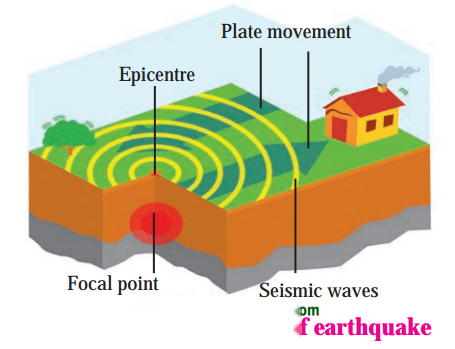
Earthquakes cause ……………. waves leading to movements of the earth’s surface.
Solution & Step-by-Step Answer:
block bg-white dark:bg-slate-900/80 border-l-4 border-emerald-500 rounded-r-xl p-5 my-3 shadow-xs border border-slate-200/60 dark:border-slate-800">
Solution & Step-by-Step Answer:
Earthquakes cause seismic waves leading to movements of the earth’s surface.
Question 2
Maharashtra Board Solution
The central point of earthquake is the point above the ……………. on the earth’s surface.
Solution & Step-by-Step Answer:
The central point of earthquake is the point above the epicentre on the earth’s surface.
Question 3
Maharashtra Board Solution
The accentuation of earthquake is measured in …………….
Solution & Step-by-Step Answer:
The accentuation of earthquake is measured in ‘Richter Scale’.
Question 4
Maharashtra Board Solution
If there is earthquake at the bottom of ocean, it may create ……………… waves.
Solution & Step-by-Step Answer:
If there is earthquake at the bottom of ocean, it may create tsunami waves.
Question 5
Maharashtra Board Solution
…………….. is the best device to put off small fires.
Solution & Step-by-Step Answer:
Stirrup pump is the best device to put off small fires.
Question 6
Maharashtra Board Solution
………………. of waterfalls occurs due to landslides.
Solution & Step-by-Step Answer:
Displacement of waterfalls occurs due to landslides.
State whether the following statements are True or False:
Question 1
Maharashtra Board Solution
Every year nearly 2,400 to 4,000 earthquakes occur on the earth.
Solution & Step-by-Step Answer:
False. (Every year nearly 12,400 to 14,000 earthquakes occur on the earth.)
Question 2
Maharashtra Board Solution
Potassium, sodium and calcium are the metals that react with water at high room temperature.
Solution & Step-by-Step Answer:
False. (Potassium, sodium and calcium are the metals that react with water at normal room temperature.)
Question 3
Maharashtra Board Solution
A fire caused due to electrical components is extinguished by fire extinguishers like carbon dioxide are used.
Solution & Step-by-Step Answer:
True.
Question 4
Maharashtra Board Solution
Indiscriminate cutting of the trees results in improvement of soil quality.
Solution & Step-by-Step Answer:
False. (Indiscriminate cutting of the trees results in soil erosion.)
Question 5
Maharashtra Board Solution
Landslide results in loss of plant life.
Solution & Step-by-Step Answer:
True.
Match the column:
Question 1
Maharashtra Board Solution
|
Column ‘A’ | Column ‘B’ |
1. Class A fire | a. Electrical components |
2. Class B fire | b. Gaseous substances |
3. Class C fire | c. Chemical substances |
4. Class D fire | d. Liquid substances |
5. Class E fire | e. Solid substances |