Maharashtra State Board Class 8 History Solutions Chapter 7 Non-co-operation Movement
Class 8 History Chapter 7 Non-co-operation Movement Textbook Questions and Answers
1. Rewrite the statements by choosing the appropriate options :
Solution & Step-by-Step Answer:
(c) South Africa
Solution & Step-by-Step Answer:
(b) Kheda
Solution & Step-by-Step Answer:
(b) Sir
2. Answer the following questions in one sentence :
Solution & Step-by-Step Answer:
In 1906, the government declared that the Blacks in South Africa should compulsorily carry an identity card. This was the restriction imposed on their freedom.
Solution & Step-by-Step Answer:
The first Satyagraha in India was launched by Gandhiji at Champaran at Bihar in 1917.
Solution & Step-by-Step Answer:
General Dyer gave orders of firing in the Jallianwala Baug.
3. Answer the following questions in 25-30 words :
Solution & Step-by-Step Answer:
Solution & Step-by-Step Answer:
1. The members of the Indian National Congress like Motilal Nehru and Chittaranjan Das put an idea to contest elections and enter the Legislative Assembly and Provincial Legislative Council to obstruct the working of the government and oppose the unjust policies. 2. Therefore, they formed the Swaraj Party in 1922.
4. Explain the following statements with reasons :
Solution & Step-by-Step Answer:
Solution & Step-by-Step Answer:
Solution & Step-by-Step Answer:
Solution & Step-by-Step Answer:
Do you Know?
Mulshi Satyagraha (1920-1924):
Muishi Pethcz was a small viilage,with hilly terrain, approximately 40-45 kms away from Pune. The Tata Company decided to set up hydro-electricity project in this part. It was given permission by the British government. The dam would have displaced 52 villages and 11000 people. There was no consent taken from the people nor was there any programme for their rehabilitation. The farmers started their struggle against a mighty power and influential capitalists. Senapa’ti Pandurcing Mahadev Bapat led the struggle. People started caffing him Senapati Bapat. In spite of resisting it for four years, they were unsuccessful. The Satyagraha became inspirational not only in India but all over the world wherever the issue of rehabilitation came up.
Project:
Trace out the pledge of independence that was taken on 26th January 1930 and read it aloud collectively in the classroom.
Class 8 History Chapter 7 Non-co-operation Movement Additional Important Questions and Answers
Rewrite the statements by choosing the appropriate options :
Solution & Step-by-Step Answer:
(d) Gandhian Era
Solution & Step-by-Step Answer:
(c) Gopal Krishna Gokhale
Solution & Step-by-Step Answer:
(c) Mahatma Gandhi
Solution & Step-by-Step Answer:
(a) Hunter
Solution & Step-by-Step Answer:
(b) Nagpur
Solution & Step-by-Step Answer:
(d) Saunders
Solution & Step-by-Step Answer:
(c) Berkenhead
Identify the wrong pair and correct it:
Work – Leader
(1) President of the Lahore session of
Congress – Motilal Nehru
(2) Demonstrated against Simon
commission at Lahore – Lala Lajpat Rai
(3) Held satyagraha
in South Africa – Mahatma Gandhi
(4) Led the Mulshi
Satyagraha – Senapati Bapat
Answer:
Wrong pair : President of the Lahore session of Congress
– Motilal Nehru.
Corrected pair : President of the Lahore session of Congress
– Jawaharlal Nehru.
Name the following:
Solution & Step-by-Step Answer:
(1) Martin Luther King in USA (2) Nelson Mandela in South Africa
Solution & Step-by-Step Answer:
(1) Pandit Jawaharlal Nehru (2) Subash Chandra Bose
Solution & Step-by-Step Answer:
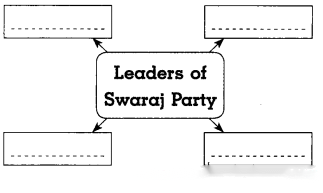
(1) Pandit Motilal Nehru (2) Chittaranjan Das.
Complete the graphical presentation :
Solution & Step-by-Step Answer:

Solution & Step-by-Step Answer:
Solution & Step-by-Step Answer:
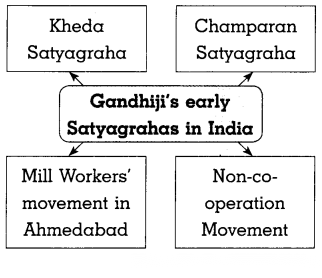
Answer the following questions in one sentence :
Solution & Step-by-Step Answer:
The principles of truth and non-violence gave new direction to the freedom movement.
Solution & Step-by-Step Answer:
Due to the constructive programme, the national movement became more comprehensive in rural areas.
Solution & Step-by-Step Answer:
Lala Lajpat Rai said that Every blow on my body will prove a nail in the coffin of the British Empire, when he was attacked by the British officer.
Write short note :
Solution & Step-by-Step Answer:
Solution & Step-by-Step Answer:
Solution & Step-by-Step Answer:
Solution & Step-by-Step Answer:
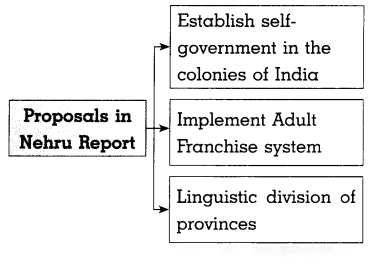
1. Berkenhead, the Secretary of State of India, criticised that Indian leaders were incapable of drafting a unanimously accepted constitution for India. 2. This challenge was taken up by all party committee under the chairmanship of Pandit Motilal Nehru. 3. The proposals of the Nehru Report were :
Explain the following statements with reasons :
Solution & Step-by-Step Answer:
Solution & Step-by-Step Answer:
Solution & Step-by-Step Answer:
Answer the following questions in 25-30 words :
Solution & Step-by-Step Answer:
Solution & Step-by-Step Answer:
Solution & Step-by-Step Answer:
Solution & Step-by-Step Answer:
Read the passage and answer the questions given below :

Solution & Step-by-Step Answer:
On 26th January 1930, people all over the country took the pledge for carrying out of freedom movement with non-violent means for attainment of independence of India.
Solution & Step-by-Step Answer:
1. The objective of Dominion Status was not acceptable to Pandit Nehru, Subash Chandra Bose and other young leaders. 2. Due to their influence, the resolution of demanding complete independence i.e. ‘Poorna Swaraj’ was passed in the Lahore session.
Solution & Step-by-Step Answer:
Answer the following in detail :
Solution & Step-by-Step Answer:
Points : (a) Preceding events (b) Massacre (c) Reactions
(a) Preceding events :
(b) Massacre :
(c) Reactions :
Solution & Step-by-Step Answer:
Solution & Step-by-Step Answer:
Therefore it is necessary to implement constructive programme in present times.