Maharashtra State Board Class 8 History Solutions Chapter 2 Europe and India
Class 8 History Chapter 2 Europe and India Textbook Questions and Answers
1. Rewrite the statements by choosing the appropriate options:
Solution & Step-by-Step Answer:
(b) Constantinople
Solution & Step-by-Step Answer:
(a) England
Solution & Step-by-Step Answer:
(b) Mir Kasim
2. Explain the following concepts:
Solution & Step-by-Step Answer:
1. Exploitation of one country by another and making it into a colony is called Colonialism. 2. On the basis of economic and military strength one country occupies a region of another country and establishes its political supremacy. 3. Many European nations established their colonies in various parts of the continents of America, Asia, Africa and Australia. 4. They grabbed the power by using force to exploit the colonies systematically. This gave rise to Imperialism.
Solution & Step-by-Step Answer:
Solution & Step-by-Step Answer:
(1) Renaissance literally means rebirth or revival. In the latter phase of medieval Europe, reformation, religious reform movement and geographical discoveries gained momentum. (2) It was a comprehensive movement which touched all aspects of human life. The Greek and Roman traditions in art, architecture and philosophy were revived in the Age of Renaissance. (3) Humanitarianism got great impetus. (4) Renaissance inspired all round progress and ushered a new era in the history of world. (5) This developments took place from 13th century to 16th century in Europe. This period is known as the Age of Renaissance.
Solution & Step-by-Step Answer:
1. Many traders participated in the competition for trade with Asia after the discovery of the new sea routes to the east. 2. As it was not possible to carry out trade single-handedly, it was decided by the traders to pool their resources to raise capital for trade. 3. Many trading companies like the East India Company were formed. 4. Trade with Oriental countries was very profitable and responsible for economic prosperity. 5. The ruling powers gave protection and trade concessions to these companies. 6. This led to the accumulation of wealth in Europe. This wealth was used as capital for trade and commerce which gave rise to capitalism in Europe.
3. Explain the following statements with reasons:
Solution & Step-by-Step Answer:
1. The officers of the British East India Company misused the trade concessions and built fortification around the factory in Kolkata. 2. Siraj-ud-Daulah captured the factory at Kolkata. 3. This created discontent in England. 4. Robert Clive diplomatically bribed Mir Jafar, Commander in Chief of Nawab’s army and promised to make him Nawab of Bengal. 5. So. the Army of Siraj-ud-Daulah under the command of Mir Kasim did not join the battle against the British at Plassey in 1757 AD. 6. Thus, the British won the battle of Plassey by treachery and deceit.
Solution & Step-by-Step Answer:
Solution & Step-by-Step Answer:
1. With the discovery of new sea routes to the east, trade with oriental countries became very profitable. Thus, European trade prospered. 2. Competition for trade began among many European nations. 3. The traders pooled their resources and formed trading companies like the East India Company. 4. As this trade brought economic prosperity, the European rulers started giving military protection and trade concessions to these trading companies.
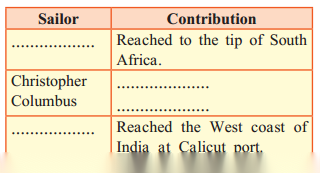
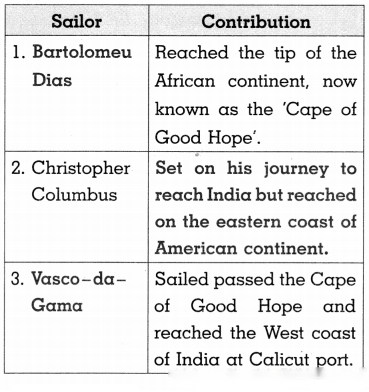
4. Complete the following table.
Solution & Step-by-Step Answer:
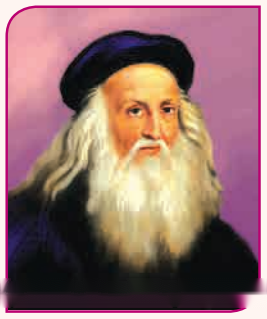
Leonardo Da Vinci :
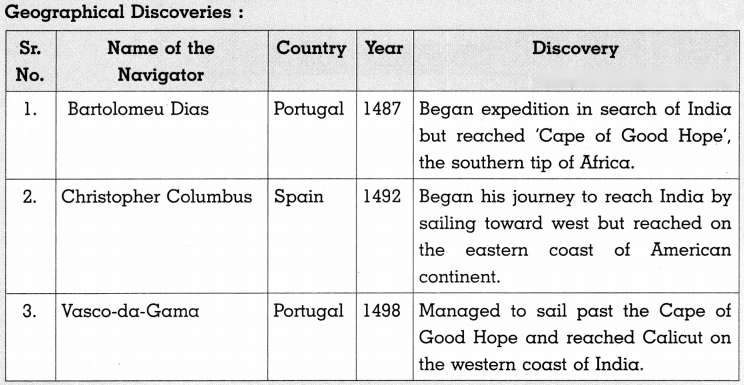
Let us Know:
Project:
Collect information and pictures about the work of famous painters, writers, scientists during renaissance period with the help of reference books and internet. Present a project on it in the classroom.
Class 8 History Chapter 2 Europe and India Additional Important Questions and Answers
Rewrite the statements by choosing the appropriate options:
Solution & Step-by-Step Answer:
(c) George Washington
Solution & Step-by-Step Answer:
(d) Surat
Solution & Step-by-Step Answer:
(a) Robert Clive
Solution & Step-by-Step Answer:
(c) Srirangapatna
Solution & Step-by-Step Answer:
(a) Multan
Solution & Step-by-Step Answer:
(c) Vasco-da- Gama
Solution & Step-by-Step Answer:
(b) thirteen
Name the following:
Solution & Step-by-Step Answer:
Johannes Gutenberg
Solution & Step-by-Step Answer:
Byzantine
Solution & Step-by-Step Answer:
Bill of Rights
Solution & Step-by-Step Answer:
Emperor Jahangir
Solution & Step-by-Step Answer:
England.
Answer the following in one sentence:
Solution & Step-by-Step Answer:
In the history of Europe, the last phase of medieval period i.e. 13th to century in Europe is known as the Period of Renaissance.
Solution & Step-by-Step Answer:
The Renaissance, the Reformation and the geographical discoveries laid the foundation of the modern era.
Solution & Step-by-Step Answer:
It became possible to take new ideas, new concepts and knowledge to all the sections of society due to the invention of the printing press.
Solution & Step-by-Step Answer:
Individual freedom and rationalism gained importance in the area of religion due to the Reformation movement.
Solution & Step-by-Step Answer:
The French Revolution gave the principles of liberty equality and fraternity to the world.
Solution & Step-by-Step Answer:
The British established the East India Company to carry out trade in India.
Solution & Step-by-Step Answer:
Due to American War of Independence, a new nation known as the United States of America with a federal government, written constitution and based on the principles of democracy was formed.
Do as Directed:
1. Complete the concept Map:
Solution & Step-by-Step Answer:
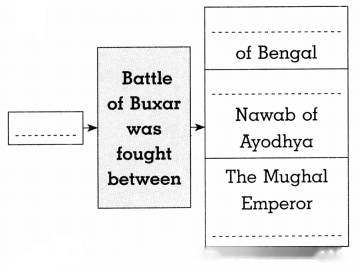
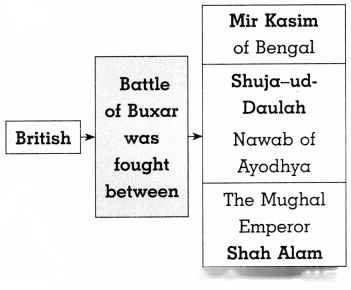
Solution & Step-by-Step Answer:
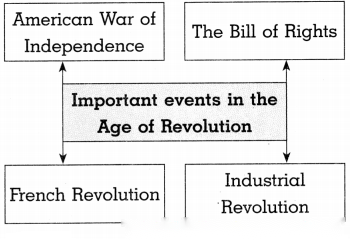
2. Arrange the following events in chronological order on timeline:
1. Battle of Srirangapatna
2. Second Anglo-Sikh War
3. Battle of Buxar
4. Battle of Plassey
Answer:
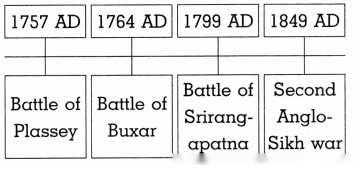
Write short notes:
Solution & Step-by-Step Answer:
Solution & Step-by-Step Answer:
Solution & Step-by-Step Answer:
Explain the following statements with reasons:
Solution & Step-by-Step Answer:
1. The British Parliament passed The Bill of Rights in 1689. It established sovereignty of Parliament and curtailed powers of the King. 2. This gave momentum to the development of Parliamentary Democracy in England. 3. The thirteen British colonies in America won the War of Independence in 1783. 4. These thirteen colonies established the first federal republic, known as the United States of America. 5. The people of France revolted against the unjust and uncontrolled monarchy and feudalism. They established a Republic. 6. The Industrial Revolution in Europe in the latter part of the 18th century brought revolutionary changes in Europe. 7. These changes had long-lasting effect on the entire world. 8. All these revolutionary events took place during 18th and 19th century period. Hence it is known as the ‘Age of Revolutions’.
Solution & Step-by-Step Answer:
Solution & Step-by-Step Answer:
Answer the following questions in 25 to 30 words:
Solution & Step-by-Step Answer:
Solution & Step-by-Step Answer:
Solution & Step-by-Step Answer:
Solution & Step-by-Step Answer:
Solution & Step-by-Step Answer:
Solution & Step-by-Step Answer:
Solution & Step-by-Step Answer:
Answer the following questions in detail: (4 marks each)
Solution & Step-by-Step Answer:
The foundation of Renaissance period was laid between 13th century and 16th century in Europe.
Solution & Step-by-Step Answer:
1. After the discovery of American continent, the imperialist European powers took control of different regions of America and established their colonies. 2. England established 13 colonies on the East coast of America. 3. Initially, England kept nominal domination but later British Parliament laid oppressive restrictions and taxes on the colonies. 4. This created discontent among the people and the colonies revolted. 5. George Washington led the American army in the war against England. 6. The colonies won the war and established the first federal democratic republic, known as the United States of America. 7. USA became the first country in the world to have a written constitution and was based on the principles of Democracy.
Solution & Step-by-Step Answer:
With changing times we find changes in every field. Religious reforms are part of this process. I feel the following are the advantages of Religious Reforms Movement.