Maharashtra State Board Class 7 Science Solutions Chapter 17 Effects of Light
Class 7 Science Chapter 17 Effects of Light Textbook Questions and Answers
1. Fill in the blanks.
Question a.
When the beams from the headlights of a car fall on an object in the night, the shadows – called ………. and …………. can be seen.
Answer:
umbra, penumbra
Question b.
During a lunar eclipse the shadow of the …………. falls on the ………..
Answer:
earth, moon
Question c.
During a solar eclipse the shadow of the ………. falls on the ………….
Answer:
moon, earth
Question d.
Various shades of colour are seen in the sky at sunrise and sunset due to ………...
Answer:
scattering of light
2. Give reasons.
Question a.
Space beyond the earth’s atmosphere appears dark.
Answer:
Question b.
We are able to read while sitting in the shade.
Answer:
Question c.
We should not observe the solar eclipse with naked eyes.
Answer:
3. Give some examples of scattering of light that we come across in day to day life.
Question a.
Give some examples of scattering of light that we come across in day to day life.
Answer:
4. Why is the shadow of a bird flying high not seen on the earth?
Question a.
Why is the shadow of a bird flying high not seen on the earth?
Answer:
5. Why is a penumbra not obtained from a point source?
Question a.
Why is a penumbra not obtained from a point source?
Answer:
6. Answer the following questions in your own words.
Question a.
What is meant by scattering of light?
Answer:
Question b.
Does the shadow really vanish in the zero shadow condition?
Answer:
1. Yes, the day on which the sun reaches exactly overhead, at noon, shadow completely disappears.
‘This event can be seen in the region between the Tropic of Cancer (23.5°N) and Tropic of Capricorn (23.5°S).
2. The shadow diminishes and eventually disappears for a while only to reappear later.
Question c.
Will the laser beam be seen if it passes through a glass box which contains a lighted incense stick?
Answer:
Yes, it will be seen.
7. Discuss and write:
Question a.
Write a science based paragraph on ‘What if the sun did not rise’?
Answer:
Question b.
What efforts will you make to remove the misconceptions about eclipses?
Answer:
Solar, lunar eclipse have been traditionally observed as an ominous sign and therefore superstitions are prevalent in association with these natural phenomena.
1. All these misconceptions should be removed by explaining scientifically the process of eclipse how it happens: (a) Explain with the help of diagram and models of sun, moon and earth, (b) Explain how special glasses which will protect us from UV rays, and excess heat can be used to observe eclipses safely.
2. Also inform that eclipses are natural phenomena and can be predicted in advance.
Question c.
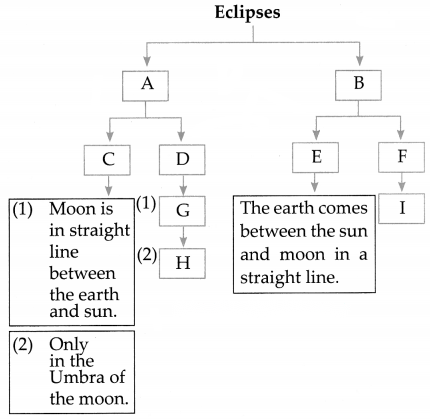
Various eclipses and the conditions during that period.
Answer:
There are two eclipses:
1. Solar eclipse:
There are two types of Solar eclipse, (a) Total solar eclipse (b) Partial solar eclipse
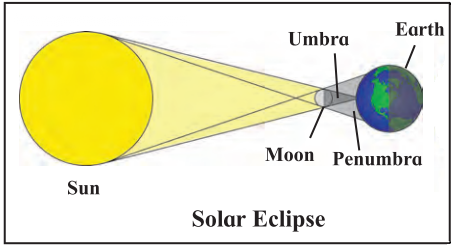
a. Total solar eclipse: In total solar eclipse, the moon is between the sun and the earth and the moon shadow covers the sun disc fully by perfect alignment. The part of the earth that lies in the umbra of the moon experiences total solar eclipse.
b. Partial solar eclipse: In partial solar eclipse, the moon is between the sun and the earth arid the moon shadow does not cover the sun disc fully, because of imperfect alignment. The part of the earth that lies in the penumbra of the moon experiences partial solar eclipse.
c. The solar eclipse occur on a new moon day.
d. Solar eclipse last for few minutes.
2. Lunar eclipse:
There are two types of Lunar eclipse, (a) Total lunar eclipse (b) Partial lunar eclipse
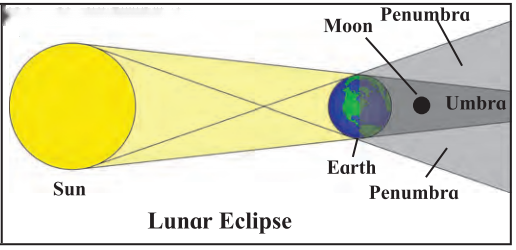
a. Total lunar eclipse: In total lunar eclipse, the earth comes in between the sun and the moon and the earth’s shadow covers the moon’s surface fully because of perfect alignment.
b. Partial lunar eclipse: In partial lunar eclipse, the earth’s shadow does not cover the moon’s surface fully because of inperfect alignment. A small part of the moon’s surface is covered by umbra part of earth’s shadow.
c. The lunar eclipse occurs on a full moon night.
d. Lunar eclipse last for few hours.
8. Explain the difference:
Question a.
Point sources and Extended sources.
Answer:
Point sources | Extended sources |
1. A source of radiation light that is concentrated at a point and considered as having no spatial extension. | 1. An extended source is a source consisting of many point sources separated internally. |
2. Shadow we get from a point source is dark called umbra. | 2. Shadow we get from extended source of light is faint called penumbra and dark called umbra |
Question b.
Umbra and Penumbra.
Answer:
Umbra | Penumbra |
1. The umbra is a central core of darkness which tapers away. | 1. The penumbra is an outer cone of partial shadow which diverges, instead of tapering. |
2. Umbra is shadow formed from a point source of light. | 2. It is the shadow formed from the extended source of light. |
3. It is dark | 3. It is faint |
4. Umbra is the area of total shadow | 4. Penumbra is the area of partial shadow. |
Project:
Question a.
Obtain information about the special goggles used to watch a solar eclipse.
Class 7 Science Chapter 17 Effects of Light Important Questions and Answers
Fill in the blanks.
Give scientific reasons:
Explain the difference:
Solar eclipse | Lunar eclipse |
1. When the moon comes between the sun and the earth, a shadow of the moon is cast on the earth and sun cannot be seen from the part in shadow. This is called a solar eclipse. | 1. When the earth comes between the sun and the moon a shadow of the earth is cast on the moon and a part of the moon in covered this is called the lunar eclipse. |
2. A solar eclipse is seen only on a new moon day. | 2. A lunar eclipse is seen only on a full moon night. |
3. A solar eclipse should never be watched with the naked eye. because ultra violate rays which are harmful to us reach the earth | 3. A lunar eclipse can be seen with the naked eye. |
4. It can be seen for a few minutes only. | 4. It can be seen over a period of a few hours. |
Explain diagrams:
Apparatus: A table lamp with a 60 or 100 W milky bulb (LED will not do), thick black paper, sticking tape, a packing needle, 100/200 ml. glass beaker, milk or milk powder, dropper, spoon, etc.
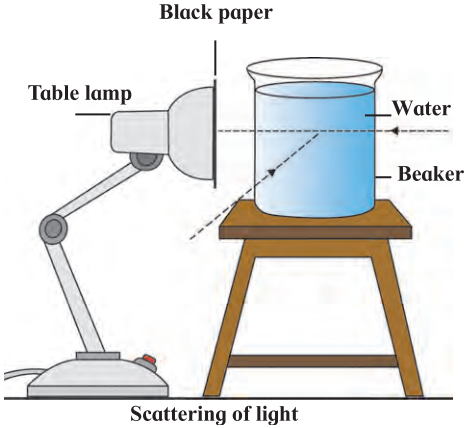
Procedure: Cover the mouth of the lampshade properly with black paper, using sticking tape. Prick a hole of 1 to 2mm diameter in the center of the paper with the help of the packing needle.
Use your brain power!
Answer the following questions:
Find Out:
Answer the following questions:
Complete the Chart.