Maharashtra State Board Class 7 Science Solutions Chapter 16 Natural Resources
Class 7 Science Chapter 16 Natural Resources Textbook Questions and Answers
1. Describe natural resources with reference to the following 3 types:
Question a.
Mineral resources
Answer:
Mineral wealth has an important place among natural resources. The rocks on the earth are mainly made of minerals. These minerals can be obtained by mining. Minerals that contain a high proportion of metals are ores, (i) Minerals are formed from the magma in the earth’s crust and the lava from the eruption of volcanoes when they cool and get transformed into crystals e.g. magnetite, mica, (ii) Minerals get transformed from one form into another due to large changes in temperature and pressure e.g. Diamond, Graphite, (iii) There are 3 types of minerals according to their properties Non-metal minerals: e.g. mica, sulphur, potash, diamond.
Some important minerals and ores are Iron ore, manganese, bauxite, copper and mica.
Question b.
Forest resources
Answer:
Question c.
Ocean resources
Answer:
2. Write answers to the following questions in your own words.
Question a.
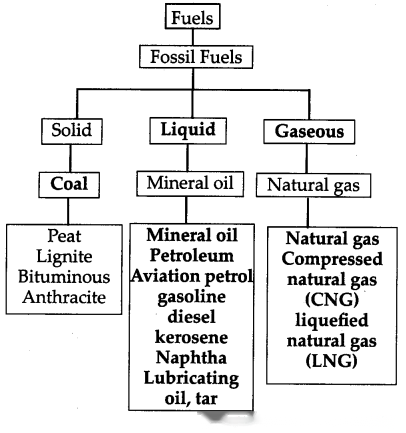
What is meant by fossil fuel? What are their types?
Answer:
a. Coal:
b. Mineral oil:
c. Natural gas:
Question b.
Make a list of the components we obtain from mineral oil.
Answer:
Question c.
What do we get from forest?
Answer:
Question d.
What are the items included in ocean resources? What are their uses?
Answer:
Bio-resources in oceans
Mineral resources from oceans
Question e.
Why should we prevent the wastage of fuels used for vehicles?
Answer:
Question f.
Why is the diversity of plants and animals in the forests declining?
Answer:
Question g.
Write the names of five minerals and the useful substances obtained from them.
Answer:
Some important minerals and ores are:
Question h.
Name the two important stages in the process of obtaining metals from ores.
Answer:
The two important stages in the process of obtaining metals from ores are extraction and purification.
3. What steps are taken for protection and conservation of natural resources?
Question a
What steps are taken for protection and conservation of natural resources?
Answer:
4. Complete the Flow Chart:
Question a.
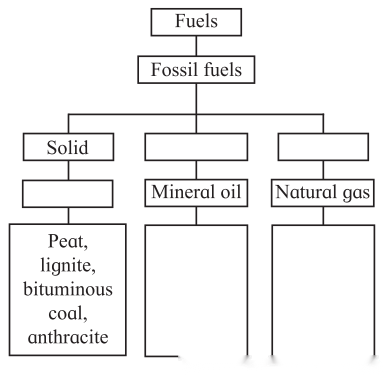
Answer:
5. How does the economic condition of a nation depend on its natural resources?
Question a.
How does the economic condition of a nation depend on its natural resources?
Answer:
1. Natural resources are a necessary condition for economic growth.
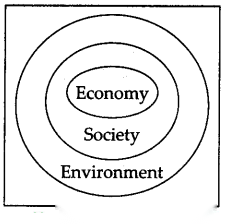
2. Three circles enclosed within one another shows how both economy and society are subsets of our planetary ecological system.
3. Natural resource economics deals with the supply, demand and allocation of the Earth’s natural resources.
4. Economic growth is an increase in the value of goods and services produced in an economy.
5. The natural resources of a country depend on the climatic and environmental conditions.
6. Countries having plenty of natural resources enjoy good growth than countries with small amount of natural resources.
7. A country having skilled and educated work force with rich natural resources takes the economy on the growth path, because skilled and educated people can efficiently utilize or exploit natural resources, e.g. Saudi Arabia: their economic growth is high, because they have oil wells.
8. All countries import fuel or oil from them so Saudi Arabia is economically a rich country.
6. Which medicinal plants will you grow on your school premises and near your house? Why?
Question a.
Which medicinal plants will you grow on your school premises and near your house? Why?
Answer:
1. I will grow tulsi, neem, lemon grass, bel, adulsa, periwinkle, cinnamon, ashwagandha, shatavari, amla, hirda, behda.
2. These plants are used for treatment of various diseases.
Project:
Question 2
Maharashtra Board Solution
Collect information about the mines of various minerals. |
Class 7 Science Chapter 16 Natural Resources Important Questions and
Fill in the blanks:
Question 1
Maharashtra Board Solution
………….. is the major raw material for biogas.
Solution & Step-by-Step Answer:
block bg-white dark:bg-slate-900/80 border-l-4 border-emerald-500 rounded-r-xl p-5 my-3 shadow-xs border border-slate-200/60 dark:border-slate-800">
Solution & Step-by-Step Answer:
cow dung
Question 2
Maharashtra Board Solution
Atomic energy is obtained by using ores of …………...
Solution & Step-by-Step Answer:
Uranium
Question 3
Maharashtra Board Solution
Biogas generation is mainly based on the principle of …………...
Solution & Step-by-Step Answer:
Fermentation
Question 4
Maharashtra Board Solution
Floods can be prevented by …………...
Solution & Step-by-Step Answer:
Afforestation
Question 5
Maharashtra Board Solution
Coal, petroleum, natural gas are ………….. resources.
Solution & Step-by-Step Answer:
non-renewable
Question 6
Maharashtra Board Solution
The total percent of land of world under forest cover is …………...
Solution & Step-by-Step Answer:
30%
Question 7
Maharashtra Board Solution
A naturally occurring substance …………...
Solution & Step-by-Step Answer:
minerals
Question 8
Maharashtra Board Solution
Minerals that contain a high proportion of metal are called …………...
Solution & Step-by-Step Answer:
ore
Question 9
Maharashtra Board Solution
Coal, mineral oil and natural gas are …………...
Solution & Step-by-Step Answer:
fossil fuel
Question 10
Maharashtra Board Solution
Deposits of common salt are also found in the earth. This salt is called …………...
Solution & Step-by-Step Answer:
rock salt
Question 11
Maharashtra Board Solution
………….. is the liquid fuel formed by the decomposition of organic substances.
Solution & Step-by-Step Answer:
Mineral oil
Question 12
Maharashtra Board Solution
The underground mineral oil is extracted through …………...
Solution & Step-by-Step Answer:
oil wells
Question 13
Maharashtra Board Solution
Mineral oil is also known as ………….. or …………...
Solution & Step-by-Step Answer:
petroleum, crude oil
Question 14
Maharashtra Board Solution
………….. are the preserved remains of dead organisms in rock.
Solution & Step-by-Step Answer:
Fossil
Question 15
Maharashtra Board Solution
Coal can be formed from …………...
Solution & Step-by-Step Answer:
Fossils
Question 16
Maharashtra Board Solution
Impurities of sand and soil in ore are called …………...
Solution & Step-by-Step Answer:
Gangue
Question 17
Maharashtra Board Solution
Coal mainly contains …………...
Solution & Step-by-Step Answer:
carbon
Question 18
Maharashtra Board Solution
Petroleum is formed from …………...
Solution & Step-by-Step Answer:
organisms in sea
Question 19
Maharashtra Board Solution
Separation of various fractions of petroleum is called …………...
Solution & Step-by-Step Answer:
Refining
Question 20
Maharashtra Board Solution
We can obtain minerals from rocks by …………...
Solution & Step-by-Step Answer:
mining
Question 21
Maharashtra Board Solution
………….. is the most important ore of aluminium
Solution & Step-by-Step Answer:
Bauxite
Question 22
Maharashtra Board Solution
………….. is the coal of the highest grade.
Solution & Step-by-Step Answer:
Anthracite
Question 23
Maharashtra Board Solution
Metals are obtained from their ore by ………….. and …………...
Solution & Step-by-Step Answer:
extraction, purification
Question 24
Maharashtra Board Solution
………….. is the largest oil and gas research and production company in India.
Solution & Step-by-Step Answer:
ONGC
Question 25
Maharashtra Board Solution
Natural gas is transformed under high pressure into ………….. and …………...
Solution & Step-by-Step Answer:
LNG and CNG
Question 26
Maharashtra Board Solution
The main component of Natural gas is …………...
Solution & Step-by-Step Answer:
Methane
Question 27
Maharashtra Board Solution
………….. and ………….. are used for adding fragrance in soaps and incense sticks.
Solution & Step-by-Step Answer:
Sandalwood and oil of Encalyptus
Question 28
Maharashtra Board Solution
………….. is a natural herbal medicine for cough and cold.
Solution & Step-by-Step Answer:
Adulsa
Answer the following:
Question 1
Maharashtra Board Solution
What is meant by natural resources?
Solution & Step-by-Step Answer:
Question 2
Maharashtra Board Solution
What are alternative fuels?
Solution & Step-by-Step Answer:
Hydrogen, biofuels, methanol or wood alcohol, ethanol or green alcohol are some of the alternative fuels.
Question 3
Maharashtra Board Solution
What is meant by fuels?
Solution & Step-by-Step Answer:
Question 4
Maharashtra Board Solution
Which natural resources do we use as fuels?
Solution & Step-by-Step Answer:
We use coal, mineral oil and natural gas as fuels.
Question 5
Maharashtra Board Solution
What is meant by forests?
Solution & Step-by-Step Answer:
An extensive area of land covered by a variety of plants is called a forest. A forest is a natural habitat of plants, animals and microbes.
Question 6
Maharashtra Board Solution
What are the uses of forests? OR Write short note on forest and its uses.
Solution & Step-by-Step Answer:
Question 7
Maharashtra Board Solution
Are minerals to be found in seas and on the seabed as they are found inside the earth?
Solution & Step-by-Step Answer:
Yes, there are very large reserves of tin chromium, phosphates, copper, zinc, iron, lead, manganese, sulphur, uranium etc. in the ocean and seabed.
Question 8
Maharashtra Board Solution
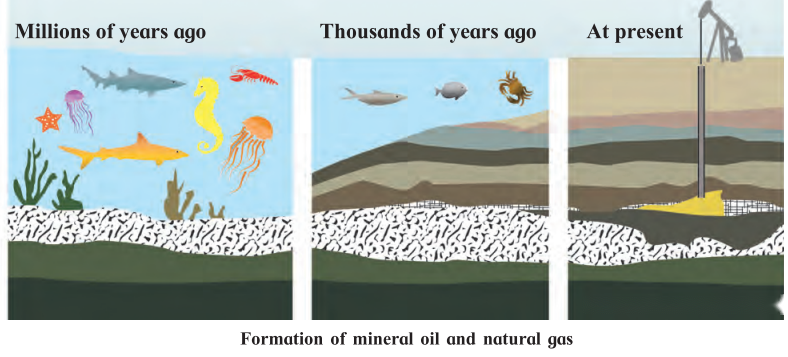
How is mineral oil formed?
Solution & Step-by-Step Answer:
Use your brain power!
Question 1
Maharashtra Board Solution
Why are all minerals not ores?
Solution & Step-by-Step Answer:
Question 2
Maharashtra Board Solution
What is meant by metal mineral and non¬metal mineral?
Solution & Step-by-Step Answer:
Question 3
Maharashtra Board Solution
Why is mineral oil called ‘liquid gold’?
Solution & Step-by-Step Answer:
Because of its high price and value and its economic need, the mineral oil is called liquid gold. It’s reserve is less and demand is more.
Question 4
Maharashtra Board Solution
Why is coal called black gold?
Solution & Step-by-Step Answer:
Question 5
Maharashtra Board Solution
What would happen if underground mineral resources are exhausted?
Solution & Step-by-Step Answer:
Question 6
Maharashtra Board Solution
Why is natural gas an eco-friendly fuel?
Solution & Step-by-Step Answer:
Question 7
Maharashtra Board Solution
What useful things will we have to do without if rubber is no longer available?
Solution & Step-by-Step Answer:
Question 8
Maharashtra Board Solution
What are the adverse effects of clearing of forest or cutting down trees?
Solution & Step-by-Step Answer:
Find out:
Question 1
Maharashtra Board Solution
How did the various ages of the prehistoric period get their names on the basis of the uses of metals.
Solution & Step-by-Step Answer:
1. The three-age system in history archaeology, and physical anthropology is a methodological concept adopted during the 19th century by which artifacts and events of late prehistory and early history could be ordered into a recognizable chronology.
2. Initially developed by C. J. Thomson, director of the Royal Museum of Nordic Antiquities, Copenhagen – as a means to classify the museum’s collection according to whether the artifacts were made of stone, bronze or iron. 3. Depending-upon the use of stone, bronze, iron, that period was known as stone age, bronze age, and iron age, respectively. Answer the following:
Question 1
Maharashtra Board Solution
Write down the difference between Metal minerals and Non-metallic minerals.
Solution & Step-by-Step Answer:
Question 2
Maharashtra Board Solution
Write down the different types of coal.
Solution & Step-by-Step Answer:
Peat, lignite (brown coal), bituminous coal and anthracite are various types of coal. Anthracite is the coal of the highest grade.
Question 3
Maharashtra Board Solution
Write down the characteristics of Compressed Natural Gas.
Solution & Step-by-Step Answer:
Characteristics of CNG:
Observe the pictures and answer the question.
Question a. Question b. Question c. Question d. |