Maharashtra State Board Class 7 Science Solutions Chapter 12 The Muscular System and Digestive System in Human Beings
Class 7 Science Chapter 12 The Muscular System and Digestive System in Human Beings Textbook Questions and Answers
1. Fill in the blanks with the right word from the brackets:
Question a.
The process of digestion starts from the ………….. (stomach, mouth).
Answer:
mouth
Question b.
Eyelids have …………… muscles. (voluntary, involuntary)
Answer:
involuntary
Question c.
……………. is not a function of muscular system. (production of blood cell, performing movement)
Answer:
Production of blood cells
Question d.
Muscles of the heart are ……………... (ordinary muscles, cardiac muscles)
Answer:
cardiac muscles
Question e.
Pushing forward the food that has been chewed is the function of the ……………. (stomach, oesophagus)
Answer:
Oesophagus.
2. Find a match for me.
Question a.
Column ‘A’ | Column B’ |
1. Cardiac muscle | a. Always functions in pairs |
2. Are brought about by muscle | b. We never feel tired |
3. Pepsin | c. Uncontrolled and painful contraction of muscles |
4. Cramps | d. Chewing movement of the jaw |
5. Skeletal muscles | e. Enzymes of the gastric juice |
3. Who is telling a lie?
Question a.
Organ | Statement |
1. Tongue | a. My taste buds can tell only a sweet taste. |
2. Liver | b. I am the largest gland in the body. |
3. Large intestine | c. I am 7.5 metre long. |
4. Appendix | d. Digestion is impossible without me |
5. Lung | e. I play an important role in excretion. |
Answer:
4. Give reasons.
So cardiac muscles are said to be involuntary muscles.
5. Answer the following.
Question a.
How many types of muscles are there? Which are those types?
Answer:
Muscles are bundles of fibres that can contract and relax as required. There are three types of muscles.
1. Skeletal muscles: (a) Skeletal muscles work with bones, the two ends of each of these muscles are attached to two different bones. (b) They are responsible for holding the bones of the skeleton together and giving shape to our body, (c) Skeletal muscles permits movement of t the body and maintain the posture of the body. (d) Skeletal muscle is voluntary e.g. muscles in our arms and legs are voluntary muscles, their action depends upon our will. That’s why they are called voluntary muscles.
2. Heart or cardiac muscles: (a) Heart or cardiac muscles bring about the contraction and relaxation (beating) of the heart. (b) Their movement is involuntary, (c) Cardiac muscles cause our heart to relax and contract continuously at a rate of about 70 times per minute, (d) Cardiac muscle is found in heart.
3. Smooth muscles: (a) These muscles are present in the internal organs other than the heart, e.g. muscles of the stomach, intestine, blood vessels, uterus etc. (b)Their movements are involuntary and slow, (c) They are not according to our will. (d) Various vital functions of our body such as digestion, respiration and movement of food material of which we remain quite unaware, are carried out by these special muscles.
Question b.
What causes the problem of acidity? What is its effect on the body?
Answer:
Question c.
Name the different types of teeth. What is the function of each type?
Answer:
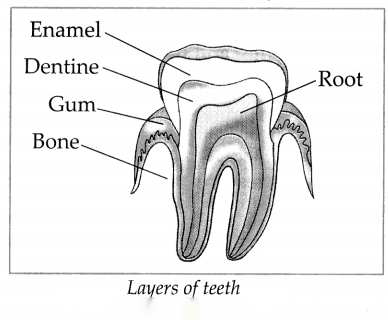
There are four types of teeth, namely incisors, canines, pre-molars, and molars.
Each tooth is covered by a hard substance called enamel. Enamel is made up of calcium salt.
The process of digestion begins with the function of the teeth in the mouth.
1. Incisors: (a) These come in first 6-months of age. Incisors are the eight teeth in the front and centre four on top and four on bottom, (b) They are sharp and blade like for cutting food. e.g. for biting an apple, (c) We use them to take first bite of food.
2. Canines: (a) These are strong and pointed, sharpest of all for tearing food. e.g. to tear off a piece of tough meat, (b) They play important role in digestion of food, (c) They appear between 11 and 20 months of age.
3. Pre-molar: Pre molar share features of both canines and molars. (a) You can use them for grinding and chewing food. So that it becomes semi-liquid helping to gulp down the throat easily, (b) They are situated at each side of your mouth in deep settings, (c) They appear at the age of 10 years.
4. Molar: (a) These are broad and flat on top for crushing and grinding food. e.g. to grind up nutmeats. (b) Two teeth above and two teeth below, they appear at the age 11-13 years. (c) Molars are more prone to germ attack because of their remote location in our mouth.
So we should keep them clean.
6. Sketch and label a diagram of the digestive system and describe it in your own words.
Question a.
Sketch and label a diagram of the digestive system and describe it in your own words.
Answer:
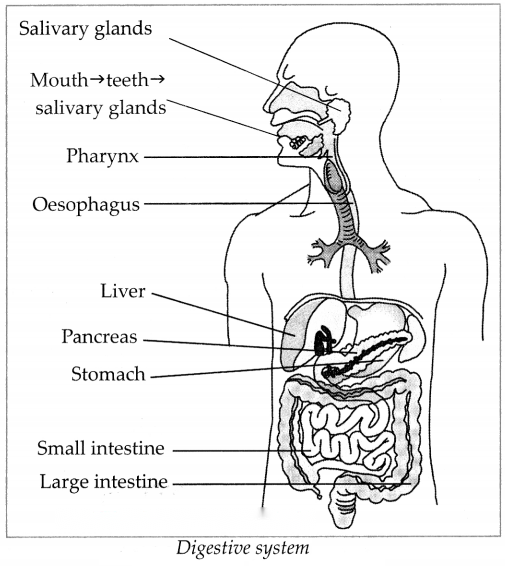
a. Oesophagus:
b. Stomach:
c. Small intestine: (6m long)
d. Large intestine: (1.5m long) only water is absorbed in the large intestine. Undigested remain is thrown out of the body through the anus.
Project:
Question 2
Maharashtra Board Solution
Design a power point presentation about the digestive system and present it in the class. |
Class 7 Science Chapter12 The Muscular System and Digestive System in Human BeingsImportant Questions and
Choose and write the correct word.
Question 1
Maharashtra Board Solution
The structure that connects bones to the muscles is the …………………... (a) ligament (b) tendon (c) fascicle (d) skin
Solution & Step-by-Step Answer:
block bg-white dark:bg-slate-900/80 border-l-4 border-emerald-500 rounded-r-xl p-5 my-3 shadow-xs border border-slate-200/60 dark:border-slate-800">
Solution & Step-by-Step Answer:
(b) tendon
Question 2
Maharashtra Board Solution
………………….. is not performed by muscles. (a) Motion (b) Excretion (c) Maintenance of posture (d) Heat production
Solution & Step-by-Step Answer:
(d) Heat production
Question 3
Maharashtra Board Solution
Approximately ………………….. skeletal muscles are there in the human body. (a) 1000 (b) 600 (c) 100 (d) 60
Solution & Step-by-Step Answer:
(b) 600
Question 4
Maharashtra Board Solution
Most of the fat digestion occurs in …………………... (a) rectum (b) stomach (c) small intestine (d) large intestine
Solution & Step-by-Step Answer:
(c) small intestine
Question 5
Maharashtra Board Solution
Protein digestion is accomplished in …………………... (a) stomach (b) ileum (c) rectum (d) duodenum
Solution & Step-by-Step Answer:
(b) ileum
Question 6
Maharashtra Board Solution
The main function of the muscular system is …………………... (a) excretion (b) digestion (c)movement (d) contraction
Solution & Step-by-Step Answer:
(c)movement
Question 7
Maharashtra Board Solution
The largest muscle of our body is in the …………………... (a) arm (b) face (c) thigh (d) None
Solution & Step-by-Step Answer:
(c) thigh
State whether True or False. Correct the false statement and rewrite:
Question 1
Maharashtra Board Solution
Saliva is mixed with food in the mouth.
Solution & Step-by-Step Answer:
True.
Question 2
Maharashtra Board Solution
Gastric juice makes food alkaline.
Solution & Step-by-Step Answer:
False. Gastric juice makes food acidic.
Question 3
Maharashtra Board Solution
Pancreas is the largest gland in the body.
Solution & Step-by-Step Answer:
False. Liver is the largest gland in the body.
Question 4
Maharashtra Board Solution
Food becomes acidic in stomach.
Solution & Step-by-Step Answer:
True
Question 5
Maharashtra Board Solution
Cardiac muscles are said to be voluntary muscles.
Solution & Step-by-Step Answer:
False. Cardiac muscles are involuntary.
Question 6
Maharashtra Board Solution
Muscles contribute 60% of the weight of a healthy adult human body.
Solution & Step-by-Step Answer:
False. Muscles contribute almost 40% of the weight of a healthy adult human body.
Question 7
Maharashtra Board Solution
There are about 30 muscles in the human face.
Solution & Step-by-Step Answer:
True
Question 8
Maharashtra Board Solution
Muscles in our arms and legs have involuntary muscles.
Solution & Step-by-Step Answer:
False. Muscles in our arm and legs are voluntary muscles.
Question 9
Maharashtra Board Solution
Functions of organs like stomach, intestine, heart are carried out by voluntary muscles.
Solution & Step-by-Step Answer:
False. Functions of these organs are carried out by involuntary muscles.
Question 10
Maharashtra Board Solution
Smooth muscles are involuntary muscles.
Solution & Step-by-Step Answer:
True.
Question 11
Maharashtra Board Solution
The digestive function of the liver is to produce bile.
Solution & Step-by-Step Answer:
True.
Question 12
Maharashtra Board Solution
The muscular tissue has the ability to contract or shorten.
Solution & Step-by-Step Answer:
True.
Find a match for me.
Question 1
Maharashtra Board Solution
|
Column A’ | Column B’ |
1. Salivary gland | a. Making food acidic |
2. Liver | b. Regulation of sugar level |
3. Pancreas | c. Digestion of carbohydrates |
4. Stomach | d. Digestion of protein, fats, carbohydrate |