Maharashtra State Board Class 7 Science Solutions Chapter 11 Cell Structure and Micro-organisms
Class 7 Science Chapter 11 Cell Structure and Micro-organisms Textbook Questions and Answers
1. Answer the following questions.
Question a.
What is a cell?
Answer:
The cell is the fundamental, structural and functional unit of living organism.
Question b.
Name the different organelles in a cell.
Answer:
The nucleus, endoplasmic reticulum, Golgi bodies, lysosomes, mitochondria, vacuoles, plastids, chloroplasts are the different organelles in a cell.
Question c.
What are micro-organisms?
Answer:
The organisms which cannot be seen with our eyes but can only be observed under a microscope are called micro-organisms.
Question d.
Which are the different types of micro-organisms?
Answer:
Algae, fungi, bacteria, protozoa and viruses are various types of micro-organism. Some are unicellular and others are multicellular. Some of them are useful and some are harmful.
2. Fill in the blanks with the proper word.
Question a.
The organelle called the ……………. is present in the plant cells only.
Answer:
chloroplasts
Question b.
Garbage is converted into ……….. by microorganisms.
Answer:
fertilizer
Question c.
In the cell, photosynthesis is carried out with the help of …………….
Answer:
chloroplast
Question d.
An electron microscope is necessary for the study of ……………….
Answer:
micro-organism
Question e.
The process of preparing their own food in presence of sunlight and chloroplast by plants cells is known as ………...
Answer:
photosynthesis.
3. What is the difference between us?
Question a.
Plant cell and animal cell.
Answer:
Plant cell | Animal cell |
1. Plant cell has cell wall. | 1. Cell wall is absent in animal cell. |
2. Plant cell has definite shape due to presence of cell wall. | 2. Animal cell do not have definite shape. |
3. Plant cell has one big vacuole. | 3. Animal cells have many small vacuoles. |
4. Plant cell has chloroplast so they produce their own food. | 4. Animal cells do not have chloroplast, so they cannot produce their own food. |
5. Plant cell has plastids. | 5. Plastids are absent in animal cell. |
6. Centrosomes are absent in plant cell. | 6. Centrosomes are present near the nucleus. |
7. Lysosomes are absent in plant cell. | 7. Lysosomes are present in animal cell. |
Question b.
Prokaryotic cell and Eukaryotic cell
Answer:
Prokaryotic cell | Eukaryotic cell |
1. No well defined nucleus. | 1. Well defined nucleus with a nuclear membrane |
2. Ribosomes are small. | 2. Ribosomes are large. |
3. A single length of DNA is present. | 3. Several lengths of genetic materials (DNA) is present. |
4. No other cell organelles are present. | 4. Several organelles like mitochondria, chloroplasts, etc. are present. |
5. Examples: Bacteria, blue green algae | 5. Examples: Euglena, Amoeba, all plant and animal cells |
4. Sketch and describe in your on words, the plant cell and animal cell.
Question a.
Sketch and describe ¡n your on words, the plant cell and animal cell.
Answer:
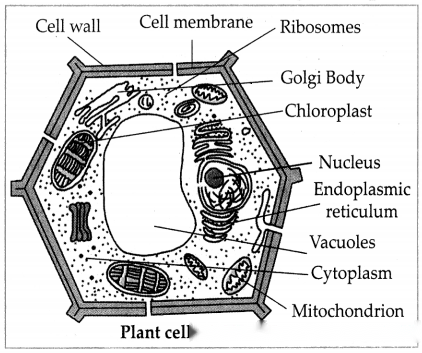
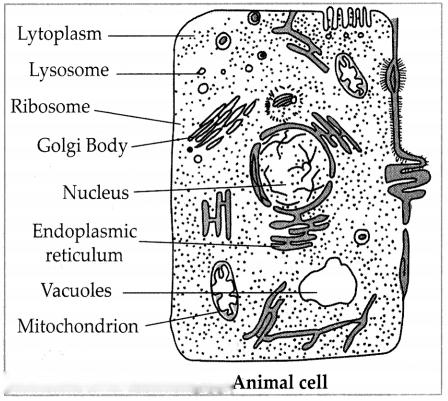
There are two types of cell-animal cells and plant cells. These cells contain various types of membrane beyond cell-organelles. Plant cells have a definite shape due to the presence of cell wall. Besides, unlike animal cells, plant cells contain single large vacuole. All these cells are known as eukaryotic cells. It cell has four main parts: the cell wall, cell membrane, cytoplasm and cell organelles.
1. Cell wall: The cell wall is the outermost covering of a cell. It is present only in plant cells.
2. Plasma membrane: The plasma membrane, also called the cell membrane, is a kind of thin covering, (a) It is extremely delicate and flexible, (b) It is the outermost covering of animal cells.
3. Cytoplasm: The liquid part in the cell, present around the nucleus is called cytoplasm, (a) It occupies the space between the plasma membrane and nucleus, (b) Cell organelles are scattered in the cytoplasm.
4. Cell organelles: These mainly include the nucleus, endoplasmic reticulum, Golgi bodies, lysosomes, mitochondria, vacuoles, plastids etc.
Plant cells contain chloroplasts.
(a) The nucleus is the most important organelle of the cell, (b) There is a porous double membrane around it. (c) The nucleus controls all functions of the cell, (d) The endoplasmic reticulum is a sprawling net-like organelle. Its function is to make necessary changes in the proteins produced by ribosomes and send them to the Golgi bodies, (e) Golgi bodies are made up of several flat sacs. Their function is the proper distribution of proteins.
(f) Mitochondria and plastids are organelles with double outer coverings, (g) As mitochondria produce energy, they are called the powerhouses of the cell, (h) The chloroplasts in plant cells carry out the function of photosynthesis, (i) Vacuoles help to throw out waste products of the cell, (j) Vacuoles in animal cells are small whereas there is only one large vacuole in a plant cell.
5. Explain the uses and the harmful effects of micro-organisms.
Question a.
Explain the uses and the harmful effects of, micro-organisms.
Answer:
Micro-organisms which are helpful are called useful micro-organisms.
Uses:
1. Micro-organisms present in nodules of leguminous plants, convert atmospheric nitrogen into its compounds and these compounds help to increase the soil fertility and protein content in the soil.
2. Some micro-organisms are useful in process of fermentation, making the food easily digestible and more nutritious. For producing milk products like butter, buttermilk, cheese, paneer, etc.
3. Microbes present in soil, dung etc. decompose garbage and convert into manure of best quality and surrounding is kept clean.
4. Microbes are also useful for sewage disposal. They help in decomposition of organic compounds in it.
5. Microbes are used in production of vaccines.
6. Microbes are also used in processes like tanning of skin, production of ropes and strings, from agave.
7. Some microbes use oil for their growth. Such microbes are used to clear a layer of oil floating on the surface of an ocean or lake formed due to leak or spill.
8. Farm waste, human urine and faeces, wet garbage etc. is collected and used in a biogas plant to produce biogas and fertilizer.
Harmful effects:
1. Disease producing micro-organisms are called pathogens, they are harmful micro-organisms.
2. Fungus grows on moist food, and microbes release enterotoxins into the food. Such toxins spoil the foods. Eating such spoiled food causes food poisoning i.e. loose motions and vomiting.
3. Pathogens may be present in water bodies contaminated with sewage, and dirt from surroundings, in food with flies sitting on it. If such contaminated food or water is consumed, we may fall ill with diseases like amoebiasis, typhoid, cholera, hepatitis, gastro, etc.
4. Pathogens are released in the air by a person having infection of the respiratory, sneezes or coughs. A healthy person may get infected by pathogens on breathing in the same air and contract diseases like common cold, cough, diphtheria, pneumonia, tuberculosis, etc.
5. Microbes that cause diseases like malaria, dengue, elephantiasis, yellow fever, chikunguniya, zike
fever etc. gain entry into the human body through the bite of a female mosquito.
6. Give reasons.
Question a.
Diseases spread on a large scale during periods of heavy rainfall and floods.
Answer:
Question b.
There is a possibility of food poisoning if we eat stale food.
Answer:
Question c.
Soil is turned over during tilling.
Answer:
Question d.
Fungus grows quickly in moist or humid condition.
Answer:
Question e.
A refrigerator is used in almost every home.
Answer:
Question f.
Bread rises during baking.
Answer:
Question g.
Fodder is soaked in water before offering to cattle.
Answer:
7. When will you use a simple microscope and when a compound microscope?
Question a.
When will you use a simple microscope and when a compound microscope?
Answer:
Project:
Class 7 Science Chapter11 Cell Structure and Micro-organismsImportant Questions and Answers
Fill in the blanks and rewrite the sentences:
Question 1
Maharashtra Board Solution
………… is the fundamental, structural and functional unit of living organism.
Solution & Step-by-Step Answer:
block bg-white dark:bg-slate-900/80 border-l-4 border-emerald-500 rounded-r-xl p-5 my-3 shadow-xs border border-slate-200/60 dark:border-slate-800">
Solution & Step-by-Step Answer:
Cell
Question 2
Maharashtra Board Solution
The four main parts of the plant cell are …………, …………, ………… and ………….
Solution & Step-by-Step Answer:
cell wall, cell membrane, cytoplasm, cell organelle
Question 3
Maharashtra Board Solution
Plant cell contains ………… which carry out the process of photosynthesis.
Solution & Step-by-Step Answer:
chloroplast
Question 4
Maharashtra Board Solution
…………… are called the power houses of the cell.
Solution & Step-by-Step Answer:
Mitochondria
Question 5
Maharashtra Board Solution
The outermost covering of plant cell is …………..
Solution & Step-by-Step Answer:
cell wall
Question 6
Maharashtra Board Solution
The outermost covering of animal cell is ………….
Solution & Step-by-Step Answer:
plasma membrane
Question 7
Maharashtra Board Solution
The ………… is the most important organelle of the cell.
Solution & Step-by-Step Answer:
nucleus
Question 8
Maharashtra Board Solution
………… is a national movement started several years ago to increase awareness about public hygiene and personal hygiene.
Solution & Step-by-Step Answer:
Swach Bharat Abhiyan
Question 9
Maharashtra Board Solution
The body temperature of a healthy human being is about ………….
Solution & Step-by-Step Answer:
37°C
Question 10
Maharashtra Board Solution
Micro-organisms use food stuffs for their own nutrition and release toxic materials called ………..
Solution & Step-by-Step Answer:
enterotoxins
Name the following:
Question 1
Maharashtra Board Solution
An instrument used to observe cells.
Solution & Step-by-Step Answer:
Microscope
Question 2
Maharashtra Board Solution
I control the function of a cell.
Solution & Step-by-Step Answer:
Nucleus
Question 3
Maharashtra Board Solution
I am like a policeman. I do not allow anything and everything to get in and out of the cell.
Solution & Step-by-Step Answer:
Cell membrane
Question 4
Maharashtra Board Solution
Outermost layer of the plant cell.
Solution & Step-by-Step Answer:
Cell wall
Question 5
Maharashtra Board Solution
Outermost layer of the animal cell.
Solution & Step-by-Step Answer:
Cell membrane
Question 6
Maharashtra Board Solution
I am the jelly like substance containing all the organelles.
Solution & Step-by-Step Answer:
Cytoplasm
Question 7
Maharashtra Board Solution
I contain thread like structures called chromosome.
Solution & Step-by-Step Answer:
Nucleus
Question 8
Maharashtra Board Solution
Which part of the cell contain organelles.
Solution & Step-by-Step Answer:
Cytoplasm
Question 9
Maharashtra Board Solution
The unit of measurement used for expressing dimension, size of the cell.
Solution & Step-by-Step Answer:
Nanometer, micrometer
Question 10
Maharashtra Board Solution
The power house of the cell.
Solution & Step-by-Step Answer:
Mitochondria
Question 11
Maharashtra Board Solution
Largest organelle in the plant cell.
Solution & Step-by-Step Answer:
Vacuole
Question 12
Maharashtra Board Solution
It is necessary for photosynthesis.
Solution & Step-by-Step Answer:
Chlorophyll
Question 13
Maharashtra Board Solution
The living substance in the cell.
Solution & Step-by-Step Answer:
Cytoplasm
Question 14
Maharashtra Board Solution
A group of cells.
Solution & Step-by-Step Answer:
Tissue
Question 15
Maharashtra Board Solution
Empty structures in cytoplasm.
Solution & Step-by-Step Answer:
Vacuole
State whether the following statements are True or False. Correct and rewrite the false statement:
Question 1
Maharashtra Board Solution
Cells can be easily seen with naked eyes.
Solution & Step-by-Step Answer:
False. We can’t see cells with naked eyes, can be seen under microscope
Question 2
Maharashtra Board Solution
A single cell can perform all the functions in a unicellular organism.
Solution & Step-by-Step Answer:
True
Question 3
Maharashtra Board Solution
Cell wall is present in both plant cells and animal cells.
Solution & Step-by-Step Answer:
False. Cell wall is present only in plant cell
Question 4
Maharashtra Board Solution
Vacuoles are not found in plant cell.
Solution & Step-by-Step Answer:
False. Large vacuole is found in plant cell
Question 5
Maharashtra Board Solution
Tissue is a group of dissimilar cells.
Solution & Step-by-Step Answer:
False. Tissue is a group of similar cells.
Question 6
Maharashtra Board Solution
Unicellular organisms have one celled body.
Solution & Step-by-Step Answer:
True.
Question 7
Maharashtra Board Solution
The basic living unit of an organism is an organ.
Solution & Step-by-Step Answer:
False. The basic living unit of an organism is the cell.
Question 8
Maharashtra Board Solution
The unit of measurement used for expressing dimension size of the cell is centimetre.
Solution & Step-by-Step Answer:
False. It is nanometer.
Question 9
Maharashtra Board Solution
Micro-organism cannot grow in extreme adverse conditions.
Solution & Step-by-Step Answer:
False. Some micro-organisms can survive in extreme adverse conditions e.g. ocean floor, ice polar region, hot water spring.
Question 10
Maharashtra Board Solution
Some micro-organisms can grow without oxygen.
Solution & Step-by-Step Answer:
True
Question 11
Maharashtra Board Solution
Amoeba has irregular shape.
Solution & Step-by-Step Answer:
True
Question 12
Maharashtra Board Solution
The process of fermentation is used for making yogurt from milk.
Solution & Step-by-Step Answer:
True
Question 13
Maharashtra Board Solution
Micro-organisms need an optimum temperature of 55°C to 70°C to grow.
Solution & Step-by-Step Answer:
False. They need temperatures between 15°C to 35°C to grow well.
Question 14
Maharashtra Board Solution
Cells with membrane bound organelles inside them are called prokaryotic cells.
Solution & Step-by-Step Answer:
False. Cells with membrane bound organelles inside them are called eukaryotic cells.
Question 15
Maharashtra Board Solution
Golgi bodies are the power houses of the cells.
Solution & Step-by-Step Answer:
False. Mitochondria are the power houses of the cell.
Choose the correct word.
Question 1
Maharashtra Board Solution
Which one of the following terms is not a part of the nucleus? (a) ribosome (b) DNA (c) chromosome (d) gene
Solution & Step-by-Step Answer:
(a) ribosome
Question 2
Maharashtra Board Solution
A suitable term for the various components of cell is. (a) tissue (b) cell organelle (c) chromosome (d) gene
Solution & Step-by-Step Answer:
(b) cell organelle
Question 3
Maharashtra Board Solution
The jelly like fluid substance present in the cells is called. (a) protoplasm (b) chromosome (c) chloroplast (d) cytoplasm
Solution & Step-by-Step Answer:
(d) cytoplasm
Question 4
Maharashtra Board Solution
The units of measurement used for expressing dimension size of the cell are, (a) centimetre (b) micrometre (c) nanometre (d) metre
Solution & Step-by-Step Answer:
(c) nanometre, (b) micrometre.
Question 5
Maharashtra Board Solution
The largest cell in the human body (a) nerve (b) muscle (c) liver (d) kidney
Solution & Step-by-Step Answer:
(a) nerve
Question 6
Maharashtra Board Solution
The barrier between protoplasm and other environment in animal cell (a) plasma membrane (b) cell wall (c) nucleus membrane
Solution & Step-by-Step Answer:
(a) plasma membrane
Question 7
Maharashtra Board Solution
The term cell wall is given by (a) Leeuwenhoek (b) Robert Hooke (c) Fleming
Solution & Step-by-Step Answer:
(b) Robert Hooke
Question 8
Maharashtra Board Solution
The cell theory was proposed by. (a) Watsonar Cricks (b) Schleiden (c) Schwann (d) Mengal Morgan
Solution & Step-by-Step Answer:
(b) Schleiden, (c) Schwann.
Question 9
Maharashtra Board Solution
Which of the following features will help you in distinguishing a plant cell from an animal cell. (a) cell wall (b) cell membrane (c) mitochondria (d) nucleus
Solution & Step-by-Step Answer:
(a) cell wall
Question 10
Maharashtra Board Solution
The gas released during the preparation of bread, (a) O2 (b) CO2 (c) nitrogen (d) sulphur oxide
Solution & Step-by-Step Answer:
(b) CO2
Question 11
Maharashtra Board Solution
The structural-functional unit of life is called. (a) cell (b) tissue (c) organ (d) organism
Solution & Step-by-Step Answer:
(a) cell
Question 12
Maharashtra Board Solution
Which organelle is called power house of the cell? (a) centrosome (b) lysosome (c) plastid (d) mitochondria
Solution & Step-by-Step Answer:
(d) mitochondria
Question 13
Maharashtra Board Solution
Living substance of cell is called. (а) cytoplasm (b) protoplasm (c) nucleus (d) chromosome
Solution & Step-by-Step Answer:
(а) cytoplasm
Give scientific reasons:
Question 1
Maharashtra Board Solution
Mitochondria are called the power houses of the cell.
Solution & Step-by-Step Answer:
Question 2
Maharashtra Board Solution
A compound microscope is used for observing cells.
Solution & Step-by-Step Answer:
Question 3
Maharashtra Board Solution
Cells are the basic structural units of living organism.
Solution & Step-by-Step Answer:
Answer the following in short:
Question 1
Maharashtra Board Solution
What is a vaccine?
Solution & Step-by-Step Answer:
Vaccine is a live micro-organism which is weak but in a very small amount, and is injected into a person so that antibodies are produced against that micro-organism.
Question 2
Maharashtra Board Solution
What are the similarities between the Plant cell and Animal cell?
Solution & Step-by-Step Answer:
They both have cell membrane, cytoplasm, nucleus, ribosomes, golgi bodies, mito-chondria, vacuoles and chromosomes.
Question 3
Maharashtra Board Solution
What do micro-organisms need for growth?
Solution & Step-by-Step Answer:
Micro-organisms need soil, water and decaying material. Temperature suitable for microbial growth is 15 to 35°C moist, humid and warm climate.
What is the difference between us:
Question 1
Maharashtra Board Solution
Simple microscope and Compound microscope.
Solution & Step-by-Step Answer:
Answer in details:
Question 1
Maharashtra Board Solution
Explain the functions of organelles in a cell.
Solution & Step-by-Step Answer:
1. Functions of cell wall: It consist of cellulose. It is present in plant cell only. It is a protective layer outside the cell membrane. It provides structural support and protection.
2. Function of cell membrane: It controls the movement of substances in and out of the cell. It protect the cell from its surrounding. 3. Function of cytoplasm: It is the jelly like liquid, it occupies space between cell membrane and nucleus. All the organelles are scattered in it. 4. Function of Nucleus: It is the brain of the cell. It directs all cell activities, and contains genetic material called chromosomes made of DNA. 5. Function of mitochondria: It is the power house of cell. It produces energy in the form of ATP from the food. 6. Vacuoles: It is the largest organelle in the plant cell surrounded by membrane. It holds material and waste. It maintains proper pressure. It helps to throw out waste products of cell. Explain:
Question 1
Maharashtra Board Solution
Ram ate chaat from a street hawker, when he reached home he fell ill and complained of stomach ache. What could be the reason?
Solution & Step-by-Step Answer:
Question 2
Maharashtra Board Solution
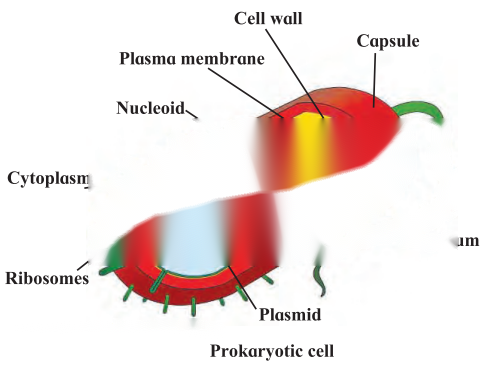
With the help of diagram describe Prokaryotic cell.
Solution & Step-by-Step Answer:
Question a.
Question b.
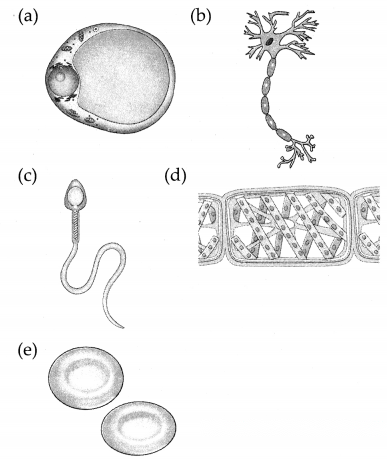
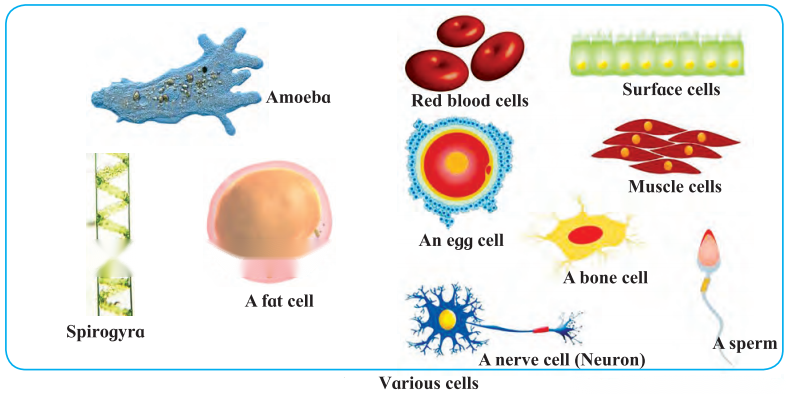
Name the types of cells shown in the diagrams.
Question 1
Maharashtra Board Solution
Solution & Step-by-Step Answer:
(a) A fat cell (b) A nerve cell (c) A sperm cell (d) Spirogyra (e) Red Blood cells
Try this: Answer the following questions:
Question 1
Maharashtra Board Solution
Keep a moistened piece of bread or bhakari in a closed box. What will you observe after 3-4 days?
Solution & Step-by-Step Answer:
Question 2
Maharashtra Board Solution
Observe a drop of muddy water or water from a stagnant puddle, under the compound microscope.
Solution & Step-by-Step Answer:
Question 3
Maharashtra Board Solution
Take a drop of yoghurt or buttermilk on a glass slide and observe it under a compound microscope.
Solution & Step-by-Step Answer:
Find out: Answer the following questions:
Question 1
Maharashtra Board Solution
Which diseases do micro-organism cause in plants and animals?
Solution & Step-by-Step Answer:
Diseases caused by micro-organism in plants and animals are:
Question 2
Maharashtra Board Solution
Why are infants vaccinated according to fixed time schedule?
Solution & Step-by-Step Answer:
Vaccination is done to protect the child against diseases. 1. If a baby is vaccinated by true vaccine schedule, that baby will have immunity to over 14 diseases by the age of two. With the recommended schedule, babies visit their doctor 5 times in the first 15 months and receive protection against upto 14 diseases in as little as 18 shots. 2. We immunize children so young against these diseases because infancy is the time period that kids are most vulnerable to life threatening diseases. 3. It is not advisable to skip or delay vaccines as this will leave the child vulnerable to disease for a longer period of time.
Can you tell? Answer the following questions:
Question 1
Maharashtra Board Solution
Observe cells from various parts of plants like leaves, bark, root tips, etc.
Solution & Step-by-Step Answer:
Question a. Are the cells that you observed, all alike? Answer: No, all cells do not look alike, each one has different shape and size.
Question b.
Question 2
Maharashtra Board Solution
Observe the roots of the pea, bean and fenugreek plants. What could be the functions of the nodules on their roots.
Solution & Step-by-Step Answer:
Question 3
Maharashtra Board Solution
What happens if clothes remain damp in the rainy season?
Solution & Step-by-Step Answer:
Question 4
Maharashtra Board Solution
What are the black or white spots sometimes seen on gunny bags?
Solution & Step-by-Step Answer:
These spots are the growth of many microbes such as fungi, mucus, mold, etc.
Question 5
Maharashtra Board Solution
Why are leather articles like purses, wallets, belts, footwear always polished before storing away?
Solution & Step-by-Step Answer:
They are polished so as to protect them from the growth of fungus.
Question 6
Maharashtra Board Solution
What is the powdery material found on old currency notes or old rubber or paper?
Solution & Step-by-Step Answer:
Question 7
Maharashtra Board Solution
Why children are vaccinated?
Solution & Step-by-Step Answer:
Question 8
Maharashtra Board Solution
Try this and answer the following questions: |
In pot A | In pot B |
Soil + garden waste + dung + fruit peel vegetable stalks | Pieces of glass + scrap metal + plastic bags + Soil. |
Question a.
Did the garbage in pot B remain unchanged.
Question b.
Where did the garbage in pot ‘A’ disappear? Why?
Answer:
Question 9
Maharashtra Board Solution
What does your mother do to make yoghurt from milk?
Solution & Step-by-Step Answer:
Question 10
Maharashtra Board Solution
Who discovered the process of fermentation?
Solution & Step-by-Step Answer:
Use your brain power! Answer the following questions:
Question 1
Maharashtra Board Solution
How will you know that a foodstuff is spoilt?
Solution & Step-by-Step Answer:
Question 2
Maharashtra Board Solution
What precautions will you take while purchasing food? Why?
Solution & Step-by-Step Answer:
Question 3
Maharashtra Board Solution
Why do food poisoning incidents occur during marriage or other community feasts?
Solution & Step-by-Step Answer:
1. During marriage feast, food is prepared in very large quantity and food may not be properly washed or if it is cooked with water contaminated, with sewage or dirt which has many disease causing microbes, or the people handling the food may be having dirty hands
2. Also the utensils used for cooking and storing food may be dirty, contaminated with dirt and may produce microbes. The consumption of such food is responsible for food poisoning.
Question 4
Maharashtra Board Solution
How do the cells acquire definite shapes?
Solution & Step-by-Step Answer:
The cells acquire definite shapes due to the presence of cell wall.
Question 5
Maharashtra Board Solution
How are cells protected?
Solution & Step-by-Step Answer:
Question 6
Maharashtra Board Solution
What are the needs of cells?
Solution & Step-by-Step Answer:
Question 7
Maharashtra Board Solution
Can the point of a needle accommodate micro-organism?
Solution & Step-by-Step Answer:
Yes, they are smaller than the point of a needle.
Question 8
Maharashtra Board Solution
Why should dry and wet waste be collected separately?
Solution & Step-by-Step Answer:
Question 9
Maharashtra Board Solution
Why is yoghurt mixed in the batter or dough for making rava-idli, butter naan?
Solution & Step-by-Step Answer:
Question 10
Maharashtra Board Solution
How do preparation like yoghurt, idli, dosa become easy to digest?
Solution & Step-by-Step Answer:
Fermentation does detoxification and splits complex carbohydrates and proteins into simple ones. Thus, making it easy to digest.
Question 11
Maharashtra Board Solution
What is the co-relation between the normal body temperature of humans which is 37°C and the optimum temperature for the growth of micro-organism, 15 °C to 35 °C?
Solution & Step-by-Step Answer:
Question 12
Maharashtra Board Solution
How do micro-organism survive the adverse conditions?
Solution & Step-by-Step Answer:
|