Maharashtra Board Class 7 Civics Solutions Chapter 6 Directive Principles of State Policy and Fundamental Duties
Class 7 Civics Chapter 6 Directive Principles of State Policy and Fundamental Duties Textbook Questions and Answers
1. List the restrictions on the powers of the Government.
Answer:
Restrictions upon the powers of the Government are listed below:

2. Say ‘Yes’ or ‘No’.
Solution & Step-by-Step Answer:
Yes
Solution & Step-by-Step Answer:
No
Solution & Step-by-Step Answer:
Yes
Solution & Step-by-Step Answer:
Yes
3. Tell why:
Solution & Step-by-Step Answer:
Solution & Step-by-Step Answer:
Solution & Step-by-Step Answer:
4. Say right or wrong. Correct and write the wrong ones:
Solution & Step-by-Step Answer:
Right: It is our Fundamental Duty to respect the National Flag.
Solution & Step-by-Step Answer:
Right: It is our Fundamental Duty to respect our National Anthem.
Solution & Step-by-Step Answer:
Wrong: It is our Fundamental Duty to value and preserve the rich heritage of our composite culture.
Solution & Step-by-Step Answer:
Wrong: Fundamental Rights put restrictions on the power of the government and one of the restriction states that the state should not discriminate between and among citizens on the basis of gender amongst other things.
Solution & Step-by-Step Answer:
Right: It is our Fundamental Duty to safeguard public property.
5. Write about the following:
Solution & Step-by-Step Answer:
(i) The State should secure adequate means of livelihood to all citizens without any gender discrimination.
(ii) The State should secure equal pay for equal work for both men and women.
(iii) The State should secure the improvement of public health.
(iv) The State shall endeavour to protect and improve the environment and safeguard the forests and wild-life of the country.
(v) The State shall protect all monuments of historic interest and national importance.
(vi) The State shall promote with special care the educational and economic interests of the weaker sections of the people, especially the Scheduled Castes and Tribes.
(vii) The State shall offer public assistance to citizens in cases of unemployment, old age, sickness, etc.
(viii) The State shall secure a uniform civil code applicable to the entire country.
Solution & Step-by-Step Answer:
(i) The provision of a Uniform Civil Code for citizens in mentioned in the Constitution.
(ii) It aims to replace personal laws based on the customs and scriptures of the different religious communities living in India with a common set of laws, which is uniform to all the citizens of India.
Solution & Step-by-Step Answer:
(i) Directive Principles of State Policy and Fundamental Rights are two sides of the same coin.
(ii) Due to Fundamental Rights, citizens get the most needed liberty, while Directive Principles of State Policy creates an atmosphere conducive to the growth of democracy.
6. What are the ways in which citizens can conserve the environment ? Write with examples.
Answer:
There are various ways in which citizens can conserve the environment:
(i) Citizens can support the endeavour of the State to protect and improve the environment and safeguard the forests and wild-life of the country.
(ii) Citizens should collectively take responsible actions to protect and improve the natural environment we are a part of.
(iii) Citizens should put to an end cruelty towards animals and have compassion for living creatures.
Activities
Class 7 Civics Chapter 6 Directive Principles of State Policy and Fundamental Duties Additional Important Questions and Answers
Complete the sentence by choosing the appropriate words from the options given below:
Solution & Step-by-Step Answer:
Fundamental Rights
Solution & Step-by-Step Answer:
Fundamental Duties
Solution & Step-by-Step Answer:
excellence
Solution & Step-by-Step Answer:
religious taxes
Solution & Step-by-Step Answer:
fourteen
Say ‘Yes’ or ‘No’:
Solution & Step-by-Step Answer:
Yes
Solution & Step-by-Step Answer:
Yes
Name the following:
Solution & Step-by-Step Answer:
Fundamental Rights
Solution & Step-by-Step Answer:
Directive Principles of the State Policy
Solution & Step-by-Step Answer:
Establishing order, carrying out smooth administration.
Solution & Step-by-Step Answer:
State should secure equal pay for equal work for both men and women.
Solution & Step-by-Step Answer:
National Flag, National Anthem.
Solution & Step-by-Step Answer:
Practices derogatory to the dignity of women.
Solution & Step-by-Step Answer:
Scientific temper, Humanism, Spirit of inquiry and reform.
Say right or wrong with reason. Correct the write down the corrections:
Solution & Step-by-Step Answer:
Right: It is our Fundamental Duty.to defend the country, and to render national service when called upon to do so.
Solution & Step-by-Step Answer:
Right: It is one of the important Directive Principles of the State Policy.
Answer in one or two sentence:
Solution & Step-by-Step Answer:
Fundamental Rights restrains the State from discriminating between and among citizens on the basis of caste, religion, race, language or gender.
Solution & Step-by-Step Answer:
When India got independence the task of nation building had to be undertaken and for this new policies had to be drawn up.
Solution & Step-by-Step Answer:
It is included in the Directive Principles of the State Policy that the State shall endeavour to protect and improve the environment and safeguard the forest and wild-life of the country.
Solution & Step-by-Step Answer:
It is stated in the Directive Principles of the State Policy that State shall promote with special care the educational and economic interest of the weaker sections of the people, especially the Scheduled Castes and Tribes.
Solution & Step-by-Step Answer:
The State is expected to secure a Uniform Civil Code applicable to the entire country according to the Directive Principles of State policy.
Solution & Step-by-Step Answer:
If a Directive is not implemented by the Government, we can put pressure on the Government in various ways to make a policy in order to meet the goals.
Solution & Step-by-Step Answer:
The benefits of the various schemes of the government cannot reach all the people if they do not fulfil their Fundamental Duties.
Solution & Step-by-Step Answer:
Fundamental Duties were included in the Constitution so that the Indian citizens become conscious of their responsibilities.
Solution & Step-by-Step Answer:
It is mentioned in our Fundamental Duties that we should strive towards excellence in all spheres of individual and collective activity so that the nation can constantly rise to higher levels of endeavour and achievement.
Answer the following in brief:
Solution & Step-by-Step Answer:
There are various ways in which citizens can conserve the environment:
Solution & Step-by-Step Answer:
Fundamental Duties of the Indian citizens are as follows:
Give reason:
Solution & Step-by-Step Answer:
Solution & Step-by-Step Answer:
Solution & Step-by-Step Answer:
Give your own response:
Solution & Step-by-Step Answer:
The list of our demands are:
Solution & Step-by-Step Answer:
Can you tell?
Solution & Step-by-Step Answer:
(i) Right to Equality and the assurance that State shall not discriminate among citizens will be realised with this objective.
(ii) Due to lack of awareness of rights and no strict implementation of law, we witness gender discrimination at work.
Observe the Picture and answer the questions given below:
Which of the Fundamental Duties are not being followed in the situations above?
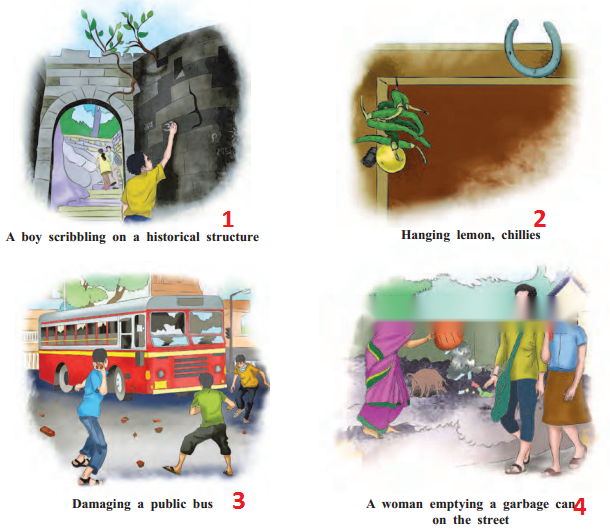
Solution & Step-by-Step Answer:
The duty to value and preserve the rich heritage of our composite culture.
Solution & Step-by-Step Answer:
The duty to develop the scientific temper, humanism and spirit of inquiry and reform.
Solution & Step-by-Step Answer:
The duty to safeguard public property and to abjure violence.
Solution & Step-by-Step Answer:
The duty to protect and improve the natural environment.
What do you think?
Solution & Step-by-Step Answer:
No I don’t think it is unfair to such children to insist that they go to school.
(i) Practising child labour is a form of exploitation and we have the Right against Exploitation which extends constitutional protection to children.
(ii) Similarly it is the Fundamental Duty of every citizen who is a parent or guardian to provide opportunities of education to his or her child or ward between the age of six and fourteen years.
Solution & Step-by-Step Answer:
(i) Public toilets :
(ii) Clean water supply:
(iii) Vaccination of children: