Maharashtra State Board Class 6 Science Solutions Chapter 7 Nutrition and Diet
Class 6 Science Chapter 7 Nutrition and Diet Textbook Questions and Answers
1. Fill in the blanks:
Question a.
The process of intake of food and utilizing it for all life processes is called ……………..
Answer:
nutrition
Question b.
All the substances in our food which are useful for various body processes are called ………….
Answer:
nutrients
Question c.
Carbohydrates and …………. provide …………… to our body.
Answer:
fats, energy
Question d.
In a balanced diet, all the nutrients are present in the ……………. proportion.
Answer:
right
Question e.
In the food pyramid, cereals are given the maximum space because they fulfill our …………… requirement.
Answer:
energy
Question f.
Intake of more food than necessary causes …………...
Answer:
overnutrition
2. Spot the following in the table of vitamins and minerals.
Question a.
The nutrient present in citrous fruits.
Answer:
Vitamin C
Question b.
Vitamins/minerals present in milk.
Answer:
Vitamin A, Vitamin B, Vitamin D, calcium, phosphorus.
Question c.
Causes and symptoms of night blindness, scurvy, rickets, beriberi.
Answer:
Diseases | Causes | Symptoms |
1. Night blindness | Deficiency of Vitamin A | Inability to see in dim light |
2. Scurvy | Deficiency of Vitamin C | Bleeding of gums |
3. Rickets | Deficiency of Vitamin D | Softening of bones |
4. Beri-beri | Deficiency of Vitamin B1 | Nerve disorder, muscle weakness |
Question d.
Foods required to prevent the above diseases.
Answer:
Diseases | *Causes | ‘Symptoms | Food for prevention |
1. Night blindness | Deficiency of Vitamin A | Inability to see in dim light | Carrots, milk, dark green vegetables. |
2. Scurvy | Deficiency of Vitamin C | Bleeding of gums | Amla, kiwi, oranges and citrus fruits. |
3. Rickets | Deficiency of Vitamin D | Softening of bones | Exposure to sunlight, milk, fish, egg, butter. |
4. Beri-beri | Deficiency of Vitamin B1 | Nerve disorder, muscle weakness | Milk, fish, meat, cereals, nuts, pulses |
Question e.
Causes of anaemia.
Answer:
Deficiency of Vitamin B12, iron.
Question f.
Essential mineral for healthy bones and teeth.
Answer:
Calcium, phosphorus.
Question g.
Sensory organ affected due to the deficiency of Vitamin A.
Answer:
Eyes, skin.
3. Choose the correct alternative.
Question a.
Pulses are a very good source of ……………..
(1) carbohydrates
(2) proteins
(3) fats
(4) minerals
Answer:
(2) proteins
Question b.
…………. provide maximum energy to our body.
(1) Cereals
(2) Leafy Vegetables
(3) Water
(4) Amla
Answer:
(1) Cereals
Question c.
Goitre is caused by the deficiency of ………...
(1) iron
(2) calcium
(3) iodine
(4) potassium
Answer:
(3) iodine
Question d.
……….. is a type of junk food.
(1) Orange
(2) Milk
(3) Bhakri
(4) Chocolate
Answer:
(4) Chocolate
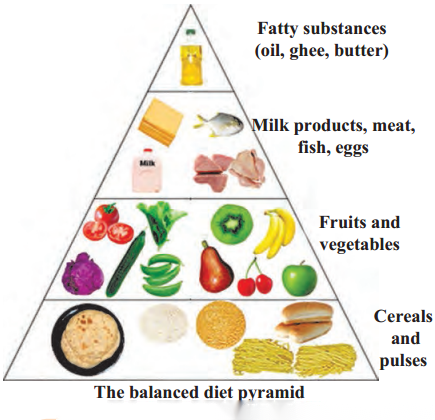
4. Use the food pyramid to select food items of your choice for three days.
Conditions:
1. The diet for all three days should be balanced.
2. There should be variety in the items chosen for the three days.
Answer:
Day 1:
Cereal like cornflakes and milk, apple, roti, sabzi and dal.
Day 2:
Bread and butter with milk, rice/ roti and chicken, curd, any one type of fruit, salad.
Day 3:
Poha, green vegetable and dal with rice or roti, raita, one fruit, vegetable sandwich.
Activity:
Class 6 Science Chapter7 Nutrition and DietImportant Questions and Answers
Choose the correct alternative:
Question 1
Maharashtra Board Solution
Vitamin ……………. and vitamin …………….. dissolve easily in water. (a) A, B (b) B, C (c) B, D (d) B, E
Solution & Step-by-Step Answer:
block bg-white dark:bg-slate-900/80 border-l-4 border-emerald-500 rounded-r-xl p-5 my-3 shadow-xs border border-slate-200/60 dark:border-slate-800">
Solution & Step-by-Step Answer:
(b) B, C
Question 2
Maharashtra Board Solution
……………. carries oxygen to all parts of the body. (a) Calcium (b) Iron (c) Iodine (d) Sodium?
Solution & Step-by-Step Answer:
(b) Iron
Question 3
Maharashtra Board Solution
Deficiency of vitamin ……………. causes excessive bleeding after an injury. (a) A (b) B (c) K (d) D
Solution & Step-by-Step Answer:
(c) K
Question 4
Maharashtra Board Solution
In accordance with the food pyramid, the proportion of ……………. should be least in our diet. (a) cereals (b) fruits (c) milk (d) oil
Solution & Step-by-Step Answer:
(d) oil
Question 5
Maharashtra Board Solution
……………. is a rich source of vitamin C. (a) Carrot (b) Amla (c) Meat (d) Milk
Solution & Step-by-Step Answer:
(b) Amla
Question 6
Maharashtra Board Solution
Children of growing age need to get approximately ……………. to ……………. calories from the food they eat. (a) 1500-2000 (b) 3150-4150 (c) 2000-2500 (d) All of them
Solution & Step-by-Step Answer:
(c) 2000-2500
Fill in the blanks:
Question 1
Maharashtra Board Solution
All food that we consume during the day is together called our ………..
Solution & Step-by-Step Answer:
diet
Question 2
Maharashtra Board Solution
………….. convert milk into yogurt.
Solution & Step-by-Step Answer:
Probiotics.
Match the columns:
Question 1
Maharashtra Board Solution
|
Column ‘A’ | Column ‘B’ |
1. Carbohydrates | a. resistance to diseases |
2. Proteins | b. energy |
3. Fibre | c. growth |
4. Vitamins | d. excretion |
Column ‘A’ | Column ‘B’ |
1. Carbohydrates | b. energy |
2. Proteins | c. growth |
3. Fibre | d. excretion |
4. Vitamins | a. resistance to diseases
Question 2
Maharashtra Board Solution
|
Column ‘A’ | Column ‘B’ |
1. Iron | a. Goitre |
2. Calcium and phosphorous | b. Anaemia |
3. Iodine | c. Inefficiency of muscles |
4. Sodium and potassium | d. Weak bones |
Column ‘A’ | Column ‘B’ |
1. Iron | b. Anaemia |
2. Calcium and phosphorous | d. Weak bones |
3. Iodine | a. Goitre |
4. Sodium and potassium | c. Inefficiency of muscles
Question 3
Maharashtra Board Solution
|
Column ‘A’ | Column ‘B’ |
1. Vitamin A | a. Scurvy |
2. Vitamin C | b. Excessive bleeding |
3. Vitamin D | c. Skin disorders |
4. Vitamin E | d. Nightblindness |
5. Vitamin K | e. Rickets |
Column ‘A’ | Column ‘B’ | ||||||||||||||||||||||||||||||||||||||||||||||||||||||||||||
1. Vitamin A | d. Nightblindness | ||||||||||||||||||||||||||||||||||||||||||||||||||||||||||||
2. Vitamin C | a. Scurvy | ||||||||||||||||||||||||||||||||||||||||||||||||||||||||||||
3. Vitamin D | e. Rickets | ||||||||||||||||||||||||||||||||||||||||||||||||||||||||||||
4. Vitamin E | c. Skin disorders | ||||||||||||||||||||||||||||||||||||||||||||||||||||||||||||
5. Vitamin K | b. Excessive bleeding Pick out the odd one:
Question 1
Maharashtra Board Solution
Chocolate, chapatti, banana, milk
Solution & Step-by-Step Answer:
Chocolate
Question 2
Maharashtra Board Solution
Rice, chapatti, carrot, dal.
Solution & Step-by-Step Answer:
Carrot
Question 3
Maharashtra Board Solution
Scurvy, Rickets, Beriberi, Goitre.
Solution & Step-by-Step Answer:
Goitre
Question 4
Maharashtra Board Solution
Vitamin A, Vitamin C, Vitamin D, Vitamin E
Solution & Step-by-Step Answer:
Vitamin C
Answer the following:
Question 1
Maharashtra Board Solution
Why do living things need food and water?
Solution & Step-by-Step Answer:
Living things take food and water and use them for:
Question 2
Maharashtra Board Solution
Name the main nutrients in our food.
Solution & Step-by-Step Answer:
There are six main nutrients in our food. They are:
Question 3
Maharashtra Board Solution
How do we get energy from the food?
Solution & Step-by-Step Answer:
Question 4
Maharashtra Board Solution
Vitamin C rich food should be eaten raw. Why?
Solution & Step-by-Step Answer:
Question 5
Maharashtra Board Solution
What is balanced diet? Give its significance.
Solution & Step-by-Step Answer:
A diet containing adequate quantities of all nutrients is called as balanced diet. Significance of a balanced diet are:
Question 6
Maharashtra Board Solution
What is obesity? How to avoid obesity?
Solution & Step-by-Step Answer:
To avoid obesity: Write short notes.
Question 1
Maharashtra Board Solution
Vitamins:
Solution & Step-by-Step Answer:
1. Vitamins are vital substances required by our body in small quantities. They help to improve the body’s resistance to diseases. Their deficiency can lead to various diseases, e.g.: deficiency of Vitamin A causes night blindness and that of Vitamin D causes rickets. The sources of vitamins are vegetables, fruits, milk, fish, meat etc. 2. There are two kinds of vitamins – water soluble vitamins and water insoluble vitamins. 3. Vitamin B and Vitamin C are water soluble vitamins because they dissolve easily in water. They are thrown out of the body through the water in sweat and urine. Hence, a regular supply of these vitamins is essential. B17B2, B3, B6, B9, and Bp are the types of vitamin B. 4. Vitamins A, D, E and K are insoluble in water but are fat soluble vitamins. They get stored in the body.
Question 2
Maharashtra Board Solution
Probiotics:
Solution & Step-by-Step Answer:
Question 3
Maharashtra Board Solution
Junk food:
Solution & Step-by-Step Answer:
Question 4
Maharashtra Board Solution
Adulteration of food:
Solution & Step-by-Step Answer:
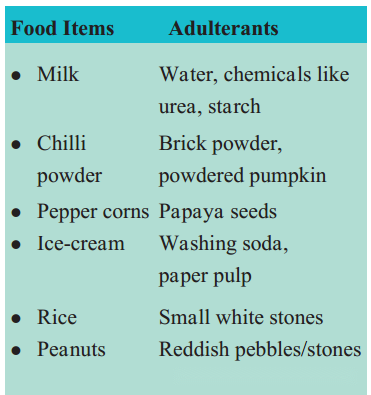
To earn more profits, cheaper substances of low quality called adulterants, are mixed with the foodstuffs. The mixing adulterants to foodstuffs is called adulteration of food. Adulterants may be poisonous or harmful and such food is impure and unfit for consumption. Some of the adulterants added to foodstuffs are given below:
Give scientific reasons:
Question 1
Maharashtra Board Solution
Deficiency of vitamin B and C are common in our body.
Solution & Step-by-Step Answer:
Question 2
Maharashtra Board Solution
Exposure to sunlight is essential.
Solution & Step-by-Step Answer:
Complete the tables given below: 1.
2.
3.
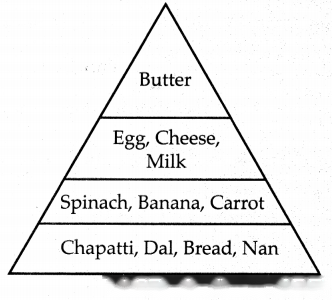
Using the food items given below, prepare a balanced diet pyramid.
Can you recall?
Question 1
Maharashtra Board Solution
Which are the various groups of foodstuff? Which main constituents of food do we get? Answer : The various groups of foodstuffs are: |
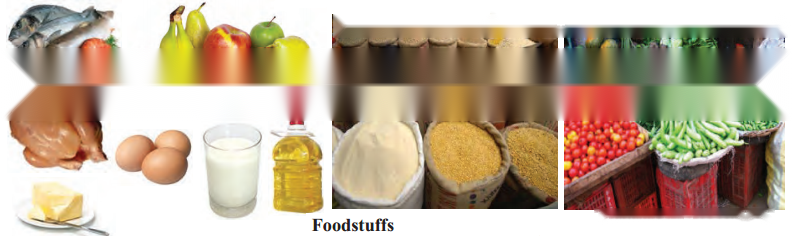
There are six main nutrients in our food: carbohydrates, fats, proteins, fibres, vitamins and minerals.
Nutrients | Foodstuffs |
1. Carbohydrates | Cereals and pulses |
2. Protein | Milk product, meat, fish, eggs |
3. Fats | Butter, oil, ghee |
4. Fibres | fruits and vegetables |
Question 2. What trouble do we have to face if we do not get enough fibre from our daily diet?
Solution & Step-by-Step Answer:
Fibres help in excretion of food, if we do not get enough fibre we will face indigestion and stomach-ache.
Question 3
Maharashtra Board Solution
What care must be taken to make sure that fibre is not lost or removed from the food we get?
Solution & Step-by-Step Answer:
We must not over-cook the foodstuff containing fibres. Fruits should be eaten raw.
|