Latest Maharashtra State Board (SSC & HSC) 2026-27 Syllabus Digest & Solutions Updated!
Class 6Science & Technology2026-27 Syllabus

Chapter 6 Substances in Daily Use Solutions

Complete Maharashtra State Board Balbharati & Yuvakbharati textbook solutions for Chapter 6 Substances in Daily Use. Step-by-step solved exercises, numerical problems, and digest answers.

51 Solved Questions1 Diagrams1556 words

Maharashtra State Board Class 6 Science Solutions Chapter 6 Substances in Daily Use

Class 6 Science Chapter 6 Substances in Daily Use Textbook Questions and Answers

1. Fill in the blanks using proper works:

Question a.
Rubber made by vulcanization is a …………… material.
Answer:
hard

Question b.
Man-made materials are made by …………… natural materials.
Answer:
processing

Question c.
…………… thread was developed simultaneously in New York and London.
Answer:
Nylon

Question d.
Rayon is also known as …………….
Answer:
synthetic silk

2. Answer the following questions.

Question a.
Why did the need for man-made materials arise?
Answer:
The need for man-made materials arose due to the following reasons:

c

Question b.
Which are the natural materials obtained from plants and animals?
Answer:
Leather, jute, wool, cotton, silk are the natural substances obtained from plants and animals.

Question c.
What is vulcanization?
Answer:

Question d.
Which natural materials are used to obtain fibres?
Answer:
Cotton, wood pulp and various hydrocarbons obtained from mineral oils are used to obtain fibres.

3. What are we used for?

Question a.
What are we used for?
Answer:

4. How is paper manufactured? Write in your own words.

Question a.
How is paper manufactured? Write in your own words.
Answer:
Coniferous trees like pine trees are used to make paper.

5. Give scientific reasons.

Question a.
We must use cotton clothes during summer.
Answer:

Question b.
We must observe economy in the use of materials.
Answer:

Question c.
Saving paper is the need of the hour.
Answer:

Question d.
Man-made materials have more demand.
Answer:

Question e.
Humus is a natural material.
Answer:

6. Find out.

Question 1 Maharashtra Board Solution
How is lac obtained from nature?
Solution & Step-by-Step Answer:
Question 2 Maharashtra Board Solution
How are pearls obtained?
Solution & Step-by-Step Answer:

Activity:

Question 1 Maharashtra Board Solution
Visit a rubber, paper or textile industry in your area and collect information about it.

Question 2 Maharashtra Board Solution
Collect various samples of paper and note their uses.

Question 3. Use blank pages from old note-books and make a new one.

Class 6 Science Chapter6 Substances in Daily UseImportant Questions and

Solution & Step-by-Step Answer:
s

Fill in the blanks using proper works.

Question 1 Maharashtra Board Solution
Natural rubber is obtained from …………… of trees.
Solution & Step-by-Step Answer:
block bg-white dark:bg-slate-900/80 border-l-4 border-emerald-500 rounded-r-xl p-5 my-3 shadow-xs border border-slate-200/60 dark:border-slate-800">
Solution & Step-by-Step Answer:
latex
Question 2 Maharashtra Board Solution
Changes where the original constituent substances cannot be obtained again from the new substances are called …………… changes.
Solution & Step-by-Step Answer:
irreversible
Question 3 Maharashtra Board Solution
A paper factory in Maharashtra is situated at …………….
Solution & Step-by-Step Answer:
Ballarpur
Question 4 Maharashtra Board Solution
Glass can be made from …………… and …………….
Solution & Step-by-Step Answer:
sand, calcium
Question 5 Maharashtra Board Solution
Botanical name of rubber plant is …………….
Solution & Step-by-Step Answer:
Hevea brasiliensis
Question 6 Maharashtra Board Solution
…………… obtained from mineral oils are used to make polymer chains.
Solution & Step-by-Step Answer:
Hydrocarbons
Question 7 Maharashtra Board Solution
The maximum production of rubber in India is in …………….
Solution & Step-by-Step Answer:
Kerala
Question 8 Maharashtra Board Solution
…………… invented the process of vulcanisation.
Solution & Step-by-Step Answer:
Charles Goodyear

Match the columns:

Question 1 Maharashtra Board Solution

Column ‘A’

Column ‘B’

1. Jute

a. Animal origin

2. Air

b. Plant origin

3. Leather

c. Man-made

4. Cement

d. Abiotic

Solution & Step-by-Step Answer:

Column ‘A’

Column ‘B’

1. Jute

b. Plant origin

2. Air

d. Abiotic

3. Leather

a. Animal origin

4. Cement

c. Man-made

State whether the following statements are ‘true’ or ‘false’.

Question 1 Maharashtra Board Solution
We can find plastic in nature.
Solution & Step-by-Step Answer:
False
Question 2 Maharashtra Board Solution
Soap is a man-made substance.
Solution & Step-by-Step Answer:
True
Question 3 Maharashtra Board Solution
We should reuse available resources.
Solution & Step-by-Step Answer:
True
Question 4 Maharashtra Board Solution
Nylon clothes are good summer wear.
Solution & Step-by-Step Answer:
False
Question 5 Maharashtra Board Solution
Glass is a man-made substance.
Solution & Step-by-Step Answer:
True
Question 6 Maharashtra Board Solution
In irreversible changes original substances can be obtained again.
Solution & Step-by-Step Answer:
False
Question 7 Maharashtra Board Solution
Rayon is made up of cotton and wood pulp.
Solution & Step-by-Step Answer:
True

Give two examples of each of the following:

Question 1 Maharashtra Board Solution
Natural fibres
Solution & Step-by-Step Answer:
cotton, silk
Question 2 Maharashtra Board Solution
Synthetic fibres
Solution & Step-by-Step Answer:
terylene, rayon
Question 3 Maharashtra Board Solution
Biotic natural substances
Solution & Step-by-Step Answer:
wool, jute
Question 4 Maharashtra Board Solution
Abiotic natural substances
Solution & Step-by-Step Answer:
air, water
Question 5 Maharashtra Board Solution
Man-made substances.
Solution & Step-by-Step Answer:
paper, glass

Classify the following substances in the table given below.
(iron, wood, brick, paper, terylene, stone, jute, air, silk, utensils, plastic, rayon, water, wool, dacron, lac, nylon, pearl)
Answer:

Natural Substances

Man-made Substances               Natural Fibres

Synthetic Fibres

iron, wood, stone, water, lac, pearl

brick, paper, utensils, plastic

jute, silk, wool

terylene, rayon, dacron, nylon

Define:

Question 1 Maharashtra Board Solution
Natural substances.
Solution & Step-by-Step Answer:
Substances available in nature are called natural substances.
Question 2 Maharashtra Board Solution
Man-made substances.
Solution & Step-by-Step Answer:
Man-made substances are new substances produced by processing naturally available resources.
Question 3 Maharashtra Board Solution
Biotic substances.
Solution & Step-by-Step Answer:
Natural substances obtained from living things are called biotic substances.
Question 4 Maharashtra Board Solution
Abiotic substances.
Solution & Step-by-Step Answer:
Natural substances that are not obtained from living things are called abiotic substances.
Question 5 Maharashtra Board Solution
Plant-originated substance.
Solution & Step-by-Step Answer:
A substance obtained from a plant is called a plant-originated substance.
Question 6 Maharashtra Board Solution
Animal-originated substance.
Solution & Step-by-Step Answer:
A substances obtained from an animal is called an animal-originated substance.
Question 7 Maharashtra Board Solution
Hydrocarbons.
Solution & Step-by-Step Answer:
Substances obtained from mineral oil are called hydrocarbons.

Answer the following in one or two sentences.

Question 1 Maharashtra Board Solution
Why was Rayon named so?
Solution & Step-by-Step Answer:
The threads of Rayon have shine and strength. They appeared to be shining bright like the sun’s rays. Hence, they were named ‘Rayon.
Question 2 Maharashtra Board Solution
How are TV sets, refrigerators, etc. packed? Why?
Solution & Step-by-Step Answer:
To pack TV sets, refrigerators, etc. big cartons and thermocol are used. These man-made substances are water resistant, light weight and easy for transportation.
Question 3 Maharashtra Board Solution
Give the properties and uses of nylon.
Solution & Step-by-Step Answer:
Nylon threads have a shine and are strong, transparent and water resistant. They are used to manufacture clothes, fishing nets, ropes, etc.
Question 4 Maharashtra Board Solution
What is latex?
Solution & Step-by-Step Answer:
Latex is a milky white natural substance produced in the stems of rubber trees.
Question 5 Maharashtra Board Solution
Name the basic material used to obtain paper.
Solution & Step-by-Step Answer:
Wood is the basic material used in the manufacture of paper.
Question 6 Maharashtra Board Solution
What kind of paper is used for currency notes manufacturing?
Solution & Step-by-Step Answer:
Flax fibre is used in the manufacture of currency notes.
Question 7 Maharashtra Board Solution
Where was the process of making paper invented?
Solution & Step-by-Step Answer:
The process of making paper was invented in China.

Answer in brief:

Question 1 Maharashtra Board Solution
What are the advantages of synthetic fibre?
Solution & Step-by-Step Answer:
Advantages of synthetic fibre are:
Question 2 Maharashtra Board Solution
Give the shortcomings of synthetic fibre.
Solution & Step-by-Step Answer:
Question 3 Maharashtra Board Solution
Write a short note on natural rubber.
Solution & Step-by-Step Answer:
Question 4 Maharashtra Board Solution
What are dacron, terylene and terene?
Solution & Step-by-Step Answer:

Give scientific reasons:

Question 1 Maharashtra Board Solution
Natural substances are depleting.
Solution & Step-by-Step Answer:

Can you tell?

Question 1 Maharashtra Board Solution
Difference between leather, jute, wool, cotton and soil, water, metals.
Solution & Step-by-Step Answer:
Question 2 Maharashtra Board Solution
How are leather and wool different from jute and cotton?
Solution & Step-by-Step Answer:
Leather and wool are obtained from animals while jute and cotton are obtained from plants.
Question 3 Maharashtra Board Solution
Do you find plastic, nylon, brass or cement in nature?
Solution & Step-by-Step Answer:
No, they are all man-made materials.
Question 4 Maharashtra Board Solution
Can red chillies become green chillies again?
Solution & Step-by-Step Answer:
No, the change from green chillies to red chillies is irreversible.
Question 5 Maharashtra Board Solution
From which substances in nature can we get threads or fibre?
Solution & Step-by-Step Answer:
Cotton plant, jute, silkworm.
Question 6 Maharashtra Board Solution
What are clothes made from?
Solution & Step-by-Step Answer:
Clothes are made from yarn obtained from fibre.

Classify the following substances according to their uses:
sand, soap, wool, window glass, bamboo, cotton, bricks, silk, leafy vegetables, cement, fruits, water, sugar.
Answer:

Make a list of objects, each of which can be made from several substances.
Answer:

Objects

Substances

Table

Wood, glass, plastic.

Toys

Wood, plastic, clay.

Utensils

Aluminium, wood, glass, ceramic, plastic.

Use your brain power!

Question 1 Maharashtra Board Solution
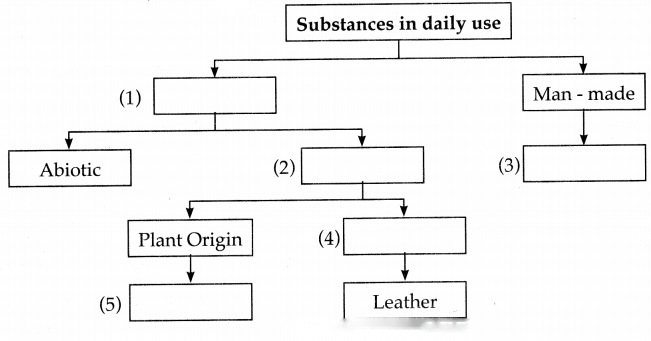
Complete the table below, showing how substance of daily use are classified.
Solution & Step-by-Step Answer: