Latest Maharashtra State Board (SSC & HSC) 2026-27 Syllabus Digest & Solutions Updated!
Class 6History2026-27 Syllabus

Chapter 3 The Harappan Civilization Solutions

Complete Maharashtra State Board Balbharati & Yuvakbharati textbook solutions for Chapter 3 The Harappan Civilization. Step-by-step solved exercises, numerical problems, and digest answers.

53 Solved Questions1 Diagrams2054 words

Maharashtra Board Class 6 History Solutions Chapter 3 The Harappan Civilization

Class 6 History Chapter 3 The Harappan Civilization Textbook Questions and Answers

1. Answer in one sentence:

Question 1 Maharashtra Board Solution
How did the civilization get the name Harappa?
Solution & Step-by-Step Answer:
Archaeological excavation first began in 1921 CE at Harappa in Punjab on the banks of river Ravi. That is how this civilization came to be known as Harappan civilization.
Question 2 Maharashtra Board Solution
What patterns are seen on the Harappan pots?
Solution & Step-by-Step Answer:
There are red terra cotta pots with patterns and designs in black colour. The patterns includes fishscales, interlocking circles, pipal leaves, etc.
Question 3 Maharashtra Board Solution
What cloth did the Harappan traders supply to Egypt?
Solution & Step-by-Step Answer:
The Harappan traders supplied muslin cloth to Egypt

2. What will you do when you visit an ancient site to obtain more information about it, to conserve it, etc ?

3. Draw a picture of the Great Bath at Mohen-jo-daro.
Answer:
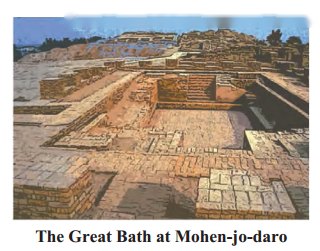
4. In the following chart, fill in the details regarding human life during the Harappan period.

Major crops

Clothes

Ornaments

Answer:

Major crops

Clothes

Ornaments

Wheat,

Knee length cloth worn by both men and women. Cloth that makes an upper garment.

Gold

Barley

A cloak with a beautiful trefoil, pattern draped across the shoulder.

Copper

Ragi

Precious

Cotton

stone, Shells

5. Answer in one word and frame similar questions. Write their answers:

Question 1 Maharashtra Board Solution
What stone was used to make the Harappan seals?
Solution & Step-by-Step Answer:
Steatite

6. On an outline map of the world, show the other civilizations that existed in other parts of the world during the Harappan period.

Activity:

Class 6 History Chapter 3 The Harappan Civilization InText Questions and Answers

Can you tell?

Question 1 Maharashtra Board Solution
Describe the structure of houses in your locality.
Solution & Step-by-Step Answer:
In my locality (Mumbai) we have building structures and tall skyscrapers. In contrast, we do have hutmen locality with small houses in rows and sometimes chawls that are built upto one storey.(Answers may vary)
Question 2 Maharashtra Board Solution
Do they have flat roofs or tiled sloping roofs?
Solution & Step-by-Step Answer:
Houses or buildings in my locality have flat roofs and provisions are made for draining away the rain water. Some of the hutments do have tiled sloping roofs.
Question 3 Maharashtra Board Solution
What problems regarding health and hygiene will arise if the drains are not covered?
Solution & Step-by-Step Answer:
If the drains are not covered they will become infested or breeding grounds to mosquitoes, flies, insects, etc. This will directly affect the health of the people living in that vicinity. People will become victim to terrible illnesses, death rate may rise, children and senior citizens will be mostly affected as they have weaker immunity.
Question 4 Maharashtra Board Solution
Visit a swimming tank in your locality. Observe how the water in the tank is changed. Compare a modem swimming tank to the Harappan Bath.
Solution & Step-by-Step Answer:
When I went to a nearby swimming pool, I observed that there is a continuous flow of water and excess water filtering system where the water is cleaned. This clean water is then recycled again to be used in the pool. Every week the entire pool water is pumped out. The moss edges and walls of the pool are scrubbled clean with disinfectants.

Fresh water is then added to the pool, with right amount of chlorine tablets. We then have a pool with sparkling water. The Harappahs too, were hygienic as they too had provisions made for draining, cleaning and re-filling the Great Bath.

Class 6 History Chapter 3 The Harappan Civilization Additional Important Questions and Answers

Complete the sentence by choosing the correct option:

Question 1 Maharashtra Board Solution
Archaeological excavation first began in 1921 CE at Harappa in the Punjab on the banks of river _______. (a) Tapi (b) Satluj (c) Ravi
Solution & Step-by-Step Answer:
Ravi
Question 2 Maharashtra Board Solution
Excavations were also carried out at ______ a place about 650 km to the south of Harappa in the Indus valley. (a) Mohen-jo-daro (b) Dholavira (c) Lothal
Solution & Step-by-Step Answer:
Mohen-jo-daro
Question 3 Maharashtra Board Solution
There was a striking _______ between the remains of structures and artefacts found at the two places. (a) beauty (b) sparks (c) resemblance
Solution & Step-by-Step Answer:
resemblance
Question 4 Maharashtra Board Solution
The houses and other structures in the Harappan civilization were mainly built with ______ bricks. (a) cooked (b) baked (c) fried
Solution & Step-by-Step Answer:
baked
Question 5 Maharashtra Board Solution
The houses had rooms built around a ________ courtyard. (a) lateral (b) central (c) forward
Solution & Step-by-Step Answer:
central
Question 6 Maharashtra Board Solution
The _______ had covered drains built with bricks. (a) streets (b) compounds (c) schools
Solution & Step-by-Step Answer:
streets
Question 7 Maharashtra Board Solution
The streets were ______ and laid out in a grid pattern. (a) narrow (b) zig-zag (c) broad
Solution & Step-by-Step Answer:
broad
Question 8 Maharashtra Board Solution
The seals of the Harappan civilization were mainly square-shaped and made from a stone called ______. (a) steatite (b) granite (c) marble
Solution & Step-by-Step Answer:
steatite
Question 9 Maharashtra Board Solution
These seals bear pictures of imaginary animals like the ________. (a) phoenix (b) unicorn (c) fairies
Solution & Step-by-Step Answer:
unicorn
Question 10 Maharashtra Board Solution
_________ pots of various types and shapes have been found at the excavation sites of Harappan civilization. (a) Metal (b) Stone (c) Earthen
Solution & Step-by-Step Answer:
Earthen
Question 11 Maharashtra Board Solution
The Harappan people ______ their dead. (a) buried (b) cremated (c) incinerated
Solution & Step-by-Step Answer:
buried
Question 12 Maharashtra Board Solution
The tank in the Great Bath was nearly ________ metres deep. (a) 12 (b)2.5 (c)7
Solution & Step-by-Step Answer:
2.5
Question 13 Maharashtra Board Solution
Great bath was lined with __________ bricks to prevent seepage of water. (a) unbaked (b) baked (c) bunds
Solution & Step-by-Step Answer:
baked
Question 14 Maharashtra Board Solution
The Harappan people practised _______. (a) singing (c) dancing (c) agriculture
Solution & Step-by-Step Answer:
agriculture
Question 15 Maharashtra Board Solution
The dress of both Harappan men and women consisted of knee length cloth and an _________ garment. (a) upper (b) head (c) shawl
Solution & Step-by-Step Answer:
upper
Question 16 Maharashtra Board Solution
Women wore _________ right up to their upper arm. (a) shawls (b) flowers (c) bangles
Solution & Step-by-Step Answer:
bangles
Question 17 Maharashtra Board Solution
The Harappan people carried on _________ within India as well as with countries outside. (a) friendship (b) trade (c) enemity
Solution & Step-by-Step Answer:
trade
Question 18 Maharashtra Board Solution
The Indus valley was known for its high quality ______. (a) cotton (b) crops (c) pots
Solution & Step-by-Step Answer:
cotton
Question 19 Maharashtra Board Solution
_______ was carried on both by land routes and sea routes. (a) Agriculture (b) Trade (c) Industry
Solution & Step-by-Step Answer:
Trade
Question 20 Maharashtra Board Solution
A huge ________ has been discoverd at Lothal. (a) dockyard (b) fishery (c) industry
Solution & Step-by-Step Answer:
dockyard
Question 21 Maharashtra Board Solution
People migrated to other places leading to the decline of ______. (a) population (b) trade (c) cities
Solution & Step-by-Step Answer:
cities

Match The following:

Question 1 Maharashtra Board Solution

Column A

Column B

(1) Harappan civilization

(a) Built with baked bricks

(2) Houses

(b) Had separate fortification

(3) Streets

(c) Banks of river ravi

(4) Mohen-jo-daro

(d) Had covered drains

(5) Towns

(e) South of Harappa

Solution & Step-by-Step Answer:

1 – c
2 – a
3 – d
4 – e
5 – b

Question 2 Maharashtra Board Solution

Column A

Column B

(1) Seals

(a) An imaginary animal carved on seals

(2) Unicorn

(b) High quality cotton

(3) The Great bath

(c) Made of stone called steatite

(4) The Indus Valley

(d) Had provision for draining, cleaning and refilling the tank

Solution & Step-by-Step Answer:
1 – c
2 – a
3 – d
4 – b

Answer in one sentence:

Question 1 Maharashtra Board Solution
Where was the excavation of Mohen-jo-daro carried out?
Solution & Step-by-Step Answer:
The excavation of Mohen-jo-daro was carried out about 650 km to the south of Harappa in the Indus valley.
Question 2 Maharashtra Board Solution
With what were the houses and other structures in Harappan civilization built?
Solution & Step-by-Step Answer:
The houses and other structures in Harappan civilization were built with baked bricks.
Question 3 Maharashtra Board Solution
What were the Harappan seals made from?
Solution & Step-by-Step Answer:
The Harappan seals were made from a stone called steatite.
Question 4 Maharashtra Board Solution
What were the seals used for?
Solution & Step-by-Step Answer:
The seals were used as stamps.
Question 5 Maharashtra Board Solution
Which pictures were depicted on seals?
Solution & Step-by-Step Answer:
Pictures of animals like bulls, buffaloes, oxen, elephants, rhinos, tigers, unicorn, etc., were depicted on seals.
Question 6 Maharashtra Board Solution
What occupation did the Harappan practise?
Solution & Step-by-Step Answer:
The Harappans practised agriculture.
Question 7 Maharashtra Board Solution
What crops did the Harappans grow?
Solution & Step-by-Step Answer:
The Harappans grew crops like wheat, barley, ragi, peas, sesame and lentils (masoor).
Question 8 Maharashtra Board Solution
How did the people in Harappa dress?
Solution & Step-by-Step Answer:
The dress of both men and women in Harappa consisted of knee length cloth and an upper garment.
Question 9 Maharashtra Board Solution
What were their ornaments made up of?
Solution & Step-by-Step Answer:
Their ornaments were made up of gold, copper, precious stones as also shells, cowries, seeds, etc.
Question 10 Maharashtra Board Solution
What is the Indus valley known for?
Solution & Step-by-Step Answer:
The Indus valley was known for its high quality cotton.
Question 11 Maharashtra Board Solution
To which countries was the cotton exported?
Solution & Step-by-Step Answer:
The cotton was exported to regions like west Asia, southern Europe and Egypt.
Question 12 Maharashtra Board Solution
Where was the Harappan dockyard discovered?
Solution & Step-by-Step Answer:
A huge dockyard was discovered at Lothal.
Question 13 Maharashtra Board Solution
What was the reasons for the decline of the Harappan civilization?
Solution & Step-by-Step Answer:
Frequent floods, invasions by foreign tribes, decline in trade were some of the reasons for the decline of Harappan civilization.
Question 14 Maharashtra Board Solution
Why did the people migrate to other places?
Solution & Step-by-Step Answer:
Some regions became arid due to weakening of monsoon, drying up of river basins, earthquakes, changes in sea-level, etc. This led the people to migrate to other places.

Answer the following questions in short:

Question 1 Maharashtra Board Solution
Which similar characteristics are seen in all the places of Harappan civilization?
Solution & Step-by-Step Answer:
Similar characteristics that are seen in all the places of Harappan civilization are town planning, roads, construction of houses, drainage system, seals, pots, toys and burial customs.
Question 2 Maharashtra Board Solution
Describe the houses built in Harappa.
Solution & Step-by-Step Answer:
Question 3 Maharashtra Board Solution
Explain why the drainage system excelled in Harappa.
Solution & Step-by-Step Answer:
Question 4 Maharashtra Board Solution
Describe the streets in Harappan town planning.
Solution & Step-by-Step Answer:
Question 5 Maharashtra Board Solution
What ritual did the people in Harappa follow for their burial?
Solution & Step-by-Step Answer:
Question 6 Maharashtra Board Solution
Describe the Great Bath of Mohen-jo-daro.
Solution & Step-by-Step Answer:
Question 7 Maharashtra Board Solution
Describe the statue found at a Harappan site.
Solution & Step-by-Step Answer:
Question 8 Maharashtra Board Solution
Comparison between today’s modem town planning with that of the Harappan periods.
Solution & Step-by-Step Answer:
Harappan houses were built in rectangular blocks and had excellent roads and drainage system. In comparison, the older cities in India do not have the Harappan style of town planning. There are places in these older cities where hutmen live in congested areas with open drainages. But today, changes are being made.

Open drainages are being replaced by underground drainage system. Rain water is diverted to avoid floods and hutmen’s areas are getting transformed into tall high-rise buildings. Cities now in India are getting transformed with broad roads, well interstate connecting highways, bridges, railway, metro, airports, etc.