Maharashtra Board Class 6 Geography Solutions Chapter 2 Let us Use the Graticule
Class 6 Geography Chapter 2 Let us Use the Graticule Textbook Questions and Answers
A. Put a tick mark against the correct option in the space given:
B. Read the following statements and correct the wrong ones:
C. Find the locations of following cities from a world map, a map of India or a Globe and write down the latitude and longitude of each of them:
Answer:
Place | Latitude | Longitude |
Mumbai | 19° 00′ N | 72 48’ E |
Guwahati | 26° 12′ N | 91 48’ E |
Srinagar | 34° 05′ N | 74 50’ E |
Bhopal | 23° 18′ N | 77 24’ E |
Chennai | 13° 06′ N | 80 18’ E |
ottawa | 45° 27′ N | 75 42’ W |
Tokyo | 35° 45′ N | 139 45’ E |
Johannesburg | 26° 10′ S | 28 03’ E |
New York | 43° 00′ N | 75 00’ W |
London | 51° 31′ N | 0 7’ W |
D. Find and write down the extent of the following. (Check them on the internet/ mobile):
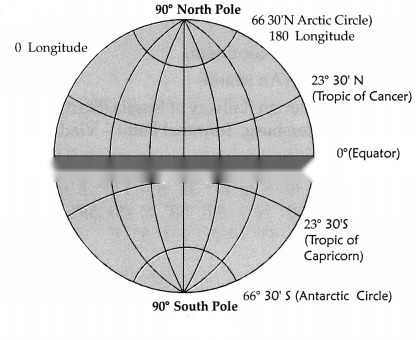
E. Draw important parallels and meridians in the figure given below and label them with appropriate angular measures. (Use the protractor.)
Answer:
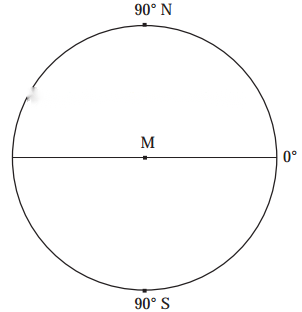
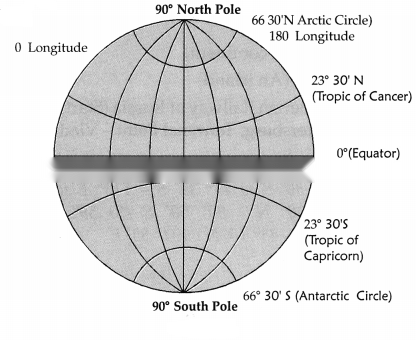
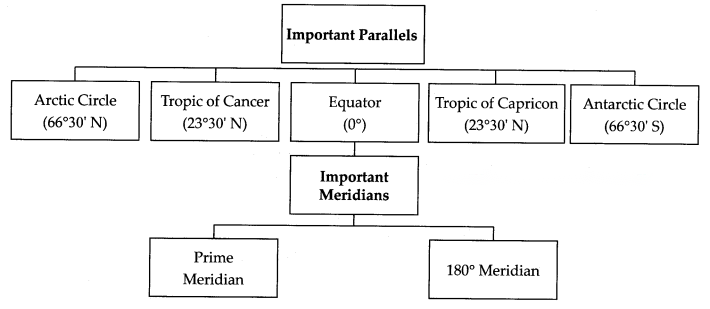
F. Write the important parallels and meridians in the following table:
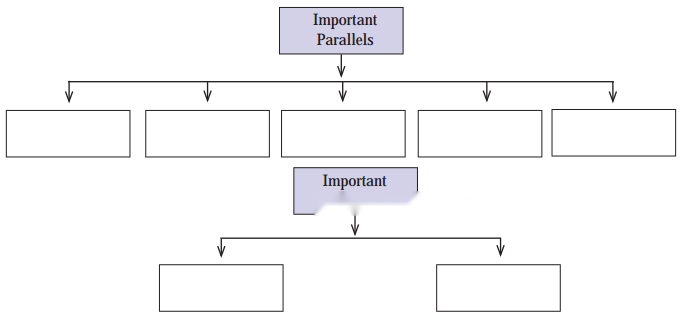
Answer:
Class 6 Geography Chapter 2 Let us Use the Graticule InText Questions and Answers
Make friends with the globe!
Observe the globe and answer the following questions.
Question 1.
What are the horizontal lines on the globe called?
Answer:
The horizontal lines on the globe are called latitudes.
State the Importance of the following:
Let us use the graticule:
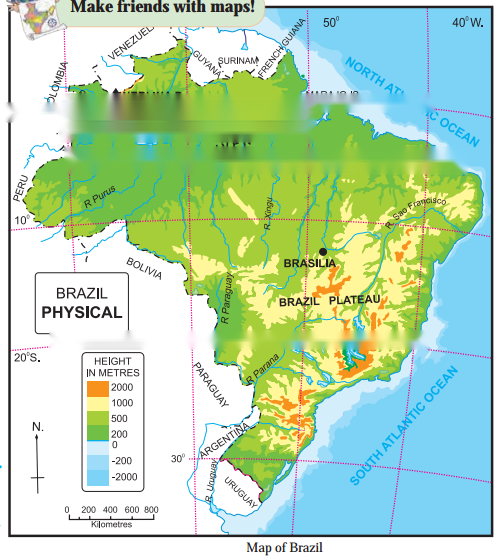
Answer the following questions about the location and extent with the help of figure page 11 of your textbook.
Think a little!
Question 1.
Find on the globe, the meridians opposite to the ones mentioned below:
90°E, 170°W, 30°E, 20°W
Answer:
Think a little!
Use your brain power!
Class 6 Geography Chapter 2 Let us Use the Graticule Additional Important Questions and Answers
Fill in the blanks:
Match the pairs correctly:
A (Latitudes) | B (Names) |
(1)23°30’N | (a) Antarctic Circle |
(2) 23°30′ S | (b) Tropic of Capricorn |
(3)66°30’N | (c) Tropic of Cancer |
(4) 66°30′ S | (d) Arctic Circle |
(e) Great Circle | |
(f) Prime Meridian |
1 – c
2 – b
3 – d
4 – a
Complete the following sentence:
Question 1
Maharashtra Board Solution
While describing the location of a place, we need to consider _______.
Solution & Step-by-Step Answer:
only one parallel and one meridian
Question 2
Maharashtra Board Solution
For describing the extent of a region, we need to consider _________.
Solution & Step-by-Step Answer:
two parallels and two meridians at the extreme ends of the region
Question 3
Maharashtra Board Solution
For describing the extent of linear features like a river or road we need to consider ______.
Solution & Step-by-Step Answer:
the latitudes and longitude of their terminal points
Question 4
Maharashtra Board Solution
All places between 23°30′ N and S of the ! equator receive perpendicular rays _____.
Solution & Step-by-Step Answer:
on two days in a year
Question 5
Maharashtra Board Solution
Depending on the seasons, daytime can be greater than 24 hours in areas between ________.
Solution & Step-by-Step Answer:
the polar circles and the poles
Question 6
Maharashtra Board Solution
All places between 23° 30′ N and South of equator ______ rays on two days in a year.
Solution & Step-by-Step Answer:
receive perpendicular
Answer the following questions in one sentence:
Question 1
Maharashtra Board Solution
What are Great Circles used for?
Solution & Step-by-Step Answer:
Great Circles are used for finding the minimum distance between any two places on the surface of the earth.
Question 2
Maharashtra Board Solution
Where is Vatican City located?
Solution & Step-by-Step Answer:
Vatican City is the smallest country in the world located within Italy on the Italian peninsula.
Question 3
Maharashtra Board Solution
Why is the Prime Meridian considered an important meridian?
Solution & Step-by-Step Answer:
The prime meridian is an important meridian because its main purpose is to fix the global standard time and co-ordinate the standard times of different countries.
|