Maharashtra Board Class 6 Geography Solutions Chapter 1 The Earth and the Graticule
Class 6 Geography Chapter 1 The Earth and the Graticule Textbook Questions and Answers
A. Place a tick mark (✓) against the correct option:
B. Observe a globe and examine the following statements. Correct the wrong ones:
C. Find the correct graticule out of the following and put a tick mark against it.
Answer:
Figure (a) is correct.
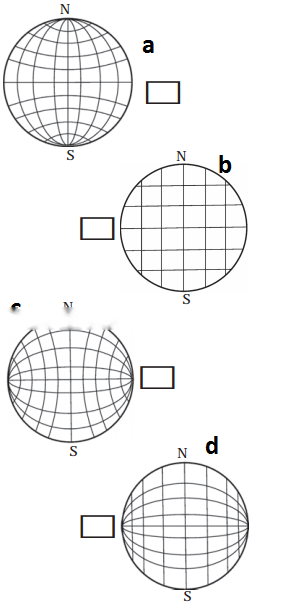
D. Answer the following:
E. Complete the following table:
Characteristics | Parallels of latitude | Meridians of longitude |
Shape | ||
Size of each parallel is different | ||
Distance | Distance between two meridians is larger on the equator and the same decreases towards the Poles. |
Answer:
Characteristics | Parallels of latitude | Meridians of longitude |
Shape | Circular | Semicircular |
Size | Size of each parallel is different | Size of each meridian is same |
Distance | Distance between two parallels is the same everywhere | Distance between two meridians is larger on the equator and the same decreases towards the Poles. |
Class 6 Geography Chapter 1 The Earth and the Graticule Textbook Questions and Answers
Think a little!
Do it yourself!
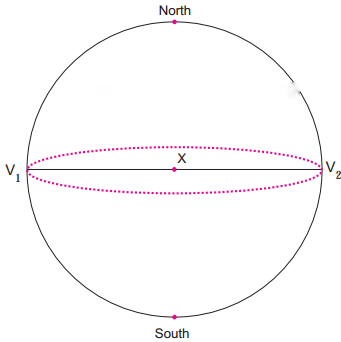
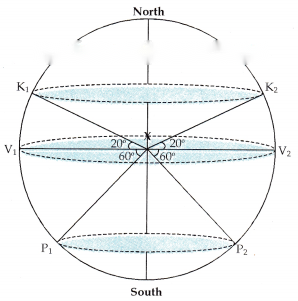
Use figure 1.4 of the geography textbook:
In the upper portion of the circle, at the centre X, draw angles of 30°, V1X K1and V2X K2; K1and K2being the points on the circle. Draw an ellipse joining K1and K2.
In the lower half of the circle, mark angles of 60° and name the points on the circle as P1and P2.
Can you tell?
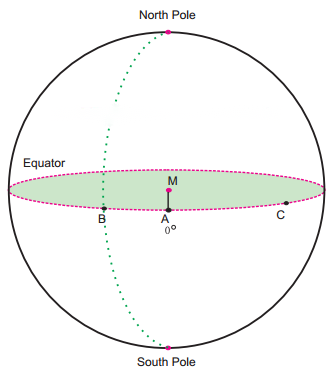
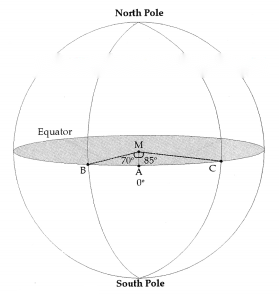
Observe the picture (fig) on page 5 of the textbook and answer the following questions:
Let the line AM be 0°.
Draw the line MB. Measure the angle it makes with the line AM and write it near B. Note the semicircle that passes through B and joins the North and South Poles. Trace it.
Now join MC. Measure ∠AMC and write it next to C. Draw a semicircle that passes through ‘C’ and joins the North and South Poles.
Draw a line that passes through point A at 0°, and joins the North and South Poles.
Answer:
∠AMB = 70°
∠AMC = 85°
Use your brain power!
Class 6 Geography Chapter 1 The Earth and the Graticule Textbook Questions and Answers
Fill in the blanks choosing the correct options from the brackets:
Match the pairs correctly:
Different parallels | Distance between meridians |
(1) Poles | (a) 111 km |
(2) Tropic of Cancer | (b) 102 km |
(3) Polar Circles | (c) 0 km |
(4) Equator | (d) 44 km |
(5) Meridians | (e) 360 |
(f) 1° |
1 – c
2 – b
3 – d
4 – a
5 – e
Place a tick mark (✓) against the correct option:
Question 1
Maharashtra Board Solution
Which meridian is considered as the Prime Meridian? (i) 0° (ii) 80° (iii) 90°
Solution & Step-by-Step Answer:
0°
Answer the following questions in one sentence:
Question 1
Maharashtra Board Solution
What are parallels of latitudes?
Solution & Step-by-Step Answer:
Ellipses that are created at some angular distance from the centre of the earth and are parallel to one another are called parallels of latitudes.
Question 2
Maharashtra Board Solution
How many parallels are there in the northern hemisphere?
Solution & Step-by-Step Answer:
There are 90 parallels in the northern hemisphere.
Question 3
Maharashtra Board Solution
Which circle divides the earth in the eastern and western hemisphere?
Solution & Step-by-Step Answer:
The Prime Meridian divides the earth in the eastern and western hemisphere.
Question 4
Maharashtra Board Solution
What is the distance between any two adjacent parallels on the surface of the earth?
Solution & Step-by-Step Answer:
The distance between any two adjacent parallels on the surface of the earth is 111 km.
Question 5
Maharashtra Board Solution
What is a graticule?
Solution & Step-by-Step Answer:
The parallels and meridians on the globe form a net that is called a graticule.
Question 6
Maharashtra Board Solution
What is used to determine the location on the earth?
Solution & Step-by-Step Answer:
Latitude and longitude is used to determine the location on the earth.
Write the full forms of:
Question 1
Maharashtra Board Solution
GIS
Solution & Step-by-Step Answer:
Geographical Information System
Question 2
Maharashtra Board Solution
GPS
Solution & Step-by-Step Answer:
Global Positioning System
Question 3
Maharashtra Board Solution
IRNSS
Solution & Step-by-Step Answer:
Indian Regional Navigation Satellite System
Question 4
Maharashtra Board Solution
ISRO
Solution & Step-by-Step Answer:
Indian Space Research Organisation
Give geographical reasons for the following statements:
Question 1
Maharashtra Board Solution
Parallels and meridians are imaginary lines on the earth.
Solution & Step-by-Step Answer:
Parallels and meridians can be drawn on a globe though not on the earth. That is why parallels and meridians are imaginary lines on the earth.
Question 2
Maharashtra Board Solution
Geographers developed a miniature model of the earth in the form of a globe.
Solution & Step-by-Step Answer:
Oceanic waters, uneven nature of the land, forest, innumerable islands of different sizes and buildings make it impossible to draw lines on the earth. In order to overcome this difficulty, geographers developed a miniature model of the earth in the form of a globe.
Question 3
Maharashtra Board Solution
Latitude and longitudes are expressed into degree, minutes and seconds.
Solution & Step-by-Step Answer:
To locate the places within the distance of 111 km exactly, the unit degree is divided into smaller units. Degrees are divided into minutes and seconds.
Answer the following questions in short:
Question 1
Maharashtra Board Solution
Explain the meaning of the term ‘equator’.
Solution & Step-by-Step Answer:
Question 2
Maharashtra Board Solution
What are Poles of the earth?
Solution & Step-by-Step Answer:
On the globe and also on the earth, at the north and south ends of the earth’s axis, Poles appear as points. These are called the North Pole and the South Pole respectively.
Observe a globe and examine the following statements. Correct the wrong ones:
Question 1
Maharashtra Board Solution
Parallels of latitude lie parallel to the Prime Meridian,
Solution & Step-by-Step Answer:
Wrong: Parallels of latitude lie parallel to the equator.
Question 2
Maharashtra Board Solution
All parallels of latitude converge at the equator.
Solution & Step-by-Step Answer:
Wrong: All meridians of longitude converge at the poles.
Question 3
Maharashtra Board Solution
Parallels and meridians are imaginary lines.
Solution & Step-by-Step Answer:
Right.
Question 4
Maharashtra Board Solution
80° 4′ 65″ N is a north meridian.
Solution & Step-by-Step Answer:
Wrong: 80° 4′ 65″ N is a north parallel.
Question 5
Maharashtra Board Solution
Meridians are parallel to each other.
Solution & Step-by-Step Answer:
Wrong: Latitudes are parallel to each other.
|