Balbharti12th Maharashtra State Board Maths Solutions BookPdf Chapter 2 Applications of Derivatives Miscellaneous Exercise 2 Questions and Answers.
Maharashtra State Board 12th Maths Solutions Chapter 2 Applications of Derivatives Miscellaneous Exercise 2
I. Choose the correct option from the given alternatives:
Solution & Step-by-Step Answer:
(a) 1, -6
Hint: f(x) = ax3+ bx2+ 11x – 6 satisfies the conditions of Rolle’s theorem in [1, 3]
∴ f(1) = f(3)
a(1)3+ b(1)2+ 11(1) – 6 = a(3)3+ b(3)2+ 11(3) – 6
a + b + 11 = 27a + 9b + 33
26a + 8b = -22
13a + 4b = -11
Only a = 1, b = -6 satisfy this equation.
Solution & Step-by-Step Answer:
(c) -1
Solution & Step-by-Step Answer:
(b) 2
Solution & Step-by-Step Answer:
(b) 3
Hint: f(x) and g(x) both satisfies the conditions of LMVT in (0, 1).
∴ f'(c) =
and g'(c) = = g(1)
But f'(c) = 2g'(c)
6 = 2g(1)
∴ g(1) = 3
Solution & Step-by-Step Answer:
(d) (1, 3)
Solution & Step-by-Step Answer:
(c) α = 2, β =
Hint: y = α log x + βx2+ x
∴
f(x) has extreme values at x = -1 and x = 2
∴ f'(-1) = 0 and f(2) = 0
α + 2β = 1
and + 4β = -1
By solving these two equations, we get
α = 2, β =
Solution & Step-by-Step Answer:
(d) meets the curve again in fourth quadrant
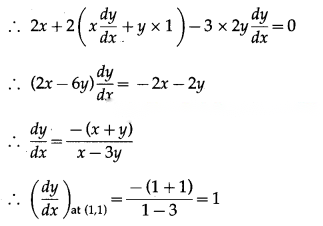
Hint: x2+ 2xy – 3y2= 0
= slope of the tangent at (1, 1)
∴ equation of the tangent at (1, 1) is -1
∴ equation of the normal is
y – 1= -1 (x – 1) = -x + 1
∴ x + y = 2
∴ y = 2 – x
Substituting y = 2 – x in x2+ 2xy – 3y2= 0, we get
x2+ 2x(2 – x) – 3 (2 – x)2= 0
⇒ x2+ 4x – 2x2– 3(4 – 4x + x2) = 0
⇒ x2– 4x + 3 = 0
⇒ (x – 1)(x – 3) = 0
⇒ x = 1, x = 3
When x = 1, y = 2 – 1 = 1
When x = 3, y = 2 – 3 = -1
∴ the normal at (1, 1) meets the curve at (3, -1) which is in the fourth quadrant.
Solution & Step-by-Step Answer:
(a) x + 2y = 0 Hint: The point of intersection of the curve with the Y-axis is the origin (0, 0).
Solution & Step-by-Step Answer:
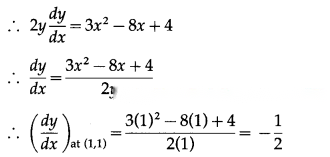
(d) Hint: y2 = x(2 – x)2 = x(4 – 4x + x2) = x3 – 4x2 + 4x = slope of the tangent at (1, 1) ∴ equation of the tangent at (1, 1) is y – 1 = – (x – 1) ∴ 2y – 2 = -x + 1 ∴ x + 2y = 3 Only the coordinates satisfy both the equations y2 = x(2 – x)2 and x + 2y = 3 ∴ P is
Solution & Step-by-Step Answer:
(d) 0.9825
II. Solve the following:
Solution & Step-by-Step Answer:
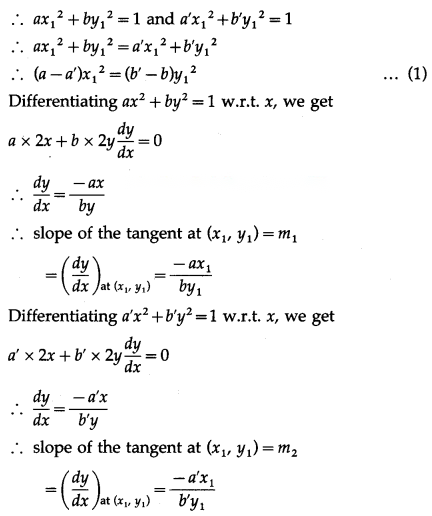
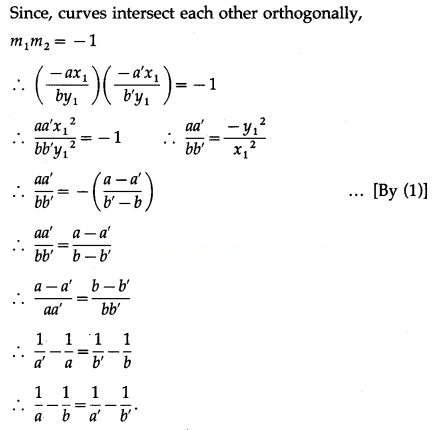
Let P(x1, y1) be the point of intersection of the curves.
Solution & Step-by-Step Answer:
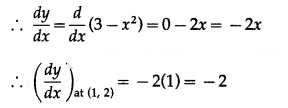
y = 3 – x2 = slope of the tangent at (1, 2) ∴ equation of the tangent at (1, 2) is y – 2= -2(x – 1) ⇒ y – 2= -2x + 2 ⇒ 2x + y = 4 Let this tangent cuts the coordinate axes at A(a, 0) and B(0, b). ∴ 2a + 0 = 4 and 2(0) + b = 4 ∴ a = 2 and b = 4 ∴ area of required triangle = × l(OA) × l(OB) = ab = (2)(4) = 4 sq units.
Solution & Step-by-Step Answer:
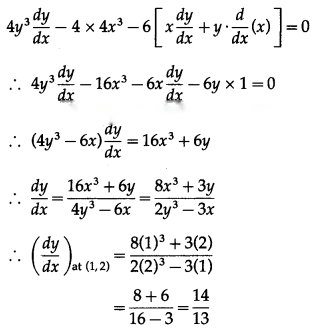
y4 – 4x4 – 6xy = 0 Differentiating both sides w.r.t. x, we get = slope of the tangent at (1, 2) ∴ the equation of normal at M (1, 2) is y – 2 = (x – 1) ∴ 13y – 26 = 14x – 14 ∴ 14x – 13y + 12 = 0 The slope of normal at (1, 2) ∴ the equation of normal at M (1, 2) is y – 2 = (x – 1) 14y – 28 = -13x + 13 13x + 14y – 41 = 0 Hence, the equations of tangent and normal are 14x – 13y + 12 = 0 and 13x + 14y – 41 = 0 respectively.
Solution & Step-by-Step Answer:
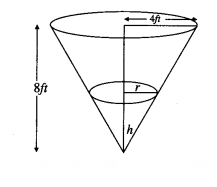
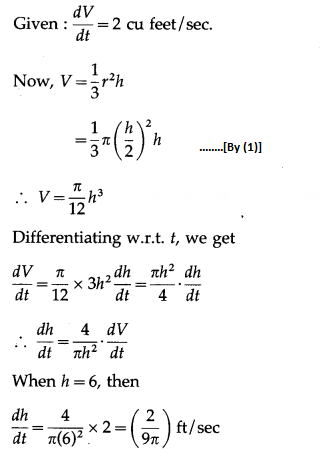
Let r be the radius of the base, h be the height and V be the volume of the water level at any time t. Since, the height of the cone is 8 feet and the radius is 4 feet, r = ……..(1) Hence, the rate of change of water level is ft/sec.
Solution & Step-by-Step Answer:
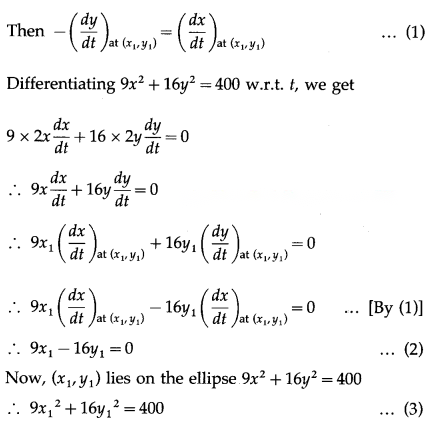
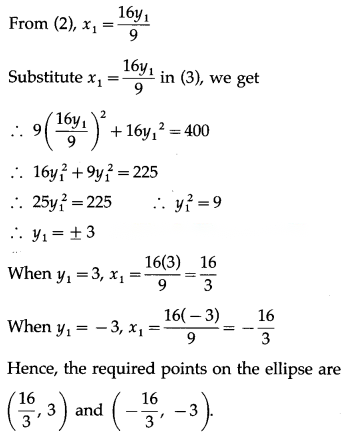
Let P(x1, y1) be the point on the ellipse 9x2 + 16y2 = 400 whose y-coordinate decreasing x-coordinate is increasing at the same rate.
Solution & Step-by-Step Answer:
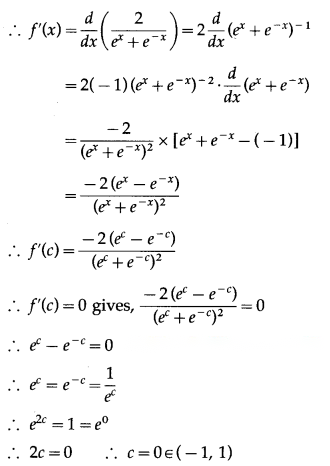
The functions ex, e-x, and 2 are continuous and differentiable in their respective domains. ∴ f(x) = is continuous on [-1, 1] and differentiable on (-1, 1), because ex + e-x ≠ 0 for all x ∈ [-1, 1]. Now, f(-1) = and f(1) = ∴ f(-1) = f(1) Thus, the function f satisfies all the conditions of the Rolle’s theorem. ∴ there exist c ∈ (-1, 1) such that f'(c) = 0 Now, f(x) = Hence, Rolle’s theorem is verified.
Solution & Step-by-Step Answer:
s(t) = 2t2 + 3t – 4 ∴ s(0) = 2(0)2 + 3(0) – 4 = -4 and s(4) = 2(4)2 + 3(4) – 4 = 32 + 12 – 4 = 40 ∴ average velocity = = = 11 Also, instantaneous velocity = = (2t2 + 3t – 4) = 2 × 2t + 3 × 1 – 0 = 4t + 3 ∴ instantaneous velocity at t = c is = 4c + 3 When instantaneous velocity at t = c equal to its average velocity, we get 4c + 3 = 11 4c = 8 ∴ c = 2 ∈ [0, 4] Hence, t = c = 2.
Solution & Step-by-Step Answer:
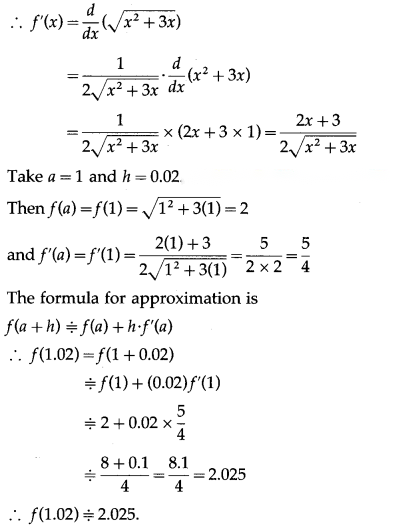
f(x) =
Solution & Step-by-Step Answer:
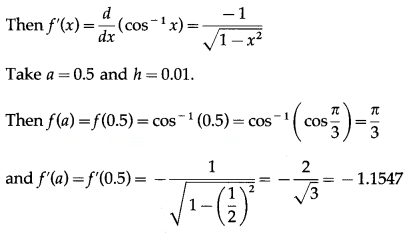
Let f(x) = cos-1 x The formula for approximation is f(a + h)= f(a) + h. f'(a) ∴ cos-1 (0.51) = f(0.51) = f(0.5 + 0.01) = f(0.5) + (0.01) f'(0.5) = + 0.01 × (-1.1547) = – 0.011547 = 1.0472 – 0.011547 = 1.035653 ∴ cos-1 (0.51) = 1.035653.
Solution & Step-by-Step Answer:
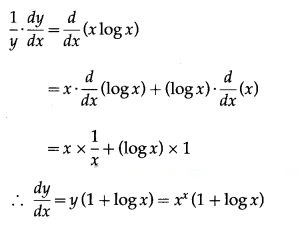
y = xx ∴ log y = log xx = x log x Differentiating both sides w.r.t. x, we get y is increasing if ≥ 0 i.e. if xx (1 + log x) ≥ 0 i.e. if 1 + log x ≥ 0 ……[∵ x > 0] i.e. if log x ≥ -1 i.e. if log x ≥ -log e …….[∵ log e = 1] i.e. if logx ≥ log i.e. if x ≥ ∴ y is increasing in y is decreasing if ≤ 0 i.e. if xx (1 + log x) ≤ 0 i.e. if 1 + log x ≤ 0 ……[∵ x > 0] i.e. if log x ≤ -1 i.e. if log x ≤ -log e i.e. if log x ≤ log i.e. if x ≤ where x > 0 ∴ y is decreasing is Hence, the given function is increasing in and decreasing in
Solution & Step-by-Step Answer:
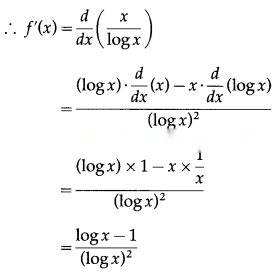
f(x) = f is increasing if f'(x) ≥ 0 i.e. if ≥ 0 i.e. if log x – 1 ≥ 0 ……..[∵ (log x)2 > 0] i.e. if log x ≥ 1 i.e. if log x ≥ log e ………[∵ log e = 1] i.e. if x ≥ e ∴ f is increasing on [e, ∞) f is decreasing if f'(x) ≤ 0 i.e. if ≤ 0 i.e. if log x – 1 ≤ 0 ……..[∵ (log x)2 > 0] i.e. if log x ≤ 1 i.e. if log x ≤ log e i.e. if x ≤ e Also, x > 0 and x ≠ 1 because f(x) = is not defined at x = 1. ∴ f is decreasing in (0, e] – {1} Hence, f is increasing in [e, ∞) and decreasing in (0, e] – {1}.
Solution & Step-by-Step Answer:
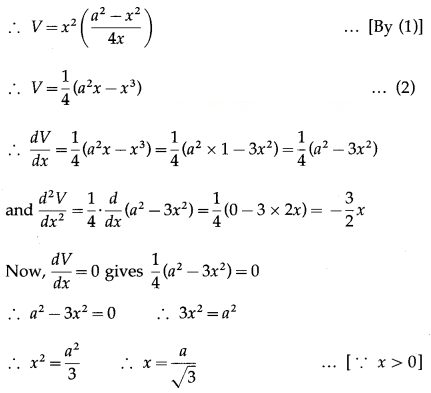
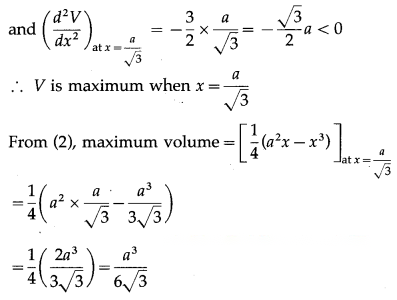
Let x be the side of square base and h be the height of the box. Then x2 + 4xh = a2 ∴ h = …….(1) Let V be the volume of the box. Then V = x2h Hence, the maximum volume of the box is cu units.
Solution & Step-by-Step Answer:
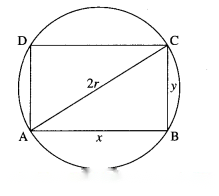
Let ABCD be a rectangle inscribed in a circle of radius r. Let AB = x and BC = y. Then x2 + y2 = 4r2 …….(1) Area of rectangle = xy = ……[By (1)] Let f(x) = x2(4r2 – x2) = 4r2x2 – x4 ∴ f'(x) = (4r2x2 – x4) = 4r2 × 2x – 4x3 = 8r2x – 4x3 and f”(x) = (8r2x – 4x3) = 8r2 × 1 – 4 × 3x2 = 8r2 – 12x2 For maximum area, f'(x) = 0 ⇒ 8r2x – 4x3 = 0 ⇒ 4x3 = 8r2x ⇒ x2 = 2r2 ……..[∵ x ≠ 0] ⇒ x = √2r …..[x > 0] and f”(√2r) = 8r2 – 12(√2r)2 = -16r2 < 0 ∴ f(x) is maximum when x = √2r If x = √2r, then from (1), (√2r)2 + y2 = 4r2 ⇒ y2 = 4r2 – 2r2 = 2r2 ⇒ y = √2r ……[∵ y > 0] ⇒ x = y ∴ rectangle is a square. Hence, amongst all rectangles inscribed in a circle, the square has maximum area.
Solution & Step-by-Step Answer:
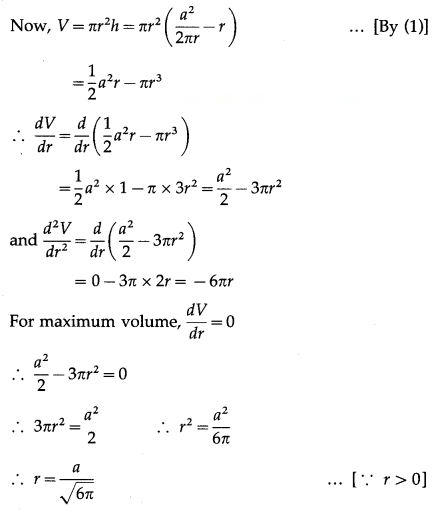
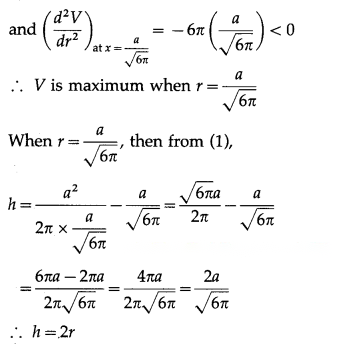
Let r be the radius of the base, h be the height and V be the volume of the closed right circular cylinder, whose surface area is a2 sq units (which is given). 2πrh + 2πr2 = a2 ⇒ 2πr(h + r) = a2 ⇒ h = – r ……(1) Hence, the volume of the cylinder is maximum if its height is equal to the diameter of the base.
Solution & Step-by-Step Answer:
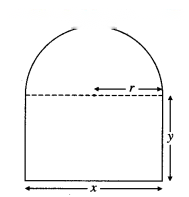
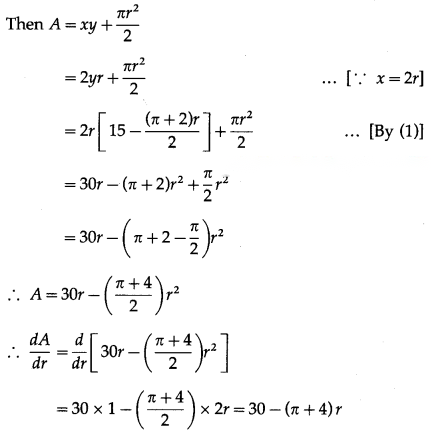
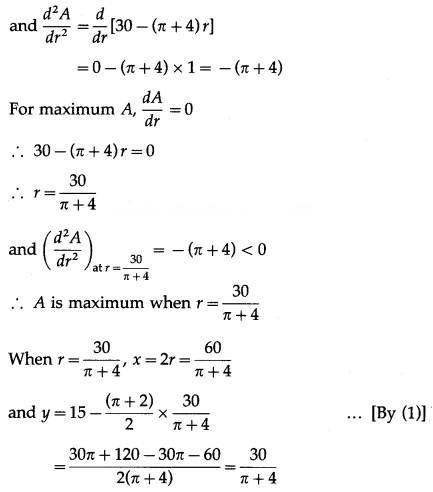
Let x be the length, y be the breadth of the rectangle and r be the radius of the semicircle. Then perimeter of the window = x + 2y + πr, where x = 2r This is given to be 30 m ⇒ 2r + 2y + πr = 30 ⇒ 2y = 30 – (π + 2)r ⇒ y = 15 – ……..(1) The greatest possible amount of light may be admitted if the area of the window is maximized. Let A be the area of the window. Hence, the required dimensions of the window are as follows: Length of rectangle = metres breadth of rectangle = metres radius of the semicircle = metres
Solution & Step-by-Step Answer:
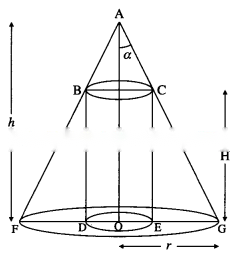
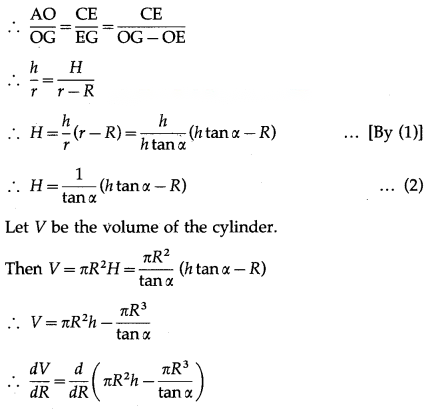
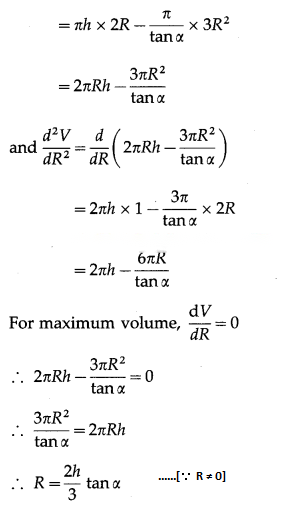
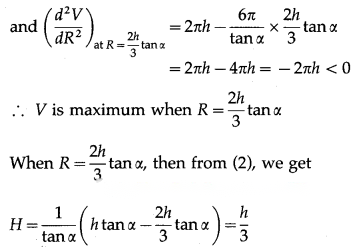
Given the right circular cone of fixed height h and semi-vertical angle a. Let R be the radius of the base and H be the height of the right circular cylinder that can be inscribed in the right circular cone. In the figure, ∠GAO = α, OG = r, OA = h, OE = R, CE = H. We have, = tan α ∴ r = h tan α ……(1) Since ∆AOG and ∆CEG are similar. Hence, the height of the right circular cylinder is one-third of that of the cone.
Solution & Step-by-Step Answer:
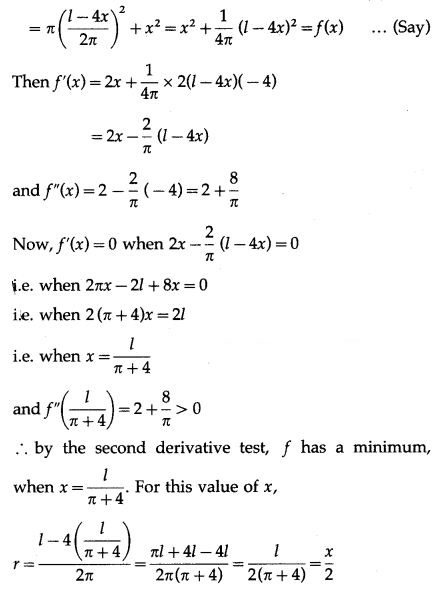
Let r be the radius of the circle and x be the length of the side of the square. Then (circumference of the circle) + (perimeter of the square) = l ∴ 2πr + 4x = l ∴ r = A = (area of the circle) + (area of the square) = πr2 + x2 This shows that the sum of the areas of circle and square is least when the radius of the circle = () side of the square.
Solution & Step-by-Step Answer:
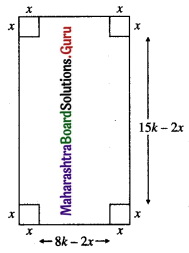
The sides of the rectangular sheet of paper are in the ratio 8 : 15. Let the sides of the rectangular sheet of paper be 8k and 15k respectively. Let x be the side of the square which is removed from the comers of the sheet of paper. The total area of removed squares is 4x2, which is given to be 100. 4x2 = 100 ⇒ x2 = 25 ⇒x = 5 ……[x > 0] Now, the length, breadth, and height of the rectangular box are 15k – 2x, 8k – 2x, and x respectively. Let V be the volume of the box. Then V = (15k – 2x) (8k – 2x). x ⇒ V = (120k2 – 16kx – 30kx + 4x2). x ⇒ V = 4x3 – 46kx2 + 120k2x (4x3 – 46kx2 + 120k2x) = 4 × 3x2 – 46k × 2x + 120k2 × 1 = 12x2 – 92kx + 120k2 Since, volume is maximum when the square of side x = 5 is removed from the corners, ⇒ 12(5)2 – 92k(5) + 120k2 = 0 ⇒ 60 – 92k + 24k2 = 0 ⇒ 6k2 – 23k + 15 = 0 ⇒ 6k2 – 18k – 5k + 15 = 0 ⇒ 6k(k – 3) – 5 (k – 3) = 0 ⇒ (k – 3)(6k – 5) = 0 ⇒ k = 3 or k = If k = , then 8k – 2x = 8k – 10 < 0 ∴ k ≠ ∴ k = 3 ∴ 8k = 8 × 3 = 24 and 15k = 15 × 3 = 45 Hence, the lengths of the rectangular sheet are 24 and 45.
Solution & Step-by-Step Answer:
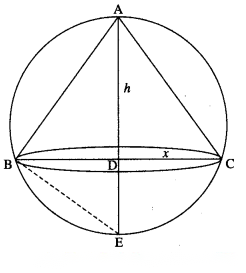
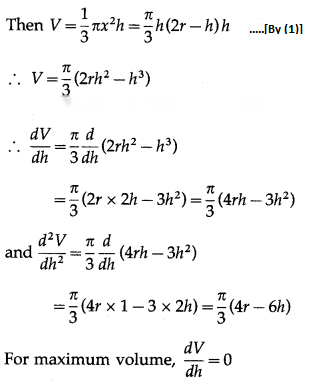
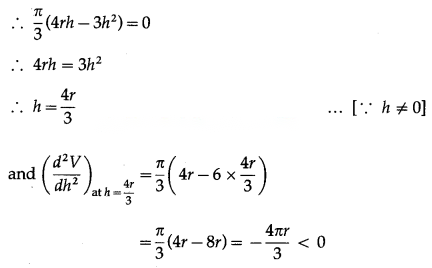
Let x be the radius of the base and h be the height of the cone which is inscribed in a sphere of radius r. In the figure, AD = h and CD = x = BD Since, ΔABD and ΔBDE are similar, BD2 = AD. DE = AD (AE – AD) x2 = h(2r – h) …… (1) Let V be the volume of the cone. ∴ V is maximum when h = Hence, the altitude (i.e. height) of the right circular cone of maximum volume = .
Solution & Step-by-Step Answer:
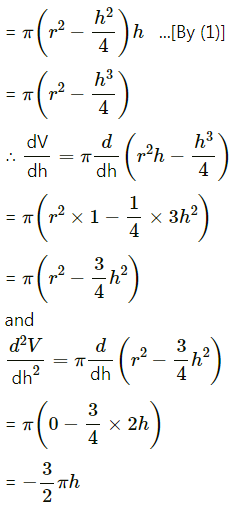
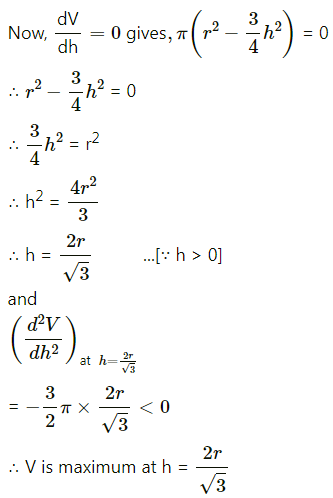
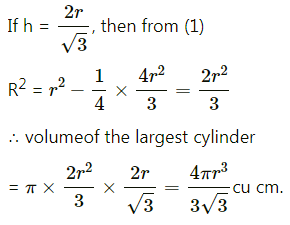
Let R be the radius and h be the height of the cylinder which is inscribed in a sphere of radius r cm. Then from the figure, ∴ R2 = r2 – ………(1) Let V be the volume of the cylinder. Then V = πR2h Hence, the volume of the largest cylinder inscribed in a sphere of radius ‘r’ cm = cu cm.
Solution & Step-by-Step Answer:
f(x) = cos2x + sin x ∴ f'(x) = (cos2x + sin x) = 2 cos x. (cos x) + cos x = 2 cos x(-sin x) + cos x = -sin 2x + cos x and f”(x) = (-sin 2x + cos x) = -cos 2x. (2x) – sin x = -cos 2x × 2 – sin x = -2 cos 2x – sin x For extreme values of f(x), f'(x) = 0 -sin 2x + cos x = 0 -2 sin x cos x + cos x = 0 cos x (-2 sin x + 1) = 0 cos x = 0 or -2 sin x + 1 = 0 cos x = cos or sin x = = sin ∴ x = or x =
(i) f”() = -2 cos π – sin
= -2(-1) – 1
= 1 > 0
∴ by the second derivative test, f is minimum at x = and minimum value of f at x =
= f()
=
= 0 + 1
= 1
(ii) f”() =
=
= < 0
∴ by the second derivative test, f is maximum at x = and maximum value of f at x =
= f()
=
=
=
Hence, the maximum and minimum values of the function f(x) are and 1 respectively.