Balbharti12th Maharashtra State Board Maths Solutions BookPdf Chapter 2 Applications of Derivatives Ex 2.4 Questions and Answers.
Maharashtra State Board 12th Maths Solutions Chapter 2 Applications of Derivatives Ex 2.4
Solution & Step-by-Step Answer:
f(x) = x3 – 6x2 + 12x – 16 ∴ f'(x) = (x3 – 6x2 + 12x – 16) = 3x2 – 6 × 2x + 12 × 1 – 0 = 3x2 – 12x + 12 = 3(x2 – 4x + 4) = 3(x – 2)2 ≥ 0 for all x ∈ R ∴ f(x) ≥ 0 for all x ∈ R ∴ f is increasing for all x ∈ R.
(ii) f(x) = 2 – 3x + 3x2– x3, x ∈ R.
Solution:
f(x) = 2 – 3x + 3x2– x3
∴ f'(x) = (2 – 3x + 3x2– x3)
= 0 – 3 × 1 + 3 × 2x – 3x2
= -3 + 6x – 3x2
= -3(x2– 2x + 1)
= -3(x – 1)2≤ 0 for all x ∈ R
∴ f'(x) ≤ 0 for all x ∈ R
∴ f is decreasing for all x ∈ R.
(iii) f(x) = x – , x ∈ R, x ≠ 0.
Solution:
f(x) = x –
f'(x) =
= > 0 for all x ∈ R, x ≠ 0
∴ f'(x) > 0 for all x ∈ R, where x ≠ 0
∴ f is increasing for all x ∈ R, where x ≠ 0.
Solution & Step-by-Step Answer:
f(x) = 2x3 – 3x2 – 12x + 6 ∴ f'(x) = (2x3 – 3x2 – 12x + 6) = 2 × 3x2 – 3 × 2x – 12 × 1 + 0 = 6x2 – 6x – 12 = 6(x2 – x – 2) f is strictly increasing if f'(x) > 0 i.e. if 6(x2 – x – 2) > 0 i.e. if x2 – x – 2 > 0 i.e. if x2 – x > 2 i.e. if x2 – x + > 2 + i.e. if i.e. if x – > or x – < i.e. if x > 2 or x < -1 ∴ f is strictly increasing if x < -1 or x > 2.
(ii) f(x) = 3 + 3x – 3x2+ x3
Solution:
f(x) = 3 + 3x – 3x2+ x3
∴ f'(x) = (3 + 3x – 3x2+ x3)
= 0 + 3 × 1 – 3 × 2x + 3x2
= 3 – 6x + 3x2
= 3(x2– 2x + 1)
f is strictly increasing if f'(x) > 0
i.e. if 3(x2– 2x + 1) > 0
i.e. if x2– 2x + 1 > 0
i.e. if (x – 1)2> 0
This is possible if x ∈ R and x ≠ 1
i.e. x ∈ R – {1}
∴ f is strictly increasing if x ∈ R – {1}.
(iii) f(x) = x3– 6x2– 36x + 7
Solution:
f(x) = x3– 6x2– 36x + 7
∴ f'(x) = (x3– 6x2– 36x + 7)
= 3x2– 6 × 2x – 36 × 1 + 0
= 3x2– 12x – 36
= 3(x2– 4x – 12)
f is strictly increasing if f'(x) > 0
i.e. if 3(x2– 4x – 12) > 0
i.e. if x2– 4x – 12 > 0
i.e. if x2– 4x > 12
i.e. if x2– 4x + 4 > 12 + 4
i.e. if (x – 2)2> 16
i.e. if x – 2 > 4 or x – 2 < -4 i.e. if x > 6 or x < -2
∴ f is strictly increasing if x < -2 or x > 6.
Solution & Step-by-Step Answer:
f(x) = 2x3 – 3x2 – 12x + 6 ∴ f'(x) = (2x3 – 3x2 – 12x + 6) = 2 × 3x2 – 3 × 2x – 12 × 1 + 0 = 6x2 – 6x – 12 = 6(x2 – x – 2) f is strictly decreasing if f'(x) < 0 i.e. if 6(x2 – x – 2) < 0 i.e. if x2 – x – 2 < 0 i.e. if x2 – x < 2 i.e. if x2 – x + < 2 + i.e. if i.e. if i.e. if i.e. if -1 < x < 2 ∴ f is strictly decreasing if -1 < x < 2.
(ii) f(x) = x +
Solution:
f(x) = x + , x ≠ 0
∴ f'(x) =
= 1 + 25(-1) x-2
= 1 –
f is is strictly decreasing if f'(x) < 0
i.e. if 1 – < 0
i.e. if 1 <
i.e. if x2< 25
i.e. if -5 < x < 5, x ≠ 0
i.e. if x ∈ (-5, 5) – {0}
∴ f is strictly decreasing if x ∈ (-5, 5) – {0}.
(iii) f(x) = x3– 9x2+ 24x + 12
Solution:
f(x) = x3– 9x2+ 24x + 12
∴ f'(x) = (x3– 9x2+ 24x + 12)
= 3x2– 9 × 2x + 24 × 1 + 0
= 3x2– 18x + 24
= 3(x2– 6x + 8)
f is strictly decreasing if f'(x) < 0
i.e. if 3(x2– 6x + 8) < 0
i.e. if x2– 6x + 8 < 0
i.e. if x2– 6x < -8
i.e. if x2– 6x + 9 < -8 + 9
i.e. if (x – 3)2< 1
i.e. if -1 < x – 3 < 1
i.e. if -1 + 3 < x – 3 + 3 < 1 + 3
i.e. if 2 < x < 4
i.e., if x ∈ (2, 4)
∴ f is strictly decreasing if x ∈ (2, 4)
Solution & Step-by-Step Answer:
f(x) = x3 – 12x2 – 144x + 13 ∴ f'(x) = (x3 – 12x2 – 144x + 13) = 3x2 – 12 × 2x – 144 × 1 + 0 = 3x2 – 24x – 144 = 3(x2 – 8x – 48)
(a) f is increasing if f'(x) ≥ 0
i.e. if 3(x2– 8x – 48) ≥ 0
i.e. if x2– 8x – 48 ≥ 0
i.e. if x2– 8x ≥ 48
i.e. if x2– 8x + 16 ≥ 48 + 16
i.e. if (x – 4)2≥ 64
i.e. if x – 4 ≥ 8 or x – 4 ≤ -8
i.e. if x > 12 or x ≤ -4
∴ f is increasing if x ≤ -4 or x ≥ 12,
i.e. x ∈ (-∞, -4] ∪ [12, ∞).
(b) f is decreasing if f'(x) ≤ 0
i.e. if 3(x2– 8x – 48) ≤ 0
i.e. if x2– 8x – 48 ≤ 0
i.e. if x2– 8x ≤ 48
i.e. if x2– 8x + 16 ≤ 48 + 16
i.e. if (x – 4)2≤ 64
i.e. if -8 ≤ x – 4 ≤ 8
i.e. if -4 ≤ x ≤ 12
∴ f is decreasing if -4 ≤ x ≤ 12, i.e. x ∈ [-4, 12].
Solution & Step-by-Step Answer:
f(x) = 2x3 – 15x2 – 144x – 7 f'(x) = (2x3 – 15x2 – 144x – 7) = 2 × 3x2 – 15 × 2x – 144 × 1 – 0 = 6x2 – 30x – 144 = 6(x2 – 5x – 24) (a) f is strictly increasing if f'(x) > 0 i.e. if 6(x2 – 5x – 24) > 0 i.e. if x2 – 5x – 24 > 0 i.e. if x2 – 5x > 24 i.e. if x2 – 5x + > 24 + i.e. if i.e. if i.e. if x > 8 or x < -3 ∴ f is strictly increasing, if x < -3 or x > 8.
(b) f is strictly decreasing if f'(x) < 0
i.e. if 6(x2– 5x – 24) < 0
i.e. if x2– 5x – 24 < 0
i.e. if x2– 5x < 24
i.e. if x2– 5x + < 24 +
i.e. if
i.e. if
i.e. if
i.e. if -3 < x < 8
∴ f is strictly decreasing, if -3 < x < 8.
Solution & Step-by-Step Answer:
f(x) =
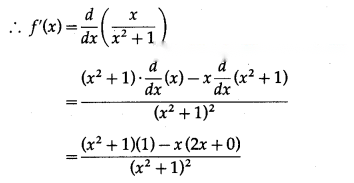

(a) f is strictly increasing if f'(x) > 0
i.e. if > 0
i.e. if 1 – x2> 0 ……..[∵ (x2+ 1)2> 0]
i.e. if 1 > x2
i.e. if x2< 1
i.e. if -1 < x < 1
∴ f is strictly increasing if -1 < x < 1
(b) f is strictly decreasing if f'(x) < 0
i.e. if < 0
i.e. if 1 – x2< 0 ……..[∵ (x2+ 1)2> 0]
i.e. if 1 < x2i.e. if x2> 1
i.e. if x > 1 or x < -1
∴ f is strictly decreasing if x < -1 or x > 1
i.e. x ∈ (-∞, -1) ∪ (1, ∞).
Solution & Step-by-Step Answer:
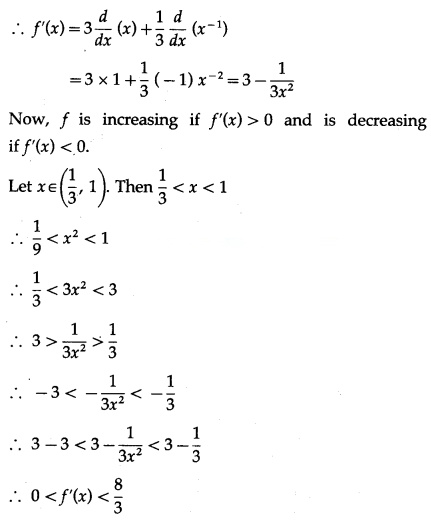
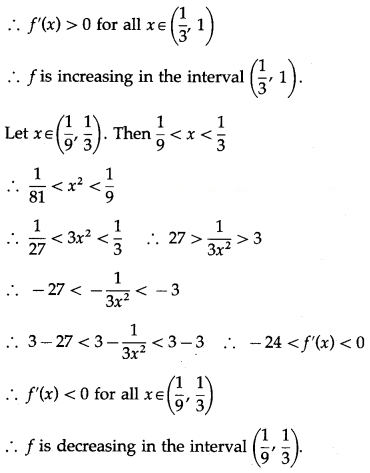
f(x) = 3x +
Solution & Step-by-Step Answer:
f(x) = x – cos x ∴ f'(x) = (x – cos x) = 1 – (-sin x) = 1 + sin x Now, -1 ≤ sin x ≤ 1 for all x ∈ R ∴ -1 + 1 ≤ 1 + sin x ≤ 1 for all x ∈ R ∴ 0 ≤ f'(x) ≤ 1 for all x ∈ R ∴ f'(x) ≥ 0 for all x ∈ R ∴ f is increasing for all x.
Solution & Step-by-Step Answer:
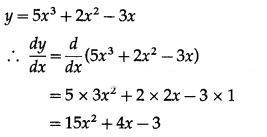
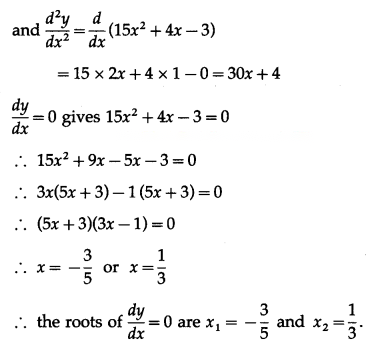
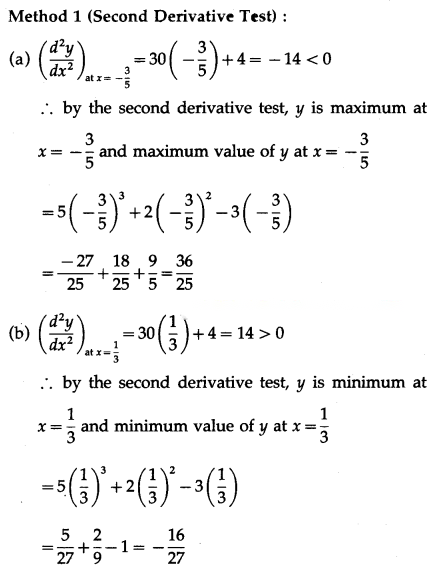
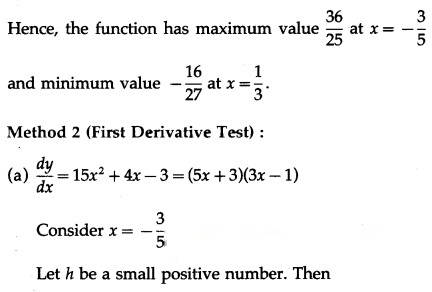
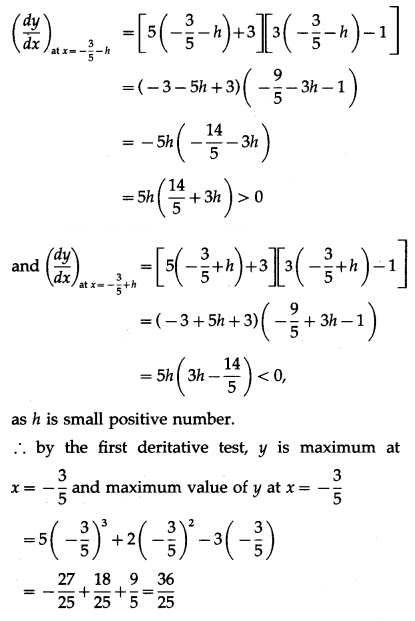
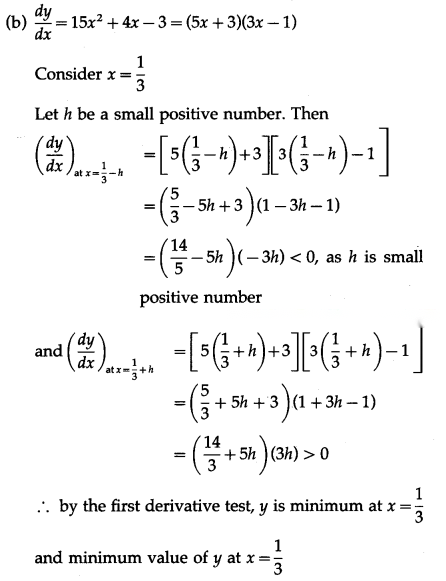
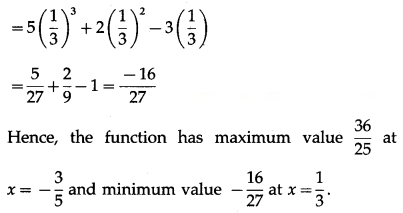
(ii) f(x) = 2x3– 21x2+ 36x – 20
Solution:
f(x) = 2x3– 21x2+ 36x – 20
∴ f'(x) = (2x3– 21x2+ 36x – 20)
= 2 × 3x2– 21 × 2x + 36 × 1 – 0
= 6x2– 42x + 36
and f”(x) = (6x2– 42x + 36)
= 6 × 2x – 42 × 1 + 0
= 12x – 42
f'(x) = 0 gives 6x2– 42x + 36 = 0
∴ x2– 7x + 6 = 0
∴ (x – 1)(x – 6) = 0
the roots of f'(x) = 0 are x1= 1 and x2= 6.
Method 1 (Second Derivative Test):
(a) f”(1) = 12(1) – 42 = -30 < 0
∴ by the second derivative test, f has maximum at x = 1
and maximum value of f at x = 1
f(1) = 2(1)3– 21(1)2+ 36(1) – 20
= 2 – 21 + 36 – 20
= -3
(b) f”(6) = 12(6) – 42 = 30 > 0
∴ by the second derivative test, f has minimum at x = 6
and minimum value of f at x = 6
f(6) = 2(6)3– 21(6)2+ 36(6) – 20
= 432 – 756 + 216 – 20
= -128.
Hence, the function f has maximum value -3 at x = 1 and minimum value -128 at x = 6.
Method 2 (First Derivative Test):
(a) f'(x) = 6(x – 1)(x – 6)
Consider x = 1
Let h be a small positive number. Then
f'(1 – h) = 6(1 – h – 1)(1 – h – 6)
= 6(-h)(-5 – h)
= 6h(5 + h)> 0
and f'(1 + h) = 6(1 + h – 1)(1 + h – 6)
= 6h(h – 5) < 0, as h is small positive number.
∴ by the first derivative test, f has maximum at x = 1 and maximum value of f at x = 1
f(1) = 2(1)3– 21(1)2+ 36(1) – 20
= 2 – 21 + 36 – 20
= -3
(b) f'(x) = 6(x – 1)(x – 6)
Consider x = 6
Let h be a small positive number. Then
f'(6 – h) = 6(6 – h – 1)(6 – h – 6)
= 6(5 – h)(-h)
= -6h(5 – h) < 0, as h is small positive number
and f'(6 + h) = 6(6 + h – 1)(6 + h – 6) = 6(5 + h)(h) > 0
∴ by the first derivative test, f has minimum at x = 6
and minimum value of f at x = 6
f(6) = 2(6)3– 21(6)2+ 36(6) – 20
= 432 – 756 + 216 – 20
= -128
Hence, the function f has maximum value -3 at x = 1
and minimum value -128 at x = 6.
(iii) f(x) = x3– 9x2+ 24x
Solution:
f(x) = x3– 9x2+ 24x
∴ f'(x) = (x3– 9x2+ 24x)
= 3x2– 9 × 2x + 24 × 1
= 3x2– 18x + 24
and f”(x) = (3x2– 18x + 24)
= 3 × 2x – 18 × 1 + 0
= 6x – 18
f'(x) = 0 gives 3x2– 18x + 24 = 0
∴ x2– 6x + 8 = 0
∴ (x – 2)(x – 4) = 0
∴ the roots of f'(x) = 0 are x1= 2 and x2= 4.
(a) f”(2) = 6(2) – 18 = -6 < 0
∴ by the second derivative test, f has maximum at x = 2
and maximum value of f at x = 2
f(2) = (2)3– 9(2)2+ 24(2)
= 8 – 36 + 48
= 20
(b) f”(4) = 6(4) – 18 = 6 > 0
∴ by the second derivative test, f has minimum at x = 4
and minimum value of f at x = 4
f(4) = (4)3– 9(4)2+ 24(4)
= 64 – 144 + 96
= 16
Hence, the function f has maximum value 20 at x = 2 and minimum value 16 at x = 4.
(iv) f(x) = x2+
Solution:
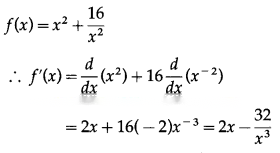
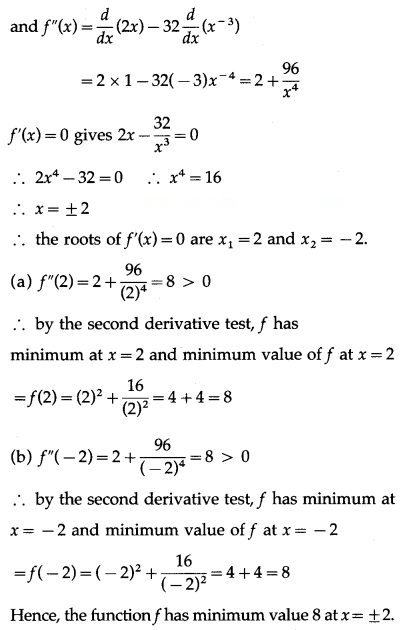
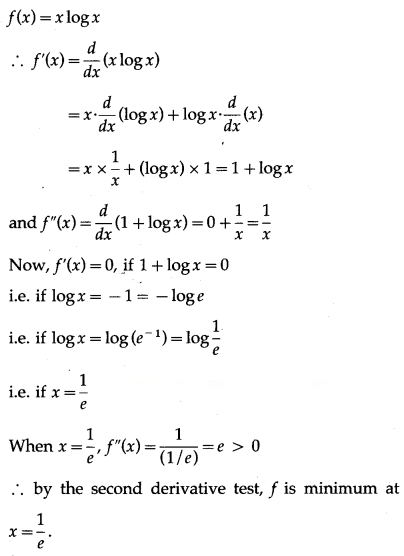
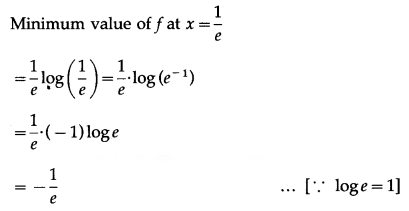
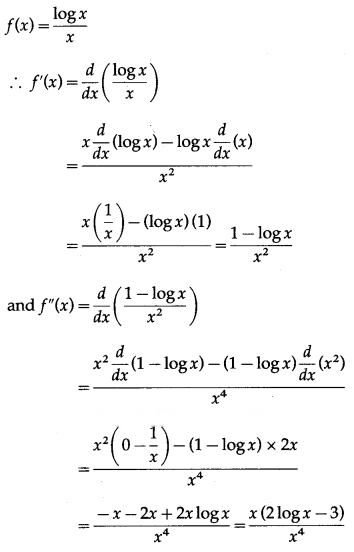
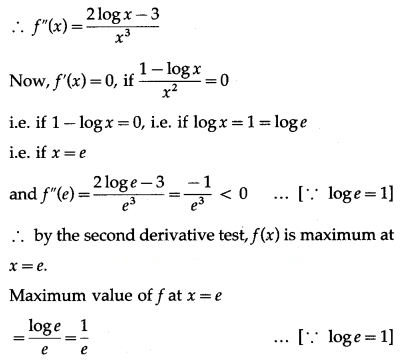
(v) f(x) = x log x
Solution:
(vi) f(x) =
Solution:
Solution & Step-by-Step Answer:
Let the first part of 30 be x. Then the second part is 30 – x. ∴ their product = x(30 – x) = 30x – x2 = f(x) ……(Say) ∴ f'(x) = (30x – x2) = 30 × 1 – 2x = 30 – 2x and f”(x) = (30 – 2x) = 0 – 2 × 1 = -2 The root of the equation f(x) = 0, i.e. 30 – 2x = 0 is x = 15 and f”(15) = -2 < 0 ∴ by the second derivative test, f is maximum at x = 15. Hence, the required parts of 30 are 15 and 15.
Solution & Step-by-Step Answer:
Let the first part of 20 be x. Then the second part is 20 – x. ∴ sum of their squares = x2 + (20 – x)2 = f(x) …… (Say) ∴ f'(x) = [x2 + (20 – x)2] = 2x + 2(20 – x). (20 – x) = 2x + 2(20 – x) × (0 – 1) = 2x – 40 + 2x = 4x – 40 and f”(x) = (4x – 40) = 4 × 1 – 0 = 4 The root of the equation f'(x) = 0, i.e. 4x – 40 = 0 is x = 10 and f”(10) = 4 > 0 ∴ by the second derivative test, f is minimum at x = 10. Hence, the required parts of 20 are 10 and 10.
Solution & Step-by-Step Answer:
Let x metres and y metres be the length and breadth of the rectangle. Then its perimeter is 2(x + y) = 36 x + y = 18 y = 18 – x Area of the rectangle = xy = x (18 – x) Let f(x) = x(18 – x) = 18x – x2 ∴ f'(x) = (18x – x2) = 18 – 2x and f”(x) = (18 – 2x) = 0 – 2 × 1 = -2 Now, f'(x) = 0, if 18 – 2x = 0 i.e. if x = 9 and f”(9) = -2 < 0 ∴ by the second derivative test, f has maximum value at x = 9. When x = 9, y = 18 – 9 = 9 ∴ x = 9 cm, y = 9 cm ∴ the rectangle is a square of side 9 metres.
Solution & Step-by-Step Answer:
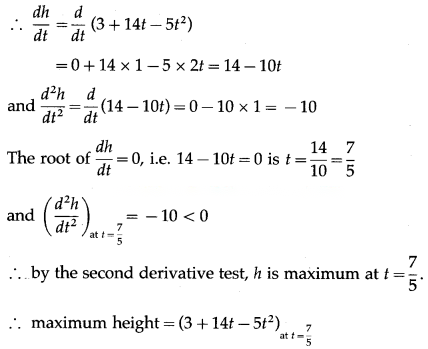
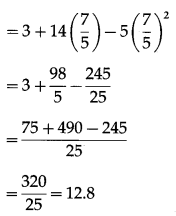
The height h at any t is given by h = 3 + 14t – 5t2 Hence, the maximum height the ball can reach = 12.8 units.
Solution & Step-by-Step Answer:
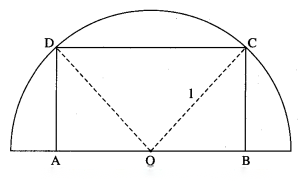
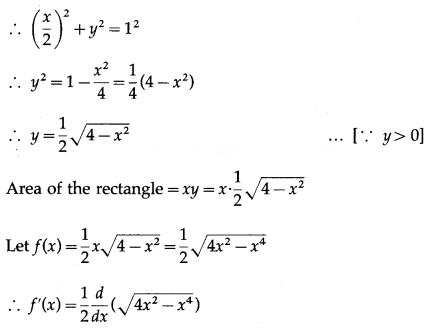
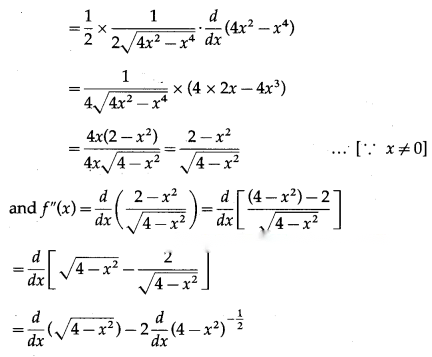
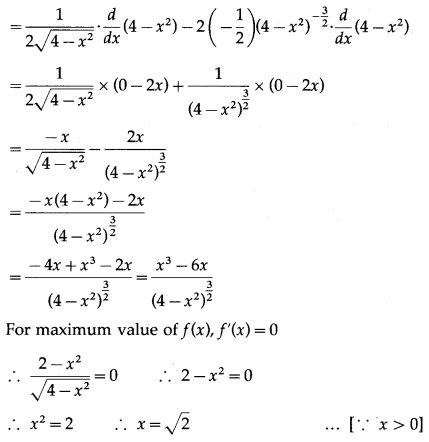
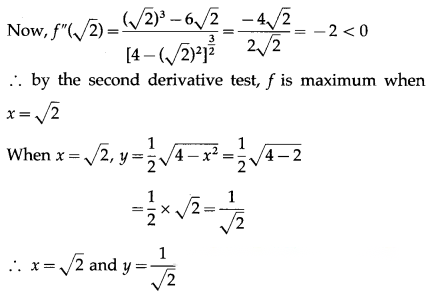
Let ABCD be the rectangle inscribed in a semicircle of radius 1 unit such that the vertices A and B lie on the diameter. Let AB = DC = x and BC = AD = y. Let O be the centre of the semicircle. Join OC and OD. Then OC = OD = radius = 1. Also, AD = BC and m∠A = m∠B = 90°. ∴ OA = OB ∴ OB = AB = In right angled triangle OBC, OB2 + BC2 = OC2 Hence, the area of the rectangle is maximum (i.e. rectangle has the largest size) when its length is √2 units and breadth is unit.
Solution & Step-by-Step Answer:
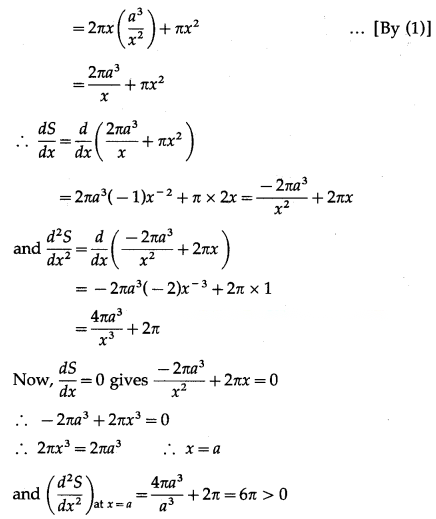
Let x be the radius of the base, h be the height, V be the volume and S be the total surface area of the cylindrical tank. Then V = πa3 … (Given) ∴ πx2h = πa3 ∴ h = ……..(1) Now, S = 2πxh + πx2 ∴ by the second derivative test, S is minimum when x = a When x = a, from (1) h = = a Hence, the quantity of metal sheet is minimum when radius height = a cm.
Solution & Step-by-Step Answer:
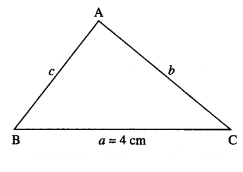
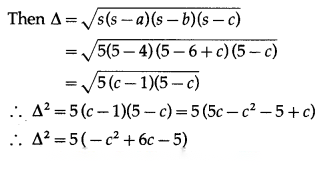
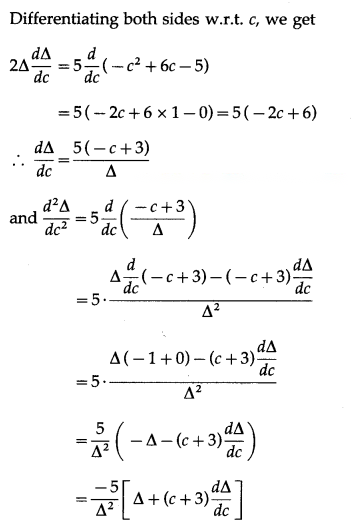
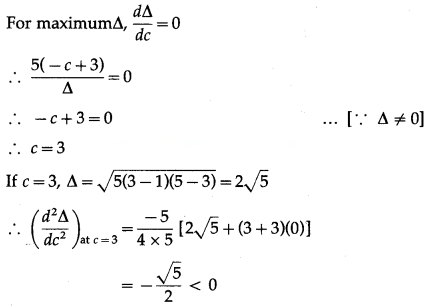
Let ABC be the triangle such that the side BC = a = 4 cm. Also, the perimeter of the triangle is 10 cm. i.e. a + b + c = 10 ∴ 2s = 10 ∴ s = 5 Also, 4 + b + c = 10 ∴ b + c = 6 ∴ b = 6 – c Let ∆ be the area of the triangle. ∴ by the second derivative test, ∆ is maximum when c = 3. When c = 3, b = 6 – c = 6 – 3 = 3 Hence, the area of the triangle is maximum when the other two sides are 3 cm and 3 cm.
Solution & Step-by-Step Answer:
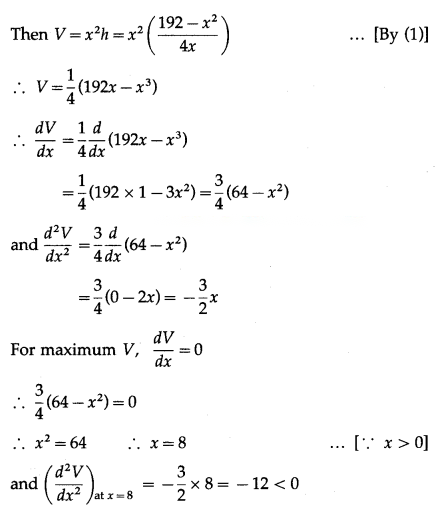
Let x cm be the side of square base and h cm be its height. Then x2 + 4xh = 192 ∴ h = …… (1) Let V be the volume of the box. ∴ by the second derivative test, V is maximum at x = 8. If x = 8, h = = 4 Hence, the volume of the box is largest, when the side of square base is 8 cm and its height is 4 cm.
Solution & Step-by-Step Answer:
Profit function P (x) is given by P(x) = (150 – x)x – 1625 = 150x – x2 -1625 ∴ P'(x) = (150x – x2 – 1625) = 150 × 1 – 2x – 0 = 150 – 2x and P”(x) = (150 – 2x) = 0 – 2 × 1 = -2 Now, P'(x) = 0 gives, 150 – 2x = 0 ∴ x = 75 and P”(75) = -2 < 0 ∴ by the second derivative test, P(x) is maximum when x = 75 Maximum profit = P(75) = (150 – 75)75 – 1625 = 75 × 75 – 1625 = 4000 Hence, the profit will be maximum, if the manufacturer manufactures 75 items and the maximum profit is 4000.
Solution & Step-by-Step Answer:
Let the two numbers be x and y. Then x + y = 15 ∴ y = 15 – x Let P is the product of square of y and cube of x. Then P = x3y2 = x3(15 – x)2 = x3(225 – 30x + x2) = x5 – 30x4 + 225x3 ∴ = (x5 – 30x4 + 225x3) = 5x4 – 30 × 4x3 + 225 × 3x2 = 5x4 – 120x3 + 675x2 and = (5x4 – 120x3 + 675x2) = 5 × 4x3 – 120 × 3x2 + 675 × 2x = 20x3 – 360x2 + 1350x = 10x(2x2 – 36x + 135) Now, = 0 gives 5x4 – 120x3 + 675x2 = 0 ∴ 5x2(x2 – 24x +135) = 0 ∴ 5x2(x2 – 15x – 9x + 135) = 0 ∴ 5x2[x(x – 15) – 9(x – 35)] = 0 ∴ 5x2(x – 15)(x – 9) = 0 ∴ the roots of = 0 are x1 = 0, x2 = 15 and x3 = 9 If x = 0, then y = 15 – 0 = 15 If x = 15, then y = 15 – 15 = 0 In both cases, product x3y2 is zero, which is not maximum. ∴ x ≠ 0 and x ≠ 15 ∴ x = 6 Now, = 10(6)[2(6)2 – 36 × 6 + 135] = 60[72 – 216 + 135] = 60(-9) = -540 < 0 ∴ P is maximum when x = 6 If x = 6, then y = 15 – 6 = 9 Hence, the required numbers are 6 and 9.
Solution & Step-by-Step Answer:
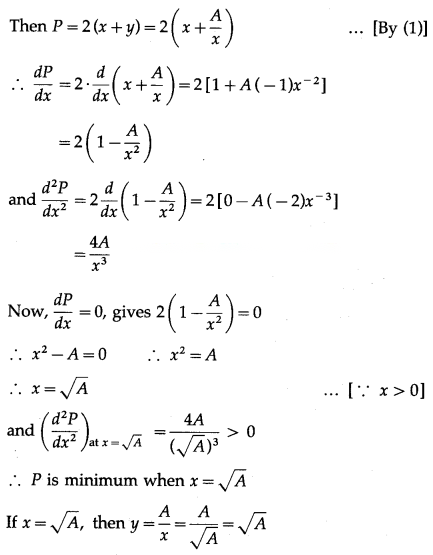
Let x be the length and y be the breadth of the rectangle whose area is A sq units (which is given as constant). Then xy = A ∴ y = ………(1) Let P be the perimeter of the rectangle. x = y ∴ rectangle is a square. Hence, among rectangles of given area, the square has least perimeter.
Solution & Step-by-Step Answer:
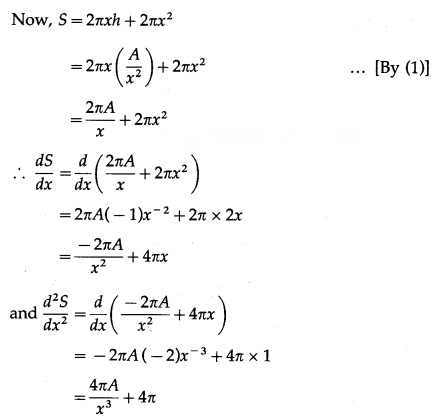
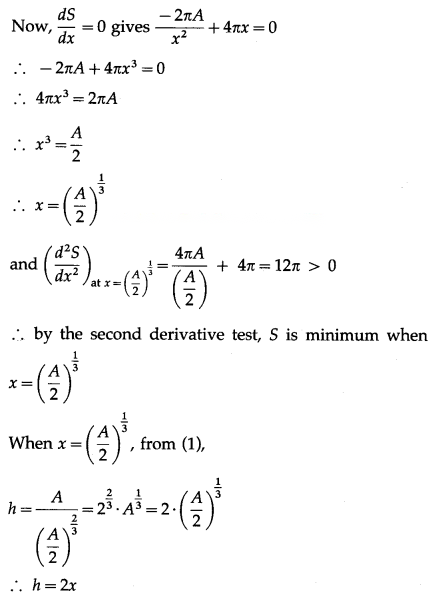
Let x be the radius of base, h be the height and S be the surface area of the closed right circular cylinder whose volume is V which is given to be constant. Then πr2h = V ∴ h = …….(1) where A = , which is constant. Hence, the surface area is least when height of the closed right circular cylinder is equal to its diameter.
Solution & Step-by-Step Answer:
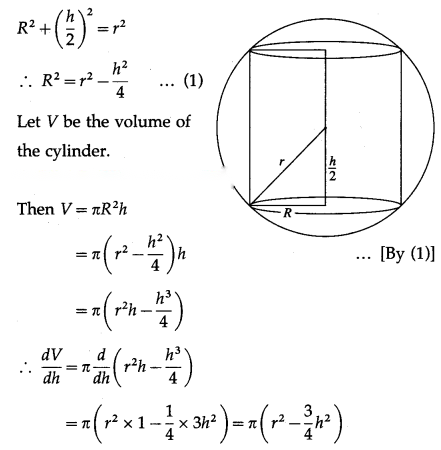
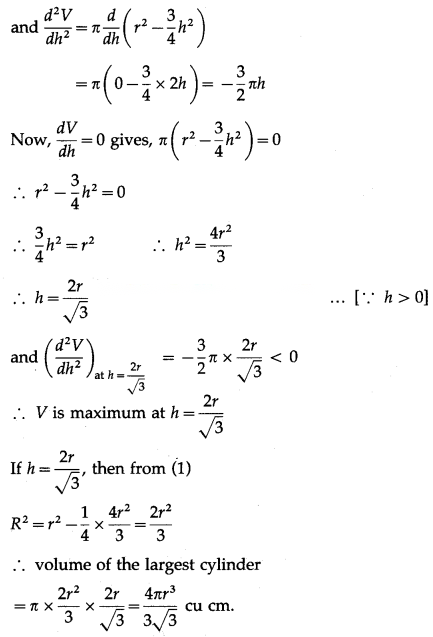
Let R be the radius and h be the height of the cylinder which is inscribed in a sphere of radius r cm. Then from the figure, Hence, the volume of the largest cylinder inscribed in a sphere of radius ‘r’ cm = cu cm.
Solution & Step-by-Step Answer:
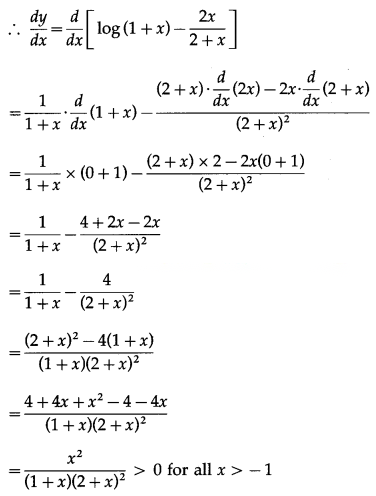
y = log(1 + x) – , x > -1 Hence, the given function is increasing function on its domain.
Solution & Step-by-Step Answer:
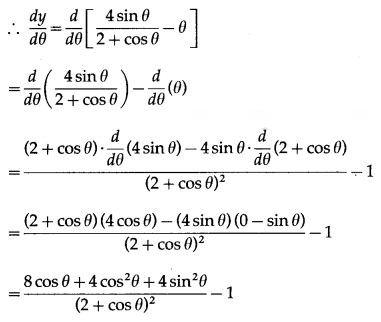
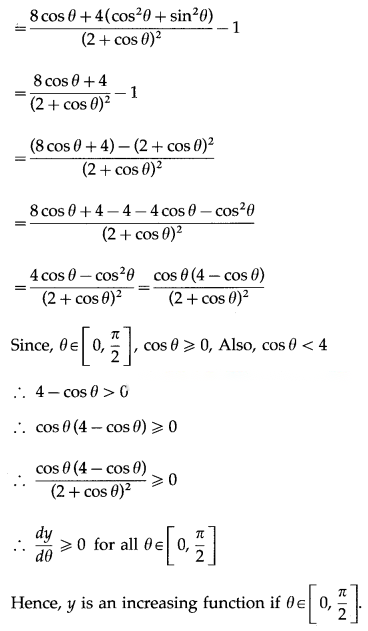
y = – θ