Balbharti12th Maharashtra State Board Maths Solutions BookPdf Chapter 2 Applications of Derivatives Ex 2.1 Questions and Answers.
Maharashtra State Board 12th Maths Solutions Chapter 2 Applications of Derivatives Ex 2.1
Solution & Step-by-Step Answer:
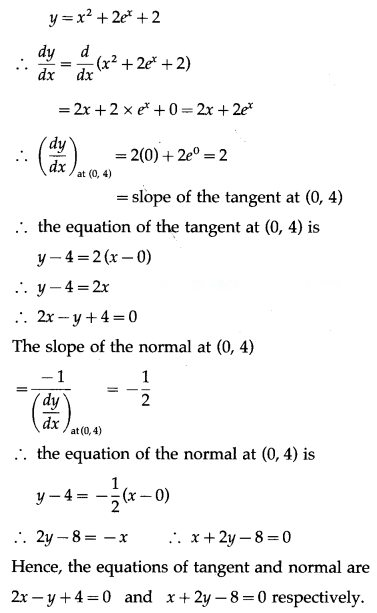
(ii) x3+ y3– 9xy = 0 at (2, 4)
Solution:
x3+ y3– 9xy = 0
Differentiating both sides w.r.t. x, we get
Hence, the equations of tangent and normal are 4x – 5y + 12 = 0 and 5x + 4y – 26 = 0 respectively.


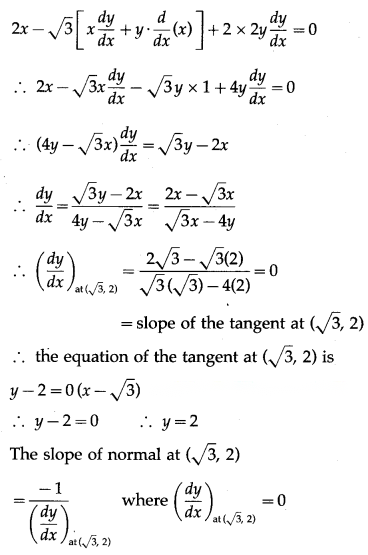
(iii) x2– √3xy + 2y2= 5 at (√3, 2)
Solution:
x2– √3xy + 2y2= 5
Differentiating both sides w.r.t. x, we get
the slope of normal at (√3, 2) does not exist.
normal is parallel to Y-axis.
equation of the normal is of the form x = k
Since, it passes through the point (√3, 2), k = √3
equation of the normal is x = √3.
Hence, the equations of tangent and normal are y = 2 and x = √3 respectively.
(iv) 2xy + π sin y = 2π at (1, )
Solution:
2xy + π sin y = 2π
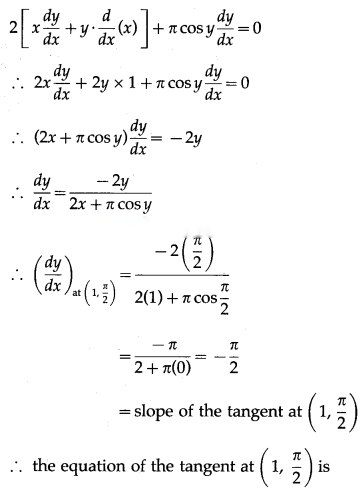
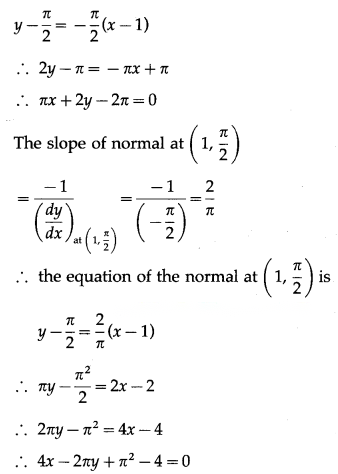
Differentiating both sides w.r.t. x, we get
Hence, the equations of tangent and normal are πx + 2y – 2π = 0 and 4x – 2πy + π2– 4 = 0 respectively.
(v) x sin 2y = y cos 2x at (, )
Solution:
x sin 2y = y cos 2x
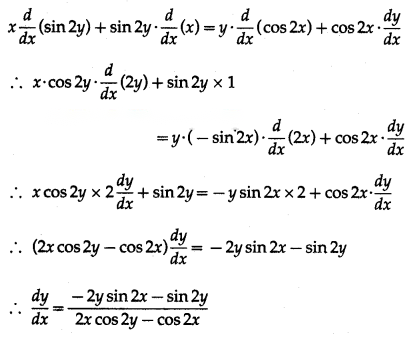
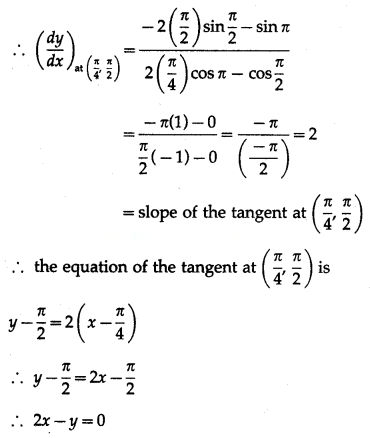
Differentiating both sides w.r.t. x, we get
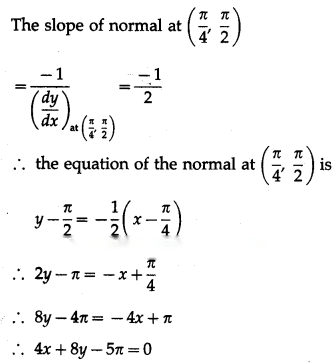
Hence, the equations of the tangent and normal are 2x – y = 0 and 4x + 8y – 5π = 0 respectively.
(vi) x = sin θ and y = cos 2θ at θ =
Solution:
When θ = , x = sin and y = cos
∴ x = and y =
Hence, the point at which we want to find the equations of tangent and normal is (, )
Now, x = sin θ, y = cos 2θ
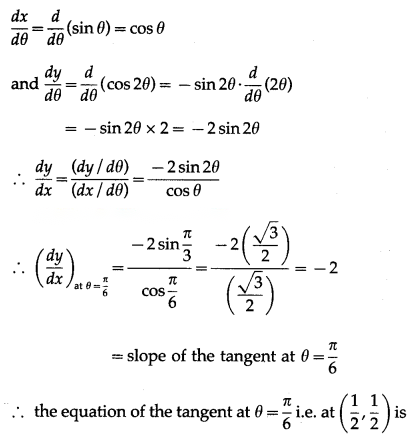
Differentiating x and y w.r.t. θ, we get
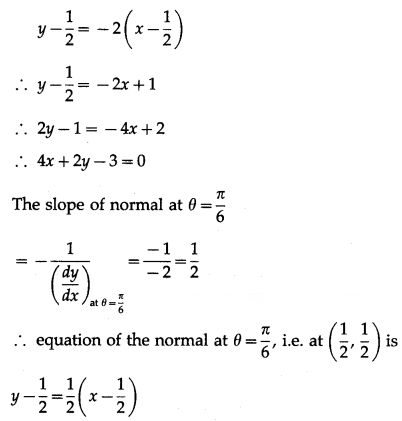
2y – 1 = x –
4y – 2 = 2x – 1
2x – 4y + 1 = 0
Hence, equations of the tangent and normal are 4x + 2y – 3 = 0 and 2x – 4y + 1 = 0 respectively.
(vii) x = √t, y = t – , at t = 4.
Solution:
When t = 4, x = √4 and y = 4 –
∴ x = 2 and y = 4 – =
Hence, the point at which we want to find the equations of tangent and normal is (2, ).
Now, x = √t, y = t –
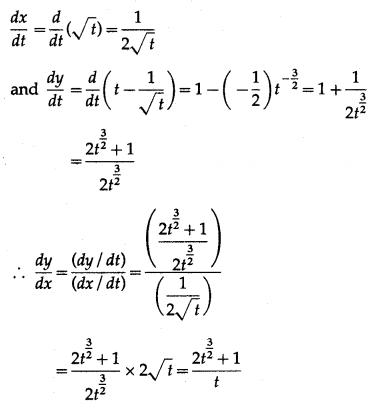
Differentiating x and y w.r.t. t, we get
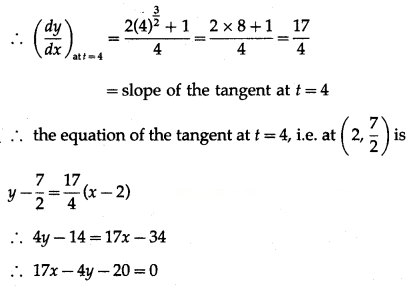
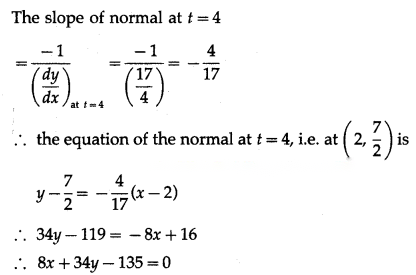
Hence, the equations of tangent and normal are 17x – 4y – 20 = 0 and 8x + 34y – 135 = 0 respectively.
Solution & Step-by-Step Answer:
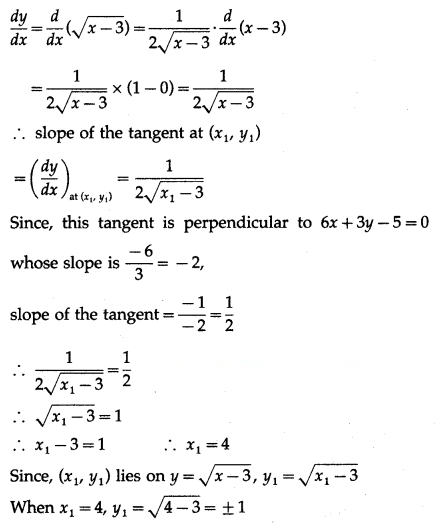
Let the required point on the curve y = be P(x1, y1). Differentiating y = w.r.t. x, we get Hence, the required points are (4, 1) and (4, -1).
Solution & Step-by-Step Answer:
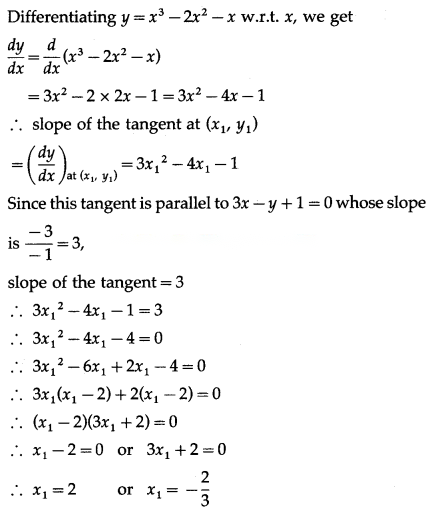
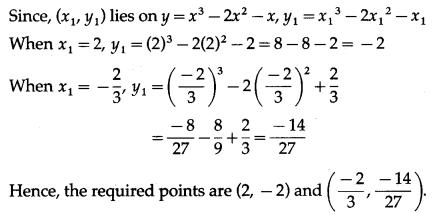
Let the required point on the curve y = x3 – 2x2 – x be P(x1, y1).
Solution & Step-by-Step Answer:
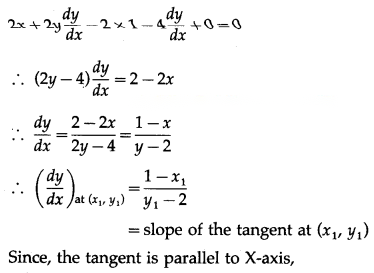
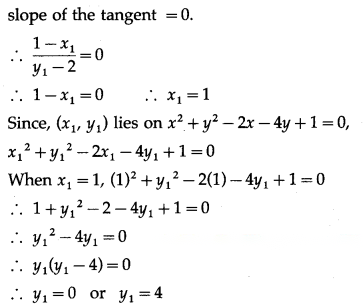
Let P (x1, y1) be the point on the curve x2 + y2 – 2x – 4y + 1 = 0 where the tangent is parallel to X-axis. Differentiating x2 + y2 – 2x – 4y + 1 = 0 w.r.t. x, we get the coordinates of the points are (1, 0) or (1, 4) Since the tangents are parallel to X-axis, their equations are of the form y = k If it passes through the point (1, 0), k = 0, and if it passes through the point (1, 4), k = 4 Hence, the equations of the tangents are y = 0 and y = 4.
Solution & Step-by-Step Answer:
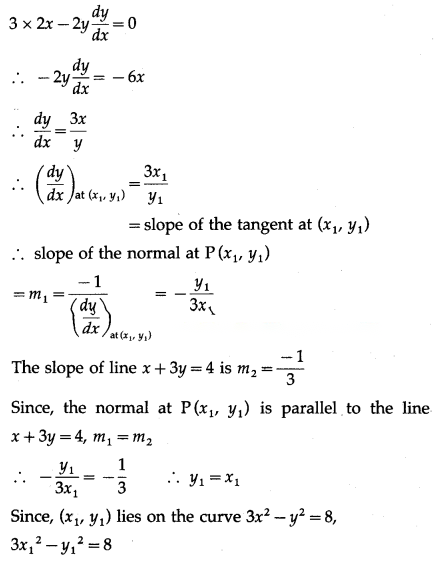
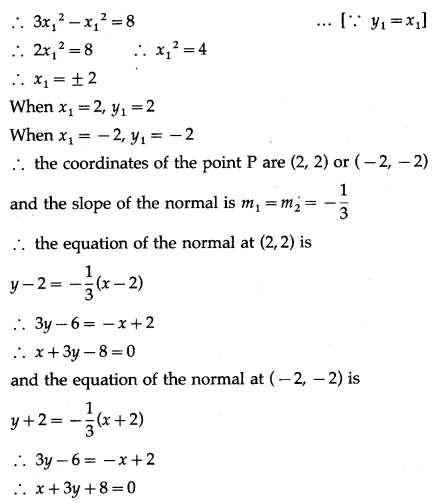
Let P(x1, y1) be the foot of the required normal to the curve 3x2 – y2 = 8. Differentiating 3x2 – y2 = 8 w.r.t. x, we get Hence, the equations of the normals are x + 3y – 8 = 0 and x + 3y + 8 = 0.
Solution & Step-by-Step Answer:
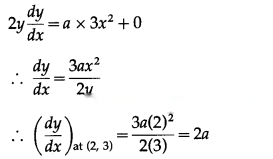
y2 = ax3 + b Differentiating both sides w.r.t. x, we get = slope of the tangent at (2, 3) Since, the line y = 4x – 5 touches the curve at the point (2, 3), slope of the tangent at (2, 3) is 4. 2a = 4 ⇒ a = 2 Since (2, 3) lies on the curve y2 = ax3 + b (3)2 = a(2)3 + b 9 = 8a + b 9 = 8(2) + b …… [∵ a = 2] b = -7 Hence, a = 2 and b = -7.
Solution & Step-by-Step Answer:
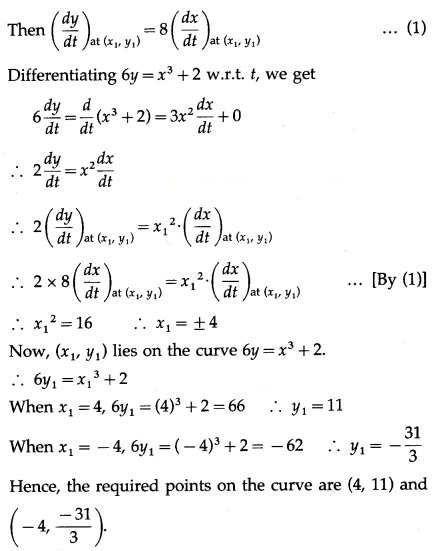
Let P(x1, y1) be the point on the curve 6y = x3 + 2 whose y-coordinate is changing 8 times as fast as the x-coordinate.
Solution & Step-by-Step Answer:
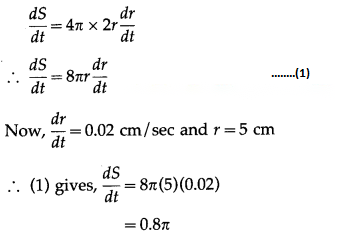
Let r be the radius and S be the surface area of the soap bubble at any time t. Then S = 4πr2 Differentiating w.r.t. t, we get Hence, the surface area of the soap bubble is increasing at the rate of 0.87c cm2 / sec.
Solution & Step-by-Step Answer:
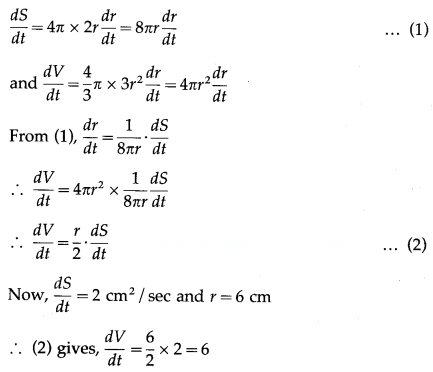
Let r be the radius, S be the surface area and V be the volume of the spherical balloon at any time t. Then S = 4πr2 and V = Differentiating w.r.t. t, we get Hence, the volume of the spherical balloon is increasing at the rate of 6 cm3 / sec.
Solution & Step-by-Step Answer:
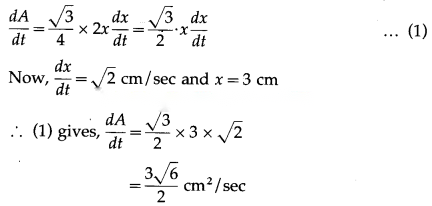
If x cm is the side of the equilateral triangle and A is its area, then Differentiating w.r.t. f, we get Hence, rate of increase of the area of equilateral triangle = cm2 / sec.
Solution & Step-by-Step Answer:
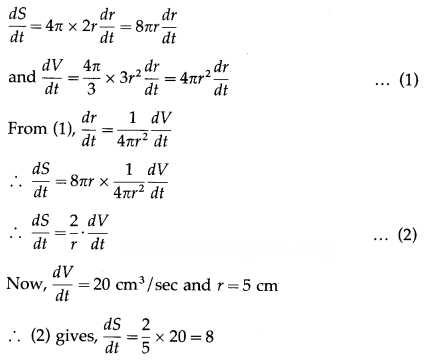
Let r be the radius, S be the surface area and V be the volume of the sphere at any time t. Then S = 4πr2 and V = Differentiating w.r.t. t, we get Hence, the surface area of the sphere is changing at the rate of 8 cm2/sec.
Solution & Step-by-Step Answer:
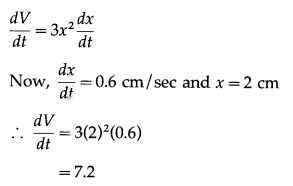
Let x be the edge of the cube and V be its volume at any time t. Then V = x3 Differentiating both sides w.r.t. t, we get Hence, the volume of the cube is decreasing at the rate of 7.2 cm3/sec.
Solution & Step-by-Step Answer:
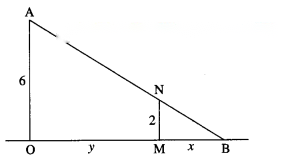
Let OA be the lamp post, MN the man, MB = x, his shadow, and OM = y, the distance of the man from the lamp post at time t. Then = 6 km/hr is the rate at which the man is moving at away from the lamp post. is the rate at which his shadow is increasing. From the figure, 6x = 2x + 2y 4x = 2y x = y Hence, the length of the shadow is increasing at the rate of 3 km/hr.
Solution & Step-by-Step Answer:
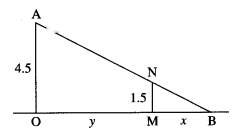
Let OA be the lamp post, MN the man, MB = x his shadow and OM = y the distance of the man from lamp post at time t. Then is the rate at which the man is moving towards the lamp post. is the rate at which his shadow is shortening. B is the tip of the shadow and it is at a distance of x + y from the post. is the rate at which the tip of the shadow is moving. From the figure, 45x = 15x + 15y 30x = 15y x = y and Hence (i) the shadow is shortening at the rate of () metre/sec, and (ii) the tip of shadow is moving at the rate of () metres/sec.
Solution & Step-by-Step Answer:
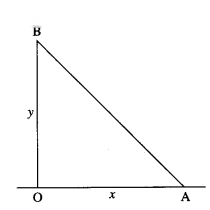
Let AB be the ladder, where AB = 10 metres. Let at time t seconds, the end A of the ladder be x metres from the wall and the end B be y metres from the ground. Since, OAB is a right angled triangle, by Pythagoras’ theorem x2 + y2 = 102 i.e. y2 = 100 – x2 Differentiating w.r.t. t, we get 2y = 0 – 2x ∴ ……..(1) Now, = 1.2 metres/sec is the rate at which the bottom at of the ladder is pulled horizontally and is the rate at which the top of ladder B is sliding. When x = 6, y2 = 100 – 36 = 64 y = 8 (1) gives Hence, the top of the ladder is sliding down the wall, at the rate of 0.9 metre/sec.
Solution & Step-by-Step Answer:
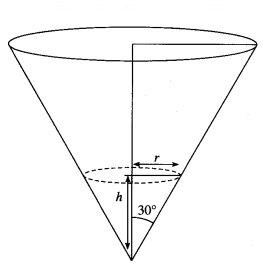
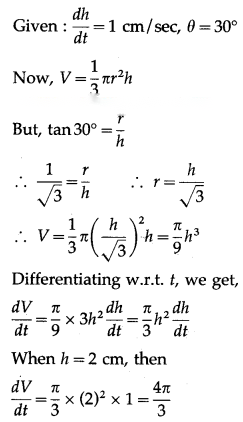
Let r be the radius, h be the height, θ be the semi-vertical angle and V be the volume of the water at any time t. Hence, the volume of water is increasing at the rate of cm3/sec.