Latest Maharashtra State Board (SSC & HSC) 2026-27 Syllabus Digest & Solutions Updated!
Class 12 (HSC Board)Mathematics & Statistics2026-27 Syllabus

Chapter 1 Mathematical Logic Miscellaneous Exercise 1 Solutions

Complete Maharashtra State Board Balbharati & Yuvakbharati textbook solutions for Chapter 1 Mathematical Logic Miscellaneous Exercise 1. Step-by-step solved exercises, numerical problems, and digest answers.

17 Solved Questions35 Diagrams3666 words

Balbharti12th Maharashtra State Board Maths Solutions BookPdf Chapter 1 Mathematical Logic Miscellaneous Exercise 1 Questions and Answers.

Maharashtra State Board 12th Maths Solutions Chapter 1 Mathematical Logic Miscellaneous Exercise 1

Question 1 Maharashtra Board Solution
Select and write the correct answer from the given alternatives in each of the following questions : i) If p ∧ q is false and p ∨ q is true, the ________ is not true. (A) p ∨ q (B) p ↔ q (C) ~p ∨ ~q (D) q ∨ ~p
Solution & Step-by-Step Answer:
(b) p ↔ q.

(ii) (p ∧ q) → r is logically equivalent to ________.
(A) p → (q → r)
(B) (p ∧ q) → ~r
(C) (~p ∨ ~q) → ~r
(D) (p ∨ q) → r
Solution:
(a) p → (q → r) [Hint: Use truth table.]

(iii) Inverse of statement pattern (p ∨ q) → (p ∧ q) is ________.
(A) (p ∧ q) → (p ∨ q)
(B) ~(p ∨ q) → (p ∧ q)
(C) (~p ∧ ~q) → (~p ∨ ~q)
(D) (~p ∨ ~q) → (~p ∧ ~q)
Solution:
(c) (~p ∧ ~q) → (~p ∨ ~ q)

(iv) If p ∧ q is F, p → q is F then the truth values of p and q are ________.
(A) T, T
(B) T, F
(C) F, T
(D) F, F
Solution:
(b) T, F

(v) The negation of inverse of ~p → q is ________.
(A) q ∧ p
(B) ~p ∧ ~q
(C) p ∧ q
(D) ~q → ~p
Solution:
(a) q ∧ p

(vi) The negation of p ∧ (q → r) is ________.
(A) ~p ∧ (~q → ~r)
(B) p ∨ (~q ∨ r)
(C) ~p ∧ (~q → ~r)
(D) ~p ∨ (~q ∧ ~r)
Solution:
(d) ~p ∨ (q ∧ ~r)

(vii) If A = {1, 2, 3, 4, 5} then which of the following is not true?
(A) Ǝ x ∈ A such that x + 3 = 8
(B) Ǝ x ∈ A such that x + 2 < 9
(C) Ɐ x ∈ A, x + 6 ≥ 9
(D) Ǝ x ∈ A such that x + 6 < 10
Solution:
(c) Ǝ x ∈ A, x + 6 ≥ 9.

Question 2 Maharashtra Board Solution
Which of the following sentences are statements in logic? Justify. Write down the truth value of the statements : (i) 4! = 24.
Solution & Step-by-Step Answer:
It is a statement which is true, hence its truth value is ‘T’.

(ii) π is an irrational number.
Solution:
It is a statement which is true, hence its truth value is ‘T’.

(iii) India is a country and Himalayas is a river.
Solution:
It is a statement which is false, hence its truth value is ‘F’. ….[T ∧ F ≡ F]

(iv) Please get me a glass of water.
Solution:
It is an imperative sentence, hence it is not a statement.

(v) cos2θ – sin2θ = cos2θ for all θ ∈ R.
Solution:
It is a statement which is true, hence its truth value is ‘T’.

(vi) If x is a whole number the x + 6 = 0.
Solution:
It is a statement which is false, hence its truth value is ‘F’.

Question 3 Maharashtra Board Solution
Write the truth values of the following statements : (i) is an irrational but is a complex number.
Solution & Step-by-Step Answer:
Let p : is an irrational. q : is a complex number. Then the symbolic form of the given statement is p ∧ q. The truth values of p and q are T and F respectively. ∴ the truth value of p ∧ q is F. … [T ∧ F ≡ F]

(ii) Ɐ n ∈ N, n2+ n is even number while n2– n is an odd number.
Solution:
Let p : Ɐ n ∈ N, n2+ n is an even number.
q : Ɐ n ∈ N, n2– n is an odd number.
Then the symbolic form of the given statement is p ∧ q.
The truth values of p and q are T and F respectively.
∴ the truth value of p ∧ q is F. … [T ∧ F ≡ F].

(iii) Ǝ n ∈ N such that n + 5 > 10.
Solution:
Ǝ n ∈ N, such that n + 5 > 10 is a true statement, hence its truth value is T.
(All n ≥ 6, where n ∈ N, satisfy n + 5 > 10).

(iv) The square of any even number is odd or the cube of any odd number is odd.
Solution:
Let p : The square of any even number is odd.
q : The cube of any odd number is odd.
Then the symbolic form of the given statement is p ∨ q.
The truth values of p and q are F and T respectively.
∴ the truth value of p ∨ q is T. … [F ∨ T ≡ T].

(v) In ∆ ABC if all sides are equal then its all angles are equal.
Solution:
Let p : ABC is a triangle and all its sides are equal.
q : Its all angles are equal.
Then the symbolic form of the given statement is p → q
If the truth value of p is T, then the truth value of q is T.
∴ the truth value of p → q is T. … [T → T ≡ T].

(vi) Ɐ n ∈ N, n + 6 > 8.
Solution:
Ɐ n ∈ N, 11 + 6 > 8 is a false statement, hence its truth value is F.
{n = 1 ∈ N, n = 2 ∈ N do not satisfy n + 6 > 8).

Question 4 Maharashtra Board Solution
If A = {1, 2, 3, 4, 5, 6, 7, 8, 9}, determine the truth value of each of the following statement : (i) Ǝ x ∈ A such that x + 8 = 15.
Solution & Step-by-Step Answer:
True

(ii) Ɐ x ∈ A, x + 5 < 12.
Solution:
False

(iii) Ǝ x ∈ A, such that x + 7 ≥ 11.
Solution:
True

(iv) Ɐ x ∈ A, 3x ≤ 25.
Solution:
False

Question 5 Maharashtra Board Solution
Write the negations of the following : (i) Ɐ n ∈ A, n + 7 > 6.
Solution & Step-by-Step Answer:
The negation of the given statements are : Ǝ n ∈ A, such that n + 7 ≤ 6. OR Ǝ n ∈ A, such that n + 7 ≯ 6.

(ii) Ǝ x ∈ A, such that x + 9 ≤ 15.
Solution:
Ɐ x ∈ A, x + 9 > 15.

(iii) Some triangles are equilateral triangle.
Solution:
All triangles are not equilateral triangles.
Question 6 Maharashtra Board Solution
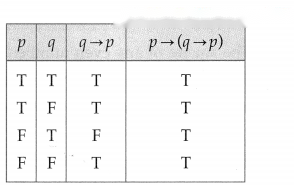
Construct the truth table for each of the following : (i) p → (q → p)
Solution & Step-by-Step Answer:

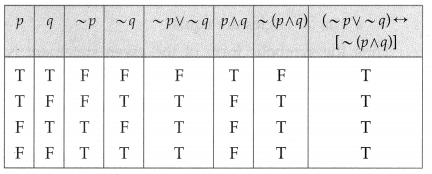
(ii) (~p ∨ ~q) ↔ [~(p ∧ q)]
Solution:
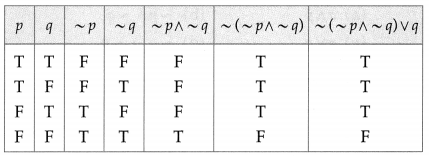
(iii) ~(~p ∧ ~q) ∨ q
Solution:
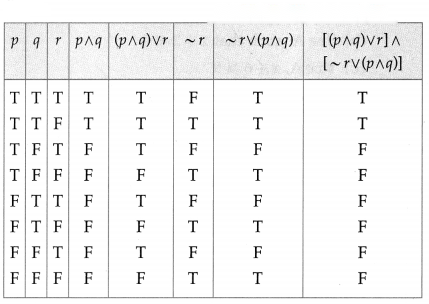
(iv) [(p ∧ q) ∨ r] ∧ [~r ∨ (p ∧ q)]
Solution:
(v) [(~p ∨ q) ∧ (q → r)] → (p → r)
Solution:
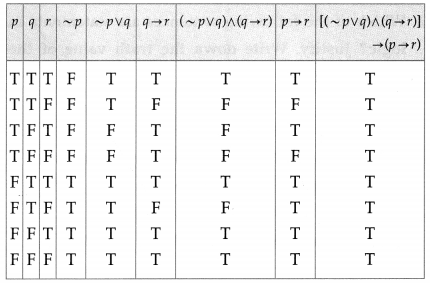
Question 7 Maharashtra Board Solution
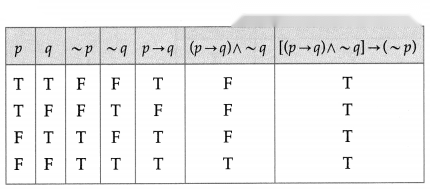
Determine whether the following statement patterns are tautologies contradictions or contingencies : (i) [(p → q) ∧ ~q)] → ~p
Solution & Step-by-Step Answer:
All the entries in the last column of the above truth table are T. ∴ [(p → q) ∧ ~q)] → ~p is a tautology.

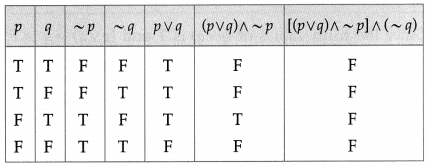
(ii) [(p ∨ q) ∧ ~p] ∧ ~q
Solution:

All the entries in the last column of the above truth table are F.
∴ [(p ∨ q) ∧ ~p] ∧ ~q is a contradiction.
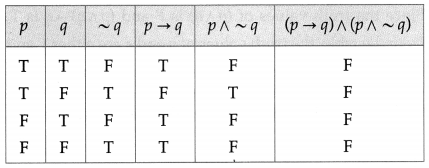
(iii) (p → q) ∧ (p ∧ ~q)
Solution:

All the entries in the last column of the above truth table are F.
∴ (p → q) ∧ (p ∧ ~q) is a contradiction.
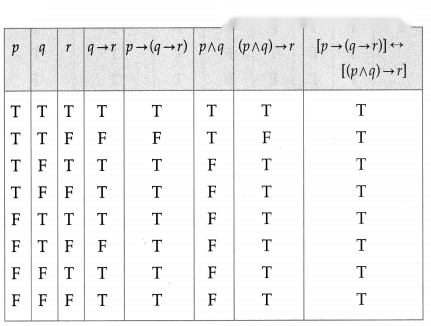
(iv) [p → (q → r)] ↔ [(p ∧ q) → r]
Solution:

All the entries in the last column of the above truth table are T.
∴ [p → (q → r)] ↔ [(p ∧ q) → r] is a tautology.
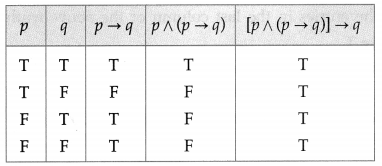
(v) [(p ∧ (p → q)] → q
Solution:

All the entries in the last column of the above truth table are T.
∴ [(p ∧ (p → q)] → q is a tautology.
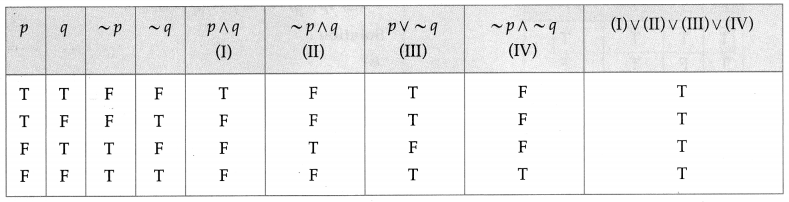
(vi) (p ∧ q) ∨ (~p ∧ q) ∨ (p ∨ ~q) ∨ (~p ∧ ~q)
Solution:

All the entries in the last column of the above truth table are T.
∴ (p ∧ q) ∨ (~p ∧ q) ∨ (p ∨ ~q) ∨ (~p ∧ ~q) is a tautology.
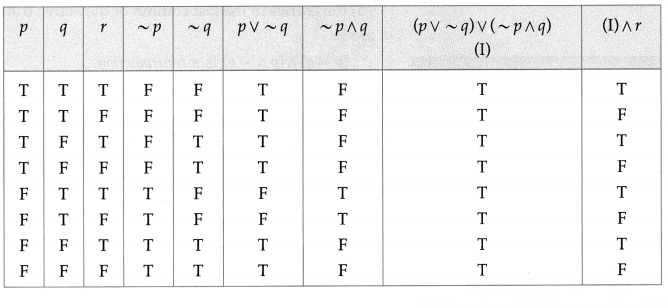
(vii) [(p ∨ ~q) ∨ (~p ∧ q)] ∧ r
Solution:

The entries in the last column are neither T nor all F.
∴ [(p ∨ ~q) ∨ (~p ∧ q)] ∧ r is a contingency.
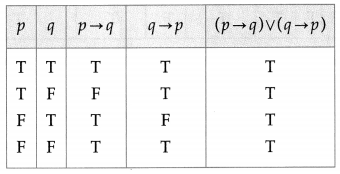
(viii) (p → q) ∨ (q → p)
Solution:

All the entries in the last column of the above truth table are T.
∴ (p → q) ∨ (q → p) is a tautology.
Question 8 Maharashtra Board Solution
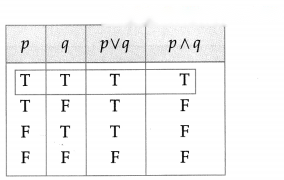
Determine the truth values ofp and q in the following cases : (i) (p ∨ q) is T and (p ∧ q) is T
Solution & Step-by-Step Answer:
Since p ∨ q and p ∧ q both are T, from the table the truth values of both p and q are T.

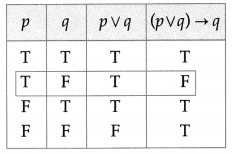
(ii) (p ∨ q) is T and (p ∨ q) → q is F
Solution:

Since the truth values of (p ∨ q) is T and (p ∨ q) → q is F, from the table, the truth values of p and q are T and F respectively.
(iii) (p ∧ q) is F and (p ∧ q) → q is T
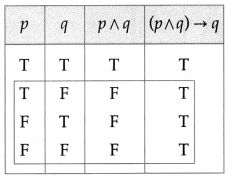
Solution:

Since the truth values of (p ∧ q) is F and (p ∧ q) → q is T, from the table, the truth values of p and q are either T and F respectively or F and T respectively or both F.
Question 9 Maharashtra Board Solution
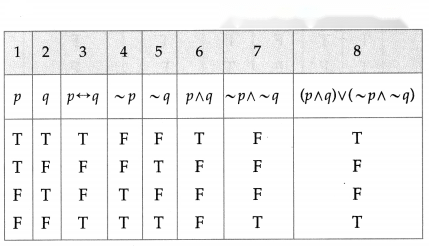
Using truth tables prove the following logical equivalences : (i) p ↔ q ≡ (p ∧ q) ∨ (~p ∧ ~q)
Solution & Step-by-Step Answer:
The entries in the columns 3 and 8 are identical. ∴ p ↔ q ≡ (p ∧ q) ∨ (~p ∧ ~q).

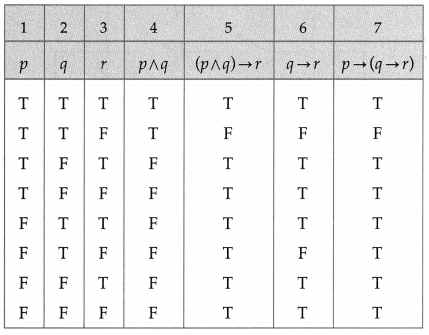
(ii) (p ∧ q) → r ≡ p → (q → r)
Solution:

The entries in the columns 5 and 7 are identical.
∴ (p ∧ q) → r ≡ p → (q → r).
Question 10 Maharashtra Board Solution
Using rules in logic, prove the following : (i) p ↔ q ≡ ~ (p ∧ ~q) ∧ ~(q ∧ ~p)
Solution & Step-by-Step Answer:
By the rules of negation of biconditional, ~(p ↔ q) ≡ (p ∧ ~q) ∨ (q ∧ ~p) ∴ ~ [(p ∧ ~ q) ∨ (q ∧ ~p)] ≡ p ↔ q ∴ ~(p ∧ ~q) ∧ ~(q ∧ ~p) ≡ p ↔ q … (Negation of disjunction) ≡ p ↔ q ≡ ~(p ∧ ~ q) ∧ ~ (q ∧ ~p).

(ii) ~p ∧ q ≡ (p ∨ q) ∧ ~p
Solution:
(p ∨ q) ∧ ~ p
≡ (p ∧ ~p) ∨ (q ∧ ~p) … (Distributive Law)
≡ F ∨ (q ∧ ~p) … (Complement Law)
≡ q ∧ ~ p … (Identity Law)
≡ ~p ∧ q …(Commutative Law)
∴ ~p ∧ q ≡ (p ∨ q) ∧ ~p.

(iii) ~(p ∨ q) ∨ (~p ∧ q) ≡ ~p
Solution:
~ (p ∨ q) ∨ (~p ∧ q)
≡ (~p ∧ ~q) ∨ (~p ∧ q) … (Negation of disjunction)
≡ ~p ∧ (~q ∨ q) … (Distributive Law)
≡ ~ p ∧ T … (Complement Law)
≡ ~ p … (Identity Law)
∴ ~(p ∨ q) ∨ (~p ∧ q) ≡ ~p.

Question 11 Maharashtra Board Solution
Using the rules in logic, write the negations of the following : (i) (p ∨ q) ∧ (q ∨ ~r)
Solution & Step-by-Step Answer:
The negation of (p ∨ q) ∧ (q ∨ ~ r) is ~ [(p ∨ q) ∧ (q ∨ ~r)] ≡ ~ (p ∨ q) ∨ ~ (q ∨ ~r) … (Negation of conjunction) ≡ (~p ∧ ~q) ∨ [~q ∧ ~(~r)] … (Negation of disjunction) ≡ {~ p ∧ ~q) ∨ (~q ∧ r) … (Negation of negation) ≡ (~q ∧ ~p) ∨ (~q ∧ r) … (Commutative law) ≡ (~ q) ∧ (~ p ∨ r) … (Distributive Law)

(ii) p ∧ (q ∨ r)
Solution:
The negation of p ∧ (q ∨ r) is
~ [p ∧ (q ∨ r)]
≡ ~ p ∨ ~(q ∨ r) … (Negation of conjunction)
≡ ~p ∨ (~q ∧ ~r) … (Negation of disjunction)

(iii) (p → q) ∧ r
Solution:
The negation of (p → q) ∧ r is
~ [(p → q) ∧ r]
≡ ~ (p → q) ∨ (~ r) … (Negation of conjunction)
≡ (p ∧ ~q) ∨ (~ r) … (Negation of implication)

(iv) (~p ∧ q) ∨ (p ∧ ~q)
Solution:
The negation of (~ p ∧ q) ∨ (p ∧ ~ q) is
~ [(~p ∧ q) ∨ (p ∧ ~q)]
≡ ~(~p ∧ q) ∧ ~ (p ∧ ~q) … (Negation of disjunction)
≡ [~(~p) ∨ ~q] ∧ [~p ∨ ~(q)] … (Negation of conjunction)
≡ (p ∨ ~ q) ∧ (~ p ∨ q) … (Negation of negation)
Question 12 Maharashtra Board Solution
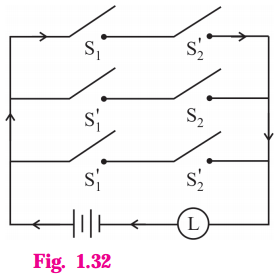
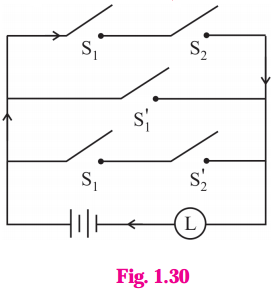
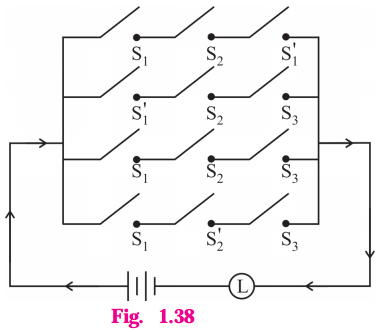
Express the following circuits in the symbolic form. Prepare the switching table : (i)
Solution & Step-by-Step Answer:
Let p : the switch S1 is closed q : the switch S2 is closed ~ p : the switch S1‘ is closed or the switch S1 is open ~ q: the switch S2‘ is closed or the switch S2 is open. Then the symbolic form of the given circuit is : (p ∧ q) ∨ (~p) ∨ (p ∧ ~q).

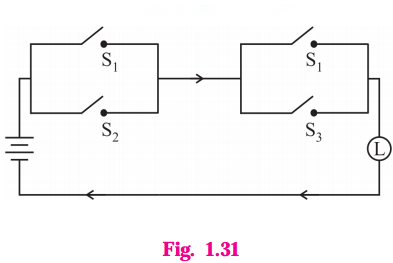
(ii)

Solution:
Let p : the switch S1is closed
q : the switch S2is closed
r : the switch S3is closed.
Then the symbolic form of the given statement is : (p ∨ q) ∧ (p ∨ r).
Question 13 Maharashtra Board Solution
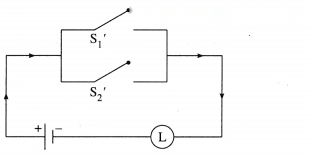
Simplify the following so that the new circuit has minimum number of switches. Also, draw the simplified circuit.
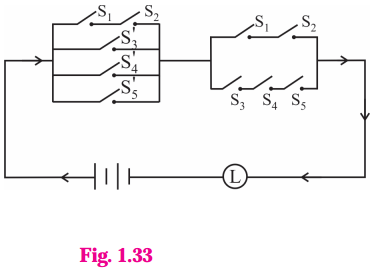
Solution & Step-by-Step Answer:
Let p : the switch S1 is closed q : the switch S2 is closed ~ p: the switch S1‘ is closed or the switch S1 is open ~ q: the switch S2‘ is closed or the switch S2 is open. Then the given circuit in symbolic form is : (p ∧ ~q) ∨ (~p ∧ q) ∨ (~p ∧ ~q) Using the laws of logic, we have, (p ∧ ~q) ∨ (~p ∧ q) ∨ (~p ∧ ~ q) = (p ∧ ~q) ∨ [(~p ∧ q) ∨ (~p ∧ ~q) …(By Complement Law) = (p ∧ ~q) ∨ [~p ∧ (q ∨ ~q)} (By Distributive Law) = (p ∧ ~q) ∨ (~p ∧ T) …(By Complement Law) = (p ∧ ~q) ∨ ~ p …(By Identity Law) = (p ∨ ~p) ∧ (~q ∨ ~p) …(By Distributive Law) = ~q ∨ ~p …(By Identity Law) = ~p ∨ ~p …(By Commutative Law) Hence, the simplified circuit for the given circuit is :

(ii)

Solution:
(ii) Let p : the switch S1is closed
q : the switch S2is closed
r : the switch S3is closed
s : the switch S4is closed
t : the switch S5is closed
~ p : the switch S1‘ is closed or the switch S1is open
~ q : the switch S2‘ is closed or the switch S2is open
~ r : the switch S3‘ is closed or the switch S3is open
~ s : the switch S4‘ is closed or the switch S4is open
~ t : the switch S5‘ is closed or the switch S5is open.
Then the given circuit in symbolic form is
[(p ∧ q) ∨ ~r ∨ ~s ∨ ~t] ∧ [(p ∧ q) ∨ (r ∧ s ∧ t)]
Using the laws of logic, we have,
[(p ∧ q) ∨ ~r ∨ ~s ∨ ~ t] ∧ [(p A q) ∨ (r ∧ s ∧ t)]
= [(p∧ q) ∨ ~(r ∧ s ∧ t)] ∧ [(p ∧ q) ∨ (r ∧ s ∧ t)] … (By De Morgan’s Law)
= (p ∧ q) ∨ [ ~(r ∧ s ∧ t) ∧ (r ∧ s ∧ t)] … (By Distributive Law)
= (p ∧ q) ∨ F … (By Complement Law)
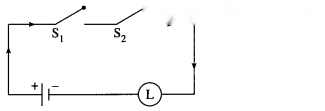
= p ∧ q … (By Identity Law)
Hence, the alternative simplified circuit is :
Question 14 Maharashtra Board Solution
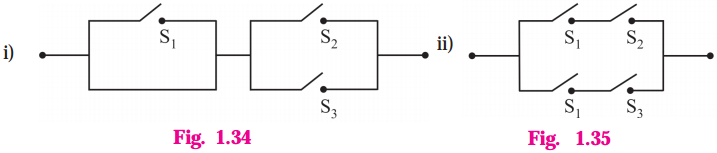
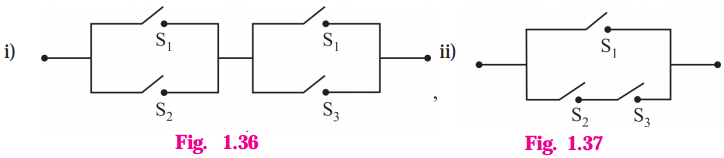
Check whether the following switching circuits are logically equivalent – Justify. (A)
Solution & Step-by-Step Answer:
Let p : the switch S1 is closed q : the switch S2 is closed r : the switch S3 is closed (A) The symbolic form of the given switching circuits are p ∧ (q ∨ r) and (p ∧ q) ∨ (p ∧ r) respectively. By Distributive Law, p ∧ (q ∨ r) ≡ (p ∧ q) ∨ (p ∧ r) Hence, the given switching circuits are logically equivalent.

(B)

Solution:
The symbolic form of the given switching circuits are
(p ∨ q) ∧ (p ∨ r) and p ∨ (q ∧ r)
By Distributive Law,
p ∨ (q ∧ r) ≡ (p ∨ q) ∧ (p ∨ r)
Hence, the given switching circuits are logically equivalent.
Question 15 Maharashtra Board Solution
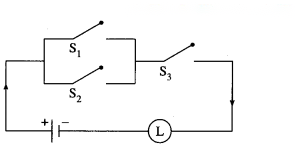
Give alternative arrangement of the switching following circuit, has minimum switches.
Solution & Step-by-Step Answer:
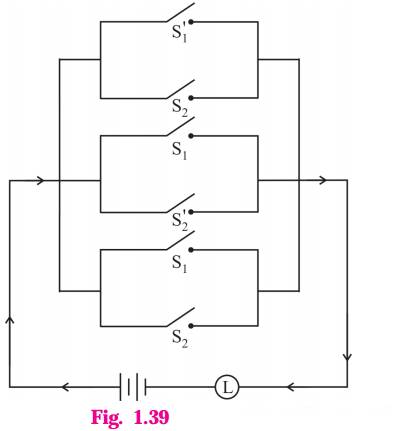
Let p : the switch S1 is closed q : the switch S2 is closed r : the switch S3 is closed ~p : the switch S1‘ is closed, or the switch S1 is open ~q : the switch S2‘ is closed or the switch S2 is open. Then the symbolic form Of the given circuit is : (p ∧ q ∧ ~p) ∨ (~p ∧ q ∧ r) ∨ (p ∧ q ∧ r) ∨ (p ∧ ~q ∧ r) Using the laws of logic, we have, (p ∧ q ∧ ~p) ∨ (~p ∧ q ∧ r) ∨ (p ∧ q ∧ r) ∨ (p ∧ ~q ∧ r) ≡ (p ∧ ~p ∧ q) ∨ (~p ∧ q ∧ r) ∨ (p ∧ q ∧ r) y (p ∧ ~q ∧ r) …(By Commutative Law) ≡ (F ∧ q) ∨ (~p ∧ q ∧ r) ∨ (p ∧ q ∧ r) ∨ (p ∧ ~q ∧ r) … (By Complement Law) ≡ F ∨ (~p ∧ q ∧ r) ∨ (p ∧ q ∧ r) ∨ (p ∧ ~q ∧ r) … (By Identity Law) ≡ (~p ∧ q ∧ r) ∨ (p ∧ q ∧ r) ∨ (p ∧ ~q ∧ r) … (By Identity Law) ≡ [(~p ∨ p) ∧ (q ∧ r)] ∨ (p ∧ ~q ∧ r) … (By Distributive Law) ≡ [T ∧ (q ∧ r)] ∨ (p ∧ ~q ∧ r) = (q ∧ r) ∨ (p ∧ ~q ∧ r) …(By Complement Law) ≡ (q ∧ r) ∨ (p ∧ ~q ∧ r) … (By Identity Law) ≡ [q ∨ (p ∧ ~q)] ∧ r … (By Distributive Law) ≡ [q ∨ p) ∧ ((q ∨ ~q)] ∧ r … (By Distributive Law) ≡ [(q ∨ p) ∧ T] ∧ r …(By Complement Law) ≡ (q ∨ p) ∧ r … (By Identity Law) ≡ (p ∨ q) ∧ r …(By Commutative Law) ∴ the alternative arrangement of the new circuit with minimum switches is :

Question 16 Maharashtra Board Solution
Simplify the following so that the new circuit circuit.
Solution & Step-by-Step Answer:
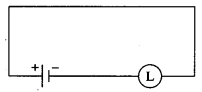
Let p : the switch S1 is closed q : the switch S2 is closed ~ p : the switch S1‘ is closed or the switch S1 is open ~ q : the switch S2‘ is closed or the switch S2 is open. Then the symbolic form of the given switching circuit is : (~p ∨ q) ∨ (p ∨ ~q) ∨ (p ∨ q) Using the laws of logic, we have, (~p ∨ q) ∨ (p ∨ ~q) ∨ (p ∨ q) ≡ (~p ∨ q ∨ p ∨ ~q) ∨ (p ∨ q) ≡ [(~p ∨ p) ∨ (q ∨ ~q)] ∨ (p ∨ q) … (By Commutative Law) ≡ (T ∨ T) ∨ (p ∨ q) … (By Complement Law) ≡ T ∨ (p ∨ q) … (By Identity Law) ≡ T … (By Identity Law) ∴ the current always flows whether the switches are open or closed. So, it is not necessary to use any switch in the circuit. ∴ the simplified form of given circuit is :

Question 17 Maharashtra Board Solution
Represent the following switching circuit in symbolic form and construct its switching table. Write your conclusion from the switching table.
Solution & Step-by-Step Answer:
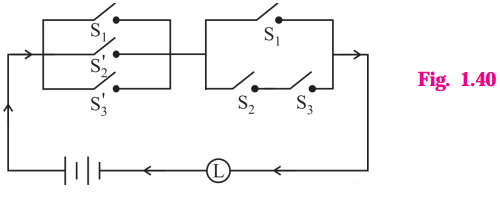
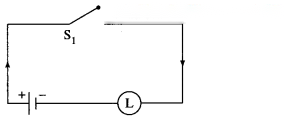
Let p : the switch S1 is closed q : the switch S2 is closed r : the switch S3 is closed ~ q : the switch S2‘ is closed or the switch S2 is open ~ r : the switch S3‘ is closed or the switch S3 is open. Then, the symbolic form of the given switching circuit is : [p ∨ (~ q) ∨ (~ r)] ∧ [p ∨ (q ∧ r)] From the table, the’ final column’ and the column of p are identical. Hence, the given circuit is equivalent to the simple circuit with only one switch S1. the simplified form of the given circuit is :