Balbharati Maharashtra State Board12th Commerce Maths Digest PdfChapter 1 Commission, Brokerage and Discount Miscellaneous Exercise 1 Questions and Answers.
Maharashtra State Board 12th Commerce Maths Solutions Chapter 1 Commission, Brokerage and Discount Miscellaneous Exercise 1
(I) Choose the correct alternative.
Question 1
Maharashtra Board Solution
An agent who gives a guarantee to his principal that the party will pay the sale price of goods is called (a) Auctioneer (b) Del Credere Agent (c) Factor (d) Broker
Solution & Step-by-Step Answer:
(b) Del Credere Agent
Question 2
Maharashtra Board Solution
An agent who is given the possession of goods to be sold is known as (a) Factor (b) Broker (c) Auctioneer (d) Del Credere Agent
Solution & Step-by-Step Answer:
(a) Factor
Question 3
Maharashtra Board Solution
The date on which the period of the bill expires is called (a) Legal Due Date (b) Grace Date (c) Nominal Due Date (d) Date of Drawing
Solution & Step-by-Step Answer:
(c) Nominal Due Date
Question 4
Maharashtra Board Solution
The payment date after adding 3 days of grace period is known as (a) The legal due date (b) The nominal due date (c) Days of grace (d) Date of drawing
Solution & Step-by-Step Answer:
(a) The legal due date
Question 5
Maharashtra Board Solution
The sum due is also called as (a) Face value (b) Present value (c) Cash value (d) True discount
Solution & Step-by-Step Answer:
(a) Face value
Question 6
Maharashtra Board Solution
P is the abbreviation of (a) Face value (b) Present worth (c) Cash value (d) True discount
Solution & Step-by-Step Answer:
(b) Present worth
Question 7
Maharashtra Board Solution
Banker’s gain is the simple interest on (a) Banker’s discount (b) Face Value (c) Cash value (d) True discount
Solution & Step-by-Step Answer:
(d) True discount
Question 8
Maharashtra Board Solution
The marked price is also called as (a) Cost price (b) Selling price (c) List price (d) Invoice price
Solution & Step-by-Step Answer:
(c) List price
Question 9
Maharashtra Board Solution
When only one discount is given then (a) List price = Invoice price (b) Invoice price = Net selling price (c) Invoice price = Cost price (d) Cost price = Net selling price
Solution & Step-by-Step Answer:
(b) Invoice price = Net selling price
Question 10
Maharashtra Board Solution
The difference between the face value and present worth is called (a) Banker’s discount (b) True discount (c) Banker’s gain (d) Cash value
Solution & Step-by-Step Answer:
(b) True discount
(II) Fill in the blanks.
Question 1
Maharashtra Board Solution
A person who draws the bill is called ____________
Solution & Step-by-Step Answer:
Drawee
Question 2
Maharashtra Board Solution
An ____________ is an agent who sells the goods by auction.
Solution & Step-by-Step Answer:
Auctioneer
Question 3
Maharashtra Board Solution
Trade discount is allowed on the ____________ price.
Solution & Step-by-Step Answer:
Catalogue/List
Question 4
Maharashtra Board Solution
The banker’s discount is also called ____________.
Solution & Step-by-Step Answer:
Commercial Discount
Question 5
Maharashtra Board Solution
The banker’s discount is always ____________ than the true discount.
Solution & Step-by-Step Answer:
higher
Question 6
Maharashtra Board Solution
The diffrence between the banker’s discount and the true discount is called ____________.
Solution & Step-by-Step Answer:
bankers gain
Question 7
Maharashtra Board Solution
The date by which the buyer is legally allowed to pay the amount is known as ____________.
Solution & Step-by-Step Answer:
legal due date
Question 8
Maharashtra Board Solution
A ____________ is an agent who brings together the buyer and the seller.
Solution & Step-by-Step Answer:
broker
Question 9
Maharashtra Board Solution
If buyer is allowed both trade and cash discounts, ____________ discount is fist calculated on ____________ price.
Solution & Step-by-Step Answer:
Trade, Catalogue/List
Question 10
Maharashtra Board Solution
____________ = List price (catalogue Price) – Trade Discount.
Solution & Step-by-Step Answer:
Invoice Price
(III) State whether each of the following is True or False.
Question 1
Maharashtra Board Solution
A broker is an agent who gives a guarantee to the seller that the buyer will pay the sale price of goods.
Solution & Step-by-Step Answer:
False
Question 2
Maharashtra Board Solution
A cash discount is allowed on the list price.
Solution & Step-by-Step Answer:
False
Question 3
Maharashtra Board Solution
Trade discount is allowed on catalogue price.
Solution & Step-by-Step Answer:
True
Question 4
Maharashtra Board Solution
The buyer is legally allowed 6 days grace period.
Solution & Step-by-Step Answer:
False
Question 5
Maharashtra Board Solution
The date on which the period of the bill expires is called the nominal due date.
Solution & Step-by-Step Answer:
True
Question 6
Maharashtra Board Solution
The difference between the banker’s discount and true discount is called sum due.
Solution & Step-by-Step Answer:
False
Question 7
Maharashtra Board Solution
The banker’s discount is always lower than the true discount.
Solution & Step-by-Step Answer:
False
Question 8
Maharashtra Board Solution
The banker’s discount is also called a commercial discount.
Solution & Step-by-Step Answer:
True
Question 9
Maharashtra Board Solution
In general cash, the discount is more than trade discount.
Solution & Step-by-Step Answer:
False
Question 10
Maharashtra Board Solution
A person can get both, trade discount and a cash discount.
Solution & Step-by-Step Answer:
True
(IV) Solve the following problems.
Question 1
Maharashtra Board Solution
A salesman gets a commission of 6.5% on the total sales made by him and a bonus of 1% on sales over ₹ 50,000. Find his total income on a turnover of ₹ 75,000.
Solution & Step-by-Step Answer:
Rate of commission = 6.5% on the total sales ∴ Commission on a turnover of ₹ 75,000 = × 75,000 = ₹ 4,875 Rate of bonus = 1% on sales over ₹ 50,000 ∴ Amount of bonus = × (75,000 – 50,000) = ₹ 250 ∴ Total income of the sales man = ₹ 4,875 + ₹ 250 = ₹ 5,125
Question 2
Maharashtra Board Solution
A shop is sold at 30% profit, the amount of brokerage at the rate of % amounts to ₹ 73,125. Find the cost of the shop.
Solution & Step-by-Step Answer:
Rate of brokerage = % Amount of brokerage = ₹ 73,125 Let the selling price of the shop be ₹ 100 then the brokerage = ₹ Thus, if the amount of brokerage is ₹ then the selling price of the shop is ₹ 100 If the amount of brokerage is ₹ 73,125, then the selling price of the shop is = 73125 × × 100 = ₹ 97,50,000 The shop is sold at 30% profit ∴ If the cost of the shop is ₹ 100, then it is sold at ₹ 130 Thus, if the shop is sold at ₹ 130, then its cost price is ₹ 100 If the shop is sold at ₹ 97,50,000 then its cost price is = = ₹ 75,00,000 Then, the cost of the shop is ₹ 75,00,000
Question 3
Maharashtra Board Solution
A merchant gives 5% commission and 1.5% delcredere to his agents. If the agent sells goods worth ₹ 30,600 how much does he get? How much does the merchant receive?
Solution & Step-by-Step Answer:
Rate of commission = 5% Total sales = ₹ 30,600 Amount of commission = × 30,600 Rate of delcredere = 1.5% = × 30,600 = ₹ 459 Thus, the agents gets 1,530 + 459 = ₹ 1,989 And the merchant receives = 30,600 – 1,989 = ₹ 28,611
Question 4
Maharashtra Board Solution
After deducting commission at 7% on first ₹ 50,000 and 5% on the balance of sales made by him, an agent remits ₹ 93,750 to his principal. Find the value of goods sold by him.
Solution & Step-by-Step Answer:
Rate of commission = 7% on first ₹ 50,000 = × 50,000 = ₹ 3,750 Let the total sales be ₹ x Rate of commission on the balance sales = 5% Commission on the balance sales = × (x – 50000) = – 2,500 Total commission = 3750 + – 2,500 = + 1,250 Now, the amount to be remitted to the principal = Value of goods sold – Commission of the agent = x – ( + 1250) = – 1250 The agents remits ₹ 93,750 to his principal ∴ – 1,250 = 93,750 ∴ = 95,000 ∴ x = ₹ 1,00,000 Thus, the value of the goods sold by the agent is ₹ 1,00,000
Question 5
Maharashtra Board Solution
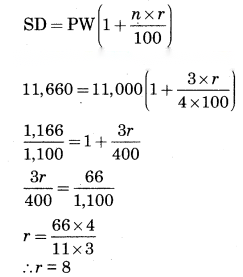
The present worth of ₹ 11,660 due 9 months hence is ₹ 11,000. Find the rate of interest.
Solution & Step-by-Step Answer:
Given, PW = ₹ 11,000, SD = ₹ 11,660 n = year = year We have, ∴ The rate of interest is 8% p.a.
Question 6
Maharashtra Board Solution
An article is marked at ₹ 800, a trader allows a discount of 2.5% and gains 20% on the cost. Find the cost price of the article?
Solution & Step-by-Step Answer:
Marked price of the article = ₹ 800 Rate of discount = 2.5% Amount of discount = × 800 = ₹ 20 ∴ Selling price of the article = 800 – 20 = ₹ 780 Now, given, gain = 20% Let cost price of the article be ₹ 100, then The selling price of the article is ₹ 120 Thus if cost price of the articles is ₹ x Then the selling price is ₹ 780 ∴ x = ∴ x = 650 ∴ Cost price of the article is ₹ 650
Question 7
Maharashtra Board Solution
A salesman is paid a fixed monthly salary plus commission on the sales. If on sale of ₹ 96,000 and ₹ 1,08,000 in two successive months he receives in all ₹ 17,600 and ₹ 18,800 respectively. Find his monthly salary and rate of commission paid to him.
Solution & Step-by-Step Answer:
Let the monthly salary of the salesman be ₹ x And the rate of commission be y% Income = monthly salary + commission on the sales 17600 = x + × 96,000 ∴ 17600 = x + 960y ………(1) and 18800 = x + × 108000 ∴ 18,800 = x + 1080y ………(2) Subtracting equation (1) from equation (2), we get 1,200 = 120y ∴ y = 10 Substituting y = 10 in (1), we get 17,600 = x + 960(10) ∴ x = 17,600 – 9,600 = 8,000 ∴ Salary of the salesman = ₹ 8,000 Rate of commission = 10%
Question 8
Maharashtra Board Solution
A merchant buys some mixers at a 15% discount on catalogue price. The catalogue price is ₹ 5,500 per price of the mixer. The freight charges amount to 2% on the catalogue price. The merchant sells each mixer at a 5% discount on the catalogue price. His net profit is ₹ 41,250, Find the number of mixers.
Solution & Step-by-Step Answer:
Catalogue price of a mixer = ₹ 5,500 Trade discount = 15% on catalogue price = × 5,500 = ₹ 825 Freight charges = 2% of the catalogue price = = ₹ 137.5 ∴ Cost price of a mixer for the merchant = 5,500 – 825 + 137.5 = 4,812,5 Catalogue price = ₹ 5,500 Rate of discount = 5% ∴ Selling price of one mixer = 5500 – × 5,500 = ₹ 5,225 ∴ Profit on one mixer = 5,225 – 4,812.5 = ₹ 412.5 Now, total profit = ₹ 41,250 ∴ Number of mixers = = 100 Thus the number of mixers is 100.
Question 9
Maharashtra Board Solution
A bill is drawn for ₹ 7,000 on 3rd May for 3 months and is discounted on 25th May at 5.5% Find the present worth.
Solution & Step-by-Step Answer:
Face value of the bill = ₹ 7,000 Date of drawing = 3rd May Period = 3 months Normal due date = 3rd August Legal due date = 6th August Rate of interest = 5.5% Date of discounting = 25th May Unexpired period (number of days from date of discounting to legal due date) ∴ Bankers discount = 7,000 × = ₹ 77 Also PW = SD – BD = 7,000 – 77 = ₹ 6,923 ∴ Present worth is ₹ 6,923

Question 10
Maharashtra Board Solution
A bill was drawn on 14th April 2005 for ₹ 3,500 and was discounted on 6th July 2005 at 5% per annum. The banker paid ₹ 3,465 for the bill. Find the period of the bill.
Solution & Step-by-Step Answer:
Face value of the bill = ₹ 3,500 Date of drawing = 14/04/2005 Date of discount = 06/07/2005 Rate of interest = 5% Cash value = ₹ 3,465 Bankers discount = Face value – Cash value = 3,500 – 3,465 = ₹ 35 Let the unexpired days be n days ∴ BD = ∴ 35 = ∴ n = 73 days Thus, legal due date is 73 days from the date of discounting ∴ Legal due date = 17/09/2005 ∴ Nominal due date = 14/09/2005 ∴ The period of the bill is 5 months

Question 11
Maharashtra Board Solution
The difference between true discount and banker’s discount on 6 months hence at 4% p.a. is ₹ 80. Find the true discount, banker’s discount, and amount of the bill.
Solution & Step-by-Step Answer:
BG = BD – TD ∴ BG = ₹ 80 Also BG = ∴ 80 = ∴ TD = ∴ TD = ₹ 4,000 Now BD = TD + BG = 4,000 + 80 = ₹ 4,080 Also, BD = ∴ 4,080 = ∴ FV = ∴ FV = ₹ 2,04,000 Amount of the bill = ₹ 2,04,000
Question 12
Maharashtra Board Solution
A manufacturer makes a clear profit of 30% on the cost after allowing a 35% discount. If the cost of production rises by 20%, by what percentage should he reduce the rate of discount so as to make the same rate of profit keeping his list prices unaltered.
Solution & Step-by-Step Answer:
Rate of discount = 35% Let the list price be ₹ 100. Then discount at 35% = ₹ 35 ∴ Net selling price = 100 – 35 = ₹ 65 ……..(1) The manufacturer makes a clear profit of 30% on the cost after allowing a 35% Discount. Let the cost be ₹ 100. Then selling price at 30% profit is 100 + 30 = ₹ 130. Thus, if the net selling price is ₹ 130, then the cost price is ₹ 100. But, the net selling price is ₹ 130, then the cost price is ₹ 65 ……[from (1)] ∴ The cost price is = ₹ 50 Hence, we have, Now, the cost of production has increased by 20%. Let the old cost price be ₹ 100. ∴ The new cost price is ₹ 120. But, the old cost price is ₹ 50. ∴ The new cost price is = = ₹ 60. The old net price is ₹ 65. Now 20% of ₹ 65 = = ₹ 13 ∴ New net price = 65 + 13 = ₹ 78 Hence, we have Now, 100 – 78 = ₹ 22 Thus, the rate of discount should be reduced by 22%, The original rate of discount is 35%. Hence, the reduction in discount should be (35 – 22)% = 13% so as to make the same rate of profit, keeping the list price unaltered.


Question 13
Maharashtra Board Solution
A trader offers a 25% discount on the catalogue price of the radio and yet makes a 20% profit. If he gains ₹ 160 per radio, what must be the catalogue price of the radio?
Solution & Step-by-Step Answer:
Rate of discount = 25% on the catalogue price of a radio. Let the catalogue price of the radio be ₹ 100. Then, the discount on a radio = ₹ 25. Net selling price = 100 – 25 = ₹ 75. He makes a profit of 20%. Let the cost price be ₹ 100. Then, at 20% profit, net selling price = ₹ 120. Thus, if net SP is ₹ 120, then cost price is ₹ 100. But, the net SP is ₹ 75. ∴ The cost price is × 100 = = ₹ 62.50 ∴ Profit on a radio set = 75 – 62.5 = ₹ 12.50 Thus, if the profit on a radio set is ₹ 12.50 then its catalogue price is ₹ 100. But the profit on a radio set is ₹ 160. ∴ The catalogue price of radio = × 100 = 12.80 × 100 = ₹ 1,280 ∴ Thus, the catalogue price of the radio is ₹ 1280
Question 14
Maharashtra Board Solution
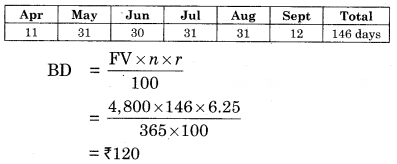
A bill of ₹ 4,800 was drawn on 9th March 2006 at 6 months and was discounted on 19th April 2006 for 6% p.a. How much does the banker charge and how much does the holder receive?
Solution & Step-by-Step Answer:
Face value of the bill = ₹ 4.800 Date of drawing = 09/03/2006 Period of the bill = 6 months Normal due date = 09/09/2006 Legal due date = 12/09/2006 Rate of discount = 6% = 6.25% Now, for the unexpired Thus the banker charges ₹ 120 Amount received by the holder = 4,800 – 120 = ₹ 4,680
Question 15
Maharashtra Board Solution
A bill of ₹ 65,700 drawn on July 10 for 6 months was discounted for ₹ 65,160 at 5% p.a. On what day was the bill discounted?
Solution & Step-by-Step Answer:
BD = FV – Cash value = 65,700 – 65,160 = ₹ 540 Let the unexpired days be x days BD = ∴ 540 = ∴ x = 60 days The unexpired days = 60 days Date-of drawing = 10th July Period of the bill = 6 months Nominal due date = 10th January (next year) Legal due date = 13th January (next year) Then the date of discount is 60 days before, the legal due date ∴ The date of discounting is 14th November

Question 16
Maharashtra Board Solution
An agent sold a car and charged a 3% commission on the sale value. If the owner of the car received ₹ 48,500, find the sale value of the car. If the agent charged 2% from the buyer, find his total remuneration.
Solution & Step-by-Step Answer:
Let the sale value of the car be ₹ x Rate of commission of the agent = 3% Since the owner received ₹ 48,500 after agent has charged his commission x – = 48500 ∴ = 48500 ∴ x = ∴ x = ₹ 50,000 ∴ Sale value of the car = ₹ 50,000 Against commission received from the owner = × 50,000 = ₹ 1500 Against commission received from the buyer = × 50,000 = ₹ 1000 ∴ Agents total remuneration = 1,500 + 1,000 = ₹ 2,500
Question 17
Maharashtra Board Solution
An agent is paid a commission of 4% on cash sales and 6% on credit sales made by him. If on the sale of ₹ 51,000 the agent claims a total commission of ₹ 2,700, find the sales made by him for cash and on credit.
Solution & Step-by-Step Answer:
Total sales = ₹ 51,000 Let eash sales be ₹ x ∴ Credit sales = ₹ (51,000 – x) Agent’s commission on cash sales = 4% = × x = Commission on credit sales = 6% = (51,000 – x) Given total commission = ₹ 2,700 ∴ Cash sales = ₹ 18,000 ∴ Credit sales = 51,000 – 18,000 = ₹ 33,000
