Latest Maharashtra State Board (SSC & HSC) 2026-27 Syllabus Digest & Solutions Updated!
Class 12 (HSC Board)Biology2026-27 Syllabus

Chapter 1 Reproduction in Lower and Higher Plants Solutions

Complete Maharashtra State Board Balbharati & Yuvakbharati textbook solutions for Chapter 1 Reproduction in Lower and Higher Plants. Step-by-step solved exercises, numerical problems, and digest answers.

35 Solved Questions7 Diagrams1373 words

Maharashtra State Board 12th Biology Solutions Chapter 1 Reproduction in Lower and Higher Plants

1. Multiple Choice Questions

Question 1 Maharashtra Board Solution
Insect pollinated flowers usually possess ……………… (a) sticky pollen with a rough surface (b) large quantities of pollens (c) dry pollen with a smooth surface (d) light-colored pollens
Solution & Step-by-Step Answer:
(a) sticky pollen with a rough surface
Question 2 Maharashtra Board Solution
In ovule, meiosis occurs in ……………… (a) Integument (b) Nucellus (c) Megaspore (d) Megaspore mother cell
Solution & Step-by-Step Answer:
(d) Megaspore mother cell
Question 3 Maharashtra Board Solution
The ploidy level is NOT the same in ……………… (a) Integuments and nucellus (b) Root tip and shoot tip (c) Secondary nucleus and endosperm (d) Antipodals and synergids
Solution & Step-by-Step Answer:
(c) Secondary nucleus and endosperm
Question 4 Maharashtra Board Solution
Which of the following types require pollination but result is genetically similar to autogamy? (a) Geitonogamy (b) Xenogamy (c) Apogamy (d) Cleistogamy
Solution & Step-by-Step Answer:
(a) Geitonogamy
Question 5 Maharashtra Board Solution
If diploid chromosome number in a flowering plant is 12, then which one of the following will have 6 chromosomes? (a) Endosperm (b) Leaf cells (c) Cotyledons (d) Synergids
Solution & Step-by-Step Answer:
(d) Synergids
Question 6 Maharashtra Board Solution
In angiosperms, endosperm is formed by/ due to ……………… (a) free nuclear divisions of megaspore (b) polar nuclei (c) polar nuclei and male gamete (d) synergids and male gametes
Solution & Step-by-Step Answer:
(c) polar nuclei and male gamete
Question 7 Maharashtra Board Solution
Point out the odd one. (a) Nucellus (b) Embryo sac (c) Micropyle (d) Pollen grain
Solution & Step-by-Step Answer:
(d) Pollen grain

2. Very Short Answer Questions

Question 1 Maharashtra Board Solution
The part of gynoecium that determines the compatible nature of pollen grain.
Solution & Step-by-Step Answer:
Stigmatic surface.
Question 2 Maharashtra Board Solution
How many haploid cells are present in a mature embryo sac?
Solution & Step-by-Step Answer:
6 cells, 2 synergids, 1 egg cell, 3 antipodals.
Question 3 Maharashtra Board Solution
Even though each pollen grain has 2 male gametes why at least 20 pollen grains are required to fertilize 20 ovules in a particular carpel?
Solution & Step-by-Step Answer:
Angiosperms have phenomenon of double fertilization in which both the male gametes are utilized, one for fusion with egg cell to form zygote and other for fusion with secondary nucleus to form endosperm.
Question 4 Maharashtra Board Solution
Megasporogenesis
Solution & Step-by-Step Answer:
It is the process of formation of haploid megaspores from diploid megaspore mother cell.
Question 5 Maharashtra Board Solution
What is hydrophily?
Solution & Step-by-Step Answer:
Transfer of pollen grains in pollination process through agency of water is known as hydrophily.
Question 6 Maharashtra Board Solution
The layer which supplies nourishment to the developing pollen grains.
Solution & Step-by-Step Answer:
Tapetum
Question 7 Maharashtra Board Solution
Parthenocarpy
Solution & Step-by-Step Answer:
The condition in which fruit is developed without the process of fertilization is called parthenocarpy.
Question 8 Maharashtra Board Solution
Are pollination and fertilization necessary in apomixis?
Solution & Step-by-Step Answer:
Apomixis is formation of embryos without formation of gametes hence there is no need of pollination and fertilization.
Question 9 Maharashtra Board Solution
The part of pistil which develops into fruit and seed.
Solution & Step-by-Step Answer:
Ovary develops into fruit and ovules into seed.
Question 10 Maharashtra Board Solution
What is the function of filiform apparatus ?
Solution & Step-by-Step Answer:
Filiform apparatus guides the pollen tube towards egg cell.

3. Short Answer Questions

Question 1 Maharashtra Board Solution
How polyembryony can be commercially exploited?
Solution & Step-by-Step Answer:
Question 2 Maharashtra Board Solution
Pollination and seeds formation are very crucial for the fruit formation, Justify.
Solution & Step-by-Step Answer:
Question 3 Maharashtra Board Solution
Incompatibility is a natural barrier in the fusion of gametes. How will you explain this statement?
Solution & Step-by-Step Answer:
Question 4 Maharashtra Board Solution
Describe three devices by which cross pollination is encouraged in Angiosperms by avoiding self-pollination?
Solution & Step-by-Step Answer:

4. Long Answer Questions

Question 1 Maharashtra Board Solution
Describe the process of double fertilization.
Solution & Step-by-Step Answer:
Double fertilization: (1) Out of the two male gametes produced by the male gametophyte in angiosperms, one unites with the female gamete and the other with the secondary nucleus. Since both the male gametes take part in fertilization and fertilization occurs twice, it is called double fertilization.

(2) During double fertilization, the pollen tube on reaching the ovule enters the embryo sac through micropyle and bursts in one of the synergids. Owing to this, the two male gametes contained in the pollen tube, are set free.
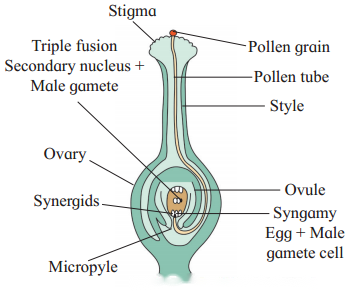
(3) Out of the two male gametes, one unites with the egg or female gamete and the other unites with the secondary nucleus of the embryo sac, forming a triploid or triple fusion nucleus, called the primary endosperm nucleus. The process involving the fusion of one of the male gametes with the egg nucleus, resulting in the formation of a diploid zygote is called syngamy.

(4) The reproductive process in which non-motile male nuclei are carried to the egg cell through a pollen tube is called siphonogamy.

(5) After fertilization, zygote develops into an embryo. Certain changes take place in the ovule leading to the development of a seed.

Question 2 Maharashtra Board Solution
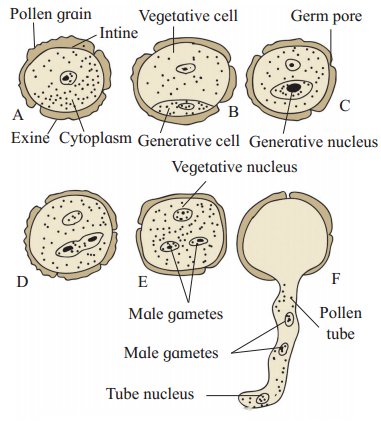
Explain the stages involved in the maturation of microspore into male gametophyte. OR Describe the development of male gametophyte before pollination in angiosperms. OR Sketch and label male gametophyte in angiosperm.
Solution & Step-by-Step Answer:

Question 3 Maharashtra Board Solution
Explain the development of dicot embryo.
Solution & Step-by-Step Answer:
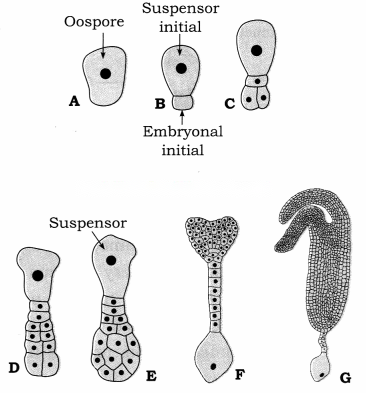
Development of embryo (dicot) in angio- sperm: The oospore undergoes a transverse division to form a large basal cell towards the micropyle and a small apical or terminal cell towards the chalaza of the embryo sac. This two celled structure is called proembryo. The basal cell or suspensor initial undergoes repeated transverse divisions to form a multicellular structure called suspensor. The suspensor pushes the embryo towards the endosperm to draw its nutrition.
Question 4 Maharashtra Board Solution
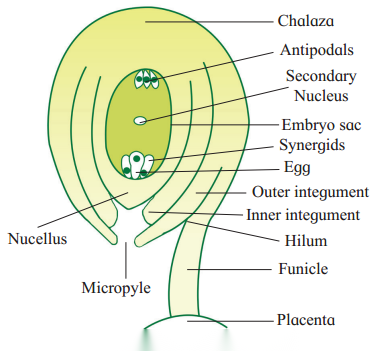
Draw a diagram of the L.S of anatropous ovule and list the components of embryo sac and mention their fate after fertilization.
Solution & Step-by-Step Answer:
Components of Embryo sac.
5. Fill in the Blanks

Question 1 Maharashtra Board Solution
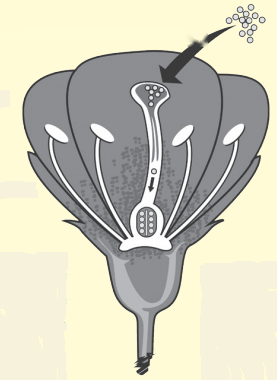
The ……………… collects the pollen grains.
Solution & Step-by-Step Answer:
biotic agents
Question 2 Maharashtra Board Solution
The male whorl, called the ……………… produces ………………
Solution & Step-by-Step Answer:
androecium, pollen grains
Question 3 Maharashtra Board Solution
The pollen grains represent the ………………
Solution & Step-by-Step Answer:
male
Question 4 Maharashtra Board Solution
The ……………… contains the egg or ovum.
Solution & Step-by-Step Answer:
embryo sac
Question 5 Maharashtra Board Solution
…………….. takes place when one male gamete and the egg fuse together. The fertilized egg grows vs into seed from which the new plants can grow.
Solution & Step-by-Step Answer:
Fertilization
Question 6 Maharashtra Board Solution
The ……………… is the base of the flower to which other floral parts are attached.
Solution & Step-by-Step Answer:
thalamus
Question 7 Maharashtra Board Solution
……………… is the transfer of pollen grains from anther of the flower to the stigma of the same or a different flower.
Solution & Step-by-Step Answer:
Pollination
Question 8 Maharashtra Board Solution
Once the pollen reaches the stigma, pollen tube traverses down the ……………… to the ovary where fertilization occurs.
Solution & Step-by-Step Answer:
style
Question 9 Maharashtra Board Solution
The ……………… are coloured to attract the insects that carry the pollen. Some flowers also produce ……………… or ……………… that attracts insects.
Solution & Step-by-Step Answer:
petals, fragrance, nectar
Question 10 Maharashtra Board Solution
The whorl ……………… is green that protects the flower until it opens.
Solution & Step-by-Step Answer:
Calyx.

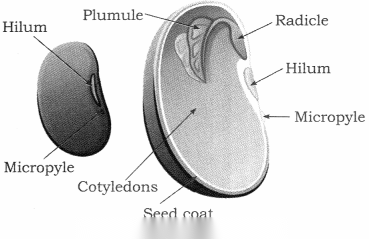
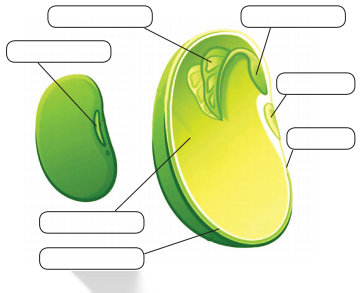
6. Label the Parts of seed.


Answer:
7. Match the following

Column I (Structure Before seed formation)

Column II (Structure After seed formation)

A. Funiculus

i. Hilum

B. Scar of Ovule

ii. Tegmen

C. Zygote

iii. Testa

D. Inner Integument

iv. Stalk of Seed

v. Embryo

(a) A-v, B-i, C-ii, D-iv
(b) A-iii, B-iv, C-i, D-v
(c) A-iv, B-i, C-v D-ii
(d) A-iv, B-v C-iii, D-ii
Answer:
(c) A-iv, B-i, C-v D-ii