Chapter 6 Mechanical Properties of Solids Solutions
Complete Maharashtra State Board Balbharati & Yuvakbharati textbook solutions for Chapter 6 Mechanical Properties of Solids. Step-by-step solved exercises, numerical problems, and digest answers.
52 Solved Questions• 11 Diagrams• 3168 words
Maharashtra State Board 11th Physics Solutions Chapter 6 Mechanical Properties of Solids
1. Choose the correct answer:
Question 1Maharashtra Board Solution
Change in dimensions is known as ………….. (A) deformation (B) formation (C) contraction (D) strain.
Solution & Step-by-Step Answer:
(A) deformation
Question 2Maharashtra Board Solution
The point on stress-strain curve at which strain begins to increase even without increase in stress is called………… (A) elastic point (B) yield point (C) breaking point (D) neck point
Solution & Step-by-Step Answer:
(B) yield point
Question 3Maharashtra Board Solution
Strain energy of a stretched wire is 18 × 10-3 J and strain energy per unit volume of the same wire and same cross section is 6 × 10⁻³ J/m3. Its volume will be…………. (A) 3cm3 (B) 3 m3 (C) 6 m3 (D) 6 cm3
Solution & Step-by-Step Answer:
(B) 3 m3
Question 4Maharashtra Board Solution
……………. is the property of a material which enables it to resist plastic deformation. (A) elasticity (B) plasticity (C) hardness (D) ductility
Solution & Step-by-Step Answer:
(C) hardness
Question 5Maharashtra Board Solution
The ability of a material to resist fracturing when a force is applied to it, is called…………… (A) toughness (B) hardness (C) elasticity (D) plasticity.
Solution & Step-by-Step Answer:
(A) toughness
2. Answer in one sentence:
Question 1Maharashtra Board Solution
Define elasticity.
Solution & Step-by-Step Answer:
If a body regains its original shape and size after removal of the deforming force, it is called an elastic body and the property is called elasticity.
Question 2Maharashtra Board Solution
What do you mean by deformation?
Solution & Step-by-Step Answer:
The change in shape or size or both of u body due to an external force is called deformation.
Question 3Maharashtra Board Solution
State the SI unit and dimensions of stress.
Solution & Step-by-Step Answer:
Question 4Maharashtra Board Solution
Define strain.
Solution & Step-by-Step Answer:
Strain:
Question 5Maharashtra Board Solution
What is Young’s modulus of a rigid body?
Solution & Step-by-Step Answer:
Young’s modulus (Y): It is the modulus of elasticity related to change in length of an object like a metal wire, rod, beam, etc., due to the applied deforming force.
Question 6Maharashtra Board Solution
Why bridges are unsafe after a very long use?
Solution & Step-by-Step Answer:
A bridge during its use undergoes recurring stress depending upon the movement of vehicles on it. When bridge is used for long time, it loses its elastic strength and ultimately may collapse. Hence, the bridges are declared unsafe after long use.
Question 7Maharashtra Board Solution
How should be a force applied on a body to produce shearing stress?
Solution & Step-by-Step Answer:
A tangential force which is parallel to the top and the bottom surface of the body should be applied to produce shearing stress.
Question 8Maharashtra Board Solution
State the conditions under which Hooke’s law holds good.
Solution & Step-by-Step Answer:
Hooke’s Taw holds good only when a wire/body is loaded within its elastic limit.
Question 9Maharashtra Board Solution
Define Poisson’s ratio.
Solution & Step-by-Step Answer:
Within elastic limit, the ratio of lateral strain to the linear strain is called the Poisson‘s ratio.
Question 10Maharashtra Board Solution
What is an elastomer?
Solution & Step-by-Step Answer:
A material that can be elastically stretched to a larger value of strain is called an elastomer.
Question 11Maharashtra Board Solution
What do you mean by elastic hysteresis?
Solution & Step-by-Step Answer:
Question 12Maharashtra Board Solution
State the names of the hardest material and the softest material.
Solution & Step-by-Step Answer:
Hardest material: Diamond Softest material: Aluminium [Note: Material with highest strength is steel whereas material with lowest strength is plasticine clay.]
Question 13Maharashtra Board Solution
Define friction.
Solution & Step-by-Step Answer:
The property which resists the relative motion between two surfaces in contact is called friction.
Question 14Maharashtra Board Solution
Why force of static friction is known as ‘self-adjusting force?
Solution & Step-by-Step Answer:
The force of static friction varies in accordance with applied force. Hence, it is called as self adjusting force.
Question 15Maharashtra Board Solution
Name two factors on which the coefficient of friction depends.
Solution & Step-by-Step Answer:
Coefficient of friction depends upon:
3. Answer in short:
Question 1Maharashtra Board Solution
Distinguish between elasticity and plasticity.
Solution & Step-by-Step Answer:
No.
Elasticity
Plasticity
i.
Body regains its original shape or size after removal of deforming force.
Body does not regain its original shape or size after removal of deforming force.
ii.
Restoring forces are strong enough to bring the displaced molecules to their original positions.
Restoring forces are not strong enough to bring the molecules back to their original positions.
Examples of elastic materials: metals, rubber, quartz, etc
Examples of plastic materials: clay, putty, plasticine, thick mud, etc
Question 2Maharashtra Board Solution
State any four methods to reduce friction.
Solution & Step-by-Step Answer:
Friction can be reduced by using polished surfaces, using lubricants, using grease and using ball bearings.
Question 3Maharashtra Board Solution
What is rolling friction? How does it arise?
Solution & Step-by-Step Answer:
Question 4Maharashtra Board Solution
Explain how lubricants help in reducing friction?
Solution & Step-by-Step Answer:
Question 5Maharashtra Board Solution
State the laws of static friction.
Solution & Step-by-Step Answer:
Laws of static friction:
Question 6Maharashtra Board Solution
State the laws of kinetic friction.
Solution & Step-by-Step Answer:
Laws of kinetic friction:
Question 7Maharashtra Board Solution
State advantages of friction.
Solution & Step-by-Step Answer:
Advantages of friction:
Question 8Maharashtra Board Solution
State disadvantages of friction.
Solution & Step-by-Step Answer:
Disadvantages of friction:
Question 9Maharashtra Board Solution
What do you mean by a brittle substance? Give any two examples.
Solution & Step-by-Step Answer:
4. Long answer type questions:
Question 1Maharashtra Board Solution
Distinguish between Young’s modulus, bulk modulus and modulus of rigidity.
Solution & Step-by-Step Answer:
No
Young’s modulus
Bulk modulus
Modulus of rigidity
i.
It is the ratio of longitudinal stress to longitudinal strain.
It is the ratio of volume stress to volume strain.
It is the ratio of shearing stress to shearing strain.
ii.
It is given by, Y =
It is given by, K =
It is given by,
iii.
It exists in solids.
It exists in solid, liquid and gases.
It exists in solids.
iv.
It relates to change inlength of a body.
It relates to change in volume of a body.
It relates to change in shape of a body.
Question 2Maharashtra Board Solution
Define stress and strain. What are their different types?
Solution & Step-by-Step Answer:
i) Stress:
ii. Strain:
Question 3Maharashtra Board Solution
What is Young’s modulus? Describe an experiment to find out Young’s modulus of material in the form of a long straight wire.
Solution & Step-by-Step Answer:
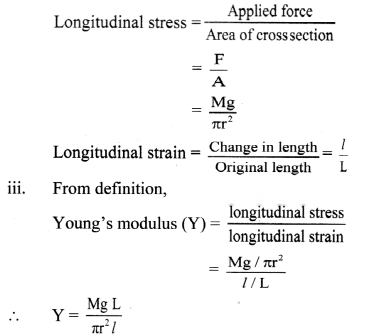
Definition: Young ‘s modulus is the ratio of longitudinal stress to longitudinal strain. It is denoted by Y. Unit: N/m2 or Pa in SI system. Dimensions: [L-1M1T-2]
Experimental description to find Young’s modulus:
i. Consider a metal wire suspended from a rigid support. A load is attached to the free end of the wire. Due to this, deforming force gets applied to the free end of wire in downward direction and it produces a change in length. Let, L = original length of wire, Mg = weight suspended to wire, l = extension or elongation, (L + l) = new length of wire. r = radius of the cross section of wire
ii. In its equilibrium position,
Question 4Maharashtra Board Solution
Derive an expression for strain energy per unit volume of the material of a wire.
Solution & Step-by-Step Answer:
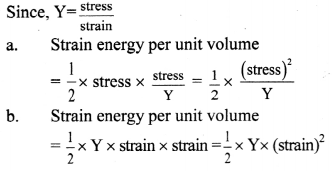
Expression for strain energy per unit volume;
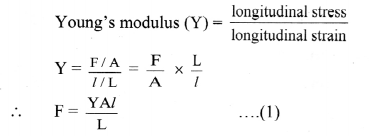
i. Consider a wire of original length L and cross sectional area A stretched by a force F acting along its length. The wire gets stretched and elongation l is produced in it
ii. If the wire is perfectly elastic then, Longitudinal stress = Longitudinal strain =
iii. The magnitude of stretching force increases from zero to F during elongation of wire. Let ‘f’ be the restoring force and ‘x’ be its corresponding extension at certain instant during the process of extension. ∴ f = ……………. (2)
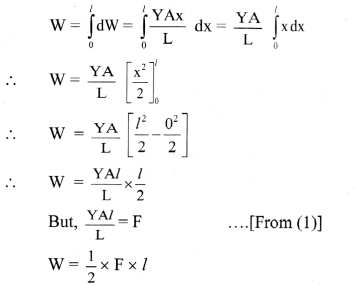
iv. Let ‘dW’ be the work done for the further small extension ‘dx’. Work = force × displacement ∴ dW = fdx ∴ dW= dx …………..(3) [From (2)]
v. The total amount of work done in stretching the wire from x = 0 to x = l can be found out by integrating equation (3).
∴ Work done in stretching a wire, W = × load × extension
vi. Work done by stretching force is equal to strain energy gained by the wire. ∴ Strain energy = × load × extension
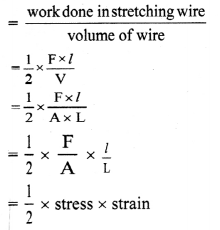
vii. Work done per unit volume
∴ Strain energy per unit volume = × stress × strain
viii. Other forms:
Question 5Maharashtra Board Solution
What is friction? Define coefficient of static friction and coefficient of kinetic friction. Give the necessary formula for each.
Solution & Step-by-Step Answer:
Question 6Maharashtra Board Solution
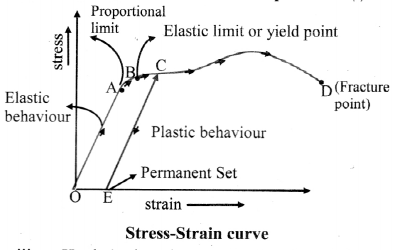
State Hooke’s law. Draw a labelled graph of tensile stress against tensile strain for a metal wire up to the breaking point. In this graph show the region in which Hooke’s law is obeyed.
Solution & Step-by-Step Answer:
i) Statement: Within elastic limit, stress is directly proportional to strain. Explanation;
ii)
iii) Hooke’s law is completely obeyed in the region OA.
5. Answer the following
Question 1Maharashtra Board Solution
Calculate the coefficient of static friction for an object of mass 50 kg placed on horizontal table pulled by attaching a spring balance. The force is increased gradually it is observed that the object just moves when spring balance shows 50N. [
Solution & Step-by-Step Answer:
µs = 0.102] Solution: Given: m = 50 kg, FL = 50 N, g = 9.8 m/s2 To find: Coefficient of static friction (µs) Formula: µs = µs = = 0.102 Answer: The coefficient of static friction is 0.102.
Question 2Maharashtra Board Solution
A block of mass 37 kg rests on a rough horizontal plane having coefficient of static friction 0.3. Find out the least force required to just move the block horizontally. [
Solution & Step-by-Step Answer:
F= 108.8N] Solution: Given: m = 37 kg, µs = 0.3, g = 9.8 m /s2 To find: Limiting force (FL) Formula: FL = µSN = µS mg Calculation: From formula, FL = 0.3 × 37 × 9.8 = 108.8 N Answer: The force required to move the block is 108.8 N.
Question 3Maharashtra Board Solution
A body of mass 37 kg rests on a rough horizontal surface. The minimum horizontal force required to just start the motion is 68.5 N. In order to keep the body moving with constant velocity, a force of 43 N is needed. What is the value of a) coefficient of static friction? and b) coefficient of kinetic friction? Asw: a) µs = 0.188 b) µk = 0.118]
Solution & Step-by-Step Answer:
Given: FL = 68.5 N, Fk = 43 N, m = 37 kg, g = 9.8 m/s2
To find:
i. Coefficient of static friction (µs) ii. Coefficient of kinetic friction (µk)
Formulae:
i. µs= = ii. µk= =
Calculation: From formula (i), ∴ µs= = 0.1889 From formula (ii), ∴ µk= = 0.1186 Answer:
[Note: Answers calculated above are in accordance with textual methods of calculation.]
Question 4Maharashtra Board Solution
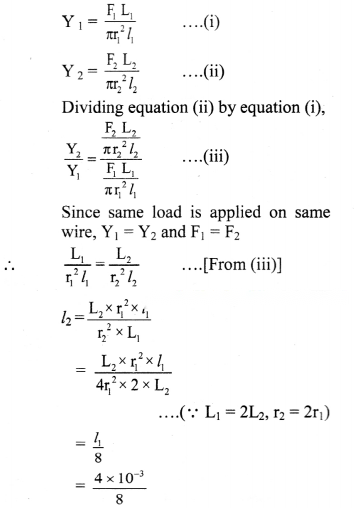
A wire gets stretched by 4mm due to a certain load. If the same load is applied to a wire of same material with half the length and double the diameter of the first wire. What will be the change in its length?
Solution & Step-by-Step Answer:
Given. l1 = 4mm = 4 × 10⁻³ m L2 = , D2 = 2D, r2 = 2r1 To find: Change in length (l2) Formula: Y = Calculation: From formula, = 0.5 × 10⁻³ m = 0.5 mm The new change in length of the wire is 0.5 mm.
Question 5Maharashtra Board Solution
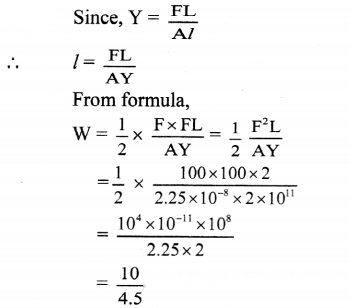
Calculate the work done in stretching a steel wire of length 2m and cross sectional area 0.0225mm2 when a load of 100 N is slowly applied to its free end. [Young’s modulus of steel= 2 × 10¹¹ N/m2]
Solution & Step-by-Step Answer:
Given. L = 2m, F = 100 N, A = 0.0225 mm2 = 2.25 × 10⁻⁸ m2, Y = 2 × 10-11 N/m2, To find: Work (W) Formula: W = × F × l Claculation: = antilog [log 10 – log 4.5] = antilog [1.0000 – 0.6532 ] = antilog [0.3468] ∴ W = 2.222 J Answer: The work done in stretching the steel wire is 2.222 J.
Question 6Maharashtra Board Solution
A solid metal sphere of volume 0.31m3 is dropped in an ocean where water pressure is 2 × 10⁷ N/m2. Calculate change in volume of the sphere if bulk modulus of the metal is 6.1 × 10¹⁰ N/m2
Solution & Step-by-Step Answer:
Given: V= 0.31 m3, dP = 2 × 10⁷ N/m2, K = 6.1 × 10¹⁰ N/m2 To find: Change in volume (dV) Formula: K = V × Calculation: From formula, dV = ∴ dV = ≈ 10-4 m3 The change in volume of the sphere is 10-4 m3.
Question 7Maharashtra Board Solution
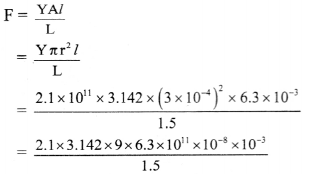
A wire of mild steel has initial length 1.5 m and diameter 0.60 mm is extended by 6.3 mm when a certain force is applied to it. If Young’s modulus of mild steel is 2.1 × 10¹¹ N/m2, calculate the force applied.
Solution & Step-by-Step Answer:
Given: L = 1.5m, d = 0.60 mm, r = = 0.30 mm = 3 × 10⁻⁴ m, Y = 2.1 × 10¹¹ N/m2, l = 6.3 mm = 6.3 × 10⁻³ m To find: Force (F) Calculation: From formula, = 2.1 × 3.142 × 6 × 6.3 = antilog [log 2.1 + log 3.142 + log 6 + log 6.3] = antilog [0.3222 + 0.4972 + 0.7782 + 0.7993] = antilog [2.3969] = 2.494 × 10² ≈ 250 N The force applied on wire is 250 N.
Question 8Maharashtra Board Solution
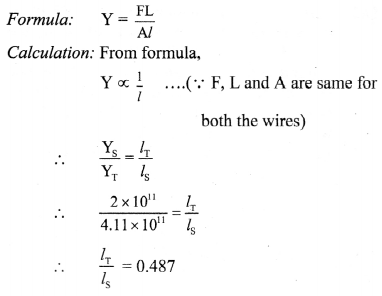
A composite wire is prepared by joining a tungsten wire and steel wire end to end. Both the wires are of the same length and the same area of cross section. If this composite wire is suspended to a rigid support and a force is applied to its free end, it gets extended by 3.25mm. Calculate the increase in length of tungsten wire and steel wire separately. [Given: Ysteel = 2 × 10¹¹ Pa, YTungsten = 4.11 × 10¹¹ Pa]
Solution & Step-by-Step Answer:
Given: ls + lT = 3.25 mm, YT = 4.11 × 10¹¹ Pa Ys = 2 × 10¹¹ Pa To find: Extension in tungsten wire (lT) Extension in steel wire (ls) But ls + lT = 3.25 ls + 0.487 ls = 3.25 ls(1 + 0.487) = 3.25 ls = 2.186 mm ∴ lT = 3.25 – 2.186 = 1.064 mm The extension in tungsten wire is 1.064 mm and the extension in steel wire is 2.186 mm.
[Note: Values of Young’s modulus of tungsten and steel considered above are standard values. Using them, calculation is carried out ¡n accordance with textual method.]
Question 9Maharashtra Board Solution
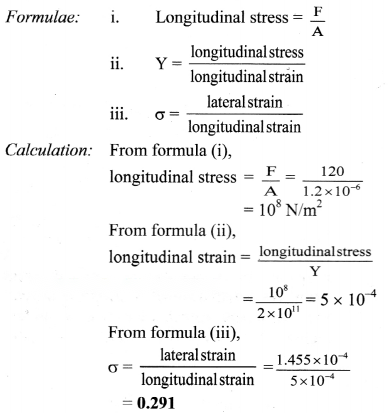
A steel wire having cross sectional area 1.2 mm2 is stretched by a force of 120 N. If a lateral strain of 1.455 mm is produced in the wire, calculate the Poisson’s ratio.
Solution & Step-by-Step Answer:
Given: A = 1.2 mm2 = 1.2 × 10⁻⁶ m2, F = 120 N, Ysteel = 2 × 10¹¹ N/m2, Lateral strain = 1.455 × 10⁻⁴ To find: Poisson’s ratio (σ) The Poisson’s ratio of steel is 0.291. [Note: Lateral strain being ratio of two same physical quantities, is unitless. hence, value given in question ¡s modified to 1.455 × 10⁻⁴ to reach the answer given in textbook.]
Question 10Maharashtra Board Solution
A telephone wire 125m long and 1mm in radius is stretched to a length 125.25m when a force of 800N is applied. What is the value of Young’s modulus for material of wire?
Solution & Step-by-Step Answer:
Given: L = 125m, r = 1 mm= 1 × 10⁻³ m l = 125.25 – 125 = 0.25 m, F = 800N To find: Young’s modulus (Y) Formula: Y Calculation: From formula, Y = = {antilog [log 800 + log 125 – log 3.142 – log 0.25 ]} × 106 = {antilog [2.9031 + 2.0969 – 0.4972 – .3979]} × 106 = {antilog[5.1049]} × 106 = 1.274 × 105 = 1.274 × 10¹¹ N/m2 The Young’s modulus of telephone wire is 1.274 × 10¹¹ N/m2.
Question 11Maharashtra Board Solution
A rubber band originally 30cm long is stretched to a length of 32cm by certain load. What is the strain produced?
Solution & Step-by-Step Answer:
Given: L = 30 cm = 30 × 10 -2 m, ∆l = 32 cm – 30 cm = 2cm = 2 × 10 -2 m To find. Strain Formula: Strain = Calculation: From formula, Strain = = 6.667 × 10 -2 The strain produced in the wire is 6.667 × 10 -2.
Question 12Maharashtra Board Solution
What is the stress in a wire which is 50m long and 0.01cm2 in cross section, if the wire bears a load of 100kg?
Solution & Step-by-Step Answer:
Given: M = 100 kg, L 50 m, A = 0.01 × 10⁻⁴ m To find: Stress Formula: Stress = Calculation: From formula, Stress = = 9.8 × 10⁸ N/m2 The stress in the wire is 9.8 × 10⁸ N/m2.
Question 13Maharashtra Board Solution
What is the strain in a cable of original length 50m whose length increases by 2.5cm when a load is lifted?
Solution & Step-by-Step Answer:
Given: L = 50m, ∆l = 2.5cm = 2.5 × 10 -2 m To find: Strain Formula: Strain = Calculation: From formula, Strain = = 5 × 10⁻⁴ The Strain produced in wire is 5 × 10⁻⁴.
11th Physics Digest Chapter 6 Mechanical Properties of Solids Intext Questions and Answers
Can you recall? (Textbook Page No. 100)
Question 1Maharashtra Board Solution
Solution & Step-by-Step Answer:
Can you tell? (Textbook Page No. 107)
Question 1Maharashtra Board Solution
Why does a rubber band become loose after repeated use?
Solution & Step-by-Step Answer:
Can you tell? (Textbook Page No.111)
Question 1Maharashtra Board Solution
i. It is difficult to run fast on sand. ii. It is easy to roll than pull a barrel along a road. iii. An inflated tyre rolls easily than a flat tyre. iv. Friction is a necessary evil.
Solution & Step-by-Step Answer:
i.
ii.
iii.
iv.
Internet my friend (Textbook Page No. 111)
Question 1Maharashtra Board Solution
i. https ://opentextbc. ca/physicstestbook2/ chapter/friction/ ii.iii.iv.chapter/5-3-elasticity-stress-and-strain/ v.
Solution & Step-by-Step Answer:
[Students are expected to visit the above mentioned websites and collect more information about mechanical properties of solid.]