Maharashtra State Board 11th Physics Solutions Chapter 5 Gravitation
1. Choose the correct option.
Solution & Step-by-Step Answer:
(C) the pole of the Earth.
Solution & Step-by-Step Answer:
(B) zero.
Solution & Step-by-Step Answer:
(A) the centre of the Earth.
Solution & Step-by-Step Answer:
(D) 3 × 10+9J
2. Answer the following questions.
Solution & Step-by-Step Answer:
The line that joins a planet and the Sun sweeps equal areas in equal intervals of time.
Solution & Step-by-Step Answer:
The square of the time period of revolution of a planet around the Sun is proportional to the cube of the semimajor axis of the ellipse traced by the planet.
Solution & Step-by-Step Answer:
The dimensions of universal gravitational constant are: [L3M-1T-2].
Solution & Step-by-Step Answer:
The minimum energy required by a satellite to escape from Earth ‘s gravitational influence is the binding energy of the satellite.
Solution & Step-by-Step Answer:
Some satellites that revolve around the Earth in equatorial plane have same sense of rotation as that of the Earth. The also have the same period of rotation as that of the Earth i.e.. 24 hours. Due to this, these satellites appear stationary from the Earth’s surface and are known as geostationary satellites.
Solution & Step-by-Step Answer:
Statement: Every particle of matter attracts every other particle of matter with a force which is directly proportional to the product of their masses and inversely proportional to the square of the distance between them.
Solution & Step-by-Step Answer:
The minimum velocity with which a both’ should he thrown vertically upwards from the surface of the Earth so that it escapes the Earth ‘s gravitational field, is called the escape velocity (ve) of the body.
Solution & Step-by-Step Answer:
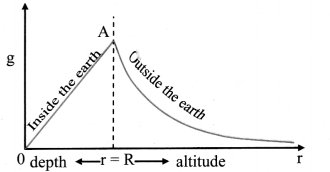
Variation in acceleration due to gravity due to altitude is given by, gh = g where, gh = acceleration due to gravity of an object placed at h altitude g = acceleration due to gravity on surface of the Earth R = radius of the Earth h = attitude height of the object from the surface of the Earth. Hence, acceleration due to gravity decreases with increase in altitude.
Solution & Step-by-Step Answer:
The escape speed depends only on the mass and radius of the planet. [Note: Escape velocity does not depend upon the mass of the body]
Solution & Step-by-Step Answer:
Solution & Step-by-Step Answer:
The periodic time of a geostationary satellite is same as that of the Earth i.e., one day or 24 hours.
Solution & Step-by-Step Answer:
Solution & Step-by-Step Answer:
Solution & Step-by-Step Answer:
Solution & Step-by-Step Answer:
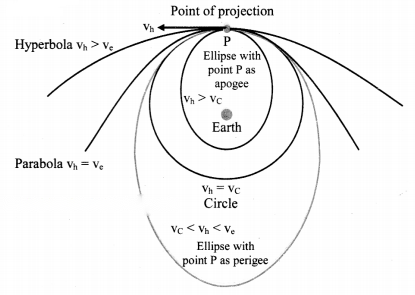
The path of the satellite depends upon the value of horizontal speed of projection vh relative to critical velocity vc and escape velocity ve. Case (I) vh < vc: The orbit of satellite is an ellipse with point of projection as apogee and Earth at one of the foci. During this elliptical path, if the satellite passes through the Earth’s atmosphere. it experiences a nonconservative force of air resistance. As a result it loses energy and spirals down to the Earth. Case (II) vh = vc: The satellite moves in a stable circular orbit around the Earth. Case (III) vc < vh < ve: The satellite moves in an elliptical orbit round the Earth with the point of projection as perigee. Case (IV) vh = ve The satellite travels along parabolic path and never returns to the point of projection. Its speed will be zero at infinity. Case (V) vh > ve: The satellite escapes from gravitational influence of Earth traversing a hyperbolic path.
3. Answer the following questions in detail.
Solution & Step-by-Step Answer:
Expression for critical velocity:
Solution & Step-by-Step Answer:
Applications of communication satellite:
Solution & Step-by-Step Answer:
Variation of g due to altitude:
Solution & Step-by-Step Answer:
vh = horizontal speed of projection v c = critical velocity ve = escape velocity
Solution & Step-by-Step Answer:
Solution & Step-by-Step Answer:
Solution & Step-by-Step Answer:
Solution & Step-by-Step Answer:
Solution & Step-by-Step Answer:
Solution & Step-by-Step Answer:
The minimum energy required by a satellite to escape from Earth ‘s gravitational influence is the binding energy of the satellite. Expression for binding energy of satellite revolving in circular orbit round the Earth:
Solution & Step-by-Step Answer:
Solution & Step-by-Step Answer:
Solution & Step-by-Step Answer:
Solution & Step-by-Step Answer:
The exact horizontal velocity of projection that must be given to a satellite at a certain height so that it can revolve in a circular orbIt round the Earth is called the critical velocity or orbital velocity (vc). Expression for critical velocity:
Solution & Step-by-Step Answer:
Solution & Step-by-Step Answer:
4. Solve the following problems.
Solution & Step-by-Step Answer:
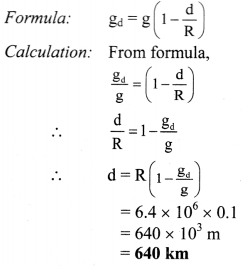
Given: gd = 90% of g i.e., = 0.9, R = 6400km = 6.4 × 10⁶ m To find: Distance below the Earth’s surface (d) At distance 640 km below the surface of the Earth, value of acceleration due to gravity decreases by 10%.
Solution & Step-by-Step Answer:
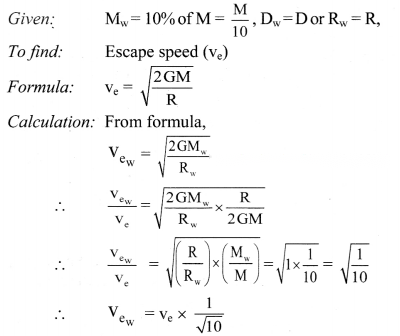
As, we know that the escape speed from surface of the Earth is 11.2 km/s, Substituting value of ve = 11.2 km/s Vew = 11.2 × = 11.2 × …………… [Taking square root value] = antilog {log(1 1.2) – Log(3.162)} = antilog {1.0492 – 0.5000} = antilog {0.5492} = 3.542 ∴ Vew = 3.54km/s The escape velocity from the surface of wooden Earth is 3.54 km/s.
Solution & Step-by-Step Answer:
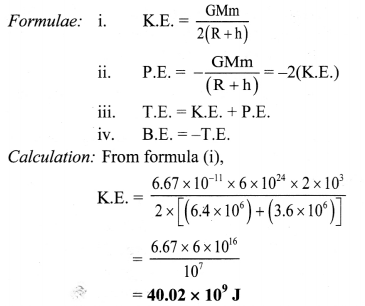
Given:- m = 2000 kg, h = 3600 km = 3.6 × 10⁶ m, G = 6.67 × 10⁻¹¹ Nm2/kg2 R = 6400 km M = 6 × 1024 kg
To find: i) Kninetic energy (K.E.)
ii) Potential Energy (P.E.)
iii) Total Energy (T.E.)
iv) Binding Energy (B.E.)
From formula (ii),
P.E. = -2 × 40.02 × 109
= -80.04 × 10⁹J
From formula (iii),
T.E. = (40.02 × 10⁹) + (-80.02 × 10⁹)
= -40.02 × 10⁹J
From formula (iv),
B.E.= -(-40.02 × 10⁹)
= 40.02 × 10⁹J
Kinetic energy of the satellite is 40.02 × 10⁹J, potential energy is -80.04 × 10⁹J, total energy is -40.02 × 10⁹J and binding energy is 40.02 × 10⁹J.
[Note: Total energy of orbiting satellite is negative.]
Solution & Step-by-Step Answer:
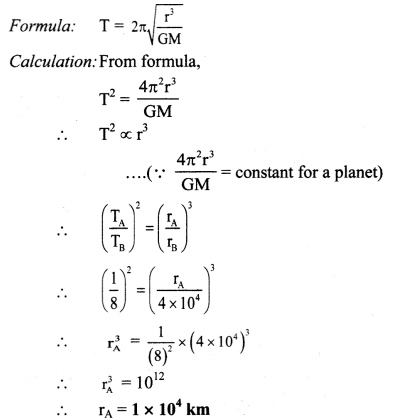
Given: TA = 1 hour, TB = 8 hour, rB = 4 × 10⁴ km To find: Radius of orbit of satellite A (rA) Radius of orbit of satellite A will be 1 × 10⁴ km.
Solution & Step-by-Step Answer:
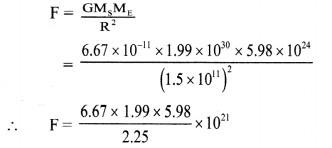
Given: MS = 1.99 × 1030 kg ME = 5.98 × 1024 kg, R = 1.5 × 10¹¹ m. To find: Gravitational force between the Sun and the Earth (F) Formula: F = Calculation:As, we know, G = 6.67 × 10⁻¹¹ N m2/kg2 From formula, = antilog {(log(6.67) + log( 1.99) + log(5.98) – log(2.25)} × 1021 = antilog {(0.8241) + (0.2989) + (0.7767) – (0.3522)} × 1021 = antilog {1.5475} × 1021 = 35.28 × 1021 = 3.5 × 10²² N The gravitational force between the Sun and the Earth is 3.5 × 10²² N.
Solution & Step-by-Step Answer:
Given: h = 300 km = 0.3 × 10⁶ m, M = 5.98 × 1024 kg, R = 6400km = 6.4 × 10⁶ m G = 6.67 × 10⁻¹¹ Nm2/kg2 To find: Acceleration due to gravity at height (gh) Formula: gh =
Calculation: From formula,
gh=
=
6.67 X 10” x 5.98 X iO
= antilog {log(6.67) + log(5.98) – 2log(6.7)} × 10
= antilog{0.8241 + 0.7767 – 2(0.8261)} × 10
= antilog {1.6008 – 1.6522} × 10
= antilog {.9486} × 10
= 0.8884 × 10 = 8.884 m/s2
Acceleration due to gravity at 300 km will be 8.884 m/s2.
Solution & Step-by-Step Answer:
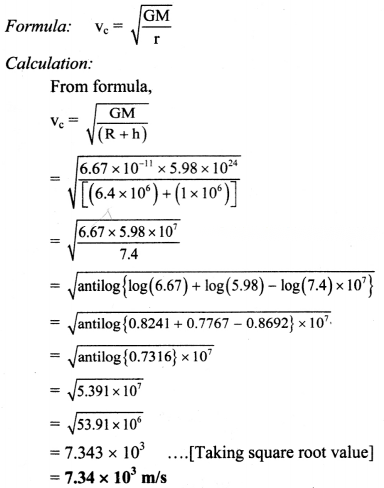
Given: h = 1000 km = 1 × 10⁶ m, ME = 5.98 × 1024 kg, R = 6.4 × 10⁶ m, G = 6.67 × 10⁻¹¹ N m2/kg2 To find: Speed of satellite (vc) Speed of the satellite at height 1000 km is 7.34 × 10³ m/s.
Solution & Step-by-Step Answer:
Given: M = 6.4 × 10²³ kg R = 3.4 × 103 = 3.4 × 10⁶ m, To find: Acceleration due to gravity on the surface of the Mars (gM) Formula: g = Calculation: As, G = 6.67 × 10⁻¹¹ N m2/kg2 From formula, gM = = antilog {log(6.67) + log(6.4) – log(3.4) – log(3.4)} = antilog {(0.8241) + (0.8062) – (0.5315) – (0.53 15)} = antilog {0.5673} = 3.693 m/s2 Acceleration due to gravity on the surface of Mars is 3.693 m/s2.
Solution & Step-by-Step Answer:
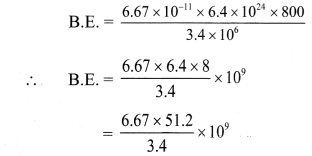
Given: M = 6.4 × 1024 kg, R = 3.4 × 10⁶ m, m = 800 kg To find: Energy required to remove the object from surface of planet to infinity = B.E. Formula: B.E. = Calculation: We know that, G = 6.67 × 10⁻¹¹ N m2/kg2 From formula, = antilog{log(6.67) + log(51.2) – log(3.4)} × 109 = antilog{0.8241 + 1.7093 – 0.5315} × 109 = antilog {2.0019} × 109 = 1.004 × 102 × 109 = 1.004 × 10¹¹ J Energy required to remove the object from the surface of the planet is 1.004 × 10¹¹ J. [Note: Answer calculated above ¡s in accordance with retual methods of calculation.]
Solution & Step-by-Step Answer:
Given: M = 6 × 1024 kg, R = 6400km = 6.4 × 10⁶ m, g = 9.8 m/s2 To find: Gravitational constant (G) Formula. g = Calculation: From formula, G = G = ∴ G = 6.69 × 10⁻¹¹ N m2/kg2 The value of gravitational constant is 6.69 × 10⁻¹¹ N m2/kg2.
Solution & Step-by-Step Answer:
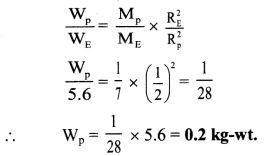
Given: WE = 5.6 kg-wt., = 2 To find: Weight of the body on the surface of planet (Wp) Formula: W = mg = Calculation: From formula, Weight of the body on the surface of a planet will be 0.2 kg-wt. [Note: The answer given above is calculated in accordance with textual method considering the given data].
Solution & Step-by-Step Answer:
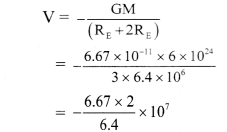
Given: M = 6 × 1024 kg, RE = 6400km = 6.4 × 10⁶ m, G = 6.67 × 10⁻¹¹ Nm2/kg2, h = 2RE To find: Gravitational potential (V) Formula: V = – Calculation: From formula, = -2.08 × 10⁷ J kg-1 Negative sign indicates the attractive nature of gravitational potential. Gravitational potential due to Earth will be 2.08 × 10⁷ J kg-1 towards the centre of the Earth. [Note: According lo definition of gravitational potential its SI unit is J/kg.]
11th Physics Digest Chapter 5 Gravitation Intext Questions and Answers
Can you recall? (Textbook Page No. 78)
Solution & Step-by-Step Answer:
Solution & Step-by-Step Answer:
When released from certain height, objects tend to fall vertically downwards because of the gravitational force exerted by the Earth.