Balbharati Maharashtra State Board11th Commerce Maths Solution Book PdfChapter 9 Differentiation Miscellaneous Exercise 9 Questions and Answers.
Maharashtra State Board 11th Commerce Maths Solutions Chapter 9 Differentiation Miscellaneous Exercise 9
I. Differentiate the following functions w.r.t.x.
Question 1
Maharashtra Board Solution
x5
Solution & Step-by-Step Answer:
Let y = x5 Differentiating w.r.t. x, we get
Question 2
Maharashtra Board Solution
x-2
Solution & Step-by-Step Answer:
Let y = x-2 Differentiating w.r.t. x, we get
Question 3
Maharashtra Board Solution
√x
Solution & Step-by-Step Answer:
Let y = √x Differentiating w.r.t. x, we get
Question 4
Maharashtra Board Solution
x√x
Solution & Step-by-Step Answer:
Let y = x√x ∴ y = Differentiating w.r.t. x, we get
Question 5
Maharashtra Board Solution
Solution & Step-by-Step Answer:
Let y = ∴ y = Differentiating w.r.t. x, we get
Question 6
Maharashtra Board Solution
7x
Solution & Step-by-Step Answer:
Let y = 7x Differentiating w.r.t. x, we get
II. Find if
Question 1
Maharashtra Board Solution
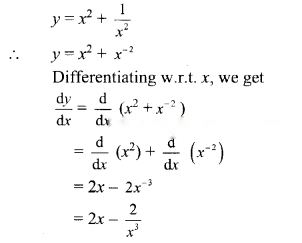
y = x2 +
Solution & Step-by-Step Answer:
Question 2
Maharashtra Board Solution
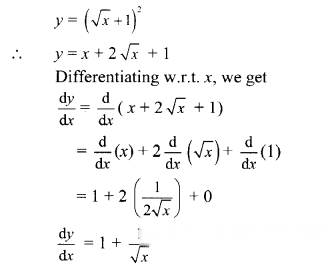
y = (√x + 1)2
Solution & Step-by-Step Answer:
Question 3
Maharashtra Board Solution
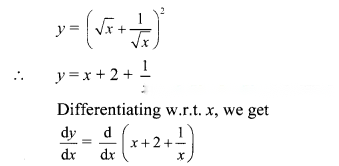
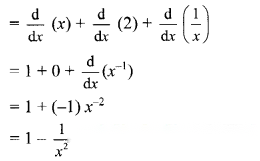
y =
Solution & Step-by-Step Answer:
Question 4
Maharashtra Board Solution
y = x3 – 2x2 + √x + 1
Solution & Step-by-Step Answer:

Question 5
Maharashtra Board Solution
y = x2 + 2x – 1
Solution & Step-by-Step Answer:

Question 6
Maharashtra Board Solution
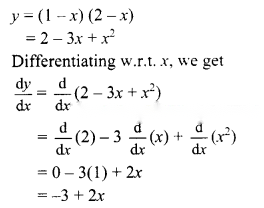
y = (1 – x)(2 – x)
Solution & Step-by-Step Answer:
Question 7
Maharashtra Board Solution
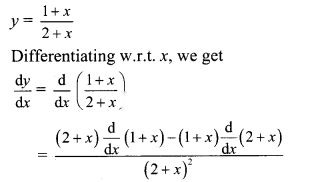
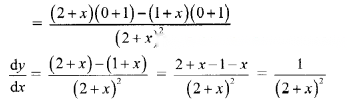
y =
Solution & Step-by-Step Answer:
Question 8
Maharashtra Board Solution
y =
Solution & Step-by-Step Answer:

Question 9
Maharashtra Board Solution
y =
Solution & Step-by-Step Answer:

Question 10
Maharashtra Board Solution
y = x log x (x2 + 1)
Solution & Step-by-Step Answer:

III. Solve the following:
Question 1
Maharashtra Board Solution
The relation between price (P) and demand (D) of a cup of Tea is given by D = . Find the rate at which the demand changes when the price is ₹ 2/-. Interpret the result.
Solution & Step-by-Step Answer:
Demand, D = Rate of change of demand When price P = 2, Rate of change of demand, ∴ When the price is 2, the rate of change of demand is -3. ∴ Here, the rate of change of demand is negative demand would fall when the price becomes ₹ 2.

Question 2
Maharashtra Board Solution
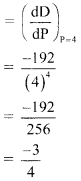
The demand (D) of biscuits at price P is given by D = , find the marginal demand when the price is ₹ 4/-.
Solution & Step-by-Step Answer:
Given demand D = Now, marginal demand When P = 4 Marginal demand

Question 3
Maharashtra Board Solution
The supply S of electric bulbs at price P is given by S = 2p3 + 5. Find the marginal supply when the price is ₹ 5/-. Interpret the result.
Solution & Step-by-Step Answer:
Given, supply S = 2p3 + 5 Now, marginal supply ∴ When p = 5 Marginal supply = = 6(5)2 = 150 Here, the rate of change of supply with respect to the price is positive which indicates that the supply increases.

Question 4
Maharashtra Board Solution
The total cost of producing x items is given by C = x2 + 4x + 4. Find the average cost and the marginal cost. What is the marginal cost when x = 7?
Solution & Step-by-Step Answer:
Total cost C = x2 + 4x + 4 Now. Average cost = = x + 4 + and Marginal cost = (x2 + 4x + 4) = (x2) + 4 (x) + (4) = 2x + 4(1) + 0 = 2x + 4 ∴ When x = 7, Marginal cost = = 2(7) + 4 = 14 + 4 = 18
Question 5
Maharashtra Board Solution
The demand D for a price P is given as D = , find the rate of change of demand when the price is ₹ 3/-.
Solution & Step-by-Step Answer:
Demand, D = Rate of change of demand = When price P = 3, Rate of change of demand, ∴ When price is 3, Rate of change of demand is -3.

Question 6
Maharashtra Board Solution
If for a commodity; the price demand relation is given as D = . Find the marginal demand when price is ₹ 2/-
Solution & Step-by-Step Answer:

Question 7
Maharashtra Board Solution
The price function P of a commodity is given as P = 20 + D – D2 where D is demand. Find the rate at which price (P) is changing when demand D = 3.
Solution & Step-by-Step Answer:
Given, P = 20 + D – D2 Rate of change of price = = (20 + D – D2) = 0 + 1 – 2D = 1 – 2D Rate of change of price at D = 3 is = 1 – 2(3) = -5 ∴ Price is changing at a rate of -5, when demand is 3.
Question 8
Maharashtra Board Solution
If the total cost function is given by C = 5x3 + 2x2 + 1; find the average cost and the marginal cost when x = 4.
Solution & Step-by-Step Answer:
Total cost function C = 5x3 + 2x2 + 1 Average cost = = = 5x2 + 2x + When x = 4, Average cost = 5(4)2 + 2(4) + = 80 + 8 + = = Marginal cost = = (5x3 + 2x2 + 1) = 5 (x3) + 2 (x2) + (1) = 5(3x2) + 2(2x) + 0 = 15x2 + 4x When x = 4, marginal cost = = 15(4)2 + 4(4) = 240 + 16 = 256 ∴ The average cost and marginal cost at x = 4 are and 256 respectively.
Question 9
Maharashtra Board Solution
The supply S for a commodity at price P is given by S = P2 + 9P – 2. Find the marginal supply when the price is 7/-.
Solution & Step-by-Step Answer:
Given, S = P2 + 9P – 2 ∴ The marginal supply is 23, at P = 7.

Question 10
Maharashtra Board Solution
The cost of producing x articles is given by C = x2 + 15x + 81. Find the average cost and marginal cost functions. Find the marginal cost when x = 10. Find x for which the marginal cost equals the average cost.
Solution & Step-by-Step Answer:
Given, cost C = x2 + 15x + 81 If marginal cost = average cost, then 2x + 15 = x + 15 + ∴ x = ∴ x2 = 81 ∴ x = 9 …..[∵ x > 0]
