Balbharati Maharashtra State Board11th Commerce Maths Solution Book PdfChapter 9 Commercial Mathematics Miscellaneous Exercise 9 Questions and Answers.
Maharashtra State Board 11th Commerce Maths Solutions Chapter 9 Commercial Mathematics Miscellaneous Exercise 9
Question 1
Maharashtra Board Solution
A man buys a house for ₹ 10 lakh and rents it. He puts 10% of the annual rent aside for repairs, pays ₹ 1,000 as annual taxes, and realizes 8% on his investment thereafter. Find the annual rent of the house.
Solution & Step-by-Step Answer:
Let ₹ ‘x’ be the annual rent of the house. The man keeps 10% of the annual rent aside for repairs. i.e., × x or ₹ aside tor repairs. In addition, he pays ₹ 1000 as annual taxes. After incurring these expenses he is left with an amount which is 8% of his investment for the house. ∴ The annual rent of the house is ₹ 90,000.

Question 2
Maharashtra Board Solution
Rose got 30% of the maximum marks in an examination and failed by 10 marks. However, Lily who appeared for the same examination got 40% of the total marks and got 15 marks more than the passing marks. What were the passing marks in the examination?
Solution & Step-by-Step Answer:
Let maximum marks be x Rose scored 30% of maximum marks i.e. Rose scored x Rose failed by 10 marks ∴ passing marks = x + 10 …..(i) Lily scored 40% of maximum marks i.e. Lily scored x Lily scored 15 marks more than passing marks ∴ passing marks = x – 15 ……(ii) equating (i) and (ii), + 10 = – 15 ∴ 10 + 15 = ∴ 10x = (25)(100) ∴ x = 250 From (i), passing marks = (250) + 10 = 75 + 10 = 85 ∴ Passing marks for the examination were 85.
Question 3
Maharashtra Board Solution
Ankita’s Salary was reduced by 50%. Again the reduced salary was increased by 50%. Find loss in terms of percentage.
Solution & Step-by-Step Answer:
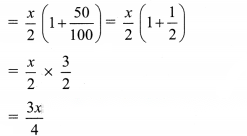
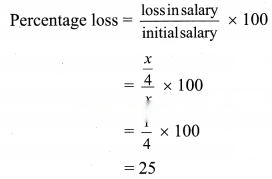
Let Ankita’s initial salary be ₹ ‘x’. Her salary was reduced by 50%. ∴ Ankita’s salary after reduction = x(1 – ) = x(1 – ) = Ankita’s reduced salary was then increased by 50% ∴ Ankita’s final salary after the increase ∴ Loss in Ankita’s salary after the decrease and increase = x – = ∴ Ankita lost 25% of her salary.
Question 4
Maharashtra Board Solution
By selling 300 lunch boxes, a shopkeeper gains the selling price of 100 lunch boxes. Find his gain percent.
Solution & Step-by-Step Answer:
Let ₹ x be the selling price (S.P.) of one lunch box. ∴ S.P. of 300 lunch boxes = 300x and S.P. of 100 lunch boxes = 100x Gain = 100x ……[given] C.P. of 300 lunch boxes = S.P. – Gain = 300x – 100x = 200x ∴ The shopkeeper’s gain percentage is 50%.

Question 5
Maharashtra Board Solution
A salesman sold an article at a loss of 10%. If the selling price has been increased by ₹ 80, there would have been a gain of 10%. What was the cost of the article?
Solution & Step-by-Step Answer:
Let ₹ x be the cost price of the article. S.P. of the article = x – x = …….(i) Given that, S.P. increased by ₹ 80 would have given 10% gain ∴ The cost price of the article is ₹ 400

Question 6
Maharashtra Board Solution
Find the single discount equivalent to a series discount of 10%, 20%, and 15%.
Solution & Step-by-Step Answer:
Let the marked price be ₹ 100 After 1st discount the price = 100(1 – ) = 90 After 2nd discount the price = 90(1 – ) = 72 After 3rd discount the price = 72(1 – ) = 61.2 ∴ The selling price after 3 discounts is ₹ 61.2. ∴ Single equivalent discount = marked price – selling price = 100 – 61.2 = ₹ 38.8 ∴ The single equivalent discount is ₹ 38.8 on ₹ 100. i.e. The single equivalent discount is 38.8%.
Question 7
Maharashtra Board Solution
Reshma put an amount at simple interest at a certain rate for 3 years. Had it been put at 2% higher rate, she would have received ₹ 360 more. Find the sum.
Solution & Step-by-Step Answer:
Let P and R represent the principal amount and rate of interest p.a. respectively. Given duration = T = 3 years Simple interest = Given that, had the amount been kept at 2% more, then the gain would have been ₹ 360 more. ∴ The sum of money is ₹ 6,000.

Question 8
Maharashtra Board Solution
The compound interest on ₹ 30000 at 7% p.a. is ₹ 4347. What is the period in years?
Solution & Step-by-Step Answer:
Given that, Principal (P) = ₹ 30,000 Rate of interest (R) = 7% p.a. Compound interest = ₹ 4,347 Amount after compound interest = = (1.07)2 ∴ T = 2 ∴ Amount is invested for 2 years.

Question 9
Maharashtra Board Solution
The value of the machine depreciates at the rate of 15% p.a. It was purchased 2 years ago. Its present value is ₹ 7,225. What was the purchase price of the machine?
Solution & Step-by-Step Answer:
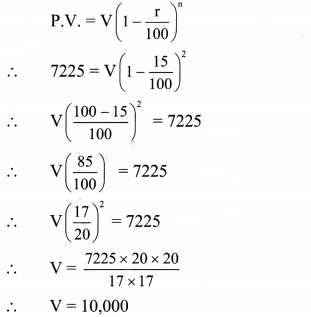
Given, Rate of depreciation = r = 15% Number of years = n = 2 years Present value of machine = P.V. = ₹ 7,225 The purchase price (V) of the machine can be found using ∴ The purchase price of the machine was ₹ 10,000/-.
Question 10
Maharashtra Board Solution
A tree increases annually by of its height. By how much will it increase after 2 years. If its length today is 8 m?
Solution & Step-by-Step Answer:
The height of the tree today is 8m. The height of the tree increases by th of its height every year. At the end of 1st year, height of the tree will be = 8 + × 8 = 9 m And, at the end of the 2nd year, height of the tree will be = 9 + × 9 = 9(1 + ) = 9 × = After six more months, the height of the tree will be ∴ Increase in the height of the tree after 2 years = 10.75 – 8 = 2.75 m.

Question 11
Maharashtra Board Solution
A building worth ₹ 1,21,000 is constructed on land worth ₹ 81,000. After how many years will the value of both be the same if land appreciates at 10% p.a and buildings depreciate at 10% p.a.
Solution & Step-by-Step Answer:
Given, Value of the building = V.B. = ₹ 1,21,000 Value of land = V.L. = ₹ 81,000/- Rate of appreciation of land = rate of depreciation of building = r = 10%. For the value of building and land to be the same. ∴ n = 2 years. ∴ After two years value of the building and land will be the same.

Question 12
Maharashtra Board Solution
Varun invested 25%, 30%, and 20% of his savings in buying shares of three different companies, ‘A’, ‘B’, and ‘C’ which declared dividends, 10%, 12%, and 15% respectively. If his total income on account of dividends is ₹ 6,370/-, find the amount he invested in buying shares of company ‘B’.
Solution & Step-by-Step Answer:
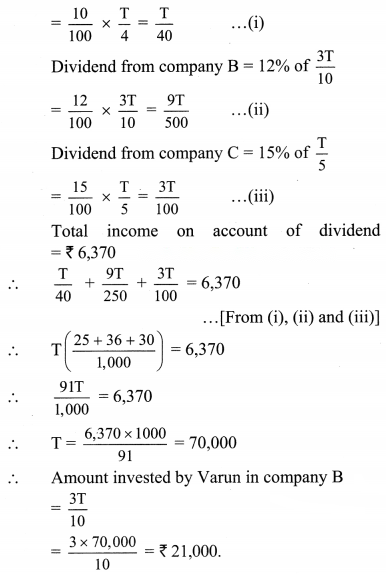
Let ‘T’ be Varan’s total savings. ∴ Investment of Varan in: Company A = 25% of T = × T = , Company B = 30% of T = × T = , Company C = 20% of T = × T = Company A, B and C declared dividends 10%, 12% and 15% respectively. ∴ Dividend from company A = 10% of ∴ Varan invested ₹ 21,000 in company B.
Question 13
Maharashtra Board Solution
Find the annual dividend received from ₹ 25,000, 8% stock at ₹ 108.
Solution & Step-by-Step Answer:
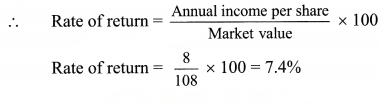
Amount invested = ₹ 25,000 Dividend = 8% Assuming face value F.V. as ₹ 100 Annual income per share = = × 100 = ₹ 8 Market value of the share M.V. = ₹ 108 Annual dividend on amount invested = Rate of return × amount invested = × 25,000 = ₹ 1850 ∴ Annual dividend of ₹ 1,850 is received from 8% stock at ₹ 108. Alternate approach Assuming ₹ 25,000 as the total face value of all the shares. Since the dividend is 8%, Annual dividend = × 25,000 = ₹ 2,000
Question 14
Maharashtra Board Solution
A, B, and C enter into a partnership. A invests 3 times as much as B invests and B invests two-thirds of what ‘C’ invests. At the end of the year, the profit earned is ₹ 8,800. What is the share of ‘B’?
Solution & Step-by-Step Answer:
Let ‘a’, ‘b’ and ‘c’ be the amounts invested by A, B and C respectively. Given that, A invests 3 times as much as B and B invests two third of what ‘C’ invests. ∴ a = 3b and b = c ∴ and or and ∴ a : b = 6 : 2 and b : c = 2 : 3 ∴ a : b : c = 6 : 2 : 3 Given that profit earned = ₹ 8800 ∴ Share of ‘B’ in profit = × 8800 = ₹ 1600 ∴ B’share in profit is ₹ 1600.
Question 15
Maharashtra Board Solution
The ratio of investment of two partners Santa and Banta is 11 : 12 and the ratio of their profits is 2 : 3. If Santa invested the money for 8 months, then for how much time did Banta his money?
Solution & Step-by-Step Answer:
Let ‘x’ be the time in months for which Banta invested his money Santa and Banta invested their money in the ratio 11 : 12. Santa invested his money for 8 months and the ratio of their profits is 2 : 3. ∴ 11 × 8 : 12 × x = 2 : 3 ∴ ∴ x = ∴ x = 11 ∴ Banta invested his money for 11 months.
Question 16
Maharashtra Board Solution
Akash, Sameer, and Sid took a house on rent for one year for ₹ 16,236. They stayed together for 4 months and then Sid left the house. After 5 more months, Sameer also left the house. How much rent should each pay?
Solution & Step-by-Step Answer:
Let ‘R’ be the rent per month to be paid to the landlord. Given that, Sid left the house after 4 months ∴ Rent paid by Sid = × 4 = Sameer left the house after another 5 months, ∴ Rent paid by Sameer = × 5 + × 4 = R() = Akash stayed in the house for the entire year. ∴ Rent paid by Akash = 3R + × 5 + × 4 = R(3 + ) = ∴ The rent paid by the three of them, over that period of one year must be in the proportion. i.e. in the proportion 41 : 23 : 8 …..(multiplying throughout by ) Let x be the constant of proportionality. Rent to be paid by Akash = ₹ 41x Rent to be paid by Sameer = ₹ 23x and rent to be paid by Sid = ₹ 8x The total rent for the house was ₹ 16236. ∴ 41x + 23x + 8x = ₹ 16236 ∴ 72x = 16236 ∴ x = 225.5 ∴ Akash should pay 41x = 41 × 225.5 = ₹ 9245.5 Sameer should pay 23x = 23 × 225.5 = ₹ 5186.5 and Sid should pay 8x = 8 × 225.5 = ₹ 1804
Question 17
Maharashtra Board Solution
Ashwin Auto Automobiles sold 10 motorcycles. Total sales amount was ₹ 6,80,000. 18% GST is applicable. Calculate how much CGST and SGST the firm has to pay.
Solution & Step-by-Step Answer:
Given, total sales amount for Ashwin Automobiles was ₹ 6,80,000. 18% GST is applicable. ∴ GST payable = 18% of 6,80,000 = × 6,80,000 = ₹ 1,22,400 Now CGST = SGST = 9% = = = ₹ 61,200 ∴ CGST = SGST = ₹ 61,200
Question 18
Maharashtra Board Solution
‘Sweet 16’ A ready made garments shop for Women’s garments, purchased stock for ₹ 4,00,000 and sold that stock for ₹ 5,50,000 (12% GST is applicable) Find, (i) Input Tax Credit (ii) CGST and SGST paid by the firm.
Solution & Step-by-Step Answer:
Given that, stock purchased by ‘Sweet 16’ was worth ₹ 4,00,000 GST applicable is 12%. ∴ Input tax = 12% of 4,00,000 = × 4,00,000 = ₹ 48,000 ∴ Input tax Credit (ITC) = ₹ 48,000 The garment stock was sold for ₹ 5,50,000 Output tax = 12% of 5,50,000 = × 5,50,000 = ₹ 66,000 ∴ GST payable = output tax – ITC = 66,000 – 48,000 = ₹ 18,000 ∴ CGST = SGST = = ₹ 9,000