Balbharati Maharashtra State Board11th Commerce Maths Solution Book PdfChapter 9 Commercial Mathematics Ex 9.7 Questions and Answers.
Maharashtra State Board 11th Commerce Maths Solutions Chapter 9 Commercial Mathematics Ex 9.7
Solution & Step-by-Step Answer:
(i) For firm 1: Face value of the share (F.V.) = ₹ 10 Market value of the share (M.V.) = ₹ 13 Dividend = 5% ∴ Annual income from the share = × 10 = ₹ 0.5 For firm 2: Face value of the share (F.V.) = ₹ 10 Market value of the share (M.V.) = ₹ 16 Dividend = 5% ∴ Annual income from the share = × 10 = ₹ 0.6 Since, the profit percentage from firm 1 > profit percentage from firm 2, the first firm is paying better.
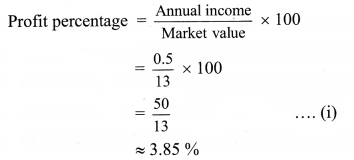

(ii) Let ‘X’ be the amount Shantanu invests in each of the firms.
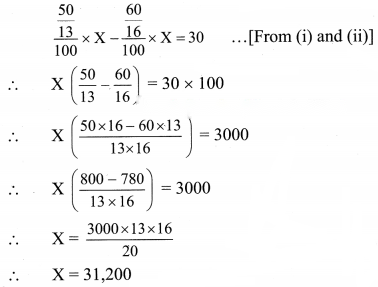
Given that difference between the return from them is ₹ 30, we have
In all, Shantanu invests = 2X
= 2 × 31,200
= ₹ 62,400/-
Solution & Step-by-Step Answer:
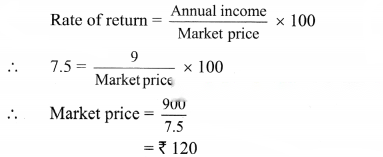
(i) Given that, Face value of the share (F.V) = ₹ 100 Dividend = 9% Rate of return = 7.5% Annual income from the share = × 100 = ₹ 9 ∴ The market price of the share is ₹ 120.
(ii) Let ‘X’ be the amount to be invested to obtain an annual dividend of ₹ 630.
∴ 7.5% of X is ₹ 630
∴ × X = 630
∴ X =
∴ X = 8400
∴ ₹ 8400 need to be invested to obtain an annual dividend of ₹ 630.
Solution & Step-by-Step Answer:
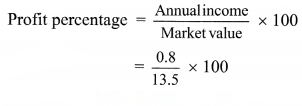
For share 1: Face value of the share (F.V.) = ₹ 10 Premium = ₹ 3.5 ∴ Market value of the share (M.V.) = 10 + 3.5 = ₹ 13.5 Dividend = 8 % ∴ Annual income from the share = × 10 = ₹ 0.8 = = 5.93%
For share 2:
Face value of the share (F.V.) = ₹ 100
Premium = 20%
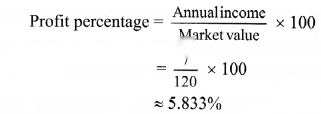
∴ Market value of the share (M.V.) = 100 + ( × 100) = ₹ 120
Dividend = 7%
Annual income from the share = × 100 = ₹ 7
Since, profit percentage from share 1 > profit percentage from share 2, investing in the first kind of shares will be more profitable for Nilesh.
Solution & Step-by-Step Answer:
Given that, Face value of the share (F.V.) = ₹ 24 Premium = 12% ∴ Market value of the share (M.V.) = 24 + ( × 24) = ₹ 26.88 (i) Sudhakar invests ₹ 1344 in the shares ∴ Number of shares purchased by Sudhakar = = 50 ∴ Sudhakar buys 50 shares. (ii) Dividend on the share = 15% Annual income on one share = × 24 = ₹ 3.6 ∴ The total dividend he receives annually = 50 × 3.6 = ₹ 180 ∴ Sudhakar receives ₹ 180 as his annual dividend.
Solution & Step-by-Step Answer:
Given: Face value of the share (F.V.) = ₹ 10 Market value of the share (M.V.) = ₹ 12.5 Amount invested in shares = ₹ 5625 ∴ Number of shares purchased by Sameer = = 450 Dividend = 7% Annual income from one share = × 10 = ₹ 0.7 ∴ Sameer’s income from this investment = number of shares × annual income from one share = 450 × 0.7 = ₹ 315 Sameer sells 60 % of these shares = × 450 = 270 shares Sameer purchased these shares at ₹ 12.5 per share. ∴ Purchase price for these shares = 270 × 12.5 = ₹ 3375 If he sells these shares at ₹ 10 per share, he would receive 270 × 10 = ₹ 2700 ∴ In this transaction, Sameer would incur a loss of 3375 – 2700 = ₹ 675
Solution & Step-by-Step Answer:
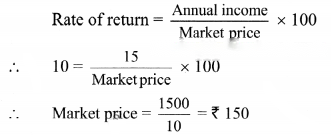
Given that, Face value of the share (F.V.) = ₹ 100 Dividend = 15% ∴ Annual income from the share = × 100 = ₹ 15 Rate of return on investment = 10% ∴ Geeta bought each share from the market at ₹ 150.
Solution & Step-by-Step Answer:
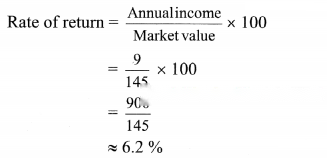
Investment of Tejas: Given that, the Face value of the share (F.V.) = ₹ 100 The market value of the share (M.V.) = ₹ 145 Dividend = 9% Annual income from the share = × 100 = ₹ 9
Investment of Shail:
Face value of the share (F.V.) = ₹ 100
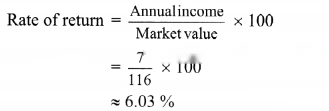
Market value of the share (M.V.) = ₹ 116
Dividend = 7%
Annual income from the share = × 100 = ₹ 7
Since the rate of return for Tejas’s investment is greater than that for Shail’s, Tejas’s investment is better.
Solution & Step-by-Step Answer:
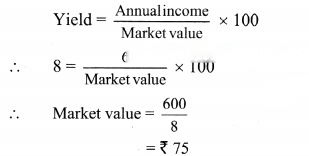
Given that, Face value of the share = ₹ 100 Dividend = 6% Yield = 8% Annual income on the share = × 100 = ₹ 6 ∴ The market value of the share = ₹ 75
Solution & Step-by-Step Answer:
Given, Face value of the shares (F.V.) = ₹ 40 Premium = 40% Market value of the shares (M.V.) = 40 + (40 × ) = 40 + 16 = ₹ 56 Ashwini invests ₹ 14000 in these shares ∴ Number of shares bought by Ashwini = = = 250 Dividend = 8% ∴ Annual income on one share = × 40 = ₹ 3.2 ∴ Income of Ashwini on 250 shares = 250 × 3.2 = ₹ 800 ∴ Ashwini earns ₹ 800 on her investment.
Solution & Step-by-Step Answer:
Given that, Face value of a share (F.V.) = ₹ 100 Premium = ₹ 50 ∴ Market value of a share (M.V.) = 100 + 50 = ₹ 150 Dividend =12% Mr. Rutvik invests ₹ 30,000 in the shares. (i) Number of shares bought by Mr. Rutvik = = = 200
(ii) Dividend on the share = 12%
∴ Annual income from one share = × 100 = ₹ 12
∴ His annual income from shares = number of shares × income from one share
= 200 × 12
= ₹ 2400
Solution & Step-by-Step Answer:
Given, Face value of the shares (F.V.) = ₹ 40 Discount = 40% ∴ Market value of the shares (M.V.) = 40 – (40 × ) = 40 – 16 = ₹ 24 Rasika invests ₹ 12,000 in these shares. ∴ Number of shares bought by Rasika = = = 500 Dividend = 11% ∴ Annual income on one share = × 40 = ₹ 4.4 ∴ Rasika’s income on 200 such shares = 500 × 4.4 = ₹ 2200 ∴ Rasika earns ₹ 2200 from her investment.
Solution & Step-by-Step Answer:
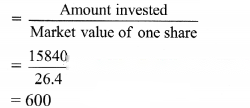
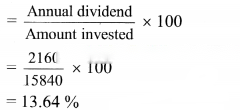
Given that, Face value of the share (F.V.) = ₹ 24 Premium = 10% ∴ Market value of the share (M.V.) = 24 + (24 × ) = 24 + 2.4 = ₹ 26.4 Dividend = 15% ∴ Annual income on the share = × 24 = ₹ 3.6 Nisha invests ₹ 15,840 in these shares. ∴ Number of shares bought by Nisha (i) Annual dividend received by Nisha = Number of shares × annual income from one share = 600 × 3.6 = ₹ 2160
(ii) Rate of return from the investment
Solution & Step-by-Step Answer:
Given Face value of the shares (F.V.) = ₹ 100 Discount = 20% ∴ Market value of the shares (M.V.) = 100 – (100 × ) = ₹ 80 (i) Amount invested by Ashutosh = number of shares × market value of the shares = 80 × 80 = ₹ 6400
(ii) Ashutosh receives a return of 12% on his money.
∴ Ashutosh’s income from shares = × 6400 = ₹ 768
∴ Ashutosh’s annual income from one share = = ₹ 9.6
Annual income from one share =
∴ 9 6 =
∴ Rate of dividend = 9.6%
Solution & Step-by-Step Answer:
Given that, Face value of the shares (F.V.) = ₹ 100 The market value of the shares (M.V.) = ₹ 130 Dividend = 8% Income from the each share = × 100 = ₹ 8 Number of shares bought by Vaishnavi = 1000 ∴ Vaishnavi’s income from dividend = 1000 × 8 = ₹ 8000 The price of the shares went up by 10% New market value of the shares = 130 + (130 × ) = ₹ 143 Vaishnavi sold the shares at ₹ 143 which she bought at ₹ 130 each. ∴ Vaishnavi’s profit on one share =143 – 130 = ₹ 13 ∴ Vaishnavi’s profit after selling all her shares =1000 × 13 = ₹ 13,000 Vaishnavi’s total income from this transaction = Income from dividend + income from sale of shares = 8,000 + 13,000 = ₹ 21,000 ∴ Vaishnavi’s total income from this transaction was ₹ 21,000.
Solution & Step-by-Step Answer:
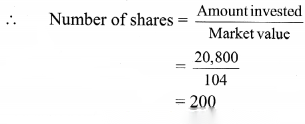
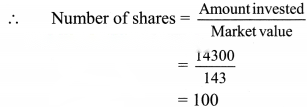
For 1st kind of shares, Face value of shares (F.V.) = ₹ 100 Dividend = 6% ∴ Annual income from one share = × 100 = ₹ 6 Market value of the share (M.V.) = ₹ 104 Total amount invested = ₹ 20,800 ∴ Total income from 1st kind of shares = 200 × 6 = ₹ 1200 For 2nd kind of shares, Face value of shares (F.V.) = ₹ 100 Dividend = 10.5% ∴ Annual income from one share = × 100 = ₹ 10.5 Market value of the share (M.V.) = ₹ 143 Total amount invested = ₹ 14300 ∴ Total income from 2nd kind of shares = 100 × 10.5 = ₹ 1050 ∴ Total annual income of Dinesh from both these shares = 1200 + 1050 = ₹ 2250
Solution & Step-by-Step Answer:
Given that, Semi-annual dividend = 5% ∴ Annual dividend = 10% Number of shares with Daniel = 400 Daniel’s annual income from the shares = ₹ 1000 ∴ Annual income from one share = = ₹ 2.5 But annual income from one share = ∴ 2.5 = × Face value of the share ∴ Face value of the share = ₹ 25
Solution & Step-by-Step Answer:
Given that, Face value of the shares (F.V.) = ₹ 20 Premium = ₹ 4 ∴ Market value of the shares (M.V.) = ₹ 24 Dividend = 12% ∴ Annual income from the share = × 20 = ₹ 2.4 Bhargav buys 400 shares (i) The amount invested by Bhargav = number of shares × market value = 400 × 24 = ₹ 9600
(ii) Bhargav’s income from the shares = number of shares × annual income from one share
= 400 × 2.4
= ₹ 960
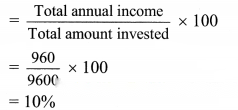
(iii) Percentage return on Bhargav’s money
∴ Bhargav gets 10% as the rate of return on his money.
Solution & Step-by-Step Answer:
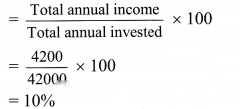
Given that, Face value of shares (F.V.) = ₹ 100 Premium = 20% ∴ Market value of shares (M.V.) = 100 + ( × 100) = ₹ 120 Dividend = 12% ∴ Annual income from one share = × 100 = ₹ 12 Anil buys 350 shares. (i) Amount invested by Anil = number of shares × market value = 350 × 120 = ₹ 42,000
(ii) Anil’s annual income from the shares = number of shares × annual income from one share
= 350 × 12
= ₹ 4200
(iii) Rate of return from shares
∴ The rate of return from Anil’s shares is 10%.