Balbharati Maharashtra State Board11th Commerce Maths Solution Book PdfChapter 7 Probability Ex 7.4 Questions and Answers.
Maharashtra State Board 11th Commerce Maths Solutions Chapter 7 Probability Ex 7.4
Solution & Step-by-Step Answer:
When two dice are thrown simultaneously, the sample space is S = {(1, 1), (1, 2), (1, 3), (1, 4), (1, 5), (1, 6), (2, 1), (2, 2), (2, 3), (2, 4), (2, 5), (2, 6), (3, 1), (3, 2), (3, 3), (3, 4), (3, 5), (3, 6), (4, 1), (4, 2), (4, 3), (4, 4), (4, 5), (4, 6), (5, 1), (5, 2), (5, 3), (5, 4), (5, 5), (5, 6), (6, 1), (6, 2), (6, 3), (6, 4), (6, 5), (6, 6)} ∴ n(S) = 36 Let A be the event that at least one die shows number 5. ∴ A = {(1, 5), (2, 5), (3, 5), (4, 5), (5, 1), (5, 2), (5, 3), (5, 4), (5, 5), (5, 6), (6, 5)} ∴ n(A) = 11 ∴ P(A) = Let B be the event that sum of the numbers on two dice is 9. ∴ B = {(3, 6), (4, 5), (5, 4), (6, 3)} Also, A ∩ B = {(4, 5), (5, 4)} ∴ n(A ∩ B) = 2 ∴ P(A ∩ B) = ∴ Probability of sum of numbers on two dice is 9, given that one dice shows number 5, is given by P(B/A) =
Solution & Step-by-Step Answer:
When two dice are thrown simultaneously, the sample space is S = {(1, 1), (1, 2), (1, 3), (1, 4), (1, 5), (1, 6), (2, 1), (2, 2), (2, 3), (2, 4), (2, 5), (2, 6), (3, 1), (3, 2), (3, 3), (3, 4), (3, 5), (3, 6), (4, 1), (4, 2), (4, 3), (4, 4), (4, 5), (4, 6), (5, 1), (5, 2), (5, 3), (5, 4), (5, 5), (5, 6), (6, 1), (6, 2), (6, 3), (6, 4), (6, 5), (6, 6)} ∴ n(S) = 36 Let A be the event that sum of the numbers is an even number. ∴ A = {(1, 1), (1, 3), (1, 5), (2, 2), (2, 4), (2, 6), (3, 1), (3, 3), (3, 5), (4, 2), (4, 4), (4, 6), (5, 1), (5, 3), (5, 5), (6, 2), (6, 4), (6, 6)} ∴ n(A) = 18 ∴ P(A) = Let B be the event that sum of outcomes is a perfect square. ∴ B = {(1, 3), (2, 2), (3, 1), (3, 6), (4, 5), (5, 4), (6, 3)} Also, A n B= {(1, 3), (2, 2), (3, 1)} ∴ n(A ∩ B) = 3 ∴ P(A ∩ B) = ∴ Probability of sum of the numbers is a perfect square, given that sum of numbers is an even number, is given by P(B/A) =
Solution & Step-by-Step Answer:
Two tickets can be drawn from 11 tickets with replacement in 11 × 11 = 121 ways. ∴ n(S) = 121 Let A be the event that the sum of two numbers is even. The event A occurs, if either both the tickets with odd numbers or both the tickets with even numbers are drawn. There are 6 odd numbers (1, 3, 5, 7, 9, 11) and 5 even numbers (2, 4, 6, 8, 10) from 1 to 11. ∴ n(A) = 6 × 6 + 5 × 5 = 36 + 25 = 61 ∴ P(A) = Let B be the event that the numbers tickets drawn are odd ∴ n(B) = 6 × 6 = 36 ∴ P(B) = Since 6 odd numbers are common between A and B. ∴ n(A ∩ B) = 6 × 6 = 36 ∴ P(A ∩ B) = ∴ Probability of both the numbers are odd, given that sum is even, is given by P(B/A) =
Solution & Step-by-Step Answer:
One card can be drawn out of 52 cards in 52C1 ways. ∴ n(S) = 52C1 Let A be the event that a club card is drawn. 1 club card out of 13 club cards can be drawn in 13C1 ways. ∴ n(A) = 13C1 ∴ P(A) = Let B be the event that an ace card is drawn. An ace card out of 4 aces can be drawn in 4C1 ways. ∴ n(B) = 4C1 ∴ P(B) = Since 1 card is common between A and B ∴ n(A ∩ B) = 1C1 ∴ P(A ∩ B) = …….(i) ∴ P(A) × P(B) = …….(ii) From (i) and (ii), we get P(A ∩ B) = P(A) × P(B) ∴ A and B are independent events.
Solution & Step-by-Step Answer:
Let A be the event that student A can solve the problem. B be the event that student B can solve the problem. C be the event that student C can solve problem. ∴ P(A) = , P(B) = , P(C) = ∴ P(A’) = 1 – P(A) = 1 – = P(B’) = 1 – P(B) = 1 – = P(C’) = 1 – P(C) = 1 – = Since A, B, C are independent events ∴ A’, B’, C’ are also independent events (i) Let X be the event that problem is solved. Problem can be solved if at least one of the three students solves the problem. P(X) = P(at least one student solves the problem) = 1 – P(no student solved problem) = 1 – P(A’ ∩ B’ ∩ C’) = 1 – P(A’) P(B’) P(C’) = 1 – = 1 – =
(ii) Let Y be the event that problem is not solved
∴ P(Y) = P(A’ ∩ B’ ∩ C’)
= P(A’) P(B’) P(C’)
=
=
(iii) Let Z be the event that exactly two students solve the problem.
∴ P(Z) = P(A ∩ B ∩ C’) ∪ P(A ∩ B’ ∩ C) ∪ P(A’ ∩ B ∩ C)
= P(A). P(B). P(C’) + P(A). P(B’). P(C) + P(A’). P(B). P(C)
=
=
=
Solution & Step-by-Step Answer:
Let A be the event that man will be alive at 60. ∴ P(A) = 0.83 Let B be the event that a woman will be alive at 55. ∴ P(B) = 0.97 A ∩ B = Event that both will be alive. Also, A and B are independent events ∴ P(both man and his wife will be alive) = P(A ∩ B) = P(A). P(B) = 0.83 × 0.97 = 0.8051
Solution & Step-by-Step Answer:
Let A be the event that the student failed in Subject I B be the event that the student failed in Subject II Then P(A) = 30% = P(B) = 20% = and P(A ∩ B) = 10% = (i) P (student failed in Subject I, given that he has failed in Subject II) = P(A/B)
(ii) P(student failed in at least one subject) = P(A ∪ B)
= P(A) + P(B) – P(A ∩ B)
=
= 0.40
(iii) P(student failed in exactly one subject) = P(A) + P(B) – 2P(A ∩ B)
=
= 0.30
Solution & Step-by-Step Answer:
A be the event that first gun hits the target B be the event that second gun hits the target C be the event that third gun hits the target P(A) = 0.5, P(B) = 0.6, P(C) = 0.8 ∴ P(A’) = 1 – P(A) = 1 – 0.5 = 0.5 ∴ P(B’) = 1 – P(B) = 1 – 0.6 = 0.4 ∴ P(C’) = 1 – P(C) = 1 – 0.8 = 0.2 Now A, B, C are independent events ∴ A’, B’, C are also independent events. ∴ P (at least one hit is registered) = 1 – P(no hit is registered) = 1 – P(A’ ∩ B’ ∩ C’) = 1 – P(A’) P(B’) P(C’) = 1 – (0.5) (0.4) (0.2) = 1 – 0.04 = 0.96
Solution & Step-by-Step Answer:
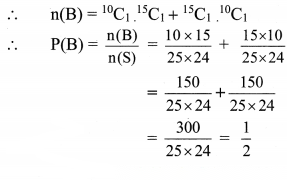
Total number of balls = 10 + 15 = 25 Let S be an event that two balls are drawn at random without replacement in succession ∴ n(S) = 25C1 × 24C1 = 25 × 24 (i) Let A be the event that the first ball is white and the second is black. First white ball can be drawn from 10 white balls in 10C1 ways and second black ball can be drawn from 15 black balls in 15C1 ways. ∴ n(A) = 10C1 × 15C1 ∴ P(A) =
Solution & Step-by-Step Answer:
Total number of balls in the urn = 4 + 5 + 6 = 15 Two balls can be drawn without replacement in 15C2 = = 105 ways ∴ n(S) = 105 Let A be the event that at least one ball is black i.e., 1 black and 1 non-black or 2 black and 0 non-black. 1 black ball can be drawn out of 4 black balls in 4C1 = 4 ways and 1 non-black ball can be drawn out of remaining 11 non-black balls in 11C1 = 11 ways ∴ 1 black and 1 non black ball can be drawn in 4 × 11 = 44 ways Also, 2 black balls can be drawn from 4 black balls in 4C2 = = 6 ways ∴ n(A) = 44 + 6 = 50 ∴ Required probability = P(A) = =
Alternate Solution:
Total number of balls = 15
Required probability = 1 – P(neither of two balls is black)
Balls are drawn without replacement
Probability of first non-black ball drawn =
Probability of second non-black ball drawn =
Probability of neither of two balls is black =
Required probability = 1 – =
Solution & Step-by-Step Answer:
Total number of balls in the urn = 5 + 3 + 7 = 15 Out of these 12 are non-blue balls. Two balls can be drawn from 15 balls without replacement in 15C2 = = 105 ways. ∴ n(S) = 105 Let A be the event that at least one ball is blue, i.e., 1 blue and other non-blue or both are blue. ∴ n(A) = 3C1 × 12C1 + 3C2 = 3 × 12 + 3 = 36 + 3 = 39 ∴ P(A) =
Alternate solution:
Total number of balls in the urn = 15
Required probability = 1 – P(neither of two balls is blue)
Balls are drawn one by one without replacement.
Probability of first non-blue ball drawn =
Probability of second non-blue ball drawn =
Probability of neither of two ball is blue =
∴ Required probability = 1 – =
Solution & Step-by-Step Answer:
Let A be the event that a blue ball is drawn from each bag. Probability of drawing one blue ball out of 4 blue balls where there are a total of 9 balls in the first bag and that of drawing one blue ball out of 3 blue balls where there are a total of 10 balls in the second bag is P(A) = Let B be the event that a green ball is drawn from each bag. Probability of drawing one green ball out of 5 green balls where there are a total of 9 balls in the first bag and that of drawing one green ball out of 7 green balls where there are a total of 10 balls in the second bag is P(B) = Since both, the events are mutually exclusive and exhaustive events ∴ P(that both the balls are of the same colour) = P(both are of blue colour) or P(both are of green colour) = P(A) + P(B) = = =
Solution & Step-by-Step Answer:
Two cards are drawn from a pack of 52 cards with replacement. ∴ n(S) = 52 × 52 Let A be the event that two cards drawn are face cards. First card from 12 face cards is drawn with replacement in 12C1 = 12 ways and second face card is drawn from 12 face card in 12C1 = 12 ways after replacement. ∴ n(A) = 12 × 12 ∴ P(that both the cards drawn are face cards) = P(A) =