Balbharati Maharashtra State Board11th Commerce Maths Solution Book PdfChapter 7 Probability Ex 7.3 Questions and Answers.
Maharashtra State Board 11th Commerce Maths Solutions Chapter 7 Probability Ex 7.3
Solution & Step-by-Step Answer:
When two dice are thrown, the sample space is S = {(1, 1), (1, 2), (1, 3), (1, 4), (1, 5), (1, 6), (2, 1), (2, 2), (2, 3), (2, 4), (2, 5), (2, 6), (3, 1), (3, 2), (3, 3), (3, 4), (3, 5), (3, 6), (4, 1), (4, 2), (4, 3), (4, 4), (4, 5), (4, 6), (5, 1), (5, 2), (5, 3), (5, 4), (5, 5), (5, 6), (6, 1), (6, 2), (6, 3), (6, 4), (6, 5), (6, 6)} ∴ n(S) = 36 Let A be the event that sum of numbers on two dice is 5. ∴ A = {(1, 4), (2, 3), (3, 2), (4, 1)} ∴ n(A) = 4 ∴ P(A) = Let B be the event that number on second die is greater than or equal to number on first die. B = {(1, 1), (1, 2), (1, 3), (1, 4), (1, 5), (1, 6), (2, 2), (2, 3), (2, 4), (2, 5), (2, 6), (3, 3), (3, 4), (3, 5), (3, 6), (4, 4), (4, 5), (4, 6), (5, 5), (5, 6), (6, 6)} ∴ n(B) = 21 ∴ P(B) = Now, A ∩ B = {(1, 4), (2, 3)} ∴ n(A ∩ B) = 2 ∴ P(A ∩ B) = ∴ Required probability = P(A ∪ B) P(A ∪ B) = P(A) + P(B) – P(A ∩ B) = =
Solution & Step-by-Step Answer:
One card can be drawn from the pack of 52 cards in 52C1 = 52 ways ∴ n(S) = 52 Also, the pack of 52 cards consists of 26 red and 26 black cards. (i) Let A be the event that a red card is drawn Red card can be drawn in 26C1 = 26 ways ∴ n(A) = 26 ∴ P(A) = Let B be the event that a black card is drawn ∴ Black card can be drawn in 26C1 = 26 ways. ∴ n(B) = 26 ∴ P(B) = Since A and B are mutually exclusive and exhaustive events ∴ P(A ∩ B) = 0 ∴ required probability = P(A ∪ B) ∴ P(A ∪ B) = P(A) + P(B) = = = 1
(ii) Let A be the event that a red card is drawn
∴ red card can be drawn in26C1= 26 ways
∴ n(A) = 26
∴ P(A) =
Let B be the event that a face card is drawn There are 12 face cards in the pack of 52 cards
∴ 1 face card can be drawn in12C1= 12 ways
∴ n(B) = 12
∴ P(B) =
There are 6 red face cards.
∴ n(A ∩ B) = 6
∴ P(A ∩ B) =
∴ Required probability = P(A ∪ B)
P(A ∪ B) = P(A) + P(B) – P(A ∩ B)
=
=
=
Solution & Step-by-Step Answer:
Two cards can be drawn from 52 cards in 52C2 ways. ∴ n(S) = 52C2 Also, the pack of 52 cards consists of 26 red and 26 black cards. (i) Let A be the event that both cards are red. ∴ 2 red cards can be drawn in 26C2 ways. ∴ n(A) = 26C2 ∴ P(A) = Let B be the event that both cards are black. ∴ 2 black cards can be drawn in 26C2 ways ∴ n(B) = 26C2 ∴ P(B) = Since A and B are mutually exclusive and exhaustive events ∴ P(A ∩ B) = 0 ∴ Required probability = P(A ∪ B) ∴ P(A ∪ B) = P(A) + P(B) = =
(ii) Let A be the event that both cards are black.
∴ 2 black cards can be drawn in26C2ways.
∴ n(A) =26C2
∴ P(A) =
Let B be the event that both cards are queens.
There are 4 queens in a pack of 52 cards
∴ 2 queen cards can be drawn in4C2ways.
∴ n(B) =4C2
∴ P(B) =
There are two black queen cards.
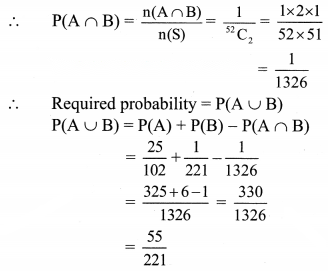
∴ n(A ∩ B) =2C2= 1
Solution & Step-by-Step Answer:
Out of the 50 tickets, a ticket can be drawn in 50C1 = 50 ways. ∴ n(S) = 50 (i) Let A be the event that the number on the ticket is a perfect square. ∴ A = {1, 4, 9, 16, 25, 36, 49} ∴ n(A) = 7 ∴ P(A) = Let B be the event that the number on the ticket is divisible by 4. ∴ B = {4, 8, 12, 16, 20, 24, 28, 32, 36, 40, 44, 48} ∴ n(B) = 12 ∴ P(B) = Now, A ∩ B = {4, 16, 36} ∴ n(A ∩ B) = 3 ∴ P(A ∩ B) = Required probability = P (A u B) P (A ∪ B) = P(A) + P(B) – P(A ∩ B) = =
(ii) Let A be the event that the number on the ticket is a prime number.
∴ A = {2, 3, 5, 7, 11, 13, 17, 19, 23, 29, 31, 37, 41, 43, 47}
∴ n(A) = 15
∴ P(A) =
Let B be the event that the number is greater than 30.
∴ B = {31, 32, 33, 34, 35, 36, 37, 38, 39, 40, 41, 42, 43, 44, 45, 46, 47, 48, 49, 50}
∴ n(B) = 20
∴ P(B) =
Now, A ∩ B = {31, 37, 41, 43, 47}
∴ n(A ∩ B) = 5
∴ P(A ∩ B) =
∴ Required probability = P(A ∪ B)
P(A ∪ B) = P(A) + P(B) – P(A ∩ B)
=
=
=
Solution & Step-by-Step Answer:
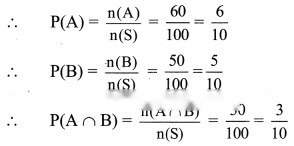
Out of hundred students 1 student can be selected in 100C1 = 100 ways. ∴ n(S) = 100 Let A be the event that the student passed in the first examination. Let B be the event that student passed in second examination. ∴ n(A) = 60, n(B) = 50 and n(A ∩ B) = 30 (i) P(student passed in at least one examination) = P(A ∪ B) = P(A) + P(B) – P (A ∩ B) = =
(ii) P(student passed in exactly one examination) = P(A) + P(B) – 2.P(A ∩ B)
=
=
(iii) P(student failed in both examinations) = P(A’ ∩ B’)
= P(A ∪ B)’ …..[De Morgan’s law]
= 1 – P(A ∪ B)
= 1 –
=
Solution & Step-by-Step Answer:
Here, P(A) = , P(B) = and P(A ∪ B) = (i) P(A ∪ B) = P(A) + P(B) – P(A ∩ B) ∴ P(A ∩ B) = P(A) + P(B) – P(A ∪ B) = =
(ii) P(A’ ∩ B’) = P(A) – P(A ∩ B)
=
=
(iii) P(A’ ∩ B) = P(B) – P(A ∩ B)
=
=
(iv) P(A’ ∪ B’) = P(A ∩ B)’ …..[De Morgan’s law]
= 1 – P(A ∩ B)
= 1 –
=
(v) P(A’ ∩ B’) = P(A ∪ B)’ …..[De Morgan’s law]
= 1 – P(A ∪ B)
= 1 –
=
Solution & Step-by-Step Answer:
Let A be the event that the company will get software A. ∴ P(A) = Let B be the event that company will get software B. ∴ P(B) = Also, P(A ∩ B) = ∴ P(the company will get at least one software) = P(A ∪ B) = P(A) + P(B) – P(A ∩ B) = = =
Solution & Step-by-Step Answer:
One card can be drawn from the pack of 52 cards in 52C1 = 52 ways ∴ n(S) = 52 Also, the pack of 52 cards consists of 13 heart cards and 4 queen cards Let A be the event that a card drawn is the heart. A heart card can be drawn from 13 heart cards in 13C1 ways ∴ n(A) = 13C1 ∴ P(A) = Let B be the event that a card drawn is queen. A queen card can be drawn from 4 queen cards in 4C1 ways ∴ n(B) = 4C1 ∴ P(B) = There is one queen card out of 4 which is also a heart card ∴ n(A ∩ B) = 1C1 ∴ P(A ∩ B) = ∴ P(card is a heart or a queen) = P(A ∪ B) = P(A) + P(B) – P(A ∩ B) = = = ∴ P(A ∪ B) =
Solution & Step-by-Step Answer:
The group consists of 3 boys and 4 girls i.e., 7 students. 4 students can be selected from this group in 7C4 = = 35 ways. ∴ n(S) = 35 Let A be the event that 3 boys and 1 girl are selected. 3 boys can be selected in 3C3 ways while a girl can be selected in 4C1 ways. ∴ n(A) = 3C3 × 4C1 = 4 ∴ P(A) = Let B be the event that 3 girls and 1 boy are selected. 3 girls can be selected in 4C3 ways and a boy can be selected in 3C1 ways. ∴ n(B) = 4C3 × 3C1 = 12 ∴ P(B) = Since A and B are mutually exclusive and exhaustive events ∴ P(A ∩ B) = 0 ∴ Required probability = P(A ∪ B) = P(A) + P(B) = =