Balbharati Maharashtra State Board11th Commerce Maths Solution Book PdfChapter 6 Determinants Ex 6.3 Questions and Answers.
Maharashtra State Board 11th Commerce Maths Solutions Chapter 6 Determinants Ex 6.3
Check:
We can check if our answer is right or wrong.
In order to do so, substitute the values of x, y and z in the given equations.
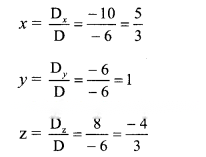
x = , y = 1 and z = satisfy the given equations.
If either one of the equations is not satisfied, then our answer is wrong.
If x = , y = 1 and z = are the solutions of the given equations.
L.H.S. = x + 2y – z
=
=
≠ R.H.S.
L.H.S. = 2x – y + z
=
=
≠ R.H.S.
L.H.S. = 3x + 3y
= 5 + 3
= 8
= R.H.S.
(ii) 2x – y + 6z = 10, 3x + 4y – 5z = 11, 8x – 7y – 9z = 12
Solution:
Given equations are
2x – y + 6z = 10
3x + 4y – 5z = 11
8x – 7y – 9z = 12
∴ D = ≤ft|{array}{ccc}
2 & -1 & 6 \\
3 & 4 & -5 \\
8 & -7 & -9
{array}
= 2(-36 – 35) – (-1)(-27 + 40) + 6(-21 – 32)
= -142 + 13 – 318
= -447
Dx= ≤ft|{array}{ccc}
10 & -1 & 6 \\
11 & 4 & -5 \\
12 & -7 & -9
{array}
= 10(-36 – 35) – (-1)(-99 + 60) + 6(-77 – 48)
= -710 – 39 – 750
= -1499
Dy= ≤ft|{array}{ccc}
2 & 10 & 6 \\
3 & 11 & -5 \\
8 & 12 & -9
{array}
= 2(-99 + 60) – 10(-27 + 40) + 6(36 – 88)
= -78 – 130 – 312
= -520
Dz= ≤ft|{array}{ccc}
2 & -1 & 10 \\
3 & 4 & 11 \\
8 & -7 & 12
{array}
= 2(48 + 77) – (-1)(36 – 88) + 10(-21 – 32)
= 250 – 52 – 530
= -332
By Cramer’s Rule,
∴ x = , y = and z = are the solutions of the given equations.

(iii) 11x – y – z = 31, x – 6y + 2z = -26, x + 2y – 7z = -24
Solution:
Given equations are
11x – y – z = 31
x – 6y + 2z = -26
x + 2y – 7z = -24
D = ≤ft|{array}{ccc}
11 & -1 & -1 \\
1 & -6 & 2 \\
1 & 2 & -7
{array}
= 11(42 – 4) – (-1)(-7 – 2) + (-1)(2 + 6)
= 418 – 9 – 8
= 401
Dx= ≤ft|{array}{ccc}
31 & -1 & -1 \\
-26 & -6 & 2 \\
-24 & 2 & -7
{array}
= 31(42 – 4) – (-1)(182 + 48) + (-1)(-52 – 144)
= 1178 + 230 + 196
= 1604
Dy= ≤ft|{array}{ccc}
11 & 31 & -1 \\
1 & -26 & 2 \\
1 & -24 & -7
{array}
= 11(182 + 48) – 31(-7 – 2) + (-1)(-24 + 26)
= 2530 + 279 – 2
= 2807
Dz= ≤ft|{array}{ccc}
11 & -1 & 31 \\
1 & -6 & -26 \\
1 & 2 & -24
{array}
= 11(144 + 52) – (-1)(-24 + 26) + 31(2 + 6)
= 2156 + 2 + 248
= 2406
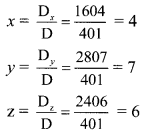
By Cramer’s Rule,
∴ x = 4, y = 7 and z = 6 are the solutions of the given equations.
(iv) , ,
Solution:
Let = p, = q, = r
The given equations become
p + q + r = -2
p – 2q + r = 3
2p – q + 3r = -1
D = ≤ft|{array}{ccc}
1 & 1 & 1 \\
1 & -2 & 1 \\
2 & -1 & 3
{array}
= 1(-6 + 1) – 1(3 – 2) + 1(-1 + 4)
= -5 – 1 + 3
= -3
Dp= ≤ft|{array}{rrr}
-2 & 1 & 1 \\
3 & -2 & 1 \\
-1 & -1 & 3
{array}
= -2(-6 + 1) – 1(9 + 1) + 1(-3 – 2)
= 10 – 10 – 5
= -5
Dq= ≤ft|{array}{ccc}
1 & -2 & 1 \\
1 & 3 & 1 \\
2 & -1 & 3
{array}
= 1(9 + 1) + 2(3 – 2) + 1(-1 – 6)
= 10 + 2 – 7
= 5
Dr= ≤ft|{array}{rrr}
1 & 1 & -2 \\
1 & -2 & 3 \\
2 & -1 & -1
{array}
= 1(2 + 3) – 1(-1 – 6) – 2(-1 + 4)
= 5 + 7 – 6
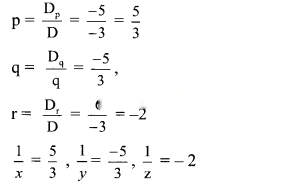
= 6
By Cramer’s Rule,
∴ x = , y = , z = are the solutions of the given equations.
(v)
Solution:
Let = p, = q, = r
The given equations become
2p – q – 3r = 4
p – q + r = 2
3p + q – r = 2
D = ≤ft|{array}{ccc}
2 & -1 & 3 \\
1 & -1 & 1 \\
3 & 1 & -1
{array}
= 2(1 – 1) – (-1)(-1 – 3) + 3(1 + 3)
= 0 – 4 + 12
= 8
Dp= ≤ft|{array}{ccc}
4 & -1 & 3 \\
2 & -1 & 1 \\
2 & 1 & -1
{array}
= 4(1 – 1) – (-1)(-2 – 2) + 3(2 + 2)
= 0 – 4 + 12
= 8
Dq= ≤ft|{array}{ccc}
2 & 4 & 3 \\
1 & 2 & 1 \\
3 & 2 & -1
{array}
= 2(-2 – 2) – 4(-1 – 3) + 3(2 – 6)
= -8 + 16 – 12
= -4
Dr= ≤ft|{array}{ccc}
2 & -1 & 4 \\
1 & -1 & 2 \\
3 & 1 & 2
{array}
= 2(-2 – 2) – (-1)(2 – 6) + 4(1 + 3)
= -8 – 4 + 16
= 4
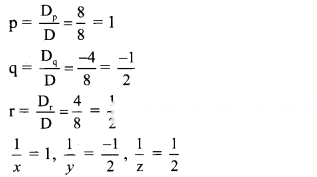
By Cramer’s Rule,
∴ x = 1, y = -2 and z = 2 are the solutions of the given equations.
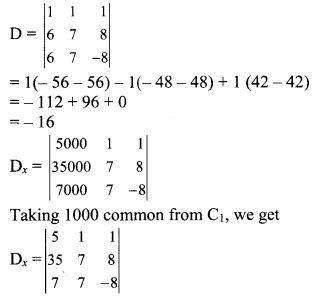
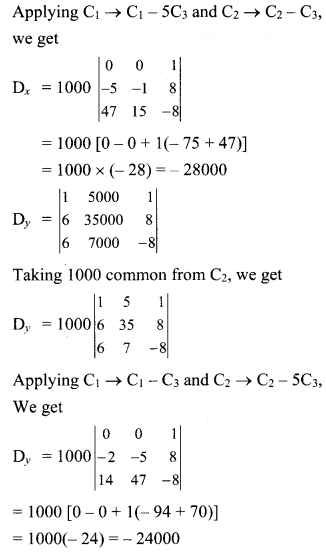
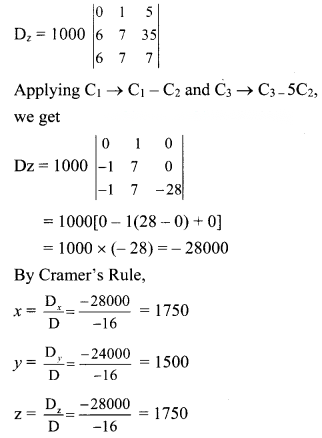
Check:
First condition:
1750 + 1500 + 1750 = 5000
Second condition:
6% of 1750 + 7% of 1500 + 8% of 1750
= 105 + 105 + 140
= 350
Third condition:
Combined income = 105 + 105
= 210
= 140 + 70
Thus, all the conditions are satisfied.
(ii) (k – 2)x + (k – 1)y = 17, (k – 1)x + (k – 2)y = 18, x + y = 5
Solution:
Given equations are
(k – 2)x + (k – 1)y = 17
(k – 1)x + (k – 2)y = 18
x + y = 5
Since, these equations are consistent.
∴ ≤ft|{array}{ccc}
k-2 & k-1 & -17 \\
k-1 & k-2 & -18 \\
1 & 1 & -5
{array}=0
Applying R1→ R1– R2, we get
≤ft|{array}{ccc}
-1 & 1 & 1 \\
k-1 & k-2 & -18 \\
1 & 1 & -5
{array}=0
∴ -1(-5k + 10 + 18) – 1(-5k + 5 + 18) + 1(k – 1 – k + 2) = 0
∴ -1(-5k – 28) – 1(- 5k + 23) + 1(1) = 0
∴ 5k – 28 + 5k – 23 – 1 = 0
∴ 10k – 50 = 0
∴ k = 5
(ii) (3, 2), (-1, 5), (-2, -3)
Solution:
Here, A(x1, y1) ≡ A(3, 2), B(x2, y2) = B(-1, 5), C(x3, y3) ≡ C(-2, -3)
Area of a triangle = ≤ft|{array}{lll}
x_{1} & y_{1} & 1 \\
x_{2} & y_{2} & 1 \\
x_{3} & y_{3} & 1
{array}
∴ A(ΔABC) = ≤ft|{array}{ccc}
3 & 2 & 1 \\
-1 & 5 & 1 \\
-2 & -3 & 1
{array}
= [3(5 + 3) – 2(-1 + 2) + 1(3 + 10)]
= (24 – 2 + 13)
= sq. units
(iii) (0, 5), (0, -5), (5, 0)
Solution:
Here, A(x1, y1) ≡ A(0, 5), B(x2, y2) ≡ B(0, -5), C(x3, y3) ≡ C(5,0)
Area of a triangle = ≤ft|{array}{lll}
x_{1} & y_{1} & 1 \\
x_{2} & y_{2} & 1 \\
x_{3} & y_{3} & 1
{array}
∴ A(ΔABC) = ≤ft|{array}{ccc}
0 & 5 & 1 \\
0 & -5 & 1 \\
5 & 0 & 1
{array}
= [0(-5 – 0) – 5(0 – 5) + 1(0 + 25)]
= (0 + 25 + 25)
=
= 25 sq.units
Check:
For k = 3,
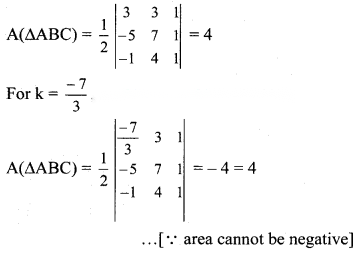
Thus, our answer is correct.