Balbharati Maharashtra State Board11th Commerce Maths Solution Book PdfChapter 6 Determinants Ex 6.2 Questions and Answers.
Maharashtra State Board 11th Commerce Maths Solutions Chapter 6 Determinants Ex 6.2
Question 1
Maharashtra Board Solution
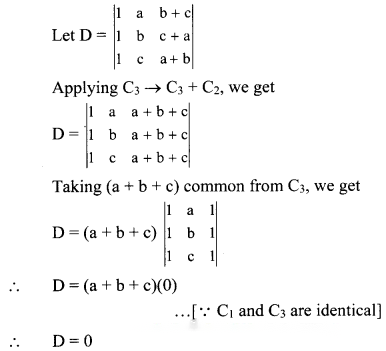
Without expanding, evaluate the following determinants. (i)
Solution & Step-by-Step Answer:
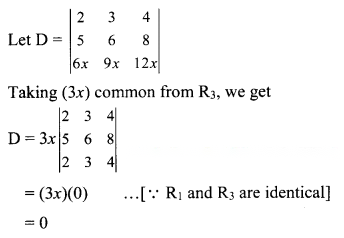
(ii) ≤ft|{array}{ccc}
2 & 3 & 4 \\
5 & 6 & 8 \\
6 x & 9 x & 12 x
{array}
Solution:
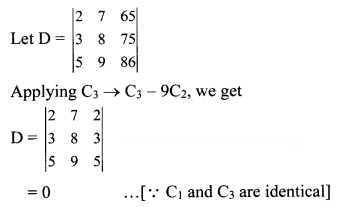
(iii) ≤ft|{array}{lll}
2 & 7 & 65 \\
3 & 8 & 75 \\
5 & 9 & 86
{array}
Solution:
Question 2
Maharashtra Board Solution
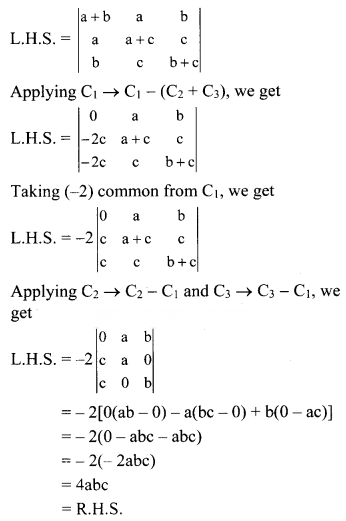
Using properties of determinants, show that = 4abc
Solution & Step-by-Step Answer:
Question 3
Maharashtra Board Solution
Solve the following equation.
Solution & Step-by-Step Answer:
Applying R2 → R2 – R1 and R3 → R3 – R1, we get ∴ (x + 2)(-49 + 12) – (x + 6)(28 + 9) + (x – 1)(-16 – 21) = 0 ∴ (x + 2) (-37) – (x + 6) (37) + (x – 1) (-37) = 0 ∴ -37(x + 2 + x + 6 + x – 1) = 0 ∴ 3x + 7 = 0 ∴ x =
Question 4
Maharashtra Board Solution
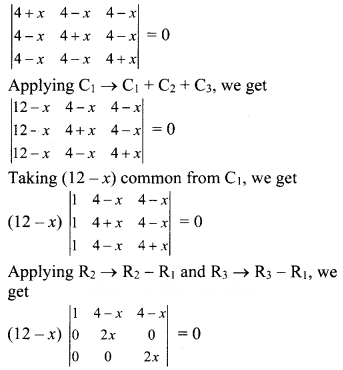
If , then find the values of x.
Solution & Step-by-Step Answer:
∴ (12 – x)[1(4x2 – 0) – (4 – x)(0 – 0) + (4 – x)(0 – 0)] = 0 ∴ (12 – x)(4x2) = 0 ∴ x2(12 – x) = 0 ∴ x = 0 or 12 – x = 0 ∴ x = 0 or x = 12
Question 5
Maharashtra Board Solution
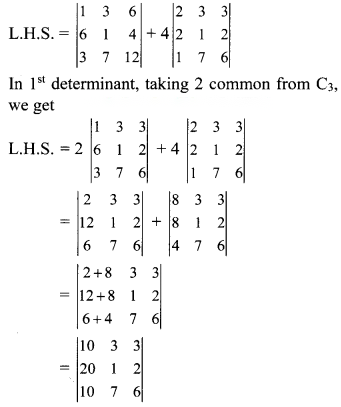
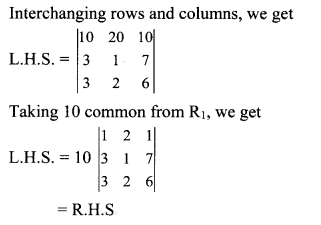
Without expanding determinants, show that
Solution & Step-by-Step Answer:
Question 6
Maharashtra Board Solution
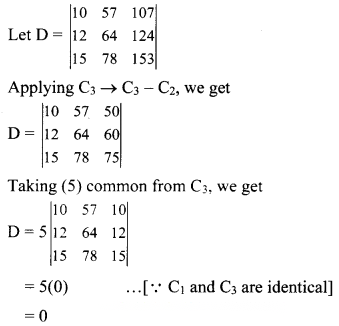
Without expanding determinants, find the value of (i)
Solution & Step-by-Step Answer:
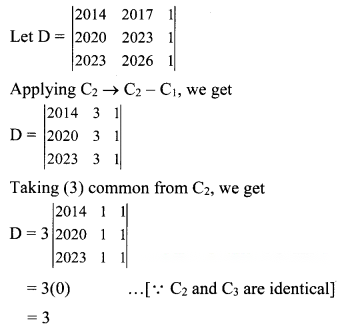
(ii) ≤ft|{array}{lll}
2014 & 2017 & 1 \\
2020 & 2023 & 1 \\
2023 & 2026 & 1
{array}
Solution:
Question 7
Maharashtra Board Solution
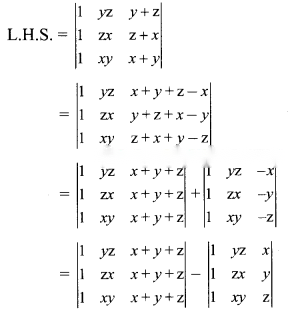
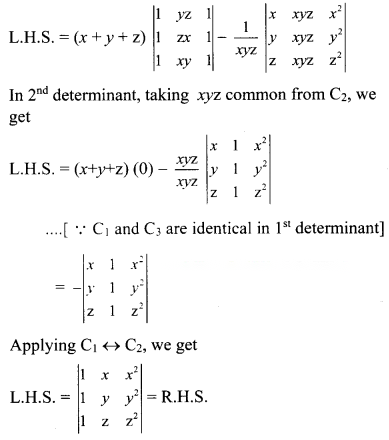
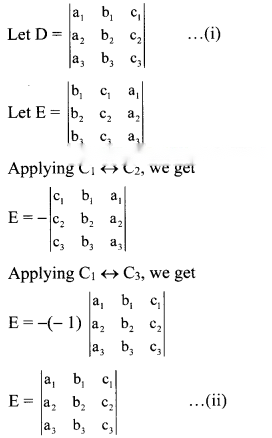
Without expanding determinants, prove that (i)
Solution & Step-by-Step Answer:
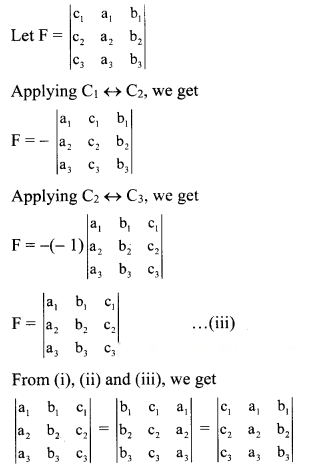
(ii) ≤ft|{array}{lll}
1 & y z & y+z \\
1 & z x & z+x \\
1 & x y & x+y
{array}|=≤ft|{array}{lll}
1 & x & x^{2} \\
1 & y & y^{2} \\
1 & z & z^{2}
{array}
Solution:
In 1st determinant, taking (x + y + z) common from C3and in 2nd determinant, taking common from R1, R2, R3respectively, we get