Latest Maharashtra State Board (SSC & HSC) 2026-27 Syllabus Digest & Solutions Updated!
Class 11 (FYJC / HSC)Commerce Mathematics & Statistics2026-27 Syllabus

Chapter 2 Functions Ex 2.1 Solutions

Complete Maharashtra State Board Balbharati & Yuvakbharati textbook solutions for Chapter 2 Functions Ex 2.1. Step-by-step solved exercises, numerical problems, and digest answers.

9 Solved Questions2 Diagrams1052 words

Balbharati Maharashtra State Board11th Commerce Maths Solution Book PdfChapter 2 Functions Ex 2.1 Questions and Answers.

Maharashtra State Board 11th Commerce Maths Solutions Chapter 2 Functions Ex 2.1
Question 1 Maharashtra Board Solution
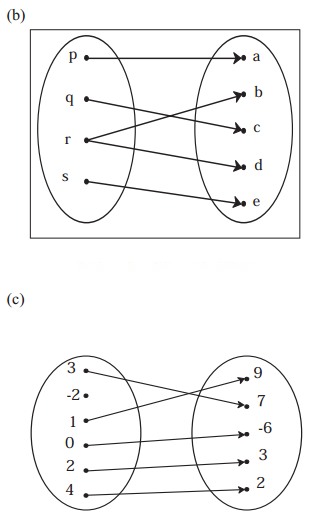
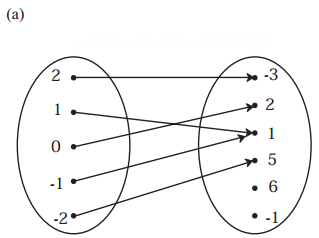
Check if the following relations are functions.
Solution & Step-by-Step Answer:
(a) Yes Reason: Every element of set A has been assigned a unique element in set B.

(b) No
Reason: An element of set A has been assigned more than one element from set B.

(c) No
Reason: Not every element of set A has been assigned an image from set B.

Question 2 Maharashtra Board Solution
Which sets of ordered pairs represent functions from A = {1, 2, 3, 4} to B = {-1, 0, 1, 2, 3}? Justify. (i) {(1, 0), (3, 3), (2, -1), (4, 1), (2, 2)} (ii) {(1, 2), (2, -1), (3, 1), (4, 3)} (iii) {(1, 3), (4, 1), (2, 2)} (iv) {(1, 1), (2, 1), (3, 1), (4, 1)}
Solution & Step-by-Step Answer:
(i) {(1, 0), (3, 3), (2, -1), (4, 1), (2, 2)} does not represent a function. Reason: (2, -1) and (2, 2) show that element 2 ∈ A has been assigned two images -1 and 2 from set B.

(ii) {(1, 2), (2, -1), (3, 1), (4, 3)} represents a function.
Reason: Every element of set A has a unique image in set B.

(iii) {(1, 3), (4, 1), (2, 2)} does not represent a function.
Reason: 3 ∈ A does not have an image in set B.

(iv) {(1, 1), (2, 1), (3, 1), (4, 1)} represents a function
Reason: Every element of set A has been assigned a unique image in set B.

Question 3 Maharashtra Board Solution
If f(m) = m2 – 3m + 1, find (i) f(0) (ii) f(-3) (iii) f() (iv) f(x + 1) (v) f(-x)
Solution & Step-by-Step Answer:
f(m) = m2 – 3m + 1 (i) f(0) = 02 – 3(0) + 1 = 1

(ii) f(-3) = (-3)2– 3(-3) + 1
= 9 + 9 + 1
= 19

(iii)
=
=
=

(iv) f(x + 1) = (x + 1)2– 3(x + 1) + 1
= x2+ 2x + 1 – 3x – 3 + 1
= x2– x – 1

(v) f(-x) = (-x)2– 3(-x) + 1 = x2+ 3x + 1

Question 4 Maharashtra Board Solution
Find x, if g(x) = 0 where (i) g(x) = (ii) g(x) = (iii) g(x) = 6x2 + x – 2
Solution & Step-by-Step Answer:
(i) g(x) = g(x) = 0 ∴ = 0 ∴ 5x – 6 = 0 ∴ x =

(ii) g(x) =
g(x) = 0
∴ = 0
∴ 18 – 2x2= 0
∴ x2= 9
∴ x = ±3

(iii) g(x) = 6x2+ x – 2
g(x) = 0
∴ 6x2+ x – 2 = 0
∴ 6x2+ 4x – 3x – 2 = 0
∴ 2x(3x + 2) – 1(3x + 2) = 0
∴ (2x – 1)(3x + 2) = 0
∴ 2x – 1 = 0 or 3x + 2 = 0
∴ x = or x =

Question 5 Maharashtra Board Solution
Find x, if f(x) = g(x) where f(x) = x4 + 2x2, g(x) = 11x2.
Solution & Step-by-Step Answer:
f(x) = x4 + 2x2, g(x) = 11x2 f(x) = g(x) ∴ x4 + 2x2 = 11x2 ∴ x4 – 9x2 = 0 ∴ x2(x2 – 9) = 0 ∴ x2 = 0 or x2 – 9 = 0 ∴ x = 0 or x2 = 9 ∴ x = 0 or x = ±3
Question 6 Maharashtra Board Solution
If f(x) = , then find (i) f(3) (ii) f(2) (iii) f(0)
Solution & Step-by-Step Answer:
f(x) = x2 + 3, x ≤ 2 = 5x + 7, x > 2 (i) f(3) = 5(3) + 7 = 15 + 7 = 22 (ii) f(2) = 22 + 3 = 4 + 3 = 7 (iii) f(0) = 02 + 3 = 3
Question 7 Maharashtra Board Solution
If f(x) = , then fmd (i) f(-4) (ii) f(-3) (iii) f(1) (iv) f(5)
Solution & Step-by-Step Answer:
f(x) = 4x – 2, x ≤ -3 = 5, -3 < x < 3 = x2, x ≥ 3 (i) f(-4) = 4(-4) – 2 = -16 – 2 = -18 (ii) f(-3) = 4(-3) – 2 = -12 – 2 = -14 (iii) f(1) = 5 (iv) f(5) = 52 = 25
Question 8 Maharashtra Board Solution
If f(x) = 3x + 5, g(x) = 6x – 1, then find (i) (f + g)(x) (ii) (f – g)(2) (iii) (fg)(3) (iv) and its domain
Solution & Step-by-Step Answer:
f(x) = 3x + 5, g(x) = 6x – 1 (i) (f + g)(x) = f(x) + g(x) = 3x + 5 + 6x – 1 = 9x + 4

(ii) (f – g) (2) = f(2) – g(2)
= [3(2) + 5] – [6(2) – 1]
= 6 + 5 – 12 + 1
= 0

(iii) (fg)(3) = f(3) g(3)
= [3(3) + 5] [6(3) – 1]
= (14) (17)
= 238

(iv)
Domain = R – {}

Question 9 Maharashtra Board Solution
If f(x) = 2x2 + 3, g(x) = 5x – 2, then find (i) fog (ii) gof (iii) fof (iv) gog
Solution & Step-by-Step Answer:
f(x) = 2x2 + 3, g(x) = 5x – 2 (i) (fog)(x) = f(g(x)) = f(5x – 2) = 2(5x – 2)2 + 3 = 2(25x2 – 20x + 4) + 3 = 50x2 – 40x + 8 + 3 = 50x2 – 40x + 11

(ii) (gof)(x) = g(f(x))
= g(2x2+ 3)
= 5(2x2+ 3) – 2
= 10x2+ 15 – 2
= 10x2+ 13

(iii) (fof)(x) = f(f(x))
= f(2x2+ 3)
= 2(2x2+ 3)2+ 3
= 2(4x4+ 12x2+ 9) + 3
= 8x4+ 24x2+ 18 + 3
= 8x4+ 24x2+ 21

(iv) (gog)(x) = g(g(x))
= g(5x – 2)
= 5(5x – 2) – 2
= 25x – 10 – 2
= 25x – 12