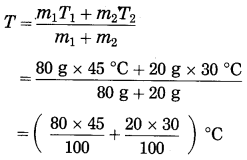
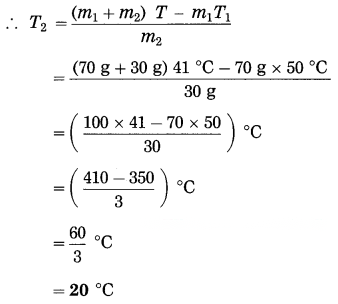
Maharashtra State Board Class 10 Science Solutions Part 1 Chapter 5 Heat
b. If objects of equal masses are given equal heat, their final temperature will be different. This is due to difference in their………….
Answer:
If objects of equal masses are given equal heat, their final temperature will be different. This is due to difference in theirspecific heat capacities.
c. When a liquid is getting converted into solid, the latent heat is………. (Practical Activity Sheet – 1 and 2)
Answer:
When a liquid is getting converted into solid, the latent heat isreleased.
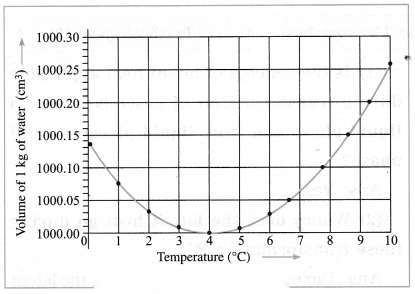
In general, when a substance is heated, its volume goes on increasing with temperature. Thus, in the range 0 °C to 4 °C, behaviour of water is different from other substances. It is called anomalous behaviour of water.
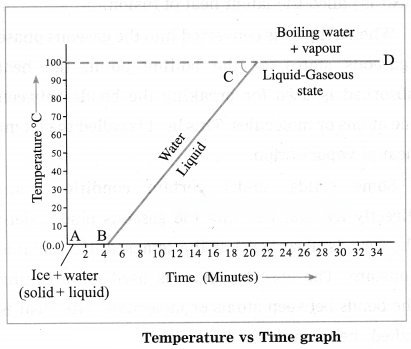
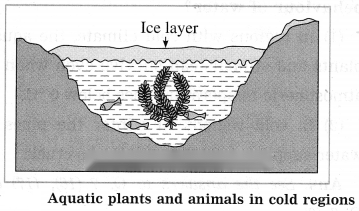
The temperature of the water at the surface continues to fall to 0 °C. Finally, the water at the surface is converted into ice, but the water below the layer of ice is at 4 °C. Ice is a bad conductor of heat. Hence, the layer of the ice at the surface does not allow transfer of heat from the water to the atmosphere. As the water below the layer of ice remains at 4 °C, fish and other aquatic animals and plants can survive in it.
b. How can you relate the formation of water droplets on the outer surface of a bottle taken out of a refrigerator with formation of dew?
Answer:
At a given temperature, there is a limit on how much water vapour the given volume of air can hold. The lower the temperature, the lower is the capacity of air to hold water vapour.
The temperature of a bottle kept in a refrigerator is lower than room temperature. Hence, when the bottle is taken out of the refrigerator, the temperature of the air surrounding the bottle is lowered. Therefore, the capacity of the air to hold water vapour becomes less. Hence, the excess water vapour condenses to form water droplets (like dew) on the outer surface of the bottle.
c. In cold regions in winter, the rocks crack due to anomalous expansion of water.
Answer:
Sometimes water enters into crevices of the rocks. When the temperature of the atmosphere falls below 4 °C, water expands. Even when water freezes to form ice, there is increase in its volume. As there is no room for expansion, it exerts a tremendous pressure on the rocks which crack and break up into small pieces.
When a liquid is converted into the gaseous phase (gaseous state), at the boiling point, the heat absorbed is used for breaking the bonds between the atoms or molecules. This heat is called the latent heat of vaporization. Some solids, under certain conditions, are directly transformed into the gaseous phase. Here the heat is absorbed but the temperature remains constant. The absorbed heat is used for breaking the bonds between atoms or molecules. This heat is called the latent heat of sublimation.
In general, latent heat is the heat absorbed or given out by a substance during a change of state at constant temperature.
In transformations from liquid to solid, gas to liquid and gas to solid, latent heat is given out by the body (substance).
(Note: change of state = change of phase)
b. Which principle is used to measure the specific heat capacity of a substance?
Answer:
The principle of heat exchange is used to measure the specific heat capacity of a substance. This principle is as follows: If a system of two objects is isolated from the environment by keeping it inside a heat resistant box, then no energy can leave the box or enter the box. In this situation, heat energy lost by the hot object = heat energy gained by the cold object.
c. Explain the role of latent heat in the change of state of a substance.
Answer:
When a solid is heated, initially, its temperature increases. Here, the heat absorbed by the body (substance) is used in increasing the kinetic energy of the particles (atomic, molecules, etc.) of the body as well as for doing work against the forces of attraction between them. As the heating is continued, at a certain temperature (melting point), solid is converted into liquid. In this case, the temperature remains constant and the heat absorbed is used for weakening the bonds and conversion into liquid phase (liquid state). This heat is called the latent heat of fusion.
When a liquid is converted into the gaseous phase (gaseous state), at the boiling point, the heat absorbed is used for breaking the bonds between the atoms or molecules. This heat is called the latent heat of vaporization. Some solids, under certain conditions, are directly transformed into the gaseous phase. Here the heat is absorbed but the temperature remains constant. The absorbed heat is used for breaking the bonds between atoms or molecules. This heat is called the latent heat of sublimation.
In general, latent heat is the heat absorbed or given out by a substance during a change of state at constant temperature.
In transformations from liquid to solid, gas to liquid and gas to solid, latent heat is given out by the body (substance).
(Note: change of state = change of phase)
d. what basis and how will you determine whether air is saturated with vapour or not?
Answer:
Whether the air is saturated with water vapour or not is determined on the basis of the extent of water vapour present in the air. If the relative humidity is 100%, the air is saturated with water vapour. In that case, we can see the formation of water droplets on the leaves of plants/grass.
If the relative humidity is less than 100%, the air is not saturated with water vapour.
The change in temperature continues till the temperatures of both the objects attain the same value. In this process, the cold object gains heat energy and the hot object loses’ heat energy. If the system of both the objects is isolated from the environment by keeping it inside a heat resistant box (meaning that the energy exchange takes place between the two objects only), then no energy can flow from inside the box or come into the box.
(1) Heat is transferred from where to where?
(2) Which principle do we learn about from this process?
(3) How will you state the principle briefly?
(4) Which property of the substance is measured using this principle?
(1) Heat is transferred from a hot object to a cold object.
(2) This process shows the principle of heat exchange.
(3) In this process, the cold object gains heat energy and the hot object loses energy. If a system of two objects is isolated from the surroundings, heat energy lost by the hot object = heat energy gained by the cold object.
(4) This principle is used to measure the specific heat capacity of a substance.
Question 9
Maharashtra Board Solution
Solve the following problems: a. Equal heat is given to two objects A and B of mass 1 g. The temperature of A increases by 3 °C and B by 5°C. Which object has more specific heat? And by what factor?
Solution & Step-by-Step Answer:
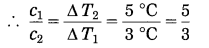
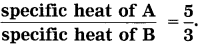
Data: m = 1 g, Δ T1 = 3 °C, Δ T2 = 5 °C, Q same Here, Q = mc1 ΔT1 = mc2 ΔT2 Thus, c1 > c2 The specific heat of A is more than that of B and
b. Liquid ammonia is used in ice factory for making ice from water. If water at 20 °C is to be converted into 2 kg, ice at 0 °C, how many grams of ammonia is to be evaporated? c. A thermally insulated pot has 150 g ice at temperature 0 °C. How much steam of 100 °C has to he mixed to it, so that water of temperature 50 °C will be obtained? d. A calorimeter has mass 100 g and specific heat 0.1 kcal/kg ·°C. It contains 250 g of liquid at 30 °C having specific heat of 0.4 kcal/kg·°C. If we drop a piece of ice of mass 10 g at 0 °C into the liquid, what will be the temperature of the mixture? Project: Can you recall? (Text Book Page No. 62)
Question 1
Maharashtra Board Solution
What is the difference between heat and temperature?
Solution & Step-by-Step Answer:
Heat is a form of energy. Particles of matter (atoms, molecules, etc.) possess potential energy and kinetic energy. Total energy (potential energy + kinetic energy) of all particles of matter in a given sample is called it’s thermal energy. When two bodies at different temperatures are in thermal contact with each other, there is transfer of thermal energy from a body at higher temperature to a body at lower temperature. This energy in transfer is called heat. It is expressed in joule, calorie and erg.
Temperature is a quantitative measure of degree of hotness or coldness of a body. It is expressed in °C, °F or K (kelvin). Temperature determines the direction of energy transfer.
Question 2
Maharashtra Board Solution
What are the different ways of heat transfer?
Solution & Step-by-Step Answer:
Ways of heat transfer: conduction, convection and radiation. [Note: heat ≡ heat energy. In the textbook, both the terms are used.]
Use your brain power! (Text Book Page No. 63)
Question 1
Maharashtra Board Solution
Is the concept of latent heat applicable during transformation of gaseous phase to liquid phase and from liquid phase to solid phase?
Solution & Step-by-Step Answer:
Yes.
Question 2
Maharashtra Board Solution
Where does the latent heat go during these transformations?
Solution & Step-by-Step Answer:
During these transformations, the latent heat is given out by the substance to the surroundings.
Use your brain power! (Text Book Page No. 64)
Question 1
Maharashtra Board Solution
In the above experiment, the wire moves through the ice slab. However, the ice slab does not break. Why?
Solution & Step-by-Step Answer:
When the thin wire with two equal weights attached to its ends is hung over the block of ice, it exerts pressure on the ice below it. Due to this, the melting point of the ice below the wire is lowered and some ice melts. The wire passes through the water so formed.
The water above the wire is no longer under pressure and, therefore, refreezes. Once again the ice below the wire melts, and the wire passes through it, and the process continues. In this way, due to alternate melting of ice and refreezing of water, the wire cuts right through the block of ice leaving the block intact.
Question 2
Maharashtra Board Solution
Is there any relationship of latent heat with regelation?
Solution & Step-by-Step Answer:
Yes. when the ice melts, heat is absorbed, but the temperature does not change. Also, when water refreezes, heat is given out, but the temperature does not change. This heat absorbed or given out is the latent heat.
Question 3
Maharashtra Board Solution
You know that as we go higher than the sea level, the boiling point of water decreases. What would be the effect on the melting point of a solid?
Solution & Step-by-Step Answer:
As we go higher than the sea level, the melting point of solids (i) that expand on melting is lowered due to a decrease in pressure (ii) that contract on melting is raised due to a decrease in pressure.
[The wire used in the experiment is made of a metal (usually copper). Metals are good conductors of heat. Hence, exchange of heat between the portion of the ice above the wire and that below the wire takes place readily.] Can you tell? (Text Book Page No. 64)
Question 1
Maharashtra Board Solution
We feel that some objects are cold, and some are hot. Is this feeling related in some way to our body temperature?
Solution & Step-by-Step Answer:
Yes. If the temperature of the object is lower than our body temperature, e.g., ice, we feel the object is cold. If the temperature of the object is higher than our body temperature, e.g., hot water, we feel the object is hot.
Use your brain power! (Text Book Page No. 66)
Question 1
Maharashtra Board Solution
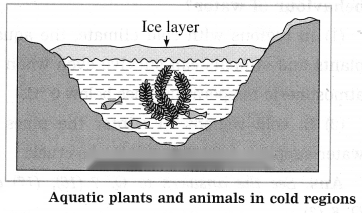
How will you explain the following statements with the help of the anomalous behaviour of water? (1) In regions with cold climate, the aquatic plants and animals can survive even when the atmospheric temperature goes below 0 °C. (2) In cold regions in winter the pipes for water supply break and even rocks crack.
Solution & Step-by-Step Answer:
In cold regions, during winter, the temperature of the atmosphere falls well below 0 °C. As the temperature decreases, the water at the surfaces of lakes and ponds starts contraeting. Hence, its density increases and it sinks to the bottom. This process continues till the temperature of all the water in a lake falls to 4 °C. As the water at the surface cools further, i.e., its temperature falls below 4 °C, it starts expanding instead of contracting. Therefore, its density decreases and it remains at the surface.
The temperature or the water at the surface continues to fall to 0 °c. Finally, the water at the surface is converted Into ice, but the water below the layer of ice is at 4 °C. Ice is a bad conductor of heat. Hence, the layer of the ice at the surface does not allow transfer of heat from the water to the atmosphere. As the water below the layer of ice remains at 4 °C, fish and other aquatic animals and plants can survive in it. (2) Sometimes water enters into crevices of the rocks. when the temperature of the atmosphere falls below 4 °C, water expands. Even when water freezes to form ice, there is increase in its volume. As there is no room for expansion, it exerts tremendous pressure on the rocks which crack and break up Into small pieces. In cold countries, in winter, the temperature of the atmosphere falls below 0 °C. when the temperature of water falls below 4 °C, it expands. Hence, the water in pipes expands. Even if ice is rormed, there is an increase in the volume. As there is no room for expansion, water (or ice) exerts a large pressure on the pipes. Hence, the pipelines carrying water burst. Fill in the blanks and rewrite the sentences:
Question 1
Maharashtra Board Solution
The amount of water vapour in air is determined in terms of its…………..
Solution & Step-by-Step Answer:
The amount of water vapour in air is determined in terms of its absolute humidity.
Question 2
Maharashtra Board Solution
If objects of equal masses are given equal heat, their final temperature will be different. This is due to difference in their……………
Solution & Step-by-Step Answer:
If objects of equal masses are given equal heat, their final temperature will be different. This is due to difference in their specific heat capacities.
Question 3
Maharashtra Board Solution
When a liquid is getting converted into solid, the latent heat is…………. (Practical Activity Sheet – 1 and 2)
Solution & Step-by-Step Answer:
When a liquid is getting converted into solid, the latent heat is released.
Rewrite the following statements by selecting the correct options:
Question 1
Maharashtra Board Solution
……….is used to study the anomalous behaviour of water. (a) Calorimeter (b) Joule’s apparatus (c) Hope’s apparatus (d) Thermos flask
Solution & Step-by-Step Answer:
(c) Hope’s apparatus
Question 2
Maharashtra Board Solution
When water boils and is converted into steam, then……….. (a) heat is taken in and temperature remains constant (b) heat is taken in and temperatures rises (c) heat is given out and temperature lowers (d) heat is given out and temperature remains constant
Solution & Step-by-Step Answer:
(a) heat is taken in and temperature remains constant
Question 3
Maharashtra Board Solution
When steam condenses to form water,……….. (a) heat is absorbed and temperature increases (b) heat is absorbed and temperature remains the same (c) heat is given out and temperature decreases (d) heat is given out and temperature remains the same
Solution & Step-by-Step Answer:
(d) heat is given out and temperature remains the same
Question 4
Maharashtra Board Solution
The temperature of ice can be decreased below 0 °C by mixing………..in it. (Practice Activity Sheet – 3) (a) saw dust (b) sand (c) salt (d) coal
Solution & Step-by-Step Answer:
(c) salt
Question 5
Maharashtra Board Solution
Ice/water is a substance that……….. (a) expands on melting and contracts on freezing (b) contracts on melting and does not undergo change in volume on freezing (c) contracts on melting and expands on freezing (d) does not undergo any change in volume on melting or freezing
Solution & Step-by-Step Answer:
(c) contracts on melting and expands on freezing
Question 6
Maharashtra Board Solution
Heat absorbed when 1 g of ice melts at 0 °C to form 1 g of water at the same temperature is………..cal. (a) 80 (b) 800 (c) 540 (d) 54
Solution & Step-by-Step Answer:
(a) 80
Question 7
Maharashtra Board Solution
The latent heat of vaporization of water is……….. (a) 540 cal/g (b) 800 cal/g (c) 80 cal/g (d) 54 cal/g
Solution & Step-by-Step Answer:
(a) 540 cal/g
Question 8
Maharashtra Board Solution
The latent heat of fusion of ice is……….. (a) 540 cal/g (b) 80 cal/g (c) 800 cal/g (d) 4cal/g
Solution & Step-by-Step Answer:
(b) 80 cal/g
Question 9
Maharashtra Board Solution
If the temperature of water is decreased from 4 °C to 10 °C, then its……….. (a) volume decreases and density increases (b) volume increases and density decreases (c) volume decreases and density decreases (d) volume increases and density increases
Solution & Step-by-Step Answer:
(b) volume increases and density decreases
Question 10
Maharashtra Board Solution
At 4 °C, the density of water is……….. (a) 10 g/cm3 (b) 4g/cm3 (c) 4 × 10³ kg/m3 (d) 1 × 10³ kg/m3
Solution & Step-by-Step Answer:
(d) 1 × 10³ kg/m3
Question 11
Maharashtra Board Solution
The density of water is maximum at……….. (a) 0 °C (b) – 4 °C (c) 100 °C (d) 4 °C
Solution & Step-by-Step Answer:
(d) 4 °C
Question 12
Maharashtra Board Solution
………..heat is needed to raise the temperature of 1 kg of water from 14.5 °C to 15.5 °C. (a) 4180 J (b) 103 J (c) 1 cal (d) 4180 cal
Solution & Step-by-Step Answer:
(a) 4180 J
Question 13
Maharashtra Board Solution
………..heat is needed to convert 1 g of water at 0 °C and at a pressure of one atmosphere into 1 g of steam under the same conditions. (a) 80 cal (b) 540 cal (c) 89 J (d) 540 J
Solution & Step-by-Step Answer:
(b) 540 cal
Question 14
Maharashtra Board Solution
Water expands on reducing its temperature below………..°C. (March 2019) (a) 0 (b) 4 (c) 8 (d) 12
Solution & Step-by-Step Answer:
(b) 4
State whether the following statements are true or false. (If a statement is false, correct it and rewrite it.):
Question 1
Maharashtra Board Solution
Specific latent heat of fusion is expressed in g/cal.
Solution & Step-by-Step Answer:
False. (Specific latent heat of fusion is expressed in cal/g.)
Question 2
Maharashtra Board Solution
If the temperature of water is raised from 0 °C to 10 °C, its volume goes on increasing.
Solution & Step-by-Step Answer:
False. (If the temperature of water is raised from 0 °C to 10 °C, its volume goes on decreasing in the range 0 °C to 4 °C and then goes on increasing in the range 4 °C to 10 °C.)
Question 3
Maharashtra Board Solution
At dew point relative humidity is 100%.
Solution & Step-by-Step Answer:
True.
Question 4
Maharashtra Board Solution
1 kcal = 4.18 joules.
Solution & Step-by-Step Answer:
False. (1 kcal = 4180 joules.)
Question 5
Maharashtra Board Solution
Specific heat capacity is expressed in cal/g·°C
Solution & Step-by-Step Answer:
True.
Question 6
Maharashtra Board Solution
Latent heat of fusion, Q = mL.
Solution & Step-by-Step Answer:
True.
Question 7
Maharashtra Board Solution
If the relative humidity is more than 60%, we feel that the air is humid.
Solution & Step-by-Step Answer:
True.
Question 8
Maharashtra Board Solution
If the relative humidity is less than 60%, we feel that the air is dry.
Solution & Step-by-Step Answer:
True.
Question 9
Maharashtra Board Solution
Relative humidity has no unit.
Solution & Step-by-Step Answer:
True.
Question 10
Maharashtra Board Solution
Absolute humidity is expressed in kg/m3.
Solution & Step-by-Step Answer:
True.
Identify the odd one and give the reason:
Question 1
Maharashtra Board Solution
Temperature, conduction, convection, radiation.
Solution & Step-by-Step Answer:
Temperature. It is a physical quantity. Others are modes of transfer of heat.
Question 2
Maharashtra Board Solution
The joule, The erg, The calorie, The newton.
Solution & Step-by-Step Answer:
The newton. It is a unit of force. Others are units of energy (as well as work.)
Question 3
Maharashtra Board Solution
cal/g, cal/g·°C, k cal/kg·°C, erg/g·°C.
Solution & Step-by-Step Answer:
cal/g. It is a unit of specific latent heat. Others are units of specific heat capacity.
Match the columns:
Answer: Answer the following questions in one sentence each:
Question 1
Maharashtra Board Solution
State units of temperature.
Solution & Step-by-Step Answer:
Units of temperature: °C, °F and K (kelvin).
Question 2
Maharashtra Board Solution
State units of energy.
Solution & Step-by-Step Answer:
Units of energy: the erg, the joule, the calorie.
Question 3
Maharashtra Board Solution
State the relation between the joule and the calorie.
Solution & Step-by-Step Answer:
1 calorie = 4.18 joules.
Question 4
Maharashtra Board Solution
State the relation between the erg and the joule.
Solution & Step-by-Step Answer:
1 joule = 107 ergs.
Question 5
Maharashtra Board Solution
State the relation between the erg and the kilocalorie.
Solution & Step-by-Step Answer:
1 kilocalorie = 4.18 × 10¹⁰ ergs.
Question 6
Maharashtra Board Solution
State the relation between the joule and the kilocalorie.
Solution & Step-by-Step Answer:
1 kilocalorie = 4.18 × 10³ joules.
Question 7
Maharashtra Board Solution
When heat energy is absorbed by an object, ΔT represents the rise in temperature. What would ΔT represent if the object loses heat energy? (Practice Activity Sheet – 4)
Solution & Step-by-Step Answer:
If the object loses heat energy, ΔT would represent the decrease in temperature.
Answer the following questions:
Question 1
Maharashtra Board Solution
Define latent heat of fusion. (OR) What is latent heat of fusion? State its units.
Solution & Step-by-Step Answer:
When a solid is converted into liquid at constant temperature (melting point of the substance) the amount of heat absorbed by it is called the latent heat of fusion. Heat is a form of energy. Hence, latent heat is expressed in units joule, erg, calorie or kilocalorie.
Question 2
Maharashtra Board Solution
Define specific latent heat of fusion. (OR) What is specific latent heat of fusion? State its units.
Solution & Step-by-Step Answer:
The amount of heat energy absorbed at constant temperature by unit mass of a solid to convert into liquid phase is called the specific latent heat of fusion. It is expressed in units J/kg, erg/g, cal/g, kJ/ kg and kcal/kg.
[Note: Specific latent heat (L) =
Question 3
Maharashtra Board Solution
Explain the term latent heat of vaporization.
Solution & Step-by-Step Answer:
When a liquid is heated continuously, initially, its temperature increases. Later, at a certain stage, its temperature does not increase even when heat is supplied to it. At this temperature, heat absorbed by the liquid is used for breaking the bonds between its atoms or molecules, i.e., for doing work against the forces of attraction between the atoms or molecules and conversion into gaseous phase.
This heat is called the latent heat of vaporization and the constant temperature at which this change of state occurs is called the boiling point of the liquid.
Question 4
Maharashtra Board Solution
Define boiling point of a liquid. (OR) What is boiling point of a liquid?
Solution & Step-by-Step Answer:
The constant temperature at which a liquid transforms into gaseous state is called the boiling point of the liquid. [Note: On application of pressure, the boiling point of a liquid is raised. On reducting the pressure, the boiling point is lowered.]
Question 5
Maharashtra Board Solution
Define specific latent heat of vaporization. OR What is specific latent heat of vaporization?
Solution & Step-by-Step Answer:
The amount of heat energy absorbed at constant temperature by unit mass of a liquid to convert into gaseous phase is called the specific latent heat of vaporization.
Question 6
Maharashtra Board Solution
The specific latent heat of fusion of ice is 80 cal/g. Explain this statement.
Solution & Step-by-Step Answer:
When 1 g of ice at a pressure of one atmosphere and at a temperature 0 °C is converted into 1 g of water, heat absorbed by the ice is 80 cal.
Question 7
Maharashtra Board Solution
The specific latent heat of fusion of silver is 88.2 kJ/kg. Explain this statement.
Solution & Step-by-Step Answer:
When 1 kg of silver at a pressure of one atmosphere and at a temperature of 962 °C (melting point of silver) is converted into 1 kg of silver in liquid phase, heat absorbed by the silver is 88.2 kJ.
Question 8
Maharashtra Board Solution
The specific latent heat of vaporization of water is 540 cal/g. Explain this statement.
Solution & Step-by-Step Answer:
When 1 g of water at a pressure of one atmosphere and at a temperature of 100 °C is converted into 1 g of steam, heat absorbed by the water is 540 cal.
Question 9
Maharashtra Board Solution
Define regelation. (OR) What is regelation?
Solution & Step-by-Step Answer:
The phenomenon in which the ice converts to liquid due to applied pressure and then re-converts to ice once the pressure is removed is called regelation.
Question 10
Maharashtra Board Solution
The terms hot and cold are used in relative context. Explain.
Solution & Step-by-Step Answer:
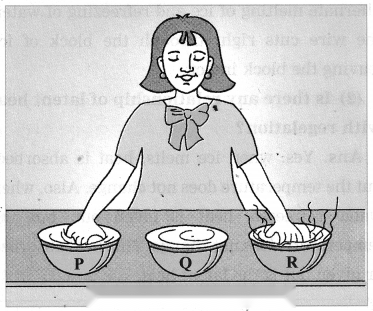
(1) Take three large bowls, P, Q and R. Fill bowl P with cold water, bowl Q with lukewarm water, and bowl R with hot water. (2) Immerse your right hand in bowl P, and left hand in bowl R for about five seconds. (3) Now, immerse both the hands in bowl Q at the same time. (4) You will find that the water in bowl Q appears warm to your right hand, and cold to your left hand. Thus, the hand immersed in cold water for some time finds the lukewarm water hot while the one immersed in hot water finds the same lukewarm water cold. This experiment shows that the terms hot and cold are relative.
Question 11
Maharashtra Board Solution
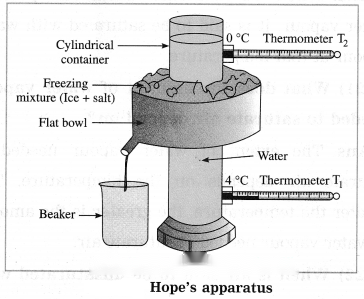
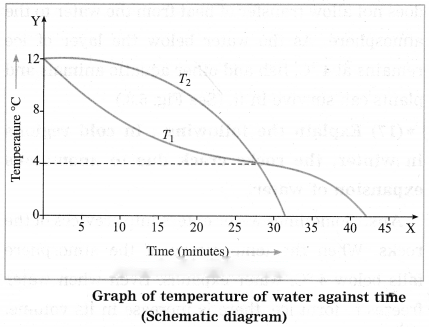
Draw a neat labelled diagram of Hope’s apparatus. Explain how this apparatus can be used to demonstrate anomalous behaviour of water. Draw a graph of temperature of water against time.
Solution & Step-by-Step Answer:
The figure shows Hope’s apparatus. Initially, the cylindrical container in Hope’s apparatus is filled with water at about 12 °C and the flat bowl is filled with a freezing mixture of ice and salt.
The temperature of water in the upper part of the container (T2) is recorded by thermometer T2and that of water in the lower part of the container (T1) is recorded by thermometer T1. Figure shows variation of temperature of water with time. Initially, both the thermometers show the same temperature (say, 12 °C). In a short time, the temperature shown by the lower thermometer starts decreasing, while the temperature shown by the upper thermometer does not change very much. This process continues till the temperature shown by the lower thermometer falls to 4 °C and remains constant thereafter. This shows that in the temperature range 12 °C to 4 °C, the density of the water in the central part of the container goes on increasing and hence the water sinks to the bottom. It means that water contracts, i.e., its volume decreases as its temperature falls from 12 °C to 4 °C. As the temperature of the water in the central part of the container becomes less than 4 °C, the temperature shown by the upper thermometer begins to fall rapidly to 0 °C. But the temperature shown by the lower thermometer remains constant (4 °C). Later, the heading shown by the lower thermometer decreases to 0 °C. In the temperature range 4 °C to 0 °C, the water moves upward. This shows that the density of water goes on decreasing in this range. It means that water expands, i.e. its volume increases as its temperature falls from 4 °C to 0 °C. Thus, the volume of a given mass of water is minimum at 4 °C, i.e., the density of water is maximum at 4 °C.
Question 12
Maharashtra Board Solution
A mountaineer climbing on the Everest, experienced the following facts. Explain each fact with the scientific reason : (1) He found j fishes alive below the ice (2) Time required for cooking was more as he went higher (3) He saw many times cliffs falling suddenly (4) He saw tubes carrying water broken.
Solution & Step-by-Step Answer:
Explanation: (1) Water expands as its temperature decreases from 4 °C to 0 °C. Water is converted into ice at 0 °C. The density of water is more than that of ice. Fishes can remain alive in the water (at 4 °C) below the ice. (2) At high altitudes, atmospheric pressure is low and hence water boils at a temperature lower than its normal boiling point. Therefore, the time required for cooking food is more at higher altitudes. (3) Water expands while freezing. Hence, the water present in the crevices of the rocks exerts a tremendous pressure on the rocks, while freezing. Therefore, the cliffs fall. (4) Water expands while freezing. Hence, the water in the tube exerts a large pressure on the tube, while freezing. Therefore, the tube carrying water breaks.
Question 13
Maharashtra Board Solution
What is humidity?
Solution & Step-by-Step Answer:
The moisture, i.e., the presence of water vapour, in the atmosphere is called humidity.
Question 14
Maharashtra Board Solution
When is air said to be saturated with water vapour?
Solution & Step-by-Step Answer:
When air contains maximum possible water vapour, it is said to be saturated with water vapour at that temperature.
Question 15
Maharashtra Board Solution
What does the amount of water vapour needed to saturate air depend on?
Solution & Step-by-Step Answer:
The extent of water vapour needed to saturate air depends on the temperature. The greater the temperature, the greater is the amount of water vapour needed to saturate air.
Question 16
Maharashtra Board Solution
When is air said to be unsaturated with water vapour?
Solution & Step-by-Step Answer:
When air contains water vapour less than its capacity to hold water vapour at that temperature, it is said to be unsaturated with water’vapour.
Question 17
Maharashtra Board Solution
What is dew point temperature? (OR) Define dew point temperature.
Solution & Step-by-Step Answer:
If the temperature of unsaturated air is decreased, a temperature is reached at which the air becomes saturated with water vapour. This temperature is called the dew point temperature.
Question 18
Maharashtra Board Solution
Name the physical quantity used to express the amount of water vapour present in air.
Solution & Step-by-Step Answer:
Absolute humidity.
Question 19
Maharashtra Board Solution
Define absolute humidity. (OR) What is absolute humidity? State its unit.
Solution & Step-by-Step Answer:
The mass of water vapour present in a unit volume of air is called absolute humidity. Generally it is expressed in kg/m3.
Question 20
Maharashtra Board Solution
Define relative humidity. (OR) What is relative humidity? Write the formula for % relative humidity.
Solution & Step-by-Step Answer:
The ratio of the actual mass of water vapour content in the air for a given volume and temperature to that required to make the same volume of air saturated with water vapour at the same temperature is called the relative humidity.
% Relative humidity = [the actual mass of water vapour content in the air for a given volume and temperature ÷ the mass of water vapour required to make the same volume of air saturated with water vapour at the same temperature] × 100%.
Question 21
Maharashtra Board Solution
What is the value of relative humidity at the dew point temperature?
Solution & Step-by-Step Answer:
At the dew point temperature, relative humidity is 100%.
Question 22
Maharashtra Board Solution
The mass of water vapour in air enclosed in a certain space is 60 g and the mass of water vapour needed to saturate the same air with water vapour under the same conditions is 100 g. What is the corresponding % relative humidity?
Solution & Step-by-Step Answer:
Here, % relative humidity = () × 100% = 60%
Question 23
Maharashtra Board Solution
During winter, sometimes we see a white trail at the back of a flying aeroplane in a clear sky. Explain why.
Solution & Step-by-Step Answer:
In winter, air temperature is low. Hence, when an aeroplane flies, the vapour released by its engine condenses and forms white clouds. If the relative humidity of the air surrounding the plane is high, we see this white trail at the back of the plane for a long time before it disappears. If.the relative humidity is low, the white trail is short and disappears quickly. If the relative humidity is very low, there is no formation of the white trail.
Question 24
Maharashtra Board Solution
State two effects of humidity present in atmosphere.
Solution & Step-by-Step Answer:
Effects of humidity present in atmosphere: When the temperature of air falls below the dew point, dew and fog are formed.
Question 25
Maharashtra Board Solution
Explain how dew and fog are formed. (OR) Write a short note on formation of dew and fog.
Solution & Step-by-Step Answer:
At a particular temperature, a given volume of air can contain a certain maximum amount of water vapour. Normally, the temperature of air during the day is such that air is not saturated with water vapour present in it.
As the temperature falls, the capacity of air to hold water vapour becomes less. During a cold night, the temperature of air may fall to the dew point, or even below the dew point. If the temperature falls below the dew point, the excess of water vapour in air condenses on the surfaces of cold bodies and dew is formed. If the water vapour condenses on the fine dust particles present in the atmosphere, mist or fog is formed.
Question 26
Maharashtra Board Solution
State the units of heat.
Solution & Step-by-Step Answer:
Units of heat: joule, erg, calorie, kilocalorie.
Question 27
Maharashtra Board Solution
Define the kilocalorie.
Solution & Step-by-Step Answer:
The amount of heat necessary to raise the temperature of 1 kg of water by 1 °C from 14.5 °C to 15.5 °C is called one kilocalorie.
Question 28
Maharashtra Board Solution
Define the calorie.
Solution & Step-by-Step Answer:
The amount of heat necessary to raise the temperature of 1 g of water by 1 °C from 14.5 °C to 15.5 °C is called one calorie.
Question 29
Maharashtra Board Solution
State the relation between the kilocalorie and the calorie.
Solution & Step-by-Step Answer:
1 kilocalorie = 103 calories.
Question 30
Maharashtra Board Solution
Study the following procedure and answer the questions below: (Practice Activity Sheet – 2) 1. Take 3 spheres of iron, copper and lead of equal mass. 2. Put all the 3 spheres in boiling water in a beaker for some time. 3. Take 3 spheres out of the water. Put them immediately on a thick slab of wax. 4. Note the depth that each sphere goes into the wax. (i) Which property of a substance can be studied with this procedure? (ii) Describe that property in minimum words. (iii) Explain the rule of heat exchange with this property.
Solution & Step-by-Step Answer:
(i) Specific heat. (ii) Specific heat: The amount of heat energy required to raise the temperature of a unit mass of an object by 1 °C. (iii) According to the rule/principle of heat exchange, heat energy lost by the hot object = heat energy gained by the cold object.
In this activity, heat absorbed by the iron sphere is transmitted more in the wax, hence the sphere goes deepest into the wax, while the lead sphere absorbs less heat, resulting in less transmission of heat in the wax, hence, the sphere goes the least depth into the wax.
Question 31
Maharashtra Board Solution
Write the symbol for specific heat capacity. State the units of specific heat capacity.
Solution & Step-by-Step Answer:
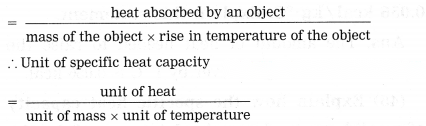
Symbol for specific heat capacity: c. Units of specific heat capacity: J/kg·°C, erg/g·°C, cal/g·°C, kcal/kg·°C. [ Notes: (1) Specific heat capacity In SI, heat is expressed in joule (J), mass in kg and temperature in kelvin(K). ∴ SI unit of specific heat capacity = . (2) The specific heat capacity of a substance depends upon its constituent particles (atoms, molecules, etc.), interaction between them, structure of the substance (atomic/molecular arrangement), temperature of the substance, etc.]
Question 32
Maharashtra Board Solution
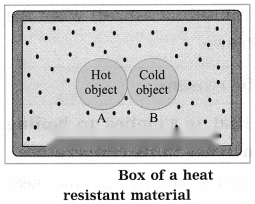
Explain the principle of heat exchange. Ans. Suppose two objects A and B at different temperature T1 and T2 respectively are enclosed in a box of heat resistant material as shown in figure. Let m1 = mass of A, m2 = mass of B, c1 = specific heat capacity of A, c2 = specific heat capacity of B and T = common temperature attained by A and B after the heat exchange between A and B. Here, no heat leaves the box or enters the box from outside. Hence, if T1 > T2, heat energy lost by A (Q1) = heat energy gained by B (Q2). ∴ m1c1 (T1 – T) = m2c2 (T – T2) [Note: If m1, c1, T1, T, m2 and T2 are known, c2 can be determined.] |
Question 33
Maharashtra Board Solution
The specific heat capacity of silver is 0.056 kcal/kg·°C. Explain this statement.
Solution & Step-by-Step Answer:
block bg-white dark:bg-slate-900/80 border-l-4 border-emerald-500 rounded-r-xl p-5 my-3 shadow-xs border border-slate-200/60 dark:border-slate-800">
Solution & Step-by-Step Answer:
The amount of heat needed to raise the temperature of 1 kg of silver by 1 °C is 0.056 kcal.
Question 34
Maharashtra Board Solution
Explain how the specific heat capacity of a solid can be determined (measured) by the method of mixture.
Solution & Step-by-Step Answer:
A hot solid is put in water in a calorimeter. The mixture is stirred continuously and the maximum temperature of the mixture is measured with a thermometer. Heat exchange between the hot solid, water and calorimeter results in sill bodies attaining the same temperature after some time. Hence, according to the principle of heat exchange, heat lost by the solid = heat gained by the water in the calorimeter + heat gained by the calorimeter.
Now, heat lost by the solid (Q) = mass of the solid × its specific heat capacity × decrease in its temperature, heat gained by the water (Q1) = mass of the water × its specific heat capacity × increase in its temperature and heat gained by the calorimeter (Q2) = mass of the calorimeter × its specific heat capacity × increase in its temperature. Heat lost by the hot object = heat gained by the calorimeter + heat gained by the water. Q = Q2+ Q1 Give scientific reasons:
Question 1
Maharashtra Board Solution
Even though heat is supplied to boiling water, there is no increase in its temperature.
Solution & Step-by-Step Answer:
Once water starts boiling, all the heat supplied to it is used in conversion of water into steam at the boiling point of water. Hence, there is no rise in its temperature.
Question 2
Maharashtra Board Solution
Burns from steam are worse those from boiling water at the same temperature.
Solution & Step-by-Step Answer:
1. A given quantity of steam contains more heat than the same quantity of boiling water at the same temperature. 2. When steam comes in contact with one’s body, it releases extra heat of 540 calories per gram and causes a more serious burn than that caused by boiling water.
Question 3
Maharashtra Board Solution
In winter, the pipelines carrying water burst in cold countries.
Solution & Step-by-Step Answer:
1. In cold countries, in winter, the temperature of the atmosphere falls below 0 °C. When the temperature of water falls below 4 °C, it expands. Hence, the water in pipes expands. Even if ice is formed, there is an increase in the volume.
2. As there is no room for expansion, water (or ice) exerts a large pressure on the pipes. Hence, the pipelines carrying water burst.
Question 4
Maharashtra Board Solution
If crushed ice is pressed and then the pressure is released, a lump of ice is formed.
Solution & Step-by-Step Answer:
1. When crushed ice is pressed, its melting point is lowered and some ice melts to form water. 2. When pressure is released, the melting point becomes normal and the water freezes to form ice forming a lump.
Question 5
Maharashtra Board Solution
In cold countries, in winter, even when the water of lakes freezes, aquatic animals and plants can survive.
Solution & Step-by-Step Answer:
1. In cold countries, in winter, a layer of ice is formed on the surface of lakes when the atmospheric temperature falls below 0 °C. However, below this layer, there is water at 4 °C. 2. Ice, being a bad conductor of heat, does not allow transfer of heat from this water to the atmosphere. Hence, aquatic animals and plants can survive in this water.
Question 6
Maharashtra Board Solution
Water droplets are seen on’ the outer surface of a cold drink bottle.
Solution & Step-by-Step Answer:
1. The temperature of the outer surface of a cold drink bottle is less than that of the atmosphere. 2. Therefore, the excess of water vapour from the air condenses to form droplets on the outer surface of the cold drink bottle.
Question 7
Maharashtra Board Solution
During cold nights, sometimes dew is formed.
Solution & Step-by-Step Answer:
1. During a cold night, the temperature of air may fall to the dew point, or even below the dew point. 2. If the temperature falls below the dew point, the excess of water vapour in air condenses on the surfaces of cold bodies and dew is formed.
Question 8
Maharashtra Board Solution
When you enter a warm room after being outside on a frosty early morning, your spectacles ‘steam up’.
Solution & Step-by-Step Answer:
1. On a frosty early morning, the temperature of air outside a warm room is lower than the dew point. 2. Hence, when you enter the room from outside, some water vapour in the room condenses on the glass of your spectacles, i.e., the spectacles ‘steam up’.
Question 9
Maharashtra Board Solution
A plastic bottle, completely filled with water, when kept in a freezer, is likely to break.
Solution & Step-by-Step Answer:
The temperature of air in the freezer (deep freeze) compartment of a refrigerator is less than 0 °C. 2. When a plastic bottle, completely filled with water, is kept in this compartment, the temperature of water falls below 4 °C and the water expands. Even when water freezes and ice is formed, there is an increase in the volume. It exerts a large pressure on the sides of the bottle and hence the bottle is likely to break.
Question 10
Maharashtra Board Solution
The outer surface of a beaker containing ice cubes becomes wet in a short while.
Solution & Step-by-Step Answer:
1. When ice cubes are placed in a beaker, ice starts melting. The heat required for melting is absorbed from the surrounding air and also from the beaker to some extent. Hence, the temperature of the air and beaker falls.
2. The capacity of air to hold water vapour depends upon the temperature of the air, and this capacity decreases as the temperature decreases. At a certain low temperature, the surrounding air becomes saturated with water vapour present in it. As the temperature falls further, the air is unable to hold all the water vapour. Hence, the extra water vapour starts condensing on the cold outer surface of the beaker in the form of minute drops. Therefore, the outer surface of the beaker containing ice cubes becomes wet in a short while. Distinguish between the following:
Question 1
Maharashtra Board Solution
Absolute humidity and Relative humidity.
Solution & Step-by-Step Answer:
Absolute humidity:
Relative humidity: Solve the following examples/Numerical problems: Problem 1. Problem 2. Problem 3. Problem 4. Problem 5. Problem 6.
Problem 7.
Problem 8. Problem 9. Numerical problems for practice: Problem 1. Problem 2. Problem 3. Problem 4. Problem 5. Problem 6. Problem 7. Problem 8. Problem 9. Problem 10. Problem 11. |