Maharashtra State Board Class 10 Science Solutions Part 2 Chapter 1 Heredity and Evolution
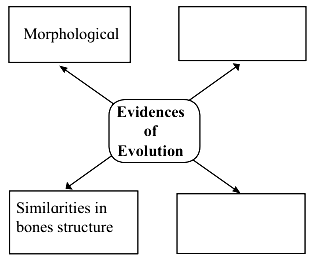
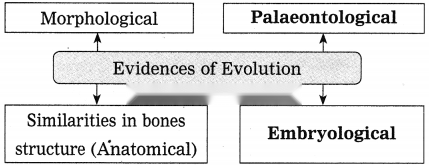
b. Geographical and reproductive isolation of organisms gradually leads to speciation.
Answer:
c. Study of fossils is an important aspect of study of evolution.
Answer:
Answer:
d. There is evidences of fatal Science among chordates.
[Please read the above question as: Among different chordates there are embryological evidences.]
Answer:
b. The proof for the fact that protein synthesis occurs through ……….. was given by George Beadle and Edward Tatum.
Answer:
Genes
c. Transfer of information from molecule of DNA to mRNA is called as …………… process.
Answer:
Transcription
d. Evolution means ………….
Answer:
Gradual development
e. Vestigial organ ……….. present in human body is proof of evolution.
Answer:
Appendix
b. Darwin’s theory of natural selection.
Answer:
c. Embryology.
Answer:
d. Evolution.
Answer:
e. Connecting link.
Answer:
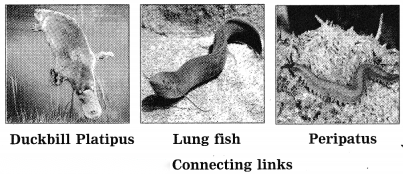
Some living organisms possess some characters in them which are the distinctive features of different groups or phyla. Such individuals connect these two groups by sharing the characters of both and hence they are known as connective links.
Examples: (1) Peripatus: Peripatus is the connecting link between Annelida and Arthropoda. It shows characters of both animal phyla. Like annelid worm, it shows segmented body, thin cuticle and parapodia. Like an arthropod, it shows open circulatory system and tracheal system for respiration.
(2) Duck Billed platypus: This is a connecting link between reptiles and mammals. Like reptiles it lays eggs but like mammals it has mammary glands and hairy skin.
(3) Lung fish: Lung fish is a connecting link between fishes and amphibians. Though a fish, it shows lungs for respiration as in amphibian animals.
(4) Connecting links indicate the direction and hierarchy of evolution.
(2) The mechanism of hereditary changes:
The process of evolution happens at a very slow pace. The favourable genes are preserved in the species as they bring about better survival of the individuals. Such individual reproduces more efficiently and evolve. The individuals with unfavourable genes are not selected by nature and are thus removed from the population through natural death. The fuel for evolution is thus truly supplied by the hereditary changes.
b. Explain the process of formation of complex proteins.
Answer:
The proteins are synthesised in following steps, viz. transcription, translation and translocation. Protein synthesis takes place according to the sequence of nucleotides present on the DNA molecule with the help of RNA molecules. This is known as central dogma of protein synthesis.
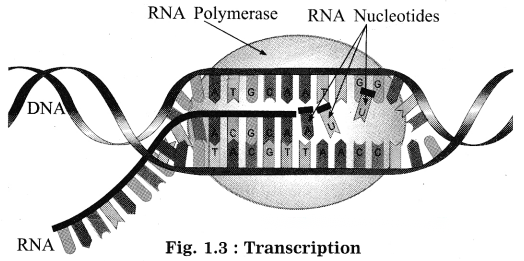
1. Transcription: In the process of transcription, mRNA is produced as per the nucleotide sequence on the DNA. For this the two strands DNA are separated. Only one strand participates in the formation of mRNA. The sequence of nucleotides which is complementary to that of present on DNA is copied on mRNA. Instead of thymine present in DNA, uracil is added on the mRNA. Transcription takes place in nucleus but the mRNA leaves nucleus, carries the genetic code and enters the cytoplasm. This genetic code is always in triplet form arid hence is known as triplet codon. The code for each amino acid always consists of three nucleotides.
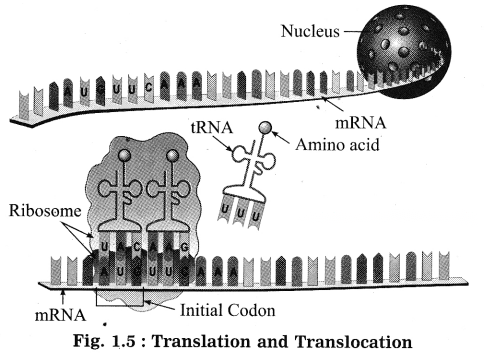
2. Translation: Each mRNA may carry thousands of codons. But each codon is specific for only one amino acid. The tRNA molecule brings the required amino acid as per the code present on mRNA. There is anticodon on each tRNA which is complementary to the codon on mRNA. This process is known as translation.
3. Translocation: In translocation, the ribosome keeps on moving from one end of mRNA molecule to other end by distance of one triplet codon. While this process is taking place, rRNA, helps in joining the amino acids together by peptide bonds. The peptide chains later come together to form complex protein molecules.
c. Explain the theory of evolution and mention the proof supporting it.
Answer:
1. Theory of evolution:
2. Proof here means evidences of evolution.
These evidences are as follows:
d. Explain with suitable examples importance of anatomical evidences in evolution. (July 2019)
Answer:
e. Define fossil. Explain importance of fossils as proof of evolution.
Answer:
f. Write evolutionary history of modern man.
Answer:
(1) Ancestors of humans developed from animals which resembled lemur like animals.
(2) Around seven crore years ago, monkey-like animals evolved from some of these lemur like animals.
(3) Then after about 4 crore years ago, in Africa the tails of these monkey like creatures very gradually disappeared.
(4) Simultaneously, there was enlargement in their body and brain volume too. The hands also improved and were provided with opposable thumb. In this way, ape-like animals were evolved.
(5) These ape-like animals independently gave rise to two lines of evolution, one giving rise to apes like gibbon and orangutan in the South and North-East Asia and gorilla and chimpanzee which stayed in Africa around 2.5 crores of years ago.
(6) The other line of evolution gave rise to human like animals around 2 crore years ago.
(7) The climate became dry and this resulted into reduction of forest cover. This made arboreal apes to descend on the land and start terrestrial mode.
(8) Due to this, there were changes in the pefvic
girdle and vertebral column. The hands were also freed from locomotion and thus they became more manipulative.
(9) Later, journey of hominoid species started from around 2 crores years ago. The first record of human like animal is ‘Ramapithecus’ ape from East Africa.
(10) Ramapithecus → Australopithecus → Neanderthal man → Cro-Magnon are the important steps in human evolution.
(11) Neanderthal man was said to be the first wise man. The increasing growth of brain made man more and more intelligent and thinking animal.
(12) Later, more than biological evolution, it was cultural evolution, when man started agriculture, animal, rearing. There was development of civilizations, arts and science etc. About 200 years ago there were industrial inventions and thus man now rules the earth.
Project:
Project 1.
Make a presentation on human evolution using various computer softwares and arrange a group disscussion over it in the class room.
Project 2.
Read the book – ‘Pruthvivur Manus Uparcich’ written by Late Dr. Sureshchandra Nadkarni and note your opinion on evolution.
Can you recall? (Text Book Page No. 1)
Choose the correct alternative and write its alphabet against the sub-question number:
Write whether the following statements are true or false with proper justification for your answer:
Match the columns:
Scientist | Discovery |
(1) Johann Gregor Mendel | (a) Chromosomes of grasshopper |
(2) Hugo de Vries | (b) DNA is genetic material |
(c) Pioneer of the modern genetics | |
(d) Mutational theory |
(1) Johann Gregor Mendel – Pioneer of the modern genetics.
(2) Hugo de Vries – Mutational theory.
Question 2
Maharashtra Board Solution
Solution & Step-by-Step Answer:
(1) Walter, Sutton – Chromosomes of grasshopper.
(2) Mclyn McCarthy – DNA is genetic material.
Question 3
Maharashtra Board Solution
|
Evidences of evolution | Examples |
(1) Morphological evidences | (a) Duck billed Platypus and Peripatus |
(2) Anatomical evidences | (b) Remnants and impressions |
(c) Human hand and fore limb of bull | |
(d) Shape and venation of leaf |
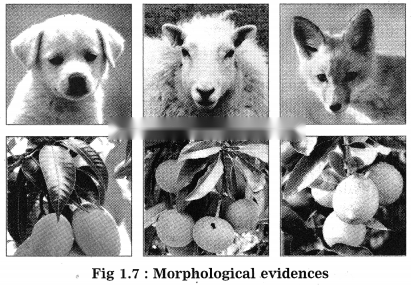
(1) Morphological evidences – Shape and venation of leaf.
(2) Anatomical evidences – Human hand and fore limb of bull.
Question 4
Maharashtra Board Solution
Solution & Step-by-Step Answer:
(1) Palaeontological evidences – Remnants and impressions.
(2) Connecting links – Duck billed Platypus and Peripatus. Find the odd one out:
Question 1
Maharashtra Board Solution
Transcription, Translation, Translocation, Mutation
Solution & Step-by-Step Answer:
Mutation. (All others are stages of protein synthesis.)
Question 2
Maharashtra Board Solution
Bones of the hands, structure of nostrils, position of eyes, structure of ear pinnae
Solution & Step-by-Step Answer:
Bones of the hands. (All the others are morphological evidences.)
Question 3
Maharashtra Board Solution
Venation, Shape of seeds, Leaf petiole, Leaf shape
Solution & Step-by-Step Answer:
Shape of seeds. (All the others are morphological evidences in plants.)
Question 4
Maharashtra Board Solution
Human hand, wing of cockroach, forelimb of bull, flipper of whale
Solution & Step-by-Step Answer:
Wing of cockroach. (All others are anatomical evidences, they are homologous organs.)
Identify the correlation between the first two words and suggest the suitable words in the fourth place:
Question 1
Maharashtra Board Solution
mRNA : Transcription :: tRNA :…………
Solution & Step-by-Step Answer:
Translation
Question 2
Maharashtra Board Solution
Peripatus : Connecting link :: Appendix :……….
Solution & Step-by-Step Answer:
Vestigial organs
Question 3
Maharashtra Board Solution
Open circulatory system : Arthropods :: Thin cuticle and parapodia :………..
Solution & Step-by-Step Answer:
Annelida
Question 4
Maharashtra Board Solution
Between Annelida and Arthropoda : Peripatus ::……….: Lungfish
Solution & Step-by-Step Answer:
Pisces/Fish and Amphibia
Question 5
Maharashtra Board Solution
Theory of natural selection : Charles Robert Darwin :: Theory of inheritance of acquired characters :…………
Solution & Step-by-Step Answer:
Jean Baptiste Lamarck
Question 6
Maharashtra Board Solution
Survival of fittest : Darwin :: Acquired characters :……….
Solution & Step-by-Step Answer:
Lamark
Question 7
Maharashtra Board Solution
Wisdom teeth : Vestigial organs :: Lungfish :………..
Solution & Step-by-Step Answer:
Connecting link.
Define the following:
Question 1
Maharashtra Board Solution
Heredity.
Solution & Step-by-Step Answer:
The transfer of biological characters from one generation to another through genes is called heredity.
Question 2
Maharashtra Board Solution
Transcription.
Solution & Step-by-Step Answer:
Question 3
Maharashtra Board Solution
Translation.
Solution & Step-by-Step Answer:
The process of bringing tRNA possessing anticodon that is complementary to the codon on mRNA for protein synthesis is called translation.
Question 4
Maharashtra Board Solution
Translocation.
Solution & Step-by-Step Answer:
The process of movement of the ribosome from one end of mRNA to other end by the distance of one triplet codon is called translocation.
Question 5
Maharashtra Board Solution
Mutation.
Solution & Step-by-Step Answer:
Sudden and drastic change that occurs in the genetic material is called mutation.
Question 6
Maharashtra Board Solution
Species.
Solution & Step-by-Step Answer:
The group of organisms that cap produce fertile individuals through natural reproduction is called a species.
Name the following:
Question 1
Maharashtra Board Solution
Three Scientists who proved that except viruses, all living organisms have DNA as genetic material.
Solution & Step-by-Step Answer:
Oswald Avery, Mclyn McCarthy and Colin MacLeod.
Question 2
Maharashtra Board Solution
Genetic disorder caused due to mutation:
Solution & Step-by-Step Answer:
Sickle cell anaemia.
Question 3
Maharashtra Board Solution
Fish that can breathe with help of lungs:
Solution & Step-by-Step Answer:
Lung fish.
Question 4
Maharashtra Board Solution
Vestigial organs in human beings:
Solution & Step-by-Step Answer:
Appendix, tail-bone or coccyx, wisdom teeth and body hair.
Question 5
Maharashtra Board Solution
Important stages in the journey of human evolution:
Solution & Step-by-Step Answer:
Distinguish between the following:
Question 1
Maharashtra Board Solution
Transcription and Translation.
Solution & Step-by-Step Answer:
Transcription:
Translation:
Question 2
Maharashtra Board Solution
Ape and Human.
Solution & Step-by-Step Answer:
Ape:
Human: Give scientific reasons:
Question 1
Maharashtra Board Solution
Some of the characters of parents are seen in their offspring.
Solution & Step-by-Step Answer:
Question 2
Maharashtra Board Solution
Darwin’s work on evolution has been a milestone.
Solution & Step-by-Step Answer:
(1) Darwin has proposed two very important theories of evolution, viz. Theory of natural selection and Theory of origin of species. (2) The evolution has taken place on the earth for last many crores of years. (3) The exact nature and process of these evolutionary changes become clear after studying Darwinism. (4) The observations made by Darwin at that time are now tested according to the modern development in science and are found to be correct. Thus, his work is said to be a milestone.
Question 3
Maharashtra Board Solution
Peripatus is said to be a connecting link between Annelida and Arthropoda.
Solution & Step-by-Step Answer:
Question 4
Maharashtra Board Solution
Vertebrates have been slowly originated from invertebrates.
Solution & Step-by-Step Answer:
Question 5
Maharashtra Board Solution
During human evolution the hands became available for use.
Solution & Step-by-Step Answer:
Read the following statements and justify the same in your own words with the help of suitable examples:
Question 1
Maharashtra Board Solution
Geographical and reproductive isolation of organisms gradually leads to speciation.
Solution & Step-by-Step Answer:
Question 2
Maharashtra Board Solution
Study of fossils is an important aspect of study of evolution.
Solution & Step-by-Step Answer:
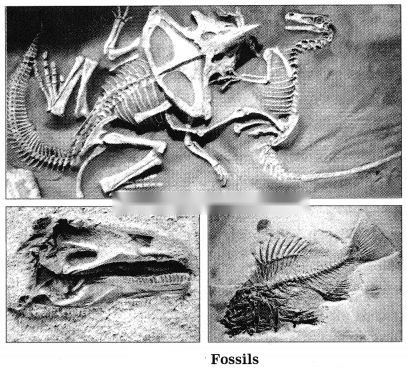
(1) Fossils offer palaeontological evidence for the evolutionary process. (2) Due to some natural calamities the organisms get buried during ancient times. (3) The impressions and remnants of such organisms remain preserved underground. The hot lava also traps some organisms or their impressions. All such formations form fossils. (4) Study of fossils help the researcher to understand the characteristics of the organisms that existed in the.past. (5) Carbon dating method also helps in finding out exact age of the fossil. According to the structure of earth’s crust the fossils are obtained at specific depths. (6) The oldest ones are obtained at the depth while the relatively recent ones occupy the upper surface. Thus fossils of invertebrates were seen in very old Palaeozoic era. Later were seen fossils of Pisces, Amphibia and Reptilia. The Mesozoic era was dominated by reptiles while Coenozoic era showed presence of mammals. (7) In this way, study of fossils unfold the evolutionary secrets.
Question 3
Maharashtra Board Solution
There is evidences of fatal Science among chordates. [Please read the above question as: Among different chordates there are embryological evidences.]
Solution & Step-by-Step Answer:
Question 4
Maharashtra Board Solution
Human evolution began approximately 7 crore years ago.
Solution & Step-by-Step Answer:
Answer the following questions:
Question 1
Maharashtra Board Solution
Answer the following questions: (March 2019) (a) What do you mean by central dogma?
Solution & Step-by-Step Answer:
Information about protein synthesis is present in DNA. As per this information, proteins are produced by DNA through RNA molecules. This is called central dogma.
(b) What is transcription? (c) What is meant by triplet codon?
Question 2
Maharashtra Board Solution
Which animal is called a connecting link between Reptiles and Mammals? (Board’s Model Activity Sheet)
Solution & Step-by-Step Answer:
Duck billed platypus is called a connecting link between Reptiles and Mammals.
Question 3
Maharashtra Board Solution
In which way is science of heredity useful these days?
Solution & Step-by-Step Answer:
The science of heredity is useful in the following ways:
Question 4
Maharashtra Board Solution
What is meant by carbon dating method?
Solution & Step-by-Step Answer:
(1) Carbon dating method is technique used for determining the age of fossils. (2) After the death of the organisms, their consumption of carbon stops. But right from that moment the decaying process of C-14 occurs continuously. (3) This results in change in the ratio between C-14 and C-12. C-12 is not radioactive as C-14. (4) Thus the time passed since the death of a plant or animal is calculated by measuring the radioactivity of C-14 and ratio of C-14 to C-12 present in their body. (5) The points noted during carbon dating are:
Question 5
Maharashtra Board Solution
Answer the following questions: (a) Describe briefly the Darwin’s theory of natural selection.
Solution & Step-by-Step Answer:
Charles Darwin (1809-1882) proposed the theory of natural selection. Theory of natural selection: ‘The survival of fittest’, i.e., organisms which are fit for survival, evolve while those that are not, perish. The natural selection thus acts to produce new species.
(b) What were the objections raised against Darwinism? (c) Which book was published by Darwin to explain this theory? (Board’s Model Activity Sheet)
Question 6
Maharashtra Board Solution
What were the objections raised against Darwinism?
Solution & Step-by-Step Answer:
Some of the main objections raised against Darwinism are as follows:
Question 7
Maharashtra Board Solution
Answer the following questions: (a) Explain in brief-Lamarck’s principle of ‘use or disuse of organs’.
Solution & Step-by-Step Answer:
The theory of use and disuse of organs says that the morphological characters of organism develop because of specific activities that the organisms perform. If some organ is not used it gets degenerated. If excessively, used, it develops. Thus, the morphological changes take place due to activities or non-working of a particular body parts in an organism.
(b) Give two examples. (c) What are acquired characters? Write short notes:
Question 1
Maharashtra Board Solution
Theory of evolution.
Solution & Step-by-Step Answer:
By choosing appropriate words given in the bracket, complete the paragraph:
Question 1
Maharashtra Board Solution
(translation, anticodon, tRNA, mRNA, amino acids, triplet codon, transcription, DNA) The …….. formed in nucleus comes in cytoplasm. It brings in the coded message from DNA. The message contains the codes for amino acids. The code for each amino acid consists of three nucleotides. It is called as ‘………..’. Each mRNA is made up of thousands of triplet codons. As per the message on mRNA, ……… are supplied by the ………. For this purpose, tRNA has ‘…………’ having complementary sequence to the codon on mRNA. This is called ‘………..’.
Solution & Step-by-Step Answer:
The mRNA formed in nucleus comes in cytoplasm. It brings in the coded message from DNA. The message contains the codes for amino acids. The code for each amino acid consists of three nucleotides. It is called as ‘triplet codon’. Each mRNA is made up of thousands of triplet codons. As per the message on mRNA, amino acids are supplied by the tRNA. For this purpose, tRNA has ‘anticodon’ having complementary sequence to the codon on mRNA. This is called ‘translation’.
Question 2
Maharashtra Board Solution
(Cultural, agriculture, fire, brain, Cro-Magnon, Homo sapiens, Neanderthal) Evolution of upright man continued in the direction of developing its ………. for the period of about 1 lakh years and meanwhile he discovered the ………. Brain of man, 50 thousand years ago had been sufficiently evolved to the extent that it could be considered as member of the species ………… Neanderthal man can be considered as the first example of wise-man. The ……….. man evolved about 50 thousand years ago and afterwards, this evolution had been faster than the earlier. About 10 thousand years ago, wise-man started to practise the ………. It started to rear the cattle-herds and established the cities. ………..development took place later.
Solution & Step-by-Step Answer:
Evolution of upright man continued in the direction of developing its brain for the period of about 1 lakh years and meanwhile he discovered the fire. Brain of man 50 thousand years ago had been sufficiently evolved to the extent that it could be considered as member of the species Homo sapiens. Neanderthal man can be considered as the first example of wise-man. The Cro-Magnon man eyolved about 50 thousand years ago and afterwards, this evolution had been faster than the earlier. About 10 thousand years ago, wise-man started-to practise the agriculture. It started to rear the cattle-herds and established the cities. Cultural development took place later.
Read the paragraph and answer the questions given below: With the help of RNA, the genes present in the form of DNA participate in the functioning of cell and thereby control the structure and functioning of the body. Information about protein synthesis is stored in the DNA and synthesis of appropriate proteins as per requirement is necessary for body. These proteins are synthesized by DNA through the RNA. This is called ‘Central Dogma’. mRNA is produced as per the sequence of nucleotides on DNA. Only one of the two strands of DNA is used in this process. The sequence of nucleotides in mRNA being produced is always complementary to the DNA strand used for synthesis. Besides, there is uracil in RNA instead of thymine of DNA. This process of RNA synthesis is called ‘transcription’. Questions and Answers:
Question 1
Maharashtra Board Solution
Which part of the cell control the structure and functioning of the body?
Solution & Step-by-Step Answer:
Genes present in the form of DNA along with RNA control the structure and functioning of the body.
Question 2
Maharashtra Board Solution
How is a specific protein synthesised in the cell?
Solution & Step-by-Step Answer:
The information of protein synthesis is stored in the DNA which is utilised as per the requirement of the body. Later the proteins are synthesised by DNA through the RNA.
Question3
Maharashtra Board Solution
What is the similarity between mRNA and DNA?
Solution & Step-by-Step Answer:
The sequence of nucleotides on DNA is copied on mRNA. The nucleotide sequence on mRNA is thus complementary to DNA.
Question 4
Maharashtra Board Solution
Give one difference between RNA and DNA.
Solution & Step-by-Step Answer:
RNA has uracil instead of thymine which is present in DNA.
Question 5
Maharashtra Board Solution
Define central dogma.
Solution & Step-by-Step Answer:
Central dogma is the concept that proteins are synthesised by DNA through the RNA.
Diagram-based questions:
Question 1
Maharashtra Board Solution
Observe the figure 1.3 of transcription given on page 9 in this chapter and answer the following questions: (1) What is the sequence of nucleotides present on one strand of the DNA?
Solution & Step-by-Step Answer:
A T G C A A T T
(2) According to the above sequence on DNA, what will be the transcribed sequence on the mRNA molecule? (3) Which enzyme is taking part in the above process of transcription?
Question 2
Maharashtra Board Solution
Observe the figure 1.5 of translation and translocation, given on page 9 this chapter and answer the following questions: (1) Which is the initiation codon? Where is it present?
Solution & Step-by-Step Answer:
AUG is the initiation codon, which is present on the mRNA.
(2) What are the types of RNA present inside the ribosome? Which triplet codon is present on it? (3) Which genetic code is present on mRNA that is leaving the nucleus? What must be the sequence on the DNA to have such code on mRNA?
Question 3
Maharashtra Board Solution
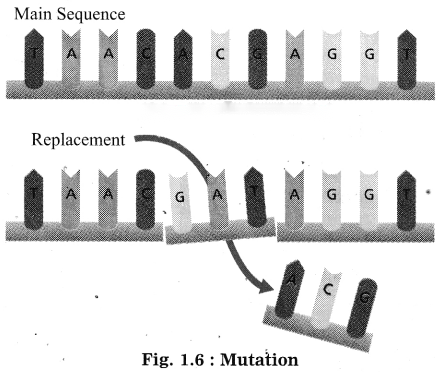
Observe the figure 1.6 given on page 10 from this chapter. Answer the following question based on your observations: What is the significance of this figure from the viewpoint of evolution? Explain in brief.
Solution & Step-by-Step Answer:
In the figure, the process of mutation is shown. The original nucleotide sequence of TGC is replaced by new mutated sequence GAT. The change in the nucleotide sequence will change the DNA.
This will result in the change in genes and then changing the hereditary characters. Due to such change in genes, the evolution proceeds. The mutation so formed can be minor or major. The greater the impact of the change, the evolution takes place rapidly. The mutation thereby produce recombinations leading to diversity.
Question 4
Maharashtra Board Solution
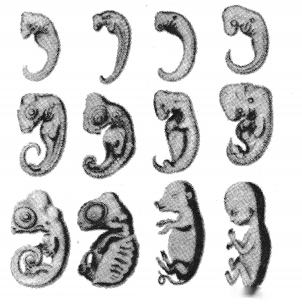
Observe the picture and answer the following questions: (1) Which evidence of evolution is shown in the picture?
Solution & Step-by-Step Answer:
Embryological evidences of evolution are shown in this picture.
(2) What can be proven with this proof? (3) Give one more example of evidence of evolution.
Question 5
Maharashtra Board Solution
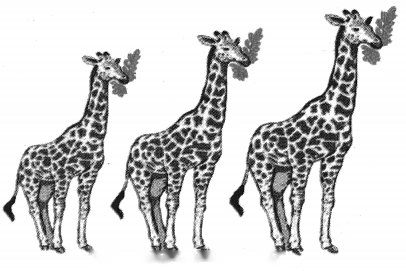
Which concept/theory do you remember after seeing this picture of Giraffes? Describe it in brief.
Solution & Step-by-Step Answer:
Activity-based Questions: Try this: (Text Book Page No. 4)
Observe and Discuss:
Question 1
Maharashtra Board Solution
Observe the pictures given below. (Text Book Page No. 5)
Solution & Step-by-Step Answer:
(1) Fossils offer palaeontological evidence for the evolutionary process. (2) Due to some natural calamities the organisms get buried during ancient times. (3) The impressions and remnants of such organisms remain preserved underground. The hot lava also traps some organisms or their impressions. All such formations form fossils. (4) Study of fossils help the researcher to understand the characteristics of the organisms that existed in the.past. (5) Carbon dating method also helps in finding out exact age of the fossil. According to the structure of earth’s crust the fossils are obtained at specific depths. (6) The oldest ones are obtained at the depth while the relatively recent ones occupy the upper surface. Thus fossils of invertebrates were seen in very old Palaeozoic era. Later were seen fossils of Pisces, Amphibia and Reptilia. The Mesozoic era was dominated by reptiles while Coenozoic era showed presence of mammals. (7) In this way, study of fossils unfold the evolutionary secrets.
Question 2
Maharashtra Board Solution
Observe the pictures given and discuss the characters observed. (Text Book Page No. 6)
Solution & Step-by-Step Answer:
Some living organisms possess some characters in them which are the distinctive features of different groups or phyla. Such individuals connect these two groups by sharing the characters of both and hence they are known as connective links.
Examples: (1) Peripatus: Peripatus is the connecting link between Annelida and Arthropoda. It shows characters of both animal phyla. Like annelid worm, it shows segmented body, thin cuticle and parapodia. Like an arthropod, it shows open circulatory system and tracheal system for respiration. Project: (Do it your self) Project 1. Project 2. Project 3. Project 4. |